








Policy Update
Khushi
Background
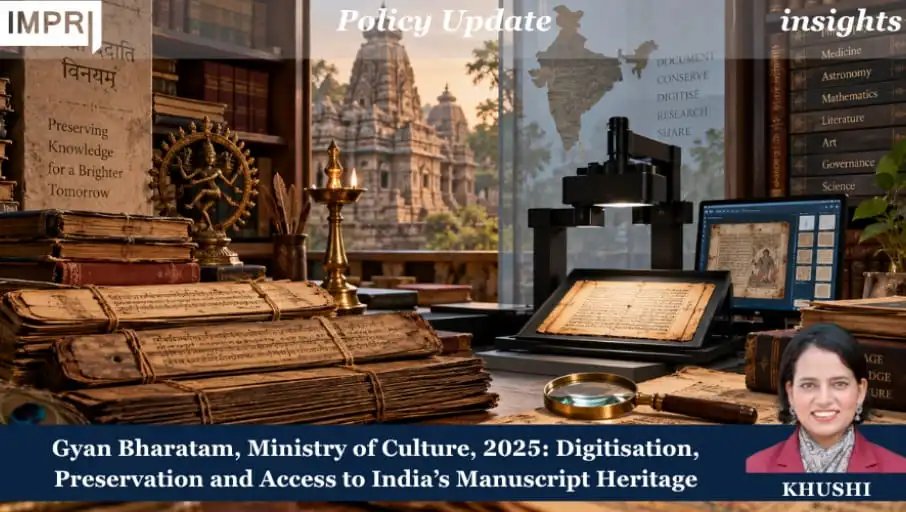
India possesses a vast and diverse manuscript heritage covering fields such as philosophy, literature, medicine, mathematics, astronomy, arts, governance and other knowledge traditions. These manuscripts are dispersed across libraries, academic institutions, museums, temples, monasteries, private collections and individual custodians, making their systematic identification, preservation and accessibility a major institutional challenge. Government sources have estimated India’s manuscript corpus in the range of 5–10 million manuscripts, highlighting the scale of the task involved in creating a comprehensive national inventory (Ministry of Culture, 2026).
This effort builds upon the National Mission for Manuscripts (NMM), established in 2003 to locate, document, conserve, digitise and disseminate India’s manuscript heritage. Initiatives such as Kriti Sampada, the National Mission for Manuscripts’ digital database, created an institutional foundation for manuscript documentation and cataloguing. By 2023, the Government reported that approximately 5.2 million manuscripts had been documented under the Mission (Press Information Bureau, 2023).
Against this background, the Government announced Gyan Bharatam in the Union Budget 2025–26 as a flagship initiative of the Ministry of Culture. The Mission builds upon the earlier manuscript-preservation framework while expanding its focus towards nationwide surveying, documentation, conservation, digitisation, technological processing, research and public access. A sanctioned outlay of ₹491.66 crore for 2025–2031 has been provided for the initiative (Press Information Bureau, 2025).
A central element of the initiative is the creation of a National Digital Repository (NDR) supported by modern technologies. Gyan Bharatam also envisages the use of Artificial Intelligence, Optical Character Recognition, Handwritten Text Recognition, script recognition, semantic search and machine-assisted translation to improve the cataloguing, discoverability and interpretation of manuscripts (Press Information Bureau, 2026).
The National Manuscript Survey was formally launched on 16 March 2026 to identify and document manuscript holdings, repositories and custodians across States and Union Territories. An early update on 19 March 2026 reported more than 12.97 lakh manuscripts, while the continuing nationwide survey had reported more than 1.19 crore manuscripts by July 2026. These figures represent successive snapshots of an ongoing nationwide survey rather than competing estimates, as the survey continued to bring additional repositories and custodians into the reporting process (Press Information Bureau, 2026).
The initiative is therefore not limited to digitising old documents. It seeks to build a digital knowledge infrastructure connecting manuscript identification, conservation, cataloguing, digitisation, technological processing, scholarly research and public access. By combining the institutional foundation created under the National Mission for Manuscripts with newer digital and Artificial Intelligence-enabled capabilities, Gyan Bharatam represents an attempt to create a comprehensive national framework for preserving and making India’s manuscript heritage accessible (Press Information Bureau, 2026).
Functioning
Gyan Bharatam is structured as an integrated manuscript-management framework covering survey and documentation, conservation, digitisation, technology-enabled processing, linguistic and translation support, and research and outreach. These activities are organised through the Mission’s five official verticals, rather than functioning as six independent components. The five verticals are National Manuscript Survey and Documentation; Conservation and Training; Digitisation; Linguistics and Translation; and Research, Publication and Outreach. The digital infrastructure cuts across these verticals by connecting manuscript records, digitised material, technological processing and public access (Press Information Bureau, 2026).
1. National Manuscript Survey and Documentation
The first stage is to identify and document manuscripts held across institutions and private collections. The National Manuscript Survey, launched on 16 March 2026, covers institutions, libraries, museums, religious institutions, scholars, private individuals and other repositories across States and Union Territories. The survey records information relating to manuscript holdings, custodians, languages, scripts and other relevant details, creating the documentary foundation for subsequent conservation and digitisation (Press Information Bureau, 2026).
2. Conservation and Training
The Conservation and Training vertical focuses on the scientific preservation of manuscripts and the development of specialised capacity. This includes conservation practices, training and capacity building for institutions and personnel involved in manuscript preservation.
The Mission also uses a network of Cluster Centres (CCs) and Independent Centres (ICs). Cluster Centres function as regional/institutional hubs bringing together multiple participating institutions and repositories for coordinated manuscript-related activities, while Independent Centres undertake manuscript-related work as individual participating institutions. Together, these centres extend the Mission’s implementation capacity beyond a single central institution and connect universities, research institutions, libraries, archives and other custodians with the national programme (Press Information Bureau, 2026).
3. Digitisation
The Digitisation vertical converts physical manuscripts into standardised digital records for preservation and access. Existing digitised manuscripts in different formats are also being brought into conformity with prescribed Gyan Bharatam standards before integration into the National Digital Repository (NDR).
The digitisation framework specifies technical standards for creating high-quality digital masters, including 300–600 DPI TIFF imaging, while associated metadata follows structured standards including the Dublin Core metadata framework. Standardisation of both image quality and metadata is important for ensuring interoperability, long-term preservation and consistent discovery across different manuscript collections (Press Information Bureau, 2026).
4. Linguistics and Translation
The Linguistics and Translation vertical addresses the language and script diversity of India’s manuscript heritage. It supports the interpretation, transcription and translation of manuscript material so that collections are not restricted to specialists familiar with the original language or script.
This vertical is particularly important for converting digitised manuscripts from simply being digital images into usable knowledge resources, by enabling their linguistic interpretation and wider scholarly access (Press Information Bureau, 2026).
5. Research, Publication and Outreach
The Research, Publication and Outreach vertical promotes scholarly engagement with manuscript collections and facilitates the dissemination of manuscript-based knowledge. It is intended to connect the growing digital corpus with researchers, academic institutions and wider audiences through research, publications and outreach activities (Press Information Bureau, 2026).
6. Artificial Intelligence and Digital Access
Artificial Intelligence-enabled technologies provide a cross-cutting technological layer across the Mission’s five verticals. Gyan Bharatam incorporates Optical Character Recognition (OCR), Handwritten Text Recognition (HTR), script recognition, semantic search and machine-assisted translation to improve the processing and discoverability of manuscript material.
Its AI-enabled Gyan Mitram interface is intended to help users explore manuscript collections by bringing together manuscript images, transcriptions and translations, thereby improving accessibility to the digital corpus (Press Information Bureau, 2026).
7. National Digital Repository and Public Access
The National Digital Repository (NDR) provides the central digital infrastructure through which manuscript records and digitised material can be organised and accessed. As of July 2026, the Government reported that more than 8 lakh manuscripts had been digitised, while more than 3.90 lakh manuscripts were available on the Gyan Bharatam portal in view mode (Press Information Bureau, 2026).
These figures demonstrate the transition from dispersed physical collections towards a more structured digital knowledge ecosystem, although digitisation and public availability represent different stages of the process.
Overall, the functioning of Gyan Bharatam can be understood through the following integrated workflow:
National Manuscript Survey & Documentation → Conservation & Training → Digitisation → Linguistics & Translation → Research, Publication & Outreach → Digital Discovery & Public Access
The National Digital Repository and Artificial Intelligence-enabled technologies operate across this workflow, rather than constituting separate verticals. This structure allows the Mission to move beyond simply creating digital copies of manuscripts towards their standardised preservation, interpretation, discoverability, scholarly use and wider public access (Press Information Bureau, 2026).
Performance
The performance of Gyan Bharatam can be assessed through the scale of manuscript identification, digitisation, institutional participation, public accessibility and financial utilisation. Since the Mission is still in its early implementation phase, current indicators primarily reflect coverage and infrastructure creation, while its longer-term impact on scholarship and preservation will require continued assessment.
1. Large-scale manuscript survey
The National Manuscript Survey, launched across all States and Union Territories in March 2026, has significantly expanded the documented knowledge of India’s manuscript holdings. By July 2026, more than 1.19 crore manuscripts had been reported through the survey (Press Information Bureau, 2026).
This represents an important shift from fragmented knowledge of manuscript collections towards the creation of a comprehensive national database covering diverse languages, scripts, repositories and custodians.
2. Expansion of digitisation
The Mission has also made progress in bringing existing digitised collections into a common digital ecosystem. In March 2026, the Government reported that more than 8 lakh digitised manuscripts existed across the country in formats including DVDs, hard drives and microfilms, with these collections being reformatted according to Gyan Bharatam’s prescribed standards (Press Information Bureau, 2026).
By July 2026, the Government reported that more than 8 lakh manuscripts had been digitised nationally, of which more than 3.90 lakh were available on the Gyan Bharatam portal for public viewing. Later official updates in August 2026 reported more than 4.40 lakh manuscripts available through the portal, indicating continued expansion of digital access (Press Information Bureau, 2026).
3. Institutional network
Gyan Bharatam has established a decentralised institutional framework through Cluster Centres (CCs) and Independent Centres (ICs). These include universities, research institutions, libraries, archives, religious institutions and other stakeholders involved in manuscript-related activities. By March 2026, more than 40 such centres had been onboarded, while 28 States and Union Territories had been brought into the institutional framework as nodal coordinating authorities (Press Information Bureau, 2026).
This network is significant because India’s manuscript collections are geographically dispersed and vary considerably in language, script, physical condition and ownership.
4. Financial allocation and utilisation
Financial support is another indicator of the Mission’s implementation capacity. The Standing Finance Committee sanctioned ₹491.66 crore for the period 2025–2031 for Gyan Bharatam (Press Information Bureau, 2026).
The annual figures reported by the Government show an allocation of ₹3.50 crore in 2024–25, ₹15 crore in 2025–26 and ₹60 crore in 2026–27, with actual expenditure of ₹2.63 crore, ₹14.25 crore and ₹4.48 crore respectively for those years (Press Information Bureau, 2026). The relatively low expenditure reported for 2026–27 should be interpreted in the context of the financial year and the ongoing expansion of the Mission rather than as a standalone measure of programme effectiveness.
5. Growing public accessibility
The movement from physical preservation towards public digital access is an important performance indicator. The increasing number of manuscripts available through the Gyan Bharatam portal demonstrates progress towards making previously dispersed manuscript resources accessible to researchers and the wider public (Press Information Bureau, 2026).
Overall, the available indicators show rapid expansion in survey coverage, digitisation, institutional participation and digital accessibility. However, these are primarily output indicators. The longer-term performance of Gyan Bharatam will depend on the quality of metadata, preservation standards, accuracy of transcription and translation, usability of the digital repository, scholarly utilisation and sustained preservation of the physical manuscripts.
Impact
Since Gyan Bharatam is still being implemented, its long-term impact should be assessed cautiously. Current evidence primarily demonstrates outputs and emerging capabilities, rather than established changes in scholarship, public access or preservation outcomes. Its potential and emerging impact can nevertheless be understood through the following dimensions.
1. Preservation of India’s manuscript heritage
By combining survey, scientific conservation and digitisation, Gyan Bharatam can help reduce the risk of permanent loss of manuscripts that are physically fragile, dispersed or held in vulnerable conditions. Digital preservation can also provide a durable reference copy that supports continued research even when the original manuscript requires restricted handling (Press Information Bureau, 2026).
2. Creation of a national knowledge infrastructure
The National Digital Repository can bring previously dispersed manuscript collections into a more structured and searchable national ecosystem. Standardised metadata and digitisation can make it easier to identify what manuscripts exist, where they are held and what subjects, languages and scripts they contain (Press Information Bureau, 2026).
3. Wider scholarly access
The integration of digital images, metadata, transcriptions, translations and semantic search has the potential to reduce geographical and institutional barriers to manuscript research. Researchers may be able to access material that was previously difficult to locate or consult physically, thereby expanding the scope for comparative and interdisciplinary scholarship.
4. Reviving under-studied knowledge traditions
Greater discoverability can facilitate research into manuscript-based traditions in areas such as medicine, mathematics, astronomy, philosophy, literature, arts and governance. However, the extent to which this translates into new scholarship will depend on the availability of reliable transcriptions, translations and appropriately trained researchers.
5. Supporting education and Indian Knowledge Systems
The digitised manuscript corpus can provide primary-source material for universities and educational institutions and can complement the Indian Knowledge Systems framework associated with NEP 2020. This creates the possibility of connecting historical knowledge resources with contemporary teaching, research and interdisciplinary study.
6. Technology-enabled discovery and interpretation
Artificial Intelligence-enabled tools such as Optical Character Recognition, Handwritten Text Recognition, script recognition and semantic search can potentially make large manuscript collections more discoverable. However, their contribution will depend on the ability to accurately process India’s diverse scripts and languages and on continued scholarly validation (Press Information Bureau, 2026).
7. Greater public engagement with manuscript heritage
By making selected manuscript collections accessible through digital platforms, Gyan Bharatam can potentially move manuscript heritage beyond specialised repositories and academic circles. User-friendly interfaces, translations, thematic collections and contextual information could allow students and the wider public to engage with India’s manuscript traditions.
8. Strengthening institutional collaboration
The Mission’s network of Cluster Centres and Independent Centres, together with universities, libraries, archives, research institutions and private custodians, can create a broader institutional ecosystem for manuscript preservation and research. This can reduce the fragmentation that has historically characterised manuscript management.
Overall, Gyan Bharatam’s impact should ultimately be judged not simply by the number of manuscripts surveyed or digitised, but by whether those manuscripts are successfully preserved, accurately interpreted, discoverable to researchers and meaningfully accessible to the wider public.
Emerging Issues
1. Scale and diversity of manuscript collections
India’s manuscript heritage is highly dispersed across private homes, temples, monasteries, libraries, museums, academic institutions and other repositories. Manuscripts also differ considerably in language, script, material and physical condition. The National Manuscript Survey therefore involves multiple stages of physical verification, cataloguing and metadata creation, making the development of a reliable national inventory a complex undertaking (Ministry of Culture, 2026).
2. Substrate-specific conservation challenges
Manuscripts cannot be treated as a uniform category because their physical substrates require different preservation approaches. Palm-leaf manuscripts can require specialised cleaning, conditioning and handling, while birch-bark manuscripts are particularly vulnerable to brittleness, cracking and environmental deterioration. Paper manuscripts may present different risks related to acidity, moisture and insect damage. Conservation protocols must therefore be adapted to the material, age and condition of individual manuscripts (Press Information Bureau, 2026).
3. Conservation and digitisation workflow
Digitisation cannot substitute for physical conservation. Fragile manuscripts may be damaged by repeated handling, unsuitable equipment or inappropriate scanning practices. The Mission therefore needs a conservation-first workflow, in which condition assessment and necessary physical or chemical conservation precede high-speed scanning wherever required.
There are also potential vendor-handling risks when digitisation or conservation activities are outsourced. Improper handling, transportation, inadequate environmental controls or insufficiently trained personnel could damage unique manuscripts. Clear handling protocols, supervision, documentation and accountability mechanisms are therefore essential.
4. Palaeographical limits across rare regional scripts
A major challenge for Artificial Intelligence-enabled processing is India’s extraordinary palaeographical and script diversity. Scripts such as Sharada, Grantha and Modi, along with numerous historical and regional script forms, may contain variations that are difficult for automated recognition systems to process accurately. Damaged, faded or handwritten manuscripts further increase the difficulty.
Consequently, Optical Character Recognition, Handwritten Text Recognition and script-recognition tools should be treated as assistive technologies requiring expert validation, particularly where rare scripts, historical variants or ambiguous characters are involved (Press Information Bureau, 2026).
5. Standardisation and metadata quality
Creating a national digital repository requires common standards for imaging, cataloguing, metadata and digital preservation. Differences in existing formats and documentation practices can affect interoperability and discoverability. Standardised imaging, metadata practices and digitisation workflows are therefore essential for ensuring that collections contributed by different institutions can function within a common digital ecosystem (Ministry of Culture, 2026).
6. Long-term digital preservation
Digitisation creates a new preservation responsibility: ensuring that digital files, metadata and associated records remain accessible over the long term. Hardware obsolescence, changing file formats, storage failures and cybersecurity risks can affect the durability of digital repositories. Long-term data storage, interoperability and digital-preservation mechanisms will therefore be essential to prevent the digital archive itself from becoming inaccessible over time (Ministry of Culture, 2026).
7. Ownership, access and intellectual property
A significant proportion of manuscripts is held by private individuals and institutions. Creating a national repository therefore requires clear arrangements concerning custodianship, consent, access rights, reproduction, attribution and potential monetisation. Controlled-access mechanisms may be necessary where custodians or institutions have legitimate restrictions on the use of manuscript material (Press Information Bureau, 2025).
8. Cultural and ritual restrictions
Some manuscripts, particularly sacred temple manuscripts and privately held pothis, may have cultural, religious or ritual restrictions governing who can handle, view, reproduce or disseminate them. A purely open-access approach may therefore not be appropriate for every manuscript. Gyan Bharatam will need context-sensitive access protocols that distinguish between material suitable for unrestricted public access and material requiring restricted or custodial access.
9. Bridging the technology–scholarship gap
Building digital infrastructure alone cannot ensure meaningful use of manuscript heritage. Effective interpretation requires expertise in Indology, philology, palaeography, conservation science, languages and historical context, alongside technological expertise. The Mission therefore needs sustained collaboration between technologists and scholars to ensure that technological processing does not detach manuscripts from their historical and cultural context (Press Information Bureau, 2026).
10. From digitisation to meaningful knowledge access
A large number of digitised manuscripts does not automatically translate into greater scholarly or public use. Searchability, reliable metadata, verified transcription, translation, contextual information and user-friendly interfaces are necessary for meaningful engagement with collections.Therefore, the long-term challenge for Gyan Bharatam is to move beyond digitising manuscripts to making their knowledge genuinely discoverable, interpretable and usable.
Way Forward
1. Establish a conservation-first workflow
Gyan Bharatam should adopt a clear physical preservation → condition assessment → conservation → digitisation → digital preservation sequence. Fragile manuscripts should undergo appropriate physical and chemical conservation before high-speed scanning or other digitisation processes. This would reduce the risk of damage during handling and ensure that digitisation does not compromise the physical integrity of manuscripts.
2. Build a unified national manuscript database
The Mission should develop a standardised national metadata framework covering manuscript title, language, script, subject, provenance, custodian, physical condition, location and digitisation status. Common metadata standards can improve interoperability between existing collections and make manuscripts easier to discover through the National Digital Repository.
3. Strengthen human validation of Artificial Intelligence
Artificial Intelligence should function as an assistive technology rather than a substitute for scholarly expertise. Optical Character Recognition, Handwritten Text Recognition, script identification and machine-assisted translation should undergo expert verification, particularly for damaged manuscripts, rare scripts and historically significant texts. Interdisciplinary teams of technologists, linguists, historians, philologists and conservation specialists can improve the reliability of the digital repository.
4. Develop a sustainable digital-preservation architecture
The National Digital Repository should adopt robust standards for data backup, cybersecurity, file-format migration, metadata preservation and disaster recovery. Multiple geographically distributed copies and periodic integrity checks can reduce the risks associated with technological obsolescence and data loss.
5. Create a legal framework for manuscript protection
A dedicated National Manuscript Act could be considered to provide a clearer legal framework for the identification, preservation, digitisation, custodianship and responsible use of manuscripts. Such a framework could clarify issues relating to ownership, custodial rights, digitisation consent, reproduction, access, attribution and protection of culturally sensitive material, while encouraging private custodians and institutions to participate in the national initiative.
6. Enable participatory transcription and crowdsourced scholarship
Gyan Bharatam could explore crowdsourced transcription platforms that allow trained volunteers, students and researchers to contribute to the transcription and annotation of digitised manuscripts under appropriate scholarly moderation. A model of citizen palaeography, supported by expert verification, could expand the pool of people able to assist with transcription while simultaneously creating learning opportunities in historical scripts and languages.
7. Integrate manuscript knowledge with the Indian Knowledge Systems framework
The Mission should establish stronger linkages with the Indian Knowledge Systems (IKS) framework under the National Education Policy (NEP) 2020. Digitised and verified manuscripts can be used as primary sources for interdisciplinary research, teaching and curriculum development in areas such as mathematics, medicine, astronomy, philosophy, literature, agriculture and traditional knowledge. This would help connect manuscript preservation with contemporary academic research and education.
8. Expand scholarly participation
Gyan Bharatam should deepen collaboration with universities, research institutions, libraries and specialised scholars. Fellowships, research grants, manuscript-based projects and training programmes in palaeography, classical and regional languages, philology, conservation and digital humanities can create the human-resource base required to interpret the growing digital corpus.
9. Make the repository accessible beyond digitised images
The next stage should focus on making manuscripts searchable, interpretable and usable, rather than merely available as scanned images. High-quality metadata, verified transcriptions, translations, thematic collections and semantic-search capabilities can make the repository more useful for researchers, students and the wider public.
10. Establish measurable performance indicators
The Mission should periodically assess itself through indicators such as manuscripts surveyed and verified, manuscripts scientifically conserved, digitisation quality, metadata completeness, number of manuscripts made publicly accessible, transcription and translation accuracy, scholarly usage and user engagement. Such indicators would help distinguish between numerical expansion and meaningful preservation and knowledge access.
Ultimately, Gyan Bharatam can become more than a digitisation programme if it successfully connects preservation with technology, technology with scholarship, and scholarship with public access. Its long-term success will depend on maintaining this balance while ensuring that India’s manuscript heritage remains both physically preserved and digitally accessible for future generations.
References
Press Information Bureau. (2026). Gyan Bharatam Mission.
Covers the launch, five verticals, ₹491.66 crore allocation, digitisation, technical standards and National Digital Repository.
PIB — Gyan Bharatam Mission, 2 February 2026
Press Information Bureau. (2026). Gyan Bharatam Mission and Preservation of Manuscript Heritage.
Particularly useful for the 1.19 crore manuscripts surveyed, 8 lakh+ digitised manuscripts and 4.40 lakh+ available on the portal figures.
PIB — Gyan Bharatam Mission and Preservation of Manuscript Heritage, 3 August 2026
Press Information Bureau. (2026). Gyan Bharatam Mission and Manuscript Digitisation.
Useful for Artificial Intelligence, OCR, Handwritten Text Recognition, script recognition, semantic search, machine-assisted translation and Gyan Mitram.
PIB — Gyan Bharatam Mission and Manuscript Digitisation, 27 July 2026
Press Information Bureau. (2026). Manuscript Clusters and Partner Institutions under Gyan Bharatam Initiative.
Useful for Cluster Centres, Independent Centres, National Manuscript Survey and digital access.
PIB — Manuscript Clusters and Partner Institutions, 27 July 2026
Press Information Bureau. (2026). National Digitization Drive Workshop under Gyan Bharatam Mission.
Useful for digitisation standards, conservation, metadata, technology and institutional coordination.
PIB — National Digitization Drive Workshop, 31 July 2026
Ministry of Culture, Government of India. Gyan Bharatam.
The Ministry’s official website and portal for the Mission.
Gyan Bharatam — Ministry of Culture
Ministry of Culture, Government of India. (2025). RFP for Digitization under Gyan Bharatam.
Particularly useful for the technical and operational side of digitisation, including the estimated manuscript-page volume and three-year digitisation project.
Ministry of Culture — Gyan Bharatam Digitization RFP
Press Information Bureau. (2025). Gyan Bharatam Initiative.
Useful for the original policy announcement, Union Budget 2025–26, National Digital Repository and target of covering more than one crore manuscripts.
PIB — Gyan Bharatam Initiative, 8 December 2025
About the contributor
Khushi holds a Master’s degree in Sociology. She serves as a Research and Editorial Intern at IMPRI and has research interests in public policy, governance, digital transformation, and institutional reforms.
Acknowledgement
The author sincerely acknowledges the IMPRI team for their guidance, valuable feedback, and continuous support throughout the preparation of this Policy Update.
Reviewers: Anushree Khare and Sneha Kohli
Disclaimer
This article is intended for academic purposes only. The views expressed are those of the author and do not necessarily reflect the views of IMPRI or any government.
Read more at IMPRI:
When War Becomes an Operating Cost: Insurance, Chokepoints and the New Gulf Security Order
The East Is Changing: Demographic Transition in West Bengal and Northeast India