





Monika Verma
India has witnessed a gradual increase in women’s Labour Force Participation Rate (LFPR), particularly following the introduction of the Periodic Labour Force Survey (PLFS) in 2017–18. However, this increase has not been accompanied by a corresponding expansion of secure and formal employment opportunities. Instead, a significant proportion of women remain concentrated in informal and low-paid occupations characterized by irregular employment, unstable incomes, and inadequate social protection.
According to the International Labour Organization (ILO, 2018), more than 61 per cent of the world’s employed population, representing nearly 2 billion workers, are engaged in informal employment. While globally 58 per cent of employed women and 63 per cent of employed men work in the informal economy, the prevalence of informal employment is considerably higher in developing countries, where 92 per cent of employed women and 87 per cent of employed men are employed informally. These statistics demonstrate that women are disproportionately employed in informal jobs in developing nations, which leaves them more susceptible to low pay, precarious work, insufficient labour rights, and restricted social security benefits.
The informal sector constitutes a substantial share of employment in India and is characterized by the absence of secure employment, written contracts, regular wages, social security, paid leave, health insurance, pension benefits, and effective legal protection. Although labour laws exist, their implementation in the informal economy remains weak, leaving workers vulnerable to exploitation, precarious employment, and poor working conditions.
Although informality is a defining characteristic of the informal sector and poses significant challenges for all workers, these challenges are considerably more severe for women because their participation in the labour market is shaped by gendered social norms and unequal power relations. Gender inequality, occupational segregation, lower educational attainment, unpaid care responsibilities, and social hierarchies based on caste continue to confine women to precarious forms of employment.
In all societies, work has traditionally been divided between women and men. Although these gender-based divisions have changed to some extent over recent decades, women and men continue to perform different types of work and remain concentrated in different sectors of employment. The gendered division of labour is sustained by socially accepted norms, values, and attitudes that define what is considered appropriate work for women and men. While biological differences determine reproductive roles such as childbearing, responsibilities such as childcare and domestic work are socially assigned to women. These socially constructed gender roles continue to influence women’s participation in the labour market and contribute to occupational segregation in both the formal and informal sectors.
Informal employment is particularly prevalent in sectors such as construction, agriculture, domestic work, street vending, waste collection, home-based work, and other forms of casual labour. It is important to note that the gendered division of labour also exists within the informal sector. As Sylvia Walby (1990) argues, patriarchy structures women’s participation in paid work by reproducing gender inequalities within both households and labour markets. Consequently, women and men are concentrated in different occupations, undertake different tasks, and experience unequal access to economic opportunities.
As a result, women are disproportionately concentrated in the lowest-paid and most vulnerable forms of informal employment. They are commonly engaged in small-scale enterprises, home-based work, unpaid family labour, domestic work, and other low-income activities that require limited capital and offer little employment security. The range of occupations available to women in the informal economy remains restricted, reflecting broader gender inequalities in the labour market.
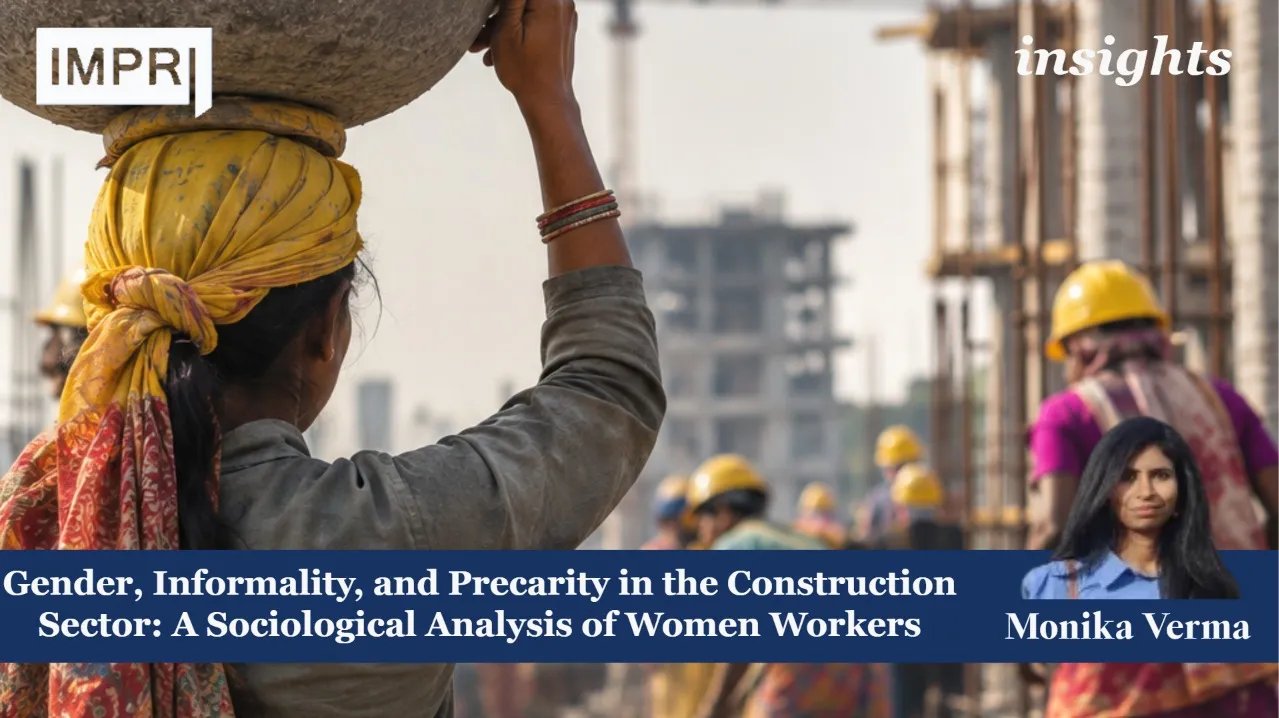
The construction industry exemplifies these characteristics of informality and labour precarity. It is one of India’s largest sources of informal employment, employing millions of workers on a casual and contractual basis. However, the organization of work within the construction industry is deeply gendered. Women are predominantly employed as unskilled or semi-skilled labourers and are generally assigned physically demanding tasks such as carrying bricks, cement, sand, concrete, and other construction materials.
Women construction workers experience multiple and intersecting forms of vulnerability. Their employment is generally casual, temporary, and mediated through contractors, with no written contracts, job security, paid leave, maternity benefits, health insurance, pension coverage, or other forms of social security. Despite performing labour-intensive work comparable to men, women frequently receive lower wages and have limited bargaining power in wage negotiations. The absence of employment security further exposes them to arbitrary dismissal and income instability.
Occupational health and safety constitute another major dimension of women’s vulnerability in the construction sector. Many construction sites fail to provide adequate personal protective equipment (PPE) such as helmets, safety shoes, gloves, masks, reflective jackets, or safety harnesses. The construction workplace also lacks adequate gender-sensitive infrastructure. Many sites do not provide separate toilets, changing rooms, washing facilities, clean drinking water, rest shelters, or crèche facilities for children.
The absence of private sanitation facilities adversely affects women’s health, menstrual hygiene, dignity, and privacy, while also increasing their vulnerability to harassment and gender-based violence. Women often continue working during pregnancy because of financial necessity and return to work shortly after childbirth due to the absence of effective maternity protection. Simultaneously, they continue to shoulder unpaid household and caregiving responsibilities, resulting in a “double burden” that adversely affects their physical health, mental well-being, and economic security.
Recognizing these challenges, the Government of India enacted the Building and Other Construction Workers (Regulation of Employment and Conditions of Service) Act, 1996 (BOCW Act) to regulate employment conditions and provide social security to construction workers. The Act provides welfare measures including accident compensation, health care, maternity benefits, educational assistance for workers’ children, pension benefits, housing assistance, disability support, and financial assistance in cases of death. Construction workers who have completed at least 90 days of work during the preceding twelve months are eligible to register as beneficiaries with the State Building and Other Construction Workers’ Welfare Boards.
Despite these progressive legal provisions, implementation remains inadequate. Employers and contractors often fail to register eligible workers or facilitate their registration with the Welfare Boards, despite being legally responsible for ensuring compliance. Consequently, many women construction workers remain excluded from welfare schemes and continue to work without access to social security benefits, occupational safety measures, maternity assistance, and other statutory protections. The gap between legislative intent and implementation highlights the persistent precarity of women’s employment in the construction sector and underscores the need for stronger enforcement of labour laws and gender-responsive workplace policies.
References
Annette Barnabas, Joseph Andarasu and Clifford Paul (2009). Study on the Empowerment of Women Construction Workers as Masons in Tamil Nadu, India. Journal of International Women Studies, Vol. 11, Issue 2, pp. 121–141.
International Labour Organization. (2023). Overview of workers in the construction subsectors (ILO Statistical Brief). ILO. https://doi.org/10.54394/CFPH997
Kalpana Devi and Kiran (2013). Status of Female Workers in Construction Industry in India: A Review. IOSR Journal of Humanities and Social Science (IOSR-JHSS), Vol. 14, Issue 4, pp. 27–30.
Kumar (2013). Gender Discrimination among Construction Workers With Reference To Vijayawada. Journal of Sociology and Social Work, Vol. 1, No. 1, pp. 42–53.
Women in Informal Employment: Globalizing and Organizing (WIEGO). (2019). Counting the world’s informal workers: A global snapshot. WIEGO
Raveendran, G., & Vanek, J. (2020). Informal workers in India: A statistical profile (WIEGO Statistical Brief No. 24). Women in Informal Employment: Globalizing and Organizing (WIEGO).
About the Contributor
Monika Verma is a researcher in Sociology. She holds a Master’s degree from Banaras Hindu University (BHU) and an MPhil from Babasaheb Bhimrao Ambedkar University (BBAU), Lucknow. She is currently pursuing her PhD in Sociology from Babasaheb Bhimrao Ambedkar University, Agra. She is a fellow in Public Policy Qualitative Action Research Fieldwork Fellowship Cohort 7
Disclaimer: All views expressed in the article belong solely to the author and not necessarily to the organisation.
Read more at IMPRI:
BRICS Anti-Narcotics Cooperation: The Guwahati Declaration, July 2026
Acknowledgement:
This article was posted by Tanisha Hooda, a Research and Editorial Intern at IMPRI.