






Policy Update
Himanshi Singh
Background
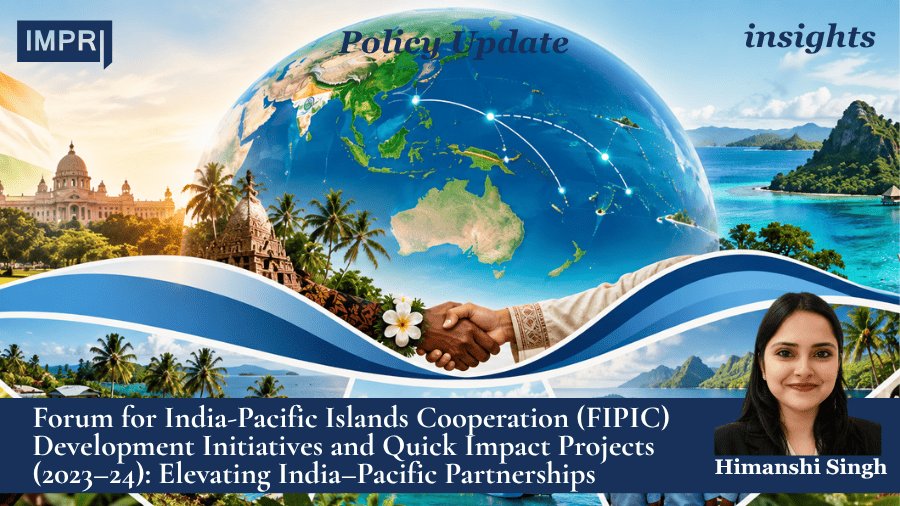
The Forum for India–Pacific Islands Cooperation (FIPIC) was established in November 2014 during Prime Minister Narendra Modi’s historic visit to Fiji, marking a transformative shift in India’s diplomatic and economic engagement with the South Pacific. Comprising India and 14 Pacific Island Countries (PICs): Cook Islands, Fiji, Kiribati, Marshall Islands, Federated States of Micronesia, Nauru, Niue, Palau, Papua New Guinea, Samoa, Solomon Islands, Tonga, Tuvalu, and Vanuatu, FIPIC was created to address the unique development priorities of these island nations through structured, action-oriented plurilateral cooperation.
The strategic rationale underlying FIPIC is rooted in India’s Act East Policy and its overarching vision for a free, open, inclusive, and peaceful Indo-Pacific. Rather than viewing these countries through a conventional small-island paradigm, India explicitly recognizes PICs as “Large Ocean States” that occupy pivotal economic, strategic, and environmental positions in the global maritime domain. India’s developmental approach is guided by the ancient philosophy of “Vasudhaiva Kutumbakam” (the world is one family), emphasizing human-centric, demand-driven partnerships that respect local sovereignty and priorities without imposing debt burdens, conditionalities, or transactional expectations [Indian Council of World Affairs (ICWA) report].
Building upon the inaugural summit in Suva (2014) and the second summit in Jaipur (2015), the 3rd FIPIC Summit held in Port Moresby, Papua New Guinea, in May 2023, established a modern milestone. Convening against a backdrop of severe post-pandemic economic vulnerability, supply chain disruptions in food, fuel, and pharmaceuticals, and existential climate risks, FIPIC III solidified India’s commitment to serve as a reliable development partner for the Global South.
Functioning
India’s developmental assistance across the 14 Pacific Island Countries operates through a dual framework consisting of the FIPIC multilateral/bilateral corridor and the India-UN Development Partnership Fund. This dual-track architecture ensures that initiatives align directly with national development plans and the broader 2050 Strategy for the Blue Pacific Continent.
At the core of the current operational framework is Prime Minister Modi’s 12-Point Action Plan, announced at the 3rd FIPIC Summit. This plan sets structured targets across healthcare infrastructure, digital connectivity, renewable energy, capacity building, and small-and-medium enterprise (SME) development.
To complement large-scale capital projects, India introduced the Quick Impact Projects (QIPs) mechanism. Under this modality, India grants USD 50,000 per project (MEA) to each of the 14 Pacific Island nations for community-tier initiatives chosen directly by the recipient governments. QIPs are designed for rapid execution using local labor, materials, and administrative resources. This ensures that funding translates immediately into tangible benefits such as clean drinking water systems, educational facility upgrades, or village solarization without generating financial liabilities or long-term debt.
Administratively, programs are coordinated by the Development Partnership Administration (DPA) within India’s Ministry of External Affairs (MEA), working alongside accredited Indian diplomatic missions, host nodal ministries, and partner international organizations. High-impact sector commitments are executed in partnership with specialized Indian bodies, including HLL Lifecare, the National Bank for Agriculture and Rural Development (NABARD), the Bureau of Indian Standards (BIS), and leading academic institutes like the Indian Institutes of Technology (IITs) and the University of the South Pacific (USP).
Performance
India’s assistance to the Pacific region combines annual Grant-in-Aid funding of approximately USD 3 million with targeted project allocations under the India-UN Development Partnership Fund and the QIP scheme. Implementation across key sectors has delivered measurable results:
Summary of Key FIPIC Development Initiatives (2023–24):
| Sector / Domain | Key Initiative & Project Scope | Target Nations / Beneficiaries | Current Status & Impact |
| Healthcare | 100-Bed Regional Super-Specialty Cardiology Hospital | Suva, Fiji (regional hub) | Largest Grant-in-Aid project in the Pacific; MoU signed. |
| Medical Technology | Hemodialysis Unit Deployment | PNG, Solomon Islands, Samoa, Palau, Nauru, Kiribati, Marshall Islands | Delivered across 7 countries; 4 additional nations in pipeline. |
| Emergency Health | Sea Ambulance Procurement | 12 Pacific Island Countries (20 units total) | Procurement underway; delivery targeted by March 2027. |
| Prosthetics & Mobility | Jaipur Foot Fitment Camps | Fiji & regional patients | Camps organized to fit ~650 amputees with prosthetics. |
| Pharmaceuticals | Jan Aushadhi Kendras & Pharmacopoeia | Fiji, Nauru, Solomon Islands | Indian Pharmacopoeia recognized; generic medicine supply initiated. |
| Digital & IT | Regional IT & Cyber Security Hub | Papua New Guinea & 8 PICs | PNG IT center upgraded; Centers of Excellence in 8 nations. |
| Education / Skills | Sagar Amrut Scholarship Scheme | All 14 Pacific Island Countries | 1,000 ITEC training opportunities provided over 5 years. |
| Marine Research | Sustainable Coastal & Ocean Research Institute (SCORI) | University of the South Pacific (USP), Fiji | Successfully launched to conduct coastal protection and ocean research. |
| Renewable Energy | Household Solarization & Female Engineers | 14 Pacific Island Countries | 2,800 households solarized; 70 female solar engineers trained |
| Community Infrastructure | USD 50,000 Quick Impact Projects (QIPs) | All 14 Pacific Island Countries | Rollout active; first project executed in Tubalevu Village, Fiji. |
Source: Ministry of External Affairs (MEA), PIB Delhi, ICWA, and Research Report on FIPIC Development Initiatives (2023–24)
- Healthcare and Lifesaving Infrastructure
Healthcare cooperation represents a flagship pillar of the FIPIC partnership. The flagship project is the construction of a 100-bed Regional Super-Specialty Hospital in Suva, Fiji, representing India’s largest Grant-in-Aid endeavor in the Pacific region. To address acute kidney disease across dispersed islands, India has supplied hemodialysis units to Papua New Guinea, the Solomon Islands, Samoa, Palau, Nauru, Kiribati, and the Marshall Islands, with four additional member states in the pipeline.
To overcome maritime transport barriers during medical emergencies, India is procuring 20 sea ambulances requested by 12 member states, with complete delivery scheduled by March 2027. Mobility support is further bolstered by Jaipur Foot camps, including a dedicated camp in Fiji servicing approximately 650 amputee patients. Additionally, Fiji, Nauru, and the Solomon Islands have formally recognized the Indian Pharmacopoeia, enabling the establishment of Jan Aushadhi Kendras to supply high-quality, low-cost generic medicines.
- Digital Capacity, Education, and Marine Research
Under the digital pillar, India upgraded the Center of Excellence in Information Technology in Papua New Guinea into a Regional IT and Cyber Security Training Hub. IT Centers of Excellence have also been operationalized across Fiji, the Cook Islands, Vanuatu, Nauru, Niue, the Solomon Islands, and the Marshall Islands.
In education, India launched the Sagar Amrut Scholarship Scheme, offering 1,000 ITEC training slots over five years specifically for Pacific Island professionals. To support environmental governance, India inaugurated the Sustainable Coastal and Ocean Research Institute (SCORI) at the University of the South Pacific (USP) in Fiji to address coastal erosion, ocean state forecasting, and potential fishing zone mapping.
- Renewable Energy and Community Impact
In clean energy, India completed the solarization of 2,800 households across all 14 PICs and trained 70 local women as solar engineers (“solar mamas”) at Barefoot College. Under the QIP scheme, the first project, the Tubalevu Village Ground Water Supply Project in Fiji was formally launched to provide clean drinking water, alongside solarization projects such as the Langafonua building for Tonga’s National Council for Women.
Regional reception has been positive, with the Pacific Islands Forum (PIF) officially placing India on its Strategic Partners Stream.
Impact
The impact of India’s FIPIC initiatives is observed across three main areas:
- Direct Community Welfare: By funding non-recourse QIPs, mobile soil-testing units, and sea ambulances, India delivers immediate improvements in health, sanitation, and rural livelihoods at the grass-roots level.
- Climate Resilience and Environmental Security: Through initiatives like SCORI, the International Solar Alliance (ISA), and the Coalition for Disaster Resilient Infrastructure (CDRI), India assists island nations in mitigating coastal erosion, predicting natural disasters, and expanding clean energy access.
- Global South Advocacy: By hosting the Voice of Global South Summits, India provides a platform for Pacific nations to voice priorities regarding climate justice, supply chain security, and multilateral governance reform on the world stage.
Emerging Issues
Despite significant progress, the execution of FIPIC initiatives faces structural, logistical, and geopolitical complexities across the South Pacific. A primary operational hurdle stems from the extreme geographic dispersion of island nations, where transporting heavy medical equipment—such as hemodialysis machines and sea ambulances across vast maritime expanses demands specialized logistics and sustained maintenance support. Furthermore, ensuring the long-term operational viability of solar installations, IT hubs, and specialized healthcare infrastructure requires continuous local technical capacity building to prevent operational bottlenecks once initial projects are handed over. Compounding these internal challenges is the backdrop of intense geopolitical competition in the South Pacific, as major global powers expand their presence in the region. In response, India maintains a distinct, transparent, and demand-driven development model that prioritizes non-recourse grant assistance and community welfare over transactional or debt-generating frameworks
Way Forward
To maximize the long-term strategic and socio-economic value of FIPIC initiatives, India and its Pacific partner nations must transition from individual project delivery toward institutionalized, self-sustaining development ecosystems. By addressing administrative, logistical, and technical bottlenecks through enhanced digital governance and targeted capacity building, both sides can ensure that development assistance translates into enduring regional resilience.
In this context, the following strategic actions are recommended:
- Customized Regional ITEC Modules: Develop specialized, region-specific ITEC training modules tailored to the administrative and technical requirements of Pacific Island cohorts.
- Expanding the QIP Framework: Scale the USD 50,000 Quick Impact Project scheme on a rolling basis as initial projects demonstrate localized success.
- Accelerating Regional Research Hubs: Fast-track the full operationalization of the Space Technology Application Center in Papua New Guinea and expand research projects at SCORI in Fiji.
- Institutionalizing Telemedicine: Expand the deployment of India’s e-Sanjeevani digital health platform to connect remote island clinics with specialist hospitals.
References
Indian Council of World Affairs. (2023, June 6). FIPIC III: Enhancing India’s engagement with Pacific islands. https://www.icwa.in/show_content.php?lang=1&level=3&ls_id=9468&lid=6142
International Business Times. (2024, August 30). In Tonga, India reaffirms multifaceted engagement with Pacific island nations. https://www.ibtimes.co.in/tonga-india-reaffirms-multifaceted-engagement-pacific-island-nations-871674
Ministry of External Affairs. (2026, September 1). Statement by MoS Shri Pabitra Margherita at the Dialogue Partner Session of the 55th Pacific Islands Forum Leaders’ Meeting in Koror, Palau [Press release]. Government of India. https://www.mea.gov.in/press-releases.htm?dtl/41728
Ministry of External Affairs. (2026, September 23). EAM’s opening statement during the Forum for India-Pacific Islands Cooperation (FIPIC) Foreign Ministers’ Meeting. Government of India. https://www.mea.gov.in/speeches-statements.htm?dtl/41824/EAMs_Opening_Statement_during_the_Forum_for_IndiaPacific_Islands_Cooperation_FIPIC_Foreign_Ministers_Meeting
Press Information Bureau. (2025, August 25). India-Fiji joint statement: Partnership in the spirit of Veilomani Dosti. Ministry of External Affairs, Government of India. https://www.pib.gov.in/PressReleasePage.aspx?PRID=2160503
About the Contributor: Himanshi Singh is a research & editorial intern at the Impact and Policy Research Institute (IMPRI). She holds a postgraduate degree in political science and international relations. Her research interests include foreign policy, strategic studies, public policy, national security, diplomacy, and global governance, with a particular focus on India’s external relations and evidence-based policy research.
Reviewer:
Lubina Dua & Sandra Menon
Acknowledgement: The author sincerely thanks the IMPRI Editorial Desk for invaluable mentorship and guidance during the development of this policy update. Special thanks are also extended to fellow interns for their thoughtful inputs and support throughout the research process.
Disclaimer: The views expressed are those of the author and do not necessarily reflect the official policy of IMPRI. All information is based on publicly available official government publications and is compiled solely for academic and research purposes.
Read More at IMPRI :
India-Finland Strategic Partnership (March 2026): Outcomes of Bilateral Discussions and Emerging Areas of Cooperation.
Sustainable Agrarian Mission on Use of Agro-Residue in Thermal power Plants (SAMARTH), 2021