







Policy Update
Deepa Baghel
Introduction
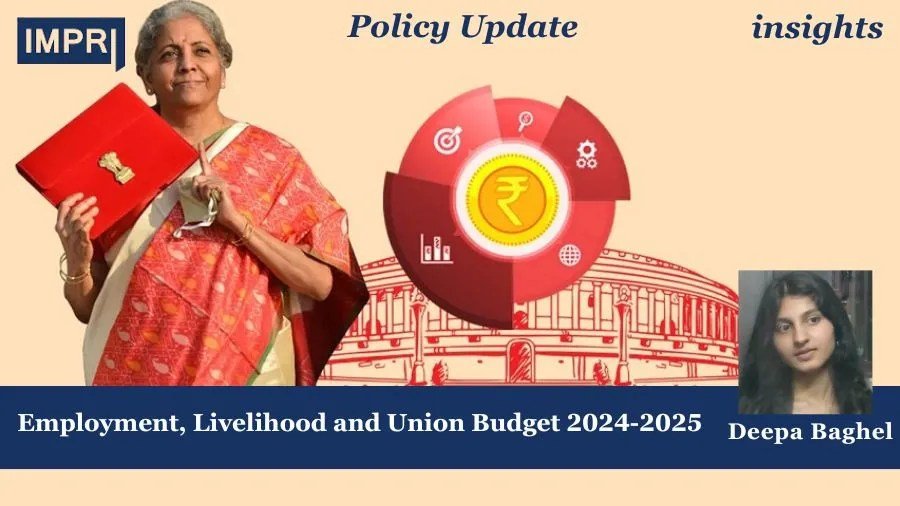
After the general elections in India, held in seven phases from April 19 to June 1, 2024, the third consecutive Narendra Modi government has taken office. On July 23rd, The ‘Modi 3.0’ administration presented its first Union Budget since holding power at the Center. The budget was delivered by Finance Minister Nirmala Sitharaman, with key focuses on education, employment skills, industrial workers, and the middle class.
Now we will discuss the employment and livelihood theme of Union Budget 2024-25.The Union Budget 2024–25 has a clear focus on employment, skill development, and support for livelihoods, especially for youth, women, and farmers. Finance Minister Nirmala Sitaraman’s speech outlines several significant measures aimed at creating ample opportunities for everyone and achieving the goal of inclusive growth. The government has introduced five schemes focused on employment and skill development.
Employment and Skill Development in Union Budget
This Budget has introduced three schemes for the “Employment-Linked Incentive“ as a part of the package announced by the Prime Minister. These schemes will be based on enrollment in the EPF(Employment provident fund) and relate to the recognition of the first time and the support given to employees and employers. EPF is a statutory body constituted by the Central Government under the provisions of Section 5A of the Employees Provident Funds and Miscellaneous Provisions Act, 1952 (Act 19 of 1952). The tenure of the EPF board is five years. Three of the five schemes in the Union Budget are employment generation schemes, while two are directed towards skill development, internships, and improving institutional facilities.
Scheme A is for first-timers. This scheme will pay one month’s wage to anyone joining any form of productive employment for the first time in any of the formal sectors. The eligibility limit shall be up to a salary of one lakh rupees per month. Scheme 2 is to provide targeted incentives for additional employment in the manufacturing sector associated with an increase in employment of new recruits. Scheme 3 is additional employment in all sectors. To promote employment generation during the duration of the scheme, the government will pay up to INR 3,000 per employee per month up to a maximum of 24 months towards the EPF contribution for each additional employee.
An example of Scheme 3 for additional employment across all sectors is the “Atma Nirbhar Bharat Rojgar Yojana” (ABRY). Under this scheme, the government will provide financial support by contributing up to INR 3,000 per employee per month towards the Employees’ Provident Fund (EPF) for a maximum of 24 months. This contribution is specifically for new employees hired by businesses or those who were re-employed after losing their jobs due to the pandemic.
The scheme aims to encourage companies to create more jobs and boost employment across various sectors. There are some skill programs that the government has already undertaken. These include Pradhan Mantri Kaushal Vikas Yojana (PMKVY), Employability Enhancement Training Programme (EETP), National Employability Enhancement Mission (NEEM), and more.
Problems and Challenges
The government has formulated an employment-linked incentive scheme to create private employment. But it still faces problems with job quality and production, whereby a huge population of engineering graduates are considered unfit for employment. With inequality in income, the apex of one percent earns 21%. Capping it at 7% of the income in 2021, the development of markets and investments remains restricted.
Farmers’ concern is very evident from the higher use of MGNREGA (Mahatma Gandhi National Rural Employment Guarantee Act ,it was passed by the Government of India in September 2005. The act guarantees that adult members of rural households who are willing to do unskilled manual work will receive at least 100 days of paid employment in a financial year. The goal of the act is to give poor people the opportunity to earn a living and provide for their families.), which shows that rural distress is still very much present.
Only the agricultural sector, which posted positive growth during the pandemic, is confronted with climate change shocks, while the recent budget steps that were undertaken seek to increase the capacity of the agricultural sector and support the national policy on cooperatives. Currently nearly 30% of the youth in India is unemployed and the remaining jobs often offer poor educational outcomes and undernourishment; the vision of ‘Viksit Bharat’ is a tough nut to crack.
Employability enhancement for instance through skills ‘development and training, including the use of private partnerships, seems to be among the intentions of a budget. The claim to transform 1000 Industrial Training Institutes (ITIs) into a hub-and-spoke model, to contour the content of the courses to the industry, and to add new courses for new skill development areas is an attempt to revamp vocational education.
The government’s centrally sponsored scheme envisaged for the capacity building of 20 lakh youth over five years also seems to uphold this policy. These institutes are very vital in offering vocational education and training to higher institutions and especially to the youth in society, particularly those from needy backgrounds who may not proceed to universities for further academic studies. There is a need to support vocational training through policies, particularly those focusing on the innovation of employment-generating processes while considering the structure of inequalities based on caste, gender, and class, which are often neglected.
In connection with this, the use of scholarships and grants must add up to a comprehensive approach to improve employability and fight the problem of job informality, which may be the key to building a sustainable economic growth and social justice model. Furthermore, the over predominance of market access and industry partnerships for skill development and internships has several challenges as well. As much as linking training to market contextual factors is productive, dependence on market solutions distorts the market by excluding people who cannot afford the products and services.
For example, the proposed schemes of internships, including paid internships in so-called top 500 companies with a stipend of five thousand rupees a month, are more ephemeral measures whose utility is more temporary in nature and do not provide an enduring solution to the employment problem and job insecurity. Predictably, internships do not secure jobs that can improve or support livelihoods as they are meant to. Additionally, relying solely on the market with no government intervention and having specific schemes for the enhancement of skills amongst youth and workers cannot hope to be a sustainable process, as they are only a mere band-aid to the unemployed situation in our economy.
Women, Livelihood and Union Budget
Enhancing women’s participation schemes in the Union Budget: As per the current Budget, women’s participation can be improved by constructing more women’s hostels with industrial support. It erases the scientific findings on the likely explanations for low women’s participation among them: deaths in the household, low education level, and relegation of women to childbearing and caregiving roles.
As applied to women’s concerns, the concept of inclusivity means eradicating systemic practices that comprise social factors and attitudes that limit women’s access to education and employment opportunities. To ensure women can fully benefit from these measures, it is essential to provide additional economic and social support, such as subsidies, household cash transfers, and protective measures.Interpreting the budget from a class point of view helps unearth the real actors in financial policies and budgets, particularly those regarding the working class and other vulnerable groups.
As noted earlier, due to electoral pressure, the budget also reflects contemporary social norms. Job creation informed by the persisting dominance of the private sector is, however, an ineffective solution in the current context given the declining capacity of labor to contribute to capital formation in recent decades. It raised doubts about such measures as the proposed one crore internships in top firms and the EPF-linked incentives, they might not suit the informal sector.
Fears about the quality of jobs that are being created drew attention to the extension of contractual employment and wage depression in the private as well as in the public sector. Criticizing aspects of the budget that focus on formal sector employment, while the larger informal sector, employing 90% of the workforce, receives only minimal attention in its middle-class segment. It shows that it is imperative to expand and enhance the role of the state in direct job provision and guaranteeing social protection, as the trickle-down approach of the given budget does not solve the fundamental problems of the majority.
The importance of MSMEs in the improvement of human welfare and the overall development of India; the sector has about 50 crore employees around the world and enjoys an annual employment growth rate of 1%. India has faced significant challenges on the unemployment front, with the number now reaching around 3 crore.
The country’s capacity to absorb labor has been on the decline since 1972 up to the present; the increase in employment last year may have come from unpaid family workers and self-employed people with work, but it could not stimulate the creation of jobs in the formal sector. MSMEs represent the new wave of enterprises, making up 96% of all businesses and contributing over 30% to industrial production and more than 40% to exports.
These are the following problems: 1) they belong to traditional sectors. 2)have a high Msme mortality rate. 3) have an average salary of Rs. 8000 to Rs. 10000 per month, etc. It poses a question for the reduction of import duties on electronics and footwear, which carries the possibility of local production by SMEs. GDP growth is achievable, but human development remains uncertain without improving worker quality and wages.
Budget tries to advocate for the improvement of skills, development, research, and the quality of education. The sparse investment in higher education loans and in skill development is worsened by the poor quality of many Indian universities. Whether MSMEs are to be made fully responsible for job generation and development, there is a dire need for qualitative enhancement in skills, research, and institutional support. Without them, efforts at creating jobs hardly lead to ‘actual’ development but instead reproduce poverty, hence the need for an integrated approach to employment as a means to ‘Viksit Bharat’.
Analyzing the budget through the lens of class brings out the real beneficiaries of financial policies and appropriation, especially the working class and the disadvantaged. Though it is influenced by electoral consideration and therefore reflects social norms, it relies on the private sector for job creation, an approach that has proven more or less irrelevant in the last few decades given the diminished role of labor in capital accumulation. It even opposed the viability of some of the measures, like proposed one-crore internships for students in the top conglomerates and EPF-linked incentives, saying that they may not cater to the informal sector populace.
Debates over the quality of jobs created draw attention to the rise in contractual employment and wage suppression, which have stretched across all sectors, including private as well as public. It is important to point out that the budget is excessively ‘formal sector biased’ as it offers much to the formally employed middle-class but overlooks informal employees who constitute 90% of the workforce. There is a dire need for the state to take an engaging role in providing direct employment opportunities and social protection because the trickle-down effect espoused in the use of the budget does not tackle the core fundamental challenges affecting the majority.
References
About the contributor- Deepa Baghel is a research intern at IMPRI, pursuing graduation in BA Hons. from Lady Shri Ram College for women .
Acknowledgement – The author extends sincere thanks to Dr. Arjun Kumar for the invaluable opportunity and to Meenu Mohan and Sana Ansari for their informative inputs.
Read more at IMPRI:
The Waqf (Amendment) Bill, 2024
Proposed Amendments to IT Rules 2021: Strengthening Digital Accountability and Media Ethics