




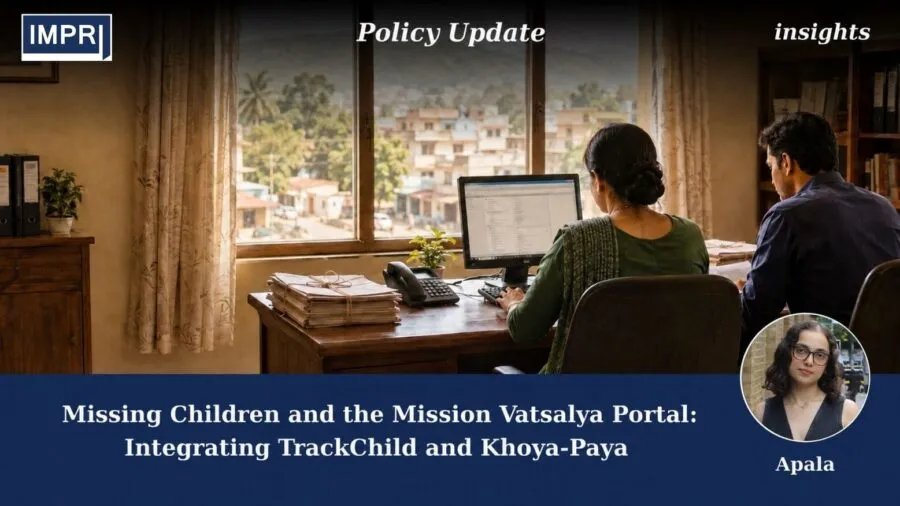
Policy Update
Apala
Background
Mission Vatsalya was built around a single promise. The scheme commits the Government to strengthen the juvenile justice care and protection system with the motto “leave no child behind” (Ministry of Women and Child Development, 2022). For a child who has disappeared, that promise is tested twice: once when the disappearance is reported, and again when the child is found and has to be returned to a family or into care.
The Mission Vatsalya Portal is the instrument built to hold both moments in a single record. Under Section 2(14)(vii) of the Juvenile Justice (Care and Protection of Children) Act, 2015, a missing or runaway child is a child in need of care and protection. Everything that follows a disappearance, from the registration of the complaint to restoration and rehabilitation, is therefore governed by the statute and by the institutions it creates: Child Welfare Committees (CWCs), Juvenile Justice Boards (JJBs) and District Child Protection Units. The tracing of a missing child is a police function, but the child who is found belongs to the child protection system.
India has attempted to bridge the gap through databases. Work on TrackChild began in 2006, first as a pilot in West Bengal and then as a national portal from late 2012. It was set up under the Integrated Child Protection Scheme to allow police stations, child care institutions, CWCs and JJBs to enter records of missing and found children and to match one against the other (NHRC, 2024, p. 44). Khoya-Paya followed in June 2015, launched under the Digital India programme as a citizen-facing lost-and-found platform on which any registered user could post a report of a missing or sighted child and search the reports of others (The Caravan, 15 September 2015).
Instead of resolving the problem through current integration, the two platforms with overlapping functions ended up creating the issue. TrackChild held the official record and Khoya-Paya held the citizen record, and neither spoke to the other or to the state-level systems such as ZIPNet that police forces actually used. A child traced through one channel could remain listed as missing on another, and there was no single figure that a district officer, a CWC or Parliament could rely on.
The Supreme Court, in Sampurna Behura, directed the Ministry to make continuing use of information technology to build databases of missing and trafficked children. When Mission Vatsalya subsumed the Child Protection Services scheme in 2021-22, its implementation guidelines promised a unified digital platform for all management information systems relating to children in difficult circumstances (NHRC, 2024, p. 49).
On 22 July 2026, the Ministry of Women and Child Development informed the Rajya Sabha that TrackChild and Khoya-Paya have been integrated into a single unified Mission Vatsalya Portal, and that the Go Home and Re-Unite (GHAR) portal has been folded in as well (PIB, Release ID 2287687). A fuller reply on 29 July 2026 repeated the integration and set it against the statutory architecture of the 2015 Act (PIB, Release ID 292175). Both answers were given by the Minister of State, Smt. Savitri Thakur.
Functioning
The TrackChild module now runs with the participation of the Ministry of Home Affairs, the Ministry of Railways, State Governments and Union Territory Administrations, CWCs, JJBs and the National Legal Services Authority. A standard operating procedure has been issued, advisories have gone to every Director General of Police, and the module is interoperable with the Crime and Criminal Tracking Network and Systems (CCTNS), which permits FIRs of missing children to be matched against the portal database. Through the Khoya-Paya module, any citizen may report a missing or sighted child. Nodal officers for missing children have been appointed at State and district level by every State and Union Territory, with their details uploaded on the portal.
The 29 July reply adds the surrounding service architecture: institutional care through Child Care Institutions, non-institutional care at ₹4,000 per month per child under sponsorship, foster care or aftercare, Child Helpline 1098 integrated with ERSS-112 and the Women Helpline 181, and dedicated WCD control rooms in all 36 States and Union Territories.
Novel or not?
The consolidation predates the announcement in Parliament by three years. The National Human Rights Commission’s Research Study on Missing Children records that the Mission Vatsalya Portal was launched in June 2023 and by then already carried TrackChild, Khoya-Paya, POCSO e-Box, adoption matters and e-Baal Nidaan (NHRC, 2024, p. 49). A PIB release of 18 March 2026 announced a revamped portal with management information dashboards, digital individual care plans and the CARINGS adoption portal integrated, along with an Identification Cell operating since July 2024 (PIB, Release ID 2241717). An MHA reply of 24 March 2026 used near-identical language to the July text (Lok Sabha U.Q. No. 5252).
Set side by side, the new elements in July 2026 are only two:
- the integration of GHAR, absent from the March reply; and
- the confirmation that nodal officer appointments are complete across all States and Union Territories.
Both are significant. Neither is a new platform.
Performance
Three separate datasets are in public circulation, and they are not directly comparable. Each is set out on its own basis below before any trend is drawn from it.


Girls below 18, 2019 to 2023 (State-wise, tabled in Parliament)
The most recent State-wise series placed before Parliament covers girls alone. In 2023, 68,835 girls were reported missing during the year. Adding cases carried forward from earlier years, the total stood at 102,633, of whom 66,965 were traced within the year and 35,668 remained untraced (Lok Sabha U.Q. No. 5252, Annexure, sourced to Crime in India). Because this series carries forward its own backlog, its year-end untraced figure is the useful indicator: it has risen from 33,371 at the close of 2019 to 35,668 at the close of 2023. The stock of unresolved cases grew over exactly the period in which portal consolidation proceeded.
All children, 2017 to 2021 (single-year reporting and recovery)
The NHRC study reproduces a consistent five-year series for all children. Reported cases moved from 118,971 in 2017 to 121,351 in 2021, the highest of the five years and an 11 per cent rise over 2020, while the recovery rate held between 59 and 63 per cent throughout. Girls accounted for between 65 and 74 per cent of the total in every year (NHRC, 2024, pp. 6, 20). This is the only like-for-like series available, and it is the one on which the recovery claim rests: across five years of successive tracking platforms, roughly three children in five were recovered and the figure did not move.
All children, 2021 to 2024 (multi-year aggregate)
Figures placed by the Ministry of Home Affairs in the Rajya Sabha in August 2026 indicate 5,35,009 children reported missing between 2021 and 2024, of whom 3,46,023 were traced and 1,88,986 were not. This is a four-year aggregate rather than an annual figure, and it does not carry forward the pre-2021 backlog, so its implied ratio of roughly 65 per cent cannot be set directly against the annual rates above. It is offered here as corroboration of order of magnitude, not as a trend observation.
Impact
- Mission Vatsalya received ₹1,500 crore in the Budget Estimates for 2025-26. The Revised Estimates cut this to ₹1,100 crore, a reduction of 26.7 per cent, in the very year the portal was revamped.
- The Budget Estimate for 2026-27 is ₹1,550 crore, against actual expenditure of ₹1,405.53 crore in 2024-25 (Expenditure Budget 2026-27, Demand No. 101). The scheme accounts for 5.5 per cent of the Ministry’s net allocation of ₹28,183.06 crore, with ₹10 crore earmarked for the POCSO component from the Nirbhaya Fund.
Those figures mark the limits of the intervention. Server integration does not require deep pockets. What the portal requires is timely and accurate entry by police stations, CWCs, JJBs and District Child Protection Units, which is a staffing and supervision cost borne largely at district level and funded from the line that was cut mid-year. A public expenditure and institutional review of Mission Vatsalya in Odisha found that volatility in fund utilisation ratios produced suboptimal performance in child care institutions, alongside deficiencies in infrastructure, personnel and service provisioning, in a State that had otherwise maintained fiscal prudence (MPRA Paper 121910, 2024). The digital initiative is a positive step, but the binding constraint sits elsewhere.
The sharper difficulty is that integration strengthens the part of the system that was already working. The NHRC’s fieldwork in Delhi found FIR registration and TrackChild data entry proceeding seamlessly, while investigation, follow-up and rehabilitation lagged, with post-restoration follow-up absent in most cases and long-term cases left without a transfer protocol (NHRC, 2024, pp. 8, 59-60). If records were being captured accurately and the outcome still did not improve, then the failure lies downstream of data capture, in what happens to a child after the entry is made.
A unified portal makes the same information visible in one place. It does not, by itself, produce an investigation, a home verification or an individual care plan. The Commission’s own assessment of the merger was accordingly cautious: with all child protection portals brought under one umbrella, it remains to be seen whether seamless service delivery to traced children and faster matching will follow.
Emerging Issues
Khoya-Paya was not received favourably at the outset either. When it launched in 2015, child rights lawyers argued that permitting any registered citizen to publish a child’s photograph and identifying details, and to display a parent’s contact information, sat uneasily with the JJ Act, under which a found child is a child in need of care and protection and the CWC alone decides what identity-related detail may be published (The Caravan, 15 September 2015). Section 32 of the Act requires that a lost or abandoned child be reported to Childline, the nearest police station, a CWC or the District Child Protection Unit within 24 hours.
The July replies confirm that any citizen may still report through the Khoya-Paya module. They say nothing about moderation, publication controls or whether a citizen report is now routed to a statutory authority before it becomes publicly visible. Integration into a common database does not answer that question, and it is the question on which the safety of the citizen-reporting channel turns.
A definitional problem also survives the merger. The definition of a missing child in Rule 92 of the Juvenile Justice Model Rules, 2016 diverges from the one used in the Ministry’s 2016 Standard Operating Procedure for cases of missing children, and Delhi Police register such cases under the kidnapping provision of the penal law because being missing is not itself an offence (NHRC, 2024, pp. 22, 59). A single portal built on top of inconsistent definitions and mismatched offence categories inherits the inconsistency rather than curing it, which is why the aggregate figures reported by the portal and by Crime in India still require separate reconciliation.
Way Forward
Four indicators will show whether the consolidation is more than architectural:
- publication of the portal’s management information dashboards with State-wise disaggregation;
- the interval between FIR registration and a CCTNS match;
- movement in the year-end untraced stock reported in Crime in India; and
- evidence that traced children are produced before CWCs within the statutory period and receive the rehabilitation plans the JJ Act requires.
Two further steps would help. The Ministry should publish the moderation and publication protocol governing citizen reports on the Khoya-Paya module, so that the channel operates within Section 32 rather than around it. And the divergent definitions in Rule 92 and the 2016 SOP should be reconciled, since a unified database is only as coherent as the category it counts. Until those figures and protocols are released, the integration is best described as an administrative tidying of a system whose recovery rate has not moved in a decade.
References
Chakraborty, L., Kaur, A., Balamuraly, B., & Yadav, J. (2024). Polycrisis and intensified risks for children: Analysing “Mission Vatsalya” scheme in India (MPRA Paper No. 121910). Munich Personal RePEc Archive.
https://mpra.ub.uni-muenchen.de/121910/
Kambampati, S. (2015, September 15). Why the government’s new portal for missing children, “Khoya-Paya,” is likely to do more harm than good. The Caravan. https://caravanmagazine.in/vantage/why-government-new-portal-missing-children-khoya-paya-harm
Ministry of Finance, Government of India. (2026). Notes on demands for grants, 2026-2027: Demand No. 101, Ministry of Women and Child Development. https://www.indiabudget.gov.in/doc/eb/sbe101.pdf
Ministry of Home Affairs, Government of India. (2026, March 24). Lok Sabha unstarred question no. 5252: Missing children.
https://www.mha.gov.in/MHA1/Par2017/pdfs/par2026-pdfs/LS24032026/5252.pdf
Ministry of Women and Child Development, Government of India. (2026, March 18). Revamped Mission Vatsalya Portal an integrated digital platform for all stakeholders related to child protection services (Press Release ID 2241717). Press Information Bureau. https://www.pib.gov.in/PressReleasePage.aspx?PRID=2241717
Ministry of Women and Child Development, Government of India. (2026, July 22). Ministry of Women and Child Development has developed integrated unified Mission Vatsalya Portal (Press Release ID 2287687). Press Information Bureau. https://www.pib.gov.in/PressReleasePage.aspx?PRID=2287687
Ministry of Women and Child Development, Government of India. (2026, July 29). Integrated unified Mission Vatsalya Portal for service delivery and real-time monitoring (Press Release ID 292175). Press Information Bureau.
https://www.pib.gov.in/newsite/erelcontent.aspx?relid=292175
National Human Rights Commission. (2024). Research study on missing children. NHRC, Government of India. https://nhrc.nic.in/assets/uploads/training_projects/Research_StudyonMissingChildren_2024.pdf
Bachpan Bachao Andolan v. Union of India, Writ Petition (Civil) No. 75 of 2012 (Supreme Court of India).
Juvenile Justice (Care and Protection of Children) Act, 2015, No. 2 of 2016, Acts of Parliament, 2016 (India).
Juvenile Justice (Care and Protection of Children) Model Rules, 2016, Rule 92 (India).
About the Contributor
Apala is a final-year student of the B.A. LL.B. (Hons.) programme at Jindal Global Law School, O.P. Jindal Global University, Sonipat. Her research interests include child rights, constitutional law, and international law.
Acknowledgement
The author extends sincere gratitude to the IMPRI Impact and Policy Research Institute team for their guidance and support, and to the reviewers, Ms. Pallavi Lad and Ms. Ambika Sharma, for their valuable feedback and insights on earlier drafts of this article.
Disclaimer: All views expressed in the article belong solely to the author and not necessarily to the organization.
Read more at IMPRI:
BRICS Youth Summit 2026, Gandhinagar: Yuva Shakti for Resilient Cooperation