








Policy Update
Khushi
Background
The growing use of Ayurveda, Siddha, Unani and Homoeopathy (ASU&H) medicines has increased the need for effective mechanisms to monitor their safety and regulate their promotion. Two major concerns necessitate stronger surveillance: the under-reporting or delayed identification of Adverse Drug Reactions (ADRs) and the circulation of misleading or objectionable advertisements making unsubstantiated therapeutic claims. Without systematic reporting, documentation and analysis, potential safety signals may remain unidentified, while misleading claims can influence consumer decisions and expose patients to health risks. Addressing these concerns requires coordinated monitoring, reliable reporting mechanisms and timely referral of complaints to the appropriate regulatory authorities.
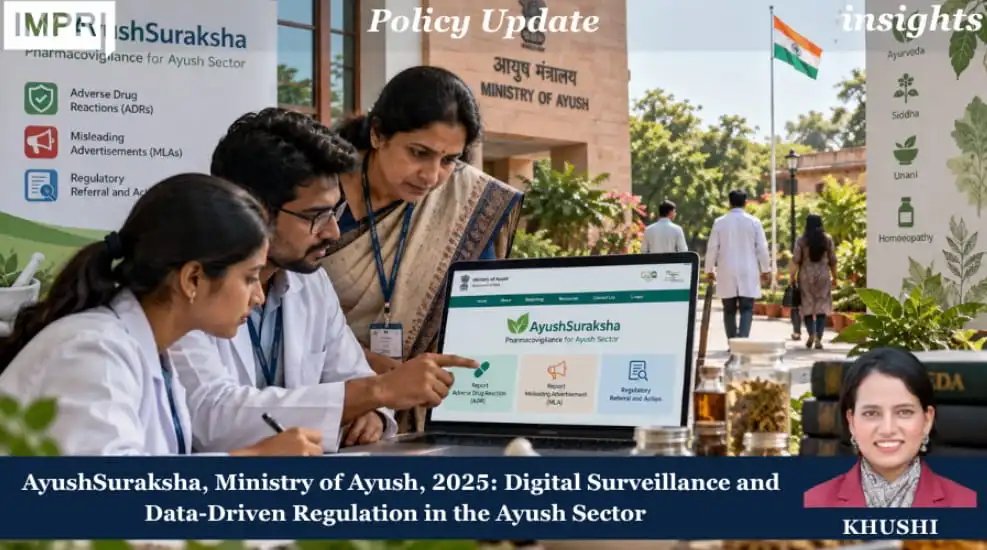
To strengthen these processes, the Ministry of Ayush launched the Ayush Suraksha Portal on 30 May 2025. The portal provides a dedicated digital platform for reporting ADRs and Misleading Advertisements (MLAs)/Objectionable Advertisements (OAs) associated with Ayush medicines. By bringing these reporting mechanisms together, it seeks to improve the systematic collection and analysis of safety-related information, strengthen regulatory coordination and support evidence-based action under the National Pharmacovigilance Programme (Press Information Bureau, 2025).
The significance of the portal extends beyond complaint registration. By bringing ADR reports and misleading-advertisement complaints into a centralised digital system, Ayush Suraksha seeks to enable data-driven surveillance, faster regulatory coordination and evidence-based safety monitoring across the Ayush ecosystem. Complaints can also be forwarded to relevant authorities, including State/Union Territory Licensing Authorities, the Central Consumer Protection Authority, the National Commission for Indian System of Medicine and other concerned bodies. (Press Information Bureau, 2025).
Thus, Ayush Suraksha represents a shift from fragmented reporting towards digitally enabled pharmacovigilance, with the broader objective of strengthening patient safety, regulatory transparency and accountability in the Ayush sector.
Functioning
Ayush Suraksha functions as a digital pharmacovigilance and regulatory-monitoring system for the Ayush sector. It integrates information from a nationwide three-tier pharmacovigilance network and provides a centralised dashboard for recording suspected Adverse Drug Reactions (ADRs), capturing Misleading Advertisements (MLAs)/Objectionable Advertisements (OAs), and facilitating their referral to the appropriate authorities. The operational process differs according to whether a report concerns a suspected medicine-related reaction or an advertisement-related complaint (Ministry of Ayush, 2025).
1. Reporting Adverse Drug Reactions
The portal enables reporting of suspected ADRs associated with Ayurveda, Siddha, Unani and Homoeopathy medicines. Healthcare professionals, including doctors, nurses and pharmacists, can report suspected reactions. Patients can report through their physician or medical faculty member. Reports should be submitted as soon as a medicine or therapy is suspected of causing an unintended adverse effect; a report does not, by itself, establish that the medicine caused the reaction (Ministry of Ayush, n.d.).
2. Assessment and Monitoring of ADR Reports
Submitted reports enter the pharmacovigilance network for documentation, assessment and continued safety monitoring. The network supports the identification and evaluation of suspected adverse effects and helps build information about possible safety signals. The National Pharmacovigilance Coordination Centre (NPvCC), located at the All India Institute of Ayurveda (AIIA), New Delhi, coordinates the programme nationally. The precise clinical assessment and follow-up of an individual report depend on the relevant pharmacovigilance procedures; therefore, the receipt of a report should not be equated with confirmation of causality (Ministry of Ayush, n.d.).
3. Responsibilities of the Three-Tier Network
The programme operates through one NPvCC, five Intermediary Pharmacovigilance Centres (IPvCs) and 97 Peripheral Pharmacovigilance Centres (PPvCs).
- National Pharmacovigilance Coordination Centre (NPvCC): Located at AIIA, New Delhi, it coordinates the national pharmacovigilance programme and supports the consolidation and monitoring of information received through the network.
- Intermediary Pharmacovigilance Centres (IPvCs): These centres, located at designated national Ayush institutions, support implementation and coordination of pharmacovigilance activities within the network.
- Peripheral Pharmacovigilance Centres (PPvCs): These centres provide reporting points closer to healthcare settings and the public. They collect and report suspected ADRs and misleading or objectionable advertisements through the designated system and support referral to the relevant authorities.
The three-tier structure connects local reporting with national coordination while distributing surveillance responsibilities across institutions (Ministry of Ayush, n.d.; Press Information Bureau, 2025).
4. Reporting and Referral of Misleading Advertisements
Ayush Suraksha provides a separate mechanism for recording advertisements suspected of making misleading, unsubstantiated or objectionable claims about Ayush products. These complaints can be captured through the portal and forwarded to the relevant regulatory authority for examination and necessary action. Depending on the nature of the complaint, the authorities may include State and Union Territory Licensing Authorities, the Central Consumer Protection Authority, the National Commission for Indian System of Medicine, the National Commission for Homoeopathy, the Ministry of Information and Broadcasting, the Press Council of India or the Food Safety and Standards Authority of India (Press Information Bureau, 2025).
5. Centralised Recording and Regulatory Follow-up
The portal’s centralised dashboard supports the recording and tracking of suspected ADRs and advertisement-related complaints. Once a complaint is referred, the concerned authority is responsible for examining it under the applicable regulatory framework and taking any necessary action. The Ministry of Ayush reported in March 2026 that complaints received through the portal had been forwarded to the concerned authorities for further action. However, referral does not necessarily mean that a complaint has been substantiated or resolved; disposal and enforcement depend on the receiving authority’s assessment (Press Information Bureau, 2026).
6. Data Analysis and Continuing Surveillance
The information accumulated through the portal can support analysis of recurring suspected adverse reactions, emerging safety concerns and patterns in misleading advertisements. At the national level, such information can inform pharmacovigilance priorities and regulatory oversight. The value of this process depends on the completeness and quality of reports, timely assessment and follow-up by the concerned institutions (Ministry of Ayush, n.d.).
Overall workflow:
Reporting → Documentation → Assessment or Complaint Review → Referral to the Appropriate Authority → Regulatory Follow-up → Data Analysis and Continuing Surveillance
This structure positions Ayush Suraksha as a digital surveillance infrastructure, rather than merely an online complaint-registration portal.
The official data supports a Performance section with measurable indicators of portal use, regulatory follow-up and public awareness. One important distinction for your article: “action taken” should not be described as “complaints resolved” unless the source explicitly confirms resolution.
The Ministry of Ayush’s parliamentary reply of 20 March 2026 reported 10,269 misleading-advertisement submissions and 216 suspected adverse drug reaction reports since the portal’s inception. A later reply, dated 7 August 2026, reported 4,165 awareness programmes reaching 3,71,477 participants under the wider pharmacovigilance programme. These figures measure different activities and reporting periods, so they should be presented separately.
Performance
Since its launch on 30 May 2025, Ayush Suraksha has created a digital mechanism for documenting suspected adverse drug reactions and monitoring misleading or objectionable advertisements. Official parliamentary replies provide measurable evidence of portal utilisation, complaint referrals, regulatory follow-up and awareness activities. However, the available figures need to be interpreted according to their reporting dates and the distinction between complaints received, actions taken and cases resolved (Press Information Bureau, 2026a; Press Information Bureau, 2026b).
1. Complaints Registered Through the Portal
As reported by the Ministry of Ayush on 20 March 2026, the portal had recorded 10,269 misleading-advertisement submissions and 216 suspected adverse drug reaction reports since inception. These figures indicate that the system is being used for both advertisement surveillance and medicine-safety monitoring. The submissions came primarily through the pharmacovigilance-centre network, while 55 misleading advertisements had been submitted directly by members of the public (Press Information Bureau, 2026a).
Table 1. Reported submissions on the Ayush Suraksha Portal since inception, as of 20 March 2026
| Category | Number reported |
| Misleading-advertisement submissions | 10,269 |
| Suspected adverse drug reaction reports | 216 |
| Total across both categories | 10,485 |
| Misleading advertisements submitted directly by the public | 55 |
Source: Ministry of Ayush, parliamentary reply published by the Press Information Bureau, 20 March 2026. The total combines two distinct reporting categories and should not be interpreted as 10,485 confirmed violations or verified adverse reactions.
2. Regulatory Follow-up and Action Taken
The Ministry reported that complaints received through the portal had been forwarded to the concerned authorities for necessary action. A subsequent parliamentary reply published on 7 August 2026 provided state-wise figures for misleading advertisements reported through the portal and action taken on them. Across the eight States and Union Territories with non-zero entries in that reply, 5,666 misleading advertisements were reported and action was recorded on 5,210. These figures represent the listed jurisdictions, not a comprehensive nationwide total (Press Information Bureau, 2026b).
Table 2. State-wise misleading-advertisement reports and action taken, as reported on 7 August 2026
| State/Union Territory | Reported | Action taken |
| Odisha | 447 | 447 |
| Kerala | 152 | 152 |
| Madhya Pradesh | 1,115 | 661 |
| Tripura | 70 | 68 |
| Delhi | 459 | 459 |
| Tamil Nadu | 3,079 | 3,079 |
| Uttarakhand | 300 | 300 |
| Uttar Pradesh | 44 | 44 |
Source: Ministry of Ayush, parliamentary reply published by the Press Information Bureau, 7 August 2026. “Action taken” does not necessarily mean that every complaint was resolved, an allegation was substantiated or enforcement resulted in a penalty.
Misleading-advertisement reports and action taken
State-wise figures reported on 7 August 2026. Action taken is not equivalent to confirmed resolution.
■ Reported
■ Action taken
Source: Ministry of Ayush, PIB, 7 August 2026.
The figures indicate that action was recorded against all listed reports in several jurisdictions, while differences remained in Madhya Pradesh and Tripura. They also show why portal performance should be evaluated not only by the volume of reports but by their subsequent examination, disposal and enforcement outcomes.
3. Public Awareness and Outreach
The pharmacovigilance programme has also undertaken awareness activities to encourage reporting and improve understanding of the safety of Ayush medicines. According to the Ministry’s parliamentary reply of 7 August 2026, pharmacovigilance centres had conducted 4,165 awareness programmes involving 3,71,477 participants. The Ministry also reported that public notices on Ayush medicines and misleading advertisements had been published in 100 leading newspapers across India in multiple languages (Press Information Bureau, 2026b).
These activities are relevant to the portal’s effectiveness because a reporting system depends on people recognising potential safety concerns and knowing how to report them. Nevertheless, participation in awareness programmes does not by itself demonstrate greater public reporting or improved medicine safety.
4. Overall Performance Assessment
The available evidence demonstrates that Ayush Suraksha has been used to register substantial numbers of advertisement-related submissions and suspected adverse drug reaction reports, while the wider programme has continued awareness and regulatory-coordination activities. However, publicly reported data do not yet provide a complete, consolidated nationwide picture of complaints resolved, average resolution time, enforcement outcomes or the proportion of suspected adverse reactions that led to verified safety signals.
Future performance reporting should therefore distinguish between reports received, reports assessed, complaints referred, actions taken, cases resolved and enforcement measures completed. Publishing these indicators together, with consistent reporting dates and category-wise data, would make it easier to evaluate whether the portal is improving the timeliness and effectiveness of pharmacovigilance and regulatory oversight.
Impact
The impact of Ayush Suraksha should be assessed cautiously because the platform is still developing. Its immediate contribution lies in creating a structured digital mechanism for safety surveillance and regulatory coordination, while longer-term effects on patient safety and regulatory outcomes require continued evidence.
1. Strengthening patient-safety surveillance
Centralised reporting of Adverse Drug Reactions (ADRs) can help identify recurring or emerging safety concerns associated with Ayush medicines. This can support earlier identification of potential risks and provide evidence for regulatory assessment.
2. Improving regulatory responsiveness
By digitally connecting complaints with relevant licensing and consumer-protection authorities, the system can reduce the gap between reporting a concern and initiating regulatory examination. This creates a more traceable pathway from complaint → assessment → regulatory response.
3. Tackling misleading health claims
The inclusion of Misleading and Objectionable Advertisements within the same surveillance architecture expands the focus beyond medicine-related adverse reactions. Systematic reporting can help regulators identify recurring patterns of unsupported or inappropriate claims in the Ayush marketplace.
4. Building an evidence base for regulation
Aggregated surveillance data can provide policymakers with information on types of adverse reactions, recurring complaints, products or practices requiring attention and patterns across regions. This can gradually support a shift towards more evidence-based regulatory decisions.
5. Strengthening accountability in the Ayush ecosystem
A centralised reporting and tracking mechanism can make safety concerns more visible to institutions responsible for regulation. This can strengthen accountability among manufacturers, practitioners, advertisers and other stakeholders.
6. Impact depends on follow-up action
The existence of a digital reporting mechanism does not by itself demonstrate improved patient safety. Its meaningful impact will depend on whether reported concerns are properly investigated, referred to the appropriate authorities, acted upon and used to prevent recurring risks.
Thus, Ayush Suraksha’s emerging impact lies in moving the Ayush sector towards continuous, data-driven safety surveillance, while its ultimate effectiveness will depend on the quality of reporting, regulatory response and follow-up action.
Emerging Issues
1. Reporting gaps and under-reporting
The effectiveness of pharmacovigilance depends on the availability of timely and accurate reports. Limited awareness among patients, practitioners and healthcare institutions may result in adverse reactions or misleading advertisements remaining unreported. Strengthening awareness and simplifying reporting mechanisms is therefore important.
2. Quality and completeness of surveillance data
Digital centralisation does not automatically guarantee high-quality data. Incomplete reports, inconsistent product information or inadequate clinical details can make assessment and identification of safety patterns more difficult. Standardised reporting and data-validation procedures are therefore necessary.
3. Coordination across regulatory authorities
Ayush Suraksha may involve multiple authorities depending on the nature of a complaint. Differences in jurisdiction, response time and institutional procedures can affect how quickly a reported issue moves from digital registration to regulatory action.
4. Monitoring misleading advertisements in the digital environment
Ayush products are increasingly promoted through social media, websites, online marketplaces and other digital channels. The volume and speed of online content make systematic identification of unsupported or misleading health claims more difficult and require stronger digital-monitoring capabilities.
5. Distinguishing adverse reactions from other factors
An adverse health event reported after the use of an Ayush product does not automatically establish that the product caused the event. Effective pharmacovigilance therefore requires scientific assessment, causality evaluation and appropriate clinical information before regulatory conclusions are drawn.
6. Capacity of the pharmacovigilance network
The three-tier system requires adequately trained personnel, technical infrastructure and consistent reporting practices across centres. Variations in human resources, expertise and institutional capacity could affect the quality and consistency of surveillance.
7. From digital reporting to regulatory action
A central challenge is ensuring that the information generated through Ayush Suraksha results in timely investigation and appropriate follow-up. A growing number of reports is useful only when the system has sufficient capacity to assess them and translate relevant findings into regulatory or preventive measures.
Overall, the central challenge for Ayush Suraksha is to ensure that digital surveillance produces reliable evidence and that reliable evidence leads to timely regulatory action.
Way Forward
1. Strengthen awareness and reporting
The Ministry should expand awareness among Ayush practitioners, patients, pharmacists and manufacturers about reporting adverse reactions and misleading advertisements. Simple multilingual reporting mechanisms can improve participation.
2. Improve data quality and standardisation
The portal should adopt standardised reporting formats, mandatory key fields and systematic data validation to improve the completeness and reliability of pharmacovigilance data.
3. Strengthen digital monitoring of advertisements
Ayush Suraksha should expand monitoring across social media, websites and online marketplaces to identify potentially misleading health claims at an early stage. Appropriate technology-assisted screening can help regulators manage the scale of online content.
4. Strengthen regulatory coordination
Clear referral protocols, responsibility matrices and timelines should be established between pharmacovigilance centres, State and Union Territory licensing authorities and other concerned regulators. This can reduce delays between reporting and regulatory action.
5. Build specialised pharmacovigilance capacity
Continuous training should be provided to personnel involved in ADR assessment, causality evaluation, data analysis and regulatory monitoring. Strengthening specialised expertise would improve the quality of surveillance.
6. Develop outcome-oriented indicators
Performance should be assessed beyond the number of complaints received. Useful indicators could include time taken to assess reports, referrals made, regulatory actions initiated, cases resolved and recurring safety concerns identified.
7. Strengthen privacy and data governance
As the platform processes health-related and personal information, appropriate data protection, access controls, cybersecurity and responsible data-sharing protocols should be maintained to protect individuals while enabling legitimate regulatory use.
8. Create a continuous feedback loop
Findings from pharmacovigilance should be fed back into regulatory guidance, practitioner awareness, manufacturer compliance and public-health communication. This would allow the system to move from simply detecting problems towards preventing their recurrence.
Ultimately, Ayush Suraksha should evolve from a digital reporting platform into an integrated evidence-to-action surveillance system, where reliable data leads to timely regulatory intervention and stronger patient safety.
References
- Ministry of Ayush. (2025, May 30). Ayush Suraksha Portal launched for strengthening pharmacovigilance of Ayush medicines. Government of India. Official Press Information Bureau release
- Ministry of Ayush. (2025, December 4). Strengthening Pharmacovigilance in Ayush Sector. Press Information Bureau. Official PIB release
- Ministry of Ayush. (2026). Ayush Suraksha Portal. Government of India. Official Ayush Suraksha Portal
- Ministry of Ayush. (2026). Pharmacovigilance Programme for Ayush. Government of India. Official Ministry of Ayush information
- Ministry of Ayush. (2024–25). Annual Report. Government of India. Official Ministry of Ayush Annual Reports
- Government of India. (2023). National Commission for Indian System of Medicine Act, 2020. Ministry of Health and Family Welfare / India Code. Official India Code
- Government of India. (2020). National Commission for Homoeopathy Act, 2020. Ministry of Health and Family Welfare / India Code. Official India Code
About the contributor
Khushi holds a Master’s degree in Sociology. She serves as a Research and Editorial Intern at IMPRI and has research interests in public policy, governance, digital transformation, and institutional reforms.
Acknowledgement
The author sincerely acknowledges the IMPRI team for their guidance, valuable feedback, and continuous support throughout the preparation of this Policy Update.
Reviewers: Pritha Chowdhury and Madhuritha D
Disclaimer
This article is intended for academic purposes only. The views expressed are those of the author and do not necessarily reflect the views of IMPRI or any government.
Read more at IMPRI:
Haryana AI Mission (2026): Building an AI-Enabled State
Rehabilitation of Bonded Labourers (2016): Issues and Challenges