








Policy Updates
Purbaa Jagannath
Background
Despite the significant contribution of micro, small and medium industries to the country’s industrial output, employment and exports, most of them are using old machines, old boilers and old processes with much higher energy consumption than modern ones. Their margins have been under pressure due to steadily increasing power tariffs and fuel costs, while there was little institutional support to encourage the adoption of efficient technology.
The prevailing energy efficiency policy in India focuses on large industry via the Perform, Achieve and Trade (PAT) scheme, the Standards and Labelling programme and the Energy Conservation Building Code, and has been created around the Bureau of Energy Efficiency (BEE) within the Ministry of Power.
PAT now applies to more than 1,300 large industrial units contributing to more than half of the energy consumption of the industrial sector in India but the approach of PAT as a designated consumer is not applied to the smaller and more fragmented industrial units in India, the MSMEs.While PAT applies to the larger industrial units, the approach of PAT as a designated consumer was never designed for the smaller, more fragmented industrial units in India, the MSMEs( Micro, Small, and Medium Enterprises).
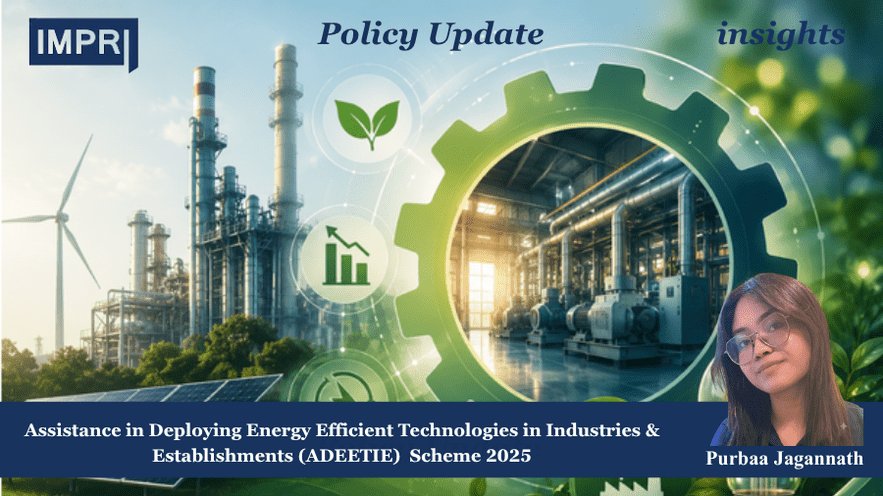
This gap was the very thing that the Ministry of Power aimed to fill with the Assistance in Deploying Energy Efficient Technologies in Industries & Establishments (ADEETIE) scheme. The scheme was announced in the later part of 2024 and was officially launched on 15 July 2025 by Shri Manohar Lal Khattar, the Union Minister for Power and Housing & Urban Affairs, at a national roll-out event in Panipat, Haryana.
ADEETIE is a Central Sector Scheme of BEE with a total outlay of ₹1,000 crore for three financial years (2025-26 to 2027-28). The scheme aims to achieve its industrial goal; however, it is also linked to the broader vision of India’s climate promises – such as the National Determined Contribution (NDC) target of emission intensity reduction of 45 per cent by 2030, the government’s long-term pledge of ‘Net Zero’ by 2070 and its overall ‘Viksit Bharat @2047’ agenda of developing a globally competitive industrial base.
Functioning
There are three interconnected pillars of support for ADEETIE:
- The first is financial: where loans are taken from banks or financial institutions, and the project adopts energy efficient technology, the interest rate can be compensated by a subsidy of 5 per cent for a Micro and Small Enterprise, and 3 per cent for a Medium Enterprise on loans between ₹10 lakh and ₹15 crore, up to 75 per cent of the loan for the project would be eligible for such subsidy.
- In addition, the second pillar is technical handholding provided by BEE through Investment Grade Energy Audits (IGEA) and Detailed Project Reports (DPRs) prepared by BEE empanelled Certified and Accredited Energy Auditors, for which BEE reimburses the auditors up to ₹1 lakh per IGEA based DPR after the project is approved by a lending institution. Post-implementation Monitoring and Verification (M&V) is funded from BEE’s internal resources and ensures that a project has demonstrated and maintained at least 10 per cent energy savings required by the scheme before the annual interest subvention is released, and that it has met the requirements to achieve this objective.
The governance of the scheme is vested in BEE under the Ministry of Power, with a Project Management Unit with a maximum fee of 2 per cent of the ₹925 crore outlay, while the Technical Committee, which includes the Central Nodal Agency and a director from the Ministry of Power, has to approve DPRs for financing and also receive M&V reports.
As far as reach is concerned, at present, the scheme is open for Udyam-registered MSMEs in 60 notified industrial clusters across 14 energy-intensive sectors including leather, paper, pharmaceuticals, steel re-rolling, textiles, forging, foundry, glass and refractory, bricks, ceramics, chemicals, food processing, and in addition, BEE allows MSMEs within 200 km of a notified cluster boundary to apply for the scheme. Phase II will be rolled out to another 100 clusters. A total of ₹1,000 crore of this disbursement has been allocated for interest subvention, energy audits and technical handholding, and a separate web portal ADEETIE has been set up to enable MSME units to register, and lenders to update loan sanction and disbursement status.
Performance
ADEETIE is in the nascent stage of implementation, and BEE has not yet provided cluster-wise information of the number of MSMEs financed/written off under the scheme, about a year after its formal launch. It is noted that some interest subvention and modernisation support is available at the state-level informally, such as MSME clusters in Chittoor and Visakhapatnam in the state of Andhra Pradesh, but a national picture is yet to be available.
The scale for which the government aims is suggested by its own estimates: The ₹1,000 crore public expenditure is projected to trigger around ₹9,000 crore in investments, including ₹6,750 crore in investment by MSMEs, which equates to a leveraging of approximately nine times the public investment, and selected technologies are expected to reduce energy consumption by 30–50 per cent in the units that invest.
ADEETIE, which is significantly less costly but broadly follows a similar market-based approach of audit, project financing and proven energy savings, is taking a similar approach to a part of industry that PAT was not intended to address.
| Component of Outlay | Amount (₹ crore) | Share |
| Interest subvention on MSME loans | 875 | 87.5% |
| Investment Grade Energy Audits and DPR support | 50 | 5% |
| Technical handholding and capacity building | 75 | 7.5% |
| Total outlay (FY 2025-26 to FY 2027-28) | 1,000 | 100% |
Table 1: Budgetary Break-up of the ADEETIE Scheme (2025-26 to 2027-28). Source: Author’s compilation based on Ministry of Power and Bureau of Energy Efficiency scheme documents, 2025.
Impact
While it’s too early to assess the macroeconomic impact of ADEETIE, there are reasonably direct pathways through which it is supposed to operate. The benefits of subsidised credit and free technical support is designed to reduce the additional burden on the MSMEs to upgrade machinery due to high and increasing power tariffs and make them more competitive. Energy intensity improvements could also, over time, affect trade competitiveness at the sectoral level, for several of the fourteen industries covered by this study, as more of these industries are subject to increased carbon-related scrutiny in export markets, such as the European Union. Even small scaled up across 60, and then 160, clusters would incrementally contribute to India’s overall emissions-intensity goals.
The design of the scheme also imposes real limits on the speed and extent of the benefits that can be realised. In fact, many of the micro enterprises do not have knowledge about the process of DPR preparation or not engage certified energy auditors and highly rely on informal credit relationship rather than institutional credit relationship. The interest subvention is only provided after a loan is sanctioned and, in order to cover the costs of IGEA and DPR, financial weaker units may be reluctant to invest in an energy audit and project report before they receive any benefit from the interest subsidy.
Emerging Issues
Some structural problems have already emerged at this preliminary stage of implementation.
- The first challenge is access and awareness: The cluster and sector-based approach of the scheme excludes MSMEs outside the 60 notified clusters and those in unlisted sectors, and with BEE’s 200 km radius relaxation, smaller town units and units in regions like the Northeast are in danger of being excluded.
- Secondly, reliance on formal credit: The interest subvention is linked to a sanctioned bank loan or financial institution’s loan, meaning MSMEs who may be the most in need those who cannot access credit due to collateral or lack of credit history may not be able to access the scheme.
- Third, the scheme relies on a small group of BEE-certified and accredited Energy Auditors for conducting IGEAs and preparing DPRs in all 60 (and eventually 160) clusters, which may lead to a shortage of auditors as the scheme becomes more popular.
- Fourth, projects have to achieve at least 10 per cent savings in their energy use under the scheme throughout its duration and continue to do so to benefit from annual subventions, which means that capacity to monitor and verify is important not to formalize or delay disbursements.
- Fifth, ADEETIE will have to work with other existing credit and guarantee schemes for MSMEs like Credit Guarantee Fund Trust for Micro and Small Enterprises, and the processes of coordination between BEE, lending institutions and industry departments in the states will have to be streamlined so that MSMEs are not left to wade through multiple overlapping portals and eligibility requirements.
Way Forward
With ADEETIE entering in its next phase 100 more clusters the programme needs to be given a boost of active outreach to MSMEs in unclustered areas in the hill and Northeastern regions to ensure that eligibility does not become geographically skewed towards the already industrialised belts. The cluster-wise details of the applications, disbursement of loans and the verified energy savings on the ADEETIE portal will empower researchers, industry associations and Parliament to know the true extent of the scheme and the same is also open to criticism for inadequate transparency as per the earlier PAT scheme.
The government may be able to attend the upfront-cost barrier of micro enterprises by partially or advance supporting IGEA and DPR costs before loan sanction, instead of reimbursement once the loan is sanctioned. With greater growth and diversification in the number of certified energy auditors especially beyond the metropolitan centres where the bulk of these companies currently operate to avoid implementation bottlenecks with increasing number of clusters.
In addition, making the scheme more explicit with export competitiveness considerations, particularly for carbon-exposed industries like leather and textiles, where new trade measures like the Carbon Border Adjustment Mechanism by the European Union (EU) are emerging, and promoting case studies and early positive returns by MSMEs could help build and maintain momentum and commitment towards the remainder of the scheme’s three-year implementation.
Selected References and Important Links
Ministry of Power (2025), Union Minister for Power and Housing & Urban Affairs, Shri Manohar Lal launches ADEETIE Scheme to Accelerate Industrial Energy Efficiency in India, Press Information Bureau, Government of India. Available at: https://www.pib.gov.in/PressReleasePage.aspx?PRID=2144822
Bureau of Energy Efficiency (2025), ADEETIE Scheme, Ministry of Power, Government of India. Available at: https://www.beeindia.gov.in/show_content.php?lang=1&level=1&ls_id=234&lid=384
Bureau of Energy Efficiency (2025), ADEETIE Scheme Portal. Available at: https://adeetie.beeindia.gov.in/
Drishti IAS (2025), ADEETIE Scheme to Boost Industrial Energy Efficiency. Available at: https://www.drishtiias.com/daily-updates/daily-news-analysis/adeetie-scheme-to-boost-industrial-energy-efficiency
Council for Leather Exports (2025), Operational Guidelines of ADEETIE (Assistance for Deploying Energy Efficient Technologies in Industries and Establishments). Available at: https://leatherindia.org/wp-content/uploads/2025/06/Operational-Guidelines-ADEETIE.pdf
IMPRI Insights (2025), Bureau of Energy Efficiency (BEE) (2002), IMPRI Impact and Policy Research Institute. Available at: https://www.impriindia.com/insights/policy-update/bureau-of-energy-efficiency-bee-2002/
MSME Sampark (2025), Power Ministry Launches ₹1,000-Cr ADEETIE Scheme to Boost Energy Efficiency in MSMEs. Available at: https://msmesampark.com/power-ministry-launches-%E2%82%B91000%E2%80%91cr-adeetie-scheme-to-boost-energy-efficiency-in-msmes/
About the Contributor
Purbaa Jagannath is an intern with IMPRI, currently pursuing her Master’s in Social Work at the Tata Institute of Social Sciences, Mumbai. Her research interests lie in social science, governance, and social issues.
Acknowledgement
The author extends sincere gratitude to the IMPRI team for their guidance and support, along with the reviewers Ayan Bordoloi and Ambika Sharma for their valuable feedback and insights.
Disclaimer: All views expressed in the article belong solely to the author and not necessarily to the organization.
Read more at IMPRI:
India-Singapore Green Economy Partnership: From Climate Cooperation to Sustainable Growth
Rashtriya Gokul Mission (2014): Revitalising India’s Indigenous Cattle Economy