








Policy Update
Shruti Chandra
Background
Agriculture remains the prime pulse of the Indian economy, forming the foundation of India’s socio-economic development. The Agriculture and Allied Sector accounts for around 18% of the total Gross Value Added (GVA) [as per the new GDP series with the base year 2022-23] and employs ~ 46% of the workforce. However, despite its critical contribution to the economy, Indian agriculture continues to face structural challenges including low productivity, fragmented landholdings, climate vulnerabilities, market inefficiencies, limited value addition and a high incidence of disguised unemployment.
Recognising the need for a transformative shift, the Government of India has prioritised measures to enhance agricultural productivity, promote diversification, strengthen value chains, improve farmers’ access to technology and markets, and support the broader objective of doubling farmers’ income. In this transition, innovation has emerged as a key driver for building a more efficient, resilient and sustainable agricultural ecosystem.
At a time when India has emerged as the world’s third-largest start-up ecosystem, there is a growing recognition of the need to channel this entrepreneurial energy towards agriculture. Agri-start-ups are increasingly emerging as drivers of technological transformation, developing innovative solutions in areas such as precision farming, digital agriculture, supply-chain optimisation, farm mechanisation and climate-resilient technologies. These enterprises hold the potential to create new avenues for sustainable growth in the sector.
The Government of India has progressively strengthened the agricultural innovation ecosystem through multiple initiatives. The Startup India initiative marked the beginning of a supportive start-up ecosystem by providing regulatory, tax exemptions and ecosystem support to recognised start-ups. Subsequently, the Innovation and Agri-Entrepreneurship Development Programme under the Rashtriya Krishi Vikas Yojana – Remunerative Approaches for Agriculture and Allied Sector Rejuvenation (RKVY-RAFTAAR) strengthened incubation and pre-seed/seed funding for agri-start-ups. The Agriculture Accelerator Fund announced in the Union Budget 2023-24 also encouraged agri start-ups founded by young entrepreneurs in rural areas.
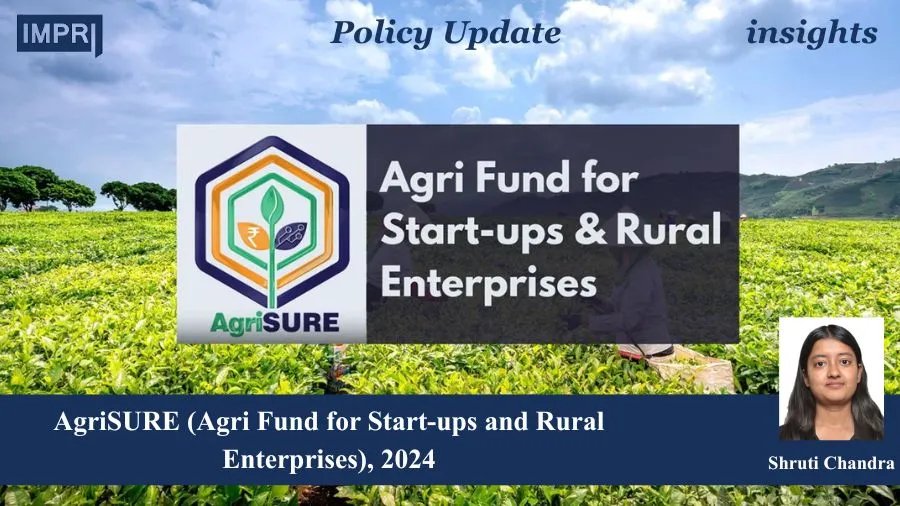
Adding a new dimension to India’s agri-start-up ecosystem, AgriSURE (Agri Fund for Start-ups & Rural Enterprises) Scheme was introduced in 2024 to broaden access to long-term institutional capital and catalyse private investment in agri-enterprises. It is a Central Sector Fund launched under the Ministry of Agriculture & Farmers Welfare to strengthen the agri-innovation and rural enterprise ecosystem by improving access to institutional capital for start-ups.
Functioning
The Fund is implemented through the National Bank for Agriculture and Rural Development (NABARD) and is registered as a Category-II Alternative Investment Fund (AIF) with the Securities and Exchange Board of India (SEBI)
AgriSURE has been designed with an operational tenure of 10 years, extendable by two or more years, to provide long-term financial support to emerging agricultural enterprises. Its investment framework covers sector-specific AIFs, sector-agnostic AIFs, debt AIFs and direct equity investments in start-ups. AgriSURE Fund aims to support approximately 85 start-ups with investments of up to ₹25 crore per start-up, enabling innovation, entrepreneurship and technology-led transformation across the agricultural value chain.
The Fund has a total corpus of ₹750 crore, structured through a blended capital model. The Government of India and NABARD each contribute ₹250 crore, while the remaining ₹250 crore is proposed to be mobilised from other institutional sources, including private investors. The Fund is managed by NABVENTURES, a wholly-owned subsidiary of NABARD, which functions as the fund manager.
To ensure a diversified investment approach, AgriSURE operates through two complementary components – the Fund of Funds (FoF) Scheme which channels capital through professionally managed AIFs and the Direct Scheme which provides direct equity support to eligible early-stage start-ups.
| Component | AgriSURE – Fund of Funds (FoF) Scheme | AgriSURE – Direct Scheme |
| Total Corpus | ₹450 crore | ₹300 crore |
| Investment Approach | Invests in SEBI-registered Alternative Investment Funds (AIFs), including sector-agnostic, sector-specific, and debt AIFs | Direct investment in early-stage start-ups |
| Target Entities | Category I and Category II AIFs that invest in start-ups operating in identified priority sectors | Start-ups that are recognised by the Department for Promotion of Industry and Internal Trade (DPIIT) and incorporated in India |
| Investment Limit | Investment in a single AIF is capped at 5% of the total corpus of the AIF or ₹25 crore, whichever is lower | Investment of up to ₹25 crore in a single start-up, subject to compliance with applicable AIF Regulations |
| Purpose | To channel institutional capital towards AIFs that support innovative start-ups in preferred sectors | To provide growth capital directly to promising early-stage agri-start-ups and enable their expansion |
(Source: content compiled from NABVENTURES)
Potential Impact
- Promoting Youth Entrepreneurship in Agriculture
AgriSURE can encourage a new generation of agripreneurs by creating opportunities for young innovators to develop technology-based solutions in agriculture. By supporting approximately 85 start-ups, the Fund can enable youth participation in areas such as agritech, food processing, farm mechanisation, supply-chain management and climate-smart agriculture, shifting agriculture from a traditional livelihood activity towards an entrepreneurship-driven sector.
- Enhancing Agricultural Productivity through Technology
India’s agricultural sector exhibits a substantial gap between labour absorption (46%) and economic output (18% of GVA), reflecting low productivity. Investment in agri-startups can accelerate the adoption of precision agriculture, artificial intelligence, digital platforms, biotechnology and smart farm solutions, improving resource-use efficiency and addressing productivity constraints.
- Overcoming Disguised Unemployment through Diversification of Rural Economy
Agri-startups can shift surplus agricultural labour to agri-services and allied activities, reducing excessive dependence on farming and improving income opportunities for rural workers.
- Crowding-in Private Investment
Through its blended capital model, AgriSURE can create a demonstration effect for private investors, reducing perceived risks in agricultural ventures and encouraging greater flow of venture capital into the rural economy.
- Export Competitiveness: India’s agricultural exports stood at nearly US$51.1 billion in FY25 (Economic Survey 2025-26), the country’s growing integration with global agri-food markets. AgriSURE can enable start-ups to drive value addition, improve quality standards, strengthen traceability, thereby reinforcing India’s aspiration to emerge as the world’s food basket.
- Climate Resilience: Rainfed agriculture accounts for ~ 58% of cultivated area (NITI Aayog Composite Water Management Index) making it highly vulnerable to climate risks. The Economic Survey 2017-18 estimated that climate change could reduce farm incomes by 15-18%, rising to 20-25% in unirrigated areas. AgriSURE can provide a push for sustainable agriculture by directing capital towards climate-smart innovations, resource-efficient technologies and resilient farming models that balance productivity with long-term ecological sustainability.
Potential Challenges
- Last-Mile Adoption Challenge: Around 86% of India’s farmers are small and marginal farmers (Agriculture Census 2015-16), making affordability and accessibility of start-up solutions a key challenge.
- Investment Risk: Agriculture contributes around 18% to India’s GVA while supporting nearly 46% of the workforce, reflecting productivity and income uncertainties that can make agricultural investments riskier.
- Digital Divide: Limited digital literacy and uneven digital access among farmers may limit access.
- Awareness Deficit: NABARD’s Department of Economic Analysis and Research, 2023 research study found that awareness of flagship schemes stood at 58% for the Kisan Credit Card (KCC) scheme and around 50% for the Pradhan Mantri Fasal Bima Yojana (PMFBY). The findings highlight that agricultural transformation requires not only greater investment but also stronger last-mile outreach and awareness campaigns.
- R&D Ecosystem : Limited investment in agricultural research, technology commercialisation and industry – academia collaboration may constrain the pipeline of high-quality agri-start-ups.
- Monitoring and Outcome Assessment : Continuous monitoring will be essential to minimise fund diversion, improve transparency and maximise the developmental impact of AgriSURE.
Way Forward
AgriSURE should focus on building a complete agricultural innovation ecosystem rather than functioning only as a financing mechanism. Strong backward and forward linkages must be created across the agricultural value chain by connecting start-ups with quality inputs, farm machinery, extension services, Farmer Producer Organisations (FPOs), processors, warehouses, cold-chain networks, exporters and organised markets.
Greater collaboration among agricultural universities, ICAR institutions, incubators and financial institutions can accelerate the conversion of research into commercially viable agri-solutions.
Additionally, performance-linked incentives may be introduced to encourage innovation, scalability and greater developmental impact. State co-investment models can further leverage additional capital while enabling investments to better reflect region-specific agricultural priorities.
However, innovation alone will not be sufficient unless it reaches the intended beneficiaries. Therefore, strengthening awareness through targeted outreach programmes and extension services will be equally important. A robust independent monitoring framework will be required to ensure efficient fund utilisation, prevent diversion of resources and enhance accountability. Ultimately, India’s vision of Viksit Bharat@2047 cannot be realised unless agriculture is empowered to lead the country’s next phase of inclusive growth.
References
National Bank for Agriculture and Rural Development (NABARD). AgriSURE Fund https://share.google/9MrnFzNdnSURNA8xX
NABVENTURES. About AgriSURE https://nabventures.in/agrisure.aspx
Press Information Bureau (PIB). (2024, September 3). Union Agriculture Minister Shri Shivraj Singh Chouhan Launches AgriSURE Fund. Ministry of Agriculture & Farmers Welfare https://www.pib.gov.in/PressReleasePage.aspx?PRID=2051466®=48&lang=2
Department of Economic Analysis and Research (2023). Assessing the state of affairs in Indian agriculture with a focus on credit & insurance and storage & marketing (Research Study No. 41, Chapter 5). NABARD. https://www.nabard.org/about-departments.aspx?id=5&cid=463
Press Information Bureau. (2026, March 26). India’s Resilient Production Systems in Agriculture. Government of India. https://share.google/O6DQ7mZTocWEJL3Db
About The Contributor
Shruti Chandra is a Research & Editorial Intern at IMPRI. She holds a B.A. (Hons) degree in Sociology from Delhi University and is currently pursuing a Master’s in Sociology. Her areas of academic interests include social and environmental justice, gender studies, social stratification, rural development and public policy.
Acknowledgement
Sincere gratitude is extended to the IMPRI team for their guidance and support and to the reviewers Shruti Sethi and Arya Gupta for their feedback.
Disclaimer
All views expressed in the article belong solely to the author and not necessarily to the organization.
Read More at IMPRI
Partnership Or Promise? The India–France Joint Statement As A Legal Instrument
The India-France Horizon 2047 Roadmap (2023) And The Future Of Bilateral Cooperation