








Policy Update
Shivani Khanna
India’s large young population offers considerable potential for economic growth. However, ensuring that young people can find suitable employment remains a challenge. Many graduates and trained individuals struggle to secure jobs that match their qualifications, while employers in certain industries face difficulties finding workers with the skills they require. This situation points towards a gap between the education and training received by jobseekers and the actual needs of the labour market.
The Periodic Labour Force Survey (PLFS) 2023–24 recorded a youth unemployment rate of 10.2% among individuals aged 15–29. The labour force participation rate for people aged 15 and above stood at 60.1% (Ministry of Statistics and Programme Implementation \[MoSPI\], 2024). Although these figures provide an understanding of overall employment conditions, they do not explain which occupations have an insufficient supply of suitably qualified workers.
The India Employment Report 2024, published by the International Labour Organization (ILO) and the Institute for Human Development (IHD), also draws attention to youth employment challenges, skill mismatches and the changing requirements of the workplace. It highlights the importance of making education and vocational training more relevant to employment opportunities (ILO & IHD, 2024).
India has already introduced initiatives such as the National Career Service (NCS), which connects jobseekers with employers, and Skill India programmes, which promote vocational training. However, information about available jobs, employer requirements and the skills possessed by workers is spread across different platforms.
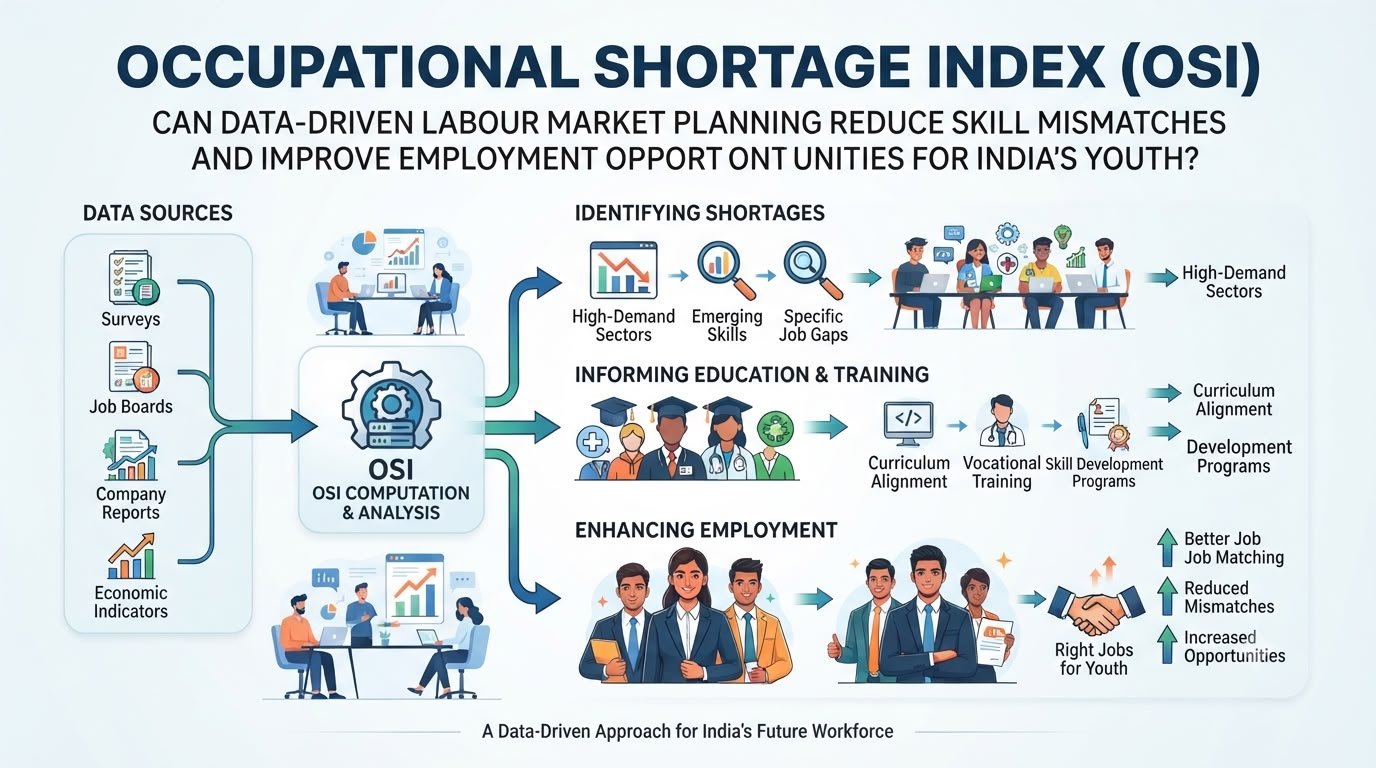
A more coordinated approach could help address this gap. This article proposes an Occupational Shortage Index (OSI), a framework that would examine the relationship between the demand for workers in particular occupations and the availability of individuals with the necessary skills. It is a proposed policy framework, not an existing government initiative. Its objective would be to help young people, employers, educational institutions and policymakers make decisions based on clearer labour-market information.
Functioning
The proposed OSI could be developed by bringing together information from existing government databases and industry sources. These could include PLFS, the NCS Portal, apprenticeship records, skill-development programmes, Sector Skill Councils and surveys conducted among employers. Using multiple sources would provide a more complete picture of occupational demand than relying only on job advertisements.
The framework could assess several indicators, including the number of verified vacancies, the availability of qualified jobseekers, the time employers take to recruit workers, wage trends and the skills required for particular positions. Considering these factors together would help distinguish genuine shortages from situations where vacancies remain unfilled for other reasons.
Based on the findings, occupations could be divided into three categories:
* Shortage occupations: Fields where employers require more suitably qualified workers than are currently available.
* Balanced occupations: Fields where the availability of qualified workers is broadly in line with employment demand.
* Surplus occupations: Fields where the number of qualified jobseekers is greater than the available employment opportunities.
The Ministry of Labour and Employment could coordinate the proposed framework in collaboration with the Ministry of Skill Development and Entrepreneurship, the Directorate General of Employment, state skill missions, employers and Sector Skill Councils.
The findings could be presented through national, state and district-level reports or a digital dashboard. District Skill Committees could use this information while preparing their skill-development plans. Regular updates, common occupational classifications and verification by employers would be essential to ensure that the index remains reliable.
Performance
Since the OSI is only a proposed framework, it has no implementation record or measurable programme outcomes at present. Its relevance can instead be understood by examining existing labour-market institutions and the information they provide.
According to PLFS 2023–24, the overall unemployment rate among individuals aged 15 and above was 3.2% under the usual-status measure. Youth unemployment stood at 10.2% for those aged 15–29, while the female labour force participation rate was 41.7% (MoSPI, 2024). These indicators help explain broader employment trends, but they do not establish whether particular occupations have enough qualified workers.
The National Career Service Portal provides another important source of information. A Ministry of Labour and Employment release dated 5 August 2026 reported that more than 10.05 crore vacancies had been mobilised through the portal since its inception. It also recorded 2.89 crore active registered jobseekers and 17.68 lakh active vacancies as of 15 July 2026 (Ministry of Labour and Employment, 2026). However, these figures represent portal activity and should not be interpreted as the number of people who have actually secured employment.
The Parliamentary Standing Committee on Labour, Textiles and Skill Development has also emphasised the need for more reliable employment information. Its Fifteenth Report highlights the importance of tracking actual placements, checking the authenticity of vacancies and improving the reporting of employment outcomes. This distinction is important because registering a vacancy does not necessarily mean that a position has been filled (Standing Committee on Labour, Textiles and Skill Development, 2026).
The Economic Survey 2024–25 provides additional information about the occupational skill composition of India’s workforce. It reports that 88.2% of workers were in low-competency occupations, 9.3% in specialised occupations and 2.5% in high-competency occupations (Ministry of Finance, 2025). However, this distribution is not direct evidence of labour shortages. It describes the skill composition of the existing workforce; it does not establish whether employers are unable to recruit qualified workers for particular occupations. Nevertheless, it underlines the importance of examining whether workers’ skills are aligned with changing industry requirements.
Overall, existing systems provide useful information, but a more integrated approach could help connect occupational demand, available skills and actual employment outcomes.
Impact
If introduced effectively, the OSI could make career planning more informed and help young people understand which occupations offer growing opportunities. Students and graduates could use its findings to identify relevant courses, acquire additional skills and make better decisions about their professional choices.
Educational institutions and training providers could also benefit. Information about emerging shortages would help them identify gaps in their existing programmes and update course content according to industry requirements. Stronger coordination with employers could further improve apprenticeship and practical training opportunities.
For businesses, the framework could provide a clearer understanding of the availability of skilled workers across different regions. Policymakers could use the findings to identify areas requiring additional training facilities and develop employment strategies suited to local economic conditions.
However, the OSI would have limitations. A shortage of qualified applicants does not automatically mean that more jobs will be created. Vacancies may remain unfilled because of low wages, poor working conditions, geographical difficulties or unsuitable working hours. Therefore, the index should support wider employment policies rather than be treated as an independent solution to unemployment.
Emerging Issues
Several concerns would need attention while developing the proposed framework.
Fragmented information: Labour-market data is maintained by different institutions, often using different reporting methods and occupational classifications. Bringing these sources together would require common standards and clearly assigned responsibilities.
Informal employment: A considerable share of India’s workforce operates outside formal employment arrangements. NITI Aayog’s 2025 report highlights the scale of informal employment in the country. Workers and employers who do not use formal recruitment platforms may therefore remain underrepresented in the information used by the OSI (NITI Aayog, 2025).
Regional and social differences: Employment requirements vary across states and districts. Women, persons with disabilities and disadvantaged communities may also face difficulties accessing training, suitable workplaces and employment information. These differences should be considered while interpreting the index’s findings.
Technological developments: Artificial intelligence, automation, digitalisation and the transition towards cleaner energy are changing the nature of work. Some occupations may require entirely new skills, while the demand for others may decline. The OSI would therefore need frequent updates to remain relevant.
Accuracy of vacancy information: Job advertisements may be duplicated, outdated or unclear about the qualifications required. Without proper verification, the framework could produce misleading estimates of occupational shortages and surpluses.
Way Forward
The first priority should be to establish a clear and standardised method for calculating the OSI. The Ministry of Labour and Employment, working with the Ministry of Skill Development and Entrepreneurship and state governments, could define common occupational categories and indicators. These may include verified vacancies, the number of suitably qualified jobseekers, recruitment time and changes in employer requirements. It would also be important to distinguish genuine skill shortages from vacancies that remain unfilled because of low wages, unsuitable working conditions or geographical barriers. Making the methodology publicly available would allow researchers, employers and policymakers to understand and assess the results.
The next step should be to improve coordination between existing information systems. Data from PLFS, NCS, apprenticeship databases, skill-development programmes and employer surveys could be connected wherever legally and technically possible. This would reduce duplication and avoid creating an entirely separate data collection structure. The framework should clearly distinguish between vacancies advertised by employers, vacancies verified as genuine, positions successfully filled and those that remain unoccupied. Such distinctions would make shortage estimates more dependable.
State governments and District Skill Committees should also be involved in identifying local workforce requirements. They could consult businesses, industry associations, colleges and training institutions to understand the skills needed in their respective regions. This would help ensure that national assessments do not overlook differences between industrial centres, smaller towns and rural areas. The framework should also consider informal employment and barriers faced by women, persons with disabilities and other underrepresented groups.
Before nationwide implementation, the OSI could be tested through pilot projects in selected states such as Maharashtra, Tamil Nadu and Uttar Pradesh. Initial assessments could focus on sectors including manufacturing, healthcare, construction and information technology. These pilots would help determine whether the selected indicators accurately identify shortages and whether the available data is sufficiently reliable. The experience gained could then be used to improve the methodology before expanding the framework.
Finally, the success of the OSI should be measured through actual employment outcomes rather than the number of vacancies recorded. Indicators such as successful placements, time taken to fill positions, employee retention, wage progression and the match between workers’ skills and job requirements could be used for evaluation. Independent reviews should be conducted regularly to identify shortcomings and update occupational classifications as economic conditions change. A publicly accessible dashboard could make the findings useful to students, jobseekers, employers and government agencies.
References
- International Labour Organization & Institute for Human Development. (2024). India employment report 2024: Youth employment, education and skills. International Labour Organization. [https://www.ilo.org/publications/india-employment-report-2024-youth-employment-education-and-skills
- Ministry of Finance. (2025). Economic Survey 2024–25, Chapter 12: Employment and skill development. Government of India. https://www.indiabudget.gov.in/budget2025-26/economicsurvey/doc/eschapter/echap12.pdf
- Ministry of Labour and Employment. (2026, August 5). National Career Service Portal mobilizes over 10.05 crore vacancies since inception. Press Information Bureau, Government of India. https://www.pib.gov.in/PressReleasePage.aspx?PRID=2294658
- Ministry of Statistics and Programme Implementation. (2024). Periodic Labour Force Survey: Annual report, July 2023–June 2024. Government of India. https://mospi.gov.in/sites/default/files/publication_reports/AnnualReport_PLFS2023-24L2.pdf
- NITI Aayog. (2025). India’s services sector: Insights from employment trends and state-level dynamics. Government of India. https://www.niti.gov.in/node/2028
- Standing Committee on Labour, Textiles and Skill Development. (2026). Fifteenth report: Demands for grants (2026–27), Ministry of Labour and Employment. Lok Sabha Secretariat. https://sansad.in/getFile/app/lsscommittee/Labour%2C%20Textiles%20and%20Skill%20Development/18_Labour_Textiles_and_Skill_Development_15.pdf?source=app
About the Contributor
Shivani Khanna is a second-year undergraduate student pursuing a BSc (Hons) Economics from the London school of economics. Her interests include public policy, labour economics, employment generation and economic development in India.
Disclaimer and Acknowledgements (Reviewers)
Disclaimer: The views and opinions expressed in this article are those of the author and do not necessarily represent the views of IMPRI or any institution with which the author is affiliated. The Occupational Shortage Index discussed in this article is a proposed policy framework and does not represent an existing government initiative.
Acknowledgements: The author sincerely thanks Aditi Bhuiyan and Aditya Chavan for reviewing the article and sharing their valuable comments and suggestions. Their feedback helped improve the organisation, clarity and overall presentation of the article.