







Policy Update
Shailja Singh
Background
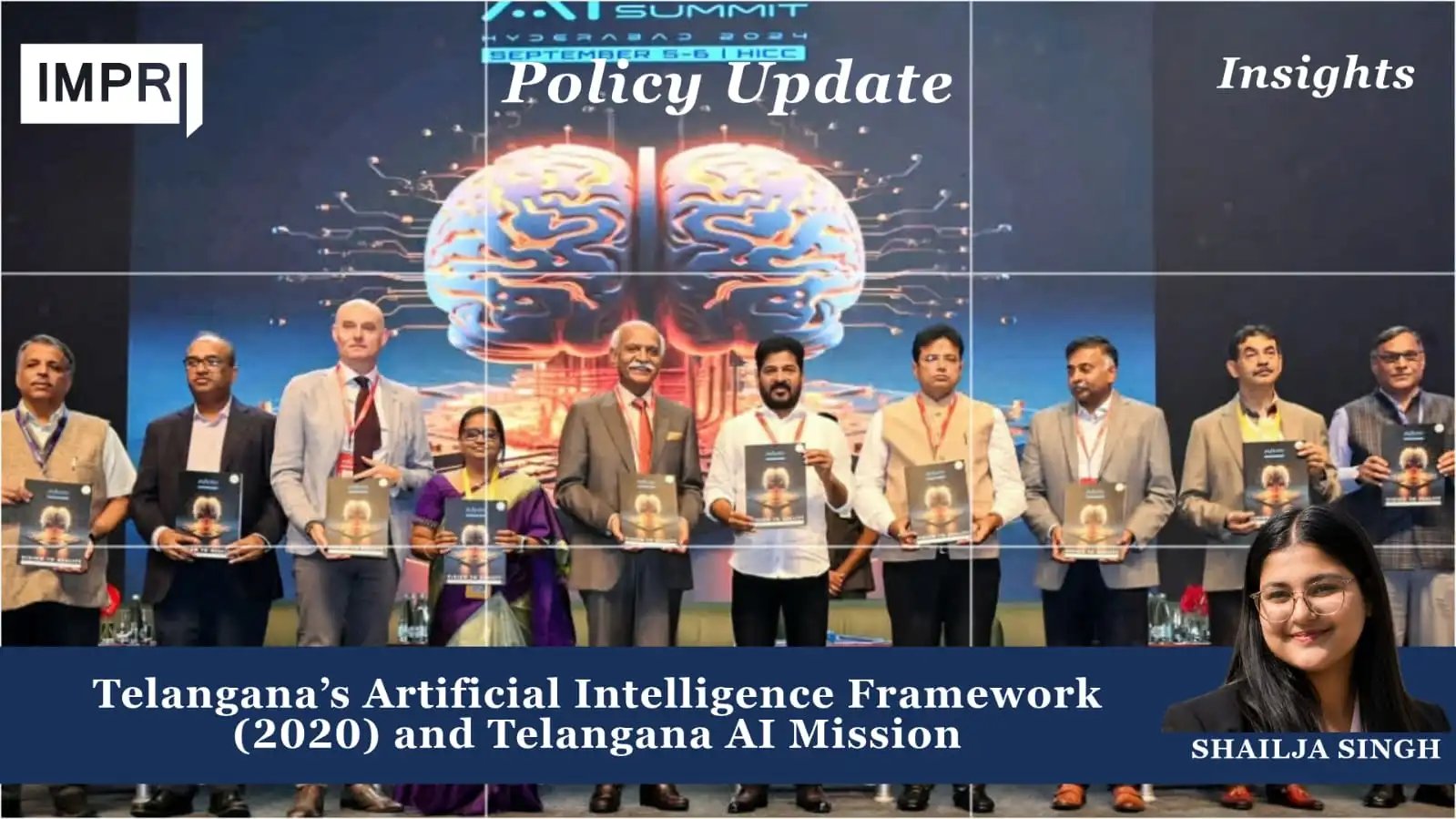
Telangana emerged as one of India’s early state-level adopters of artificial intelligence (AI) with the launch of its Artificial Intelligence Framework in June 2020. The initiative formed part of the state’s broader effort to strengthen its position in the information technology sector and prepare its economy for the growing influence of emerging technologies. Recognising AI’s potential in areas such as healthcare, agriculture, education, mobility and public administration, the Government of Telangana declared 2020 as the ‘Year of AI’ and introduced a framework to promote innovation while encouraging the responsible use of technology (Government of Telangana, 2020).
The framework aimed to establish Telangana as a global hub for artificial intelligence while using technological innovation to address social and developmental challenges. It also reflected the state’s ambition to integrate AI into its existing IT ecosystem and encourage collaboration between government departments, startups, academic institutions, researchers and private companies. One of its stated ambitions was to increase AI’s contribution to the state’s IT exports (Government of Telangana, 2020).
To coordinate the implementation of this vision, the government established the Telangana AI Mission (T-AIM) in partnership with NASSCOM. T-AIM was designed to support AI-based entrepreneurship, research, innovation and industry collaboration. Rather than functioning as an independent regulatory authority, it serves as an institutional mechanism for advancing the objectives of the state’s AI framework (Government of Telangana, 2020; Government of Telangana, 2023).
The framework identifies five major application areas: healthcare, agriculture, mobility, education and law enforcement. It also emphasises improving citizen service delivery through AI-enabled solutions. Its intended beneficiaries include technology startups, students, researchers, businesses, government departments and citizens (Government of Telangana, 2020).
Functioning
The Telangana Artificial Intelligence Framework (2020) is structured around six interconnected pillars:
- Data Exchange Platform and High-Performance AI Computing (HPAIC): The framework recognises access to quality datasets and computing infrastructure as essential for AI development. It proposes making relevant government datasets accessible to researchers, startups and academic institutions while encouraging partnerships with private organisations.
- Skilling and Education: The framework promotes AI awareness, specialised training, university partnerships and industry-oriented learning. It envisages introducing AI-related courses and micro-credentials to improve the employability of students and professionals.
- Governance, Ethics and Privacy: It recognises the importance of transparency, accountability, fairness, privacy and data security. The framework proposes an AI Ethics Group to develop sector-specific guidelines and encourage responsible deployment.
- Research and Innovation: Collaboration between academic institutions, research organisations, startups and industry is encouraged to develop practical AI applications addressing local problems.
- Enabling Adoption and Community Collaboration: The government seeks to promote AI adoption across sectors through partnerships, innovation challenges and the participation of different stakeholders.
- AI-Investment Fund: The proposed fund aims to support startups and projects using AI for social good, particularly those addressing developmental challenges and meeting environmental, social and governance considerations (Government of Telangana, 2020, pp. 8–13).
T-AIM operationalises these objectives through initiatives such as Revv Up, an acceleration programme for early-stage AI startups. The programme provides mentoring, industry connections and business development support without taking equity from participating startups. Its Grand Challenges initiative also encourages entrepreneurs and researchers to develop solutions for specific public-sector problems. The ITE&C Department’s Annual Report 2022–23 records four such challenges, covering areas including wildlife monitoring, pothole identification, digital banking, heatwave prediction and air-quality assessment in Tier-II cities (Government of Telangana, 2023, pp. 38–39).
The framework’s functioning is supported by the Information Technology, Electronics and Communications (ITE&C) Department and the state’s wider innovation ecosystem, including T-Hub, academic institutions and industry partners. This institutional arrangement allows the government to connect policy objectives with startup development, research and practical applications (Government of Telangana, 2023).
Performance
The performance of Telangana’s AI initiatives can be assessed through startup acceleration, technological infrastructure, skill development and the adoption of AI in public-service sectors.
Startup development and innovation: According to the ITE&C Department’s Annual Report 2022–23, T-AIM’s Revv Up programme was supporting 142 AI startups across three cohorts, including 62 startups in its third cohort. The programme was designed as a free, no-equity acceleration initiative for early-stage AI enterprises. The same report recorded four Grand Challenges, covering applications such as wildlife monitoring, pothole identification, digital banking and the prediction of heatwaves and air quality in Tier-II cities (Government of Telangana, 2023, pp. 38–39). These figures indicate the scale of institutional support provided to startups, although they do not establish how many participating businesses subsequently achieved commercial success.
Agriculture and rural development: The Artificial Intelligence for Agriculture Innovation (AI4AI) initiative, developed with the World Economic Forum’s Centre for the Fourth Industrial Revolution, supported more than 7,000 chilli-producing farmers during the first season of the Saagu Baagu pilot. The programme used technology-enabled quality testing, soil testing, digital advisories and market linkages to improve agricultural productivity and farmers’ access to markets (World Economic Forum, 2023, 2024).
Healthcare, education and public safety: The state has explored AI-based applications in multiple public-service areas. An AI-based skill enhancement platform was introduced at IIIT Basara in collaboration with MyPerfectice, offering personalised learning recommendations and continuous assessment to students (Government of Telangana, 2023, p. 38). Another initiative, iRASTE, used AI-based collision alerts and road-risk analysis and was deployed on 200 Telangana State Road Transport Corporation (TSRTC) buses. Its assessment recorded 40 per cent fewer accidents involving the AI-enabled buses compared with non-ADAS buses during the April 2023–March 2024 assessment period (INAI, 2024).
Computing infrastructure: In April 2023, T-AIM facilitated agreements between the state government, the Centre for Development of Advanced Computing (C-DAC) and the Indian Institute of Technology Hyderabad. These arrangements enabled startups supported through Revv Up to access high-performance computing infrastructure, including the PARAM SEVA system, at subsidised rates. C-DAC also offered access to its AI computing infrastructure for a specified period, with the benefit to participating startups estimated at ₹10 crore (Centre for Development of Advanced Computing, 2023).
Data infrastructure and ecosystem expansion: On 2 July 2025, the government launched the Telangana Data Exchange (TGDeX), developed by the Emerging Technologies Wing in collaboration with the Japan International Cooperation Agency (JICA), with strategic support from IISc Bengaluru. At launch, the platform reported more than 480 datasets and over 3,000 AI startups integrated into its ecosystem. The government also announced a target of integrating 2,000 datasets over five years and stated that 30 AI-driven projects were under implementation (Invest Telangana, 2025).
These developments indicate progress in building an AI innovation ecosystem. However, startup participation, dataset availability and project announcements should not automatically be treated as evidence of successful commercialisation or improved public-service outcomes. A comprehensive assessment requires information on completed projects, active users, investment mobilised, jobs generated and measurable benefits for citizens.
Impact
The impact of Telangana’s AI initiatives is most visible in areas where measurable changes have been reported, particularly agriculture and road safety. The Saagu Baagu pilot offers an example of how technology-based interventions can influence agricultural productivity and farmers’ earnings.
According to the World Economic Forum, participating chilli farmers recorded a 21 per cent increase in yield per acre, a 9 per cent reduction in pesticide use, a 5 per cent reduction in fertiliser use and an 8 per cent improvement in unit prices due to better produce quality. These changes were associated with an increase of more than ₹66,000 in income per acre per crop cycle, effectively doubling the earnings of participating farmers (World Economic Forum, 2024). These findings suggest that the initiative’s contribution extended beyond introducing digital tools to producing economic benefits for the farmers involved.
A similar outcome is visible in the area of road safety. The iRASTE assessment reported that 200 buses equipped with Advanced Driver Assistance Systems (ADAS) experienced 40 per cent fewer accidents than a comparison group of non-ADAS buses during April 2023–March 2024. The project also identified 60 potential road-risk locations, known as greyspots, across three road corridors and shared the findings with relevant road authorities for corrective action. These results indicate that AI-enabled monitoring can contribute to accident prevention and more informed road-safety planning, although the reported reduction is specific to the assessed buses and period (INAI, 2024).
The impact of T-AIM’s Revv Up programme is reflected primarily in the expansion of institutional support available to early-stage AI startups. The programme’s support for 142 startups across three cohorts and the provision of access to high-performance computing through partnerships with C-DAC and IIT Hyderabad helped address barriers relating to infrastructure costs and technical resources. However, the available reports do not provide consolidated evidence on startup survival, revenue growth, employment generation or the number of businesses that have successfully commercialised their products. Its long-term economic contribution therefore requires further assessment (Government of Telangana, 2023; Centre for Development of Advanced Computing, 2023).
The launch of TGDeX represents progress in developing shared data infrastructure. Its reported collection of more than 480 datasets at launch provides a foundation for collaboration between government departments, researchers and technology enterprises. However, the platform’s wider developmental impact will depend on the extent to which these datasets are actively used to develop applications, improve public services and support evidence-based decision-making. The available launch announcement does not establish such long-term outcomes (Invest Telangana, 2025).
The framework’s emphasis on responsible AI is equally significant. NITI Aayog’s Responsible AI for All approach (2021) highlights the need to address fairness, transparency, accountability, privacy and safety while developing AI systems. Telangana’s inclusion of governance, ethics and privacy as a separate pillar reflects an early recognition of these concerns (Government of Telangana, 2020; NITI Aayog, 2021).
Overall, the available evidence suggests that Telangana’s AI initiatives have produced measurable gains in selected agricultural and road-safety applications while strengthening the institutional and technical support available to startups. However, these outcomes remain concentrated in individual projects. A consolidated assessment of the framework’s overall contribution to employment, investment, public-service efficiency and citizen welfare is still required.
Emerging Issues
- Limited outcome-based evaluation: Publicly available reports largely highlight programme participation and project implementation. The government should publish annual outcome indicators covering startup survival, investment, employment, productivity and citizen benefits.
- Data privacy and security: Greater use of government datasets increases the risks of unauthorised access, misuse and data breaches. Clear data-sharing protocols, independent audits and privacy safeguards are necessary.
- Digital divide: AI-based services may not benefit citizens equally, particularly those in rural areas with limited digital infrastructure, connectivity or digital literacy. Local-language interfaces and accessible offline alternatives should be prioritised.
- Unequal access to computing infrastructure: Smaller startups and academic institutions may continue to face difficulties accessing affordable computing resources. Transparent access arrangements and shared infrastructure facilities can help address this problem.
- Skills and employment challenges: The expansion of AI creates demand for specialised skills while also changing existing employment patterns. Universities, TASK and industry partners should strengthen practical training, reskilling and industry-linked education.
- Ethical and algorithmic accountability: Bias, lack of transparency and errors in automated decision-making can affect citizens, especially in sensitive sectors such as healthcare and law enforcement. Sector-specific standards and human oversight should be mandatory.
- Implementation and coordination: AI initiatives involve several departments and external partners. Clearly defined responsibilities, timelines and monitoring arrangements are necessary to prevent duplication and ensure accountability.
Way Forward
Telangana’s Artificial Intelligence Framework (2020) and T-AIM provide an important foundation for developing a state-level AI ecosystem. Their contribution lies in bringing together innovation, entrepreneurship, research, skill development and public-sector adoption within a common policy vision.
The next phase should focus on moving beyond ecosystem-building announcements towards measurable implementation outcomes. The government should establish a publicly accessible AI performance dashboard covering project completion, startup growth, investment, employment, computing access and sector-wise impact. TGDeX should be expanded with clear data-quality standards, privacy safeguards and transparent access mechanisms.
Greater attention should also be given to the adoption of AI outside Hyderabad, particularly in rural districts and Tier-II cities. Partnerships with universities, local institutions and industry can help develop solutions that respond to regional requirements. In addition, responsible AI guidelines should be translated into enforceable procurement standards, regular audits and accessible grievance-redressal mechanisms.
Ultimately, Telangana’s ambition to become a leading AI destination will depend not simply on attracting technology companies but on making AI accessible, accountable and useful to its people. Linking innovation with inclusive development will be essential to ensuring that artificial intelligence contributes meaningfully to the state’s economic growth and public welfare.
References
Centre for Development of Advanced Computing. (2023, April 12). Telangana AI mission enables start-ups to access AI computing resources. Government of India. https://cdac.gov.in/index.aspx?id=pk_itn_spot1323
Government of Telangana. (2020). Telangana’s Artificial Intelligence Framework. Information Technology, Electronics and Communications Department, Government of Telangana, Hyderabad. https://startup.telangana.gov.in/wp-content/uploads/2021/04/AI-framework.pdf
Government of Telangana. (2023). Information Technology, Electronics and Communications Department Annual Report 2022–23. Government of Telangana, Hyderabad. https://www.nitiforstates.gov.in/public-assets/Policy/policy-repo/additional/PSSNAC000355.pdf
INAI. (2024). Executive summary: iRASTE Telangana. Applied Artificial Intelligence Research Centre, International Institute of Information Technology Hyderabad. https://inai.ai/wp-content/uploads/2024/10/Executive-Summary-iRASTE-Telangana.pdf
Invest Telangana. (2025, July 2). IT and Industries Minister Sri Duddilla Sridhar Babu launched India’s first AI-integrated Telangana Data Exchange (TGDeX) platform at T-Hub. Government of Telangana. https://invest.telangana.gov.in/it-and-industries-minister-sri-duddilla-sridhar-babu-launched-indias-first-ai-integrated-telangana-data-exchange-tgdex-platform-at-t-hub/
NITI Aayog. (2021). Approach document for India: Part 2 – Operationalising principles for responsible AI. Government of India, New Delhi. https://www.niti.gov.in/node/463
World Economic Forum. (2023, July 20). Scaling agritech at the last mile: Converging efforts for farmers’ prosperity. World Economic Forum. https://www.weforum.org/publications/scaling-agritech-at-the-last-mile-converging-efforts-for-farmers-prosperity/
World Economic Forum. (2024, January 11). AI for agriculture: How Indian farmers are harnessing emerging technologies to sustainably increase productivity. World Economic Forum. https://www.weforum.org/agenda/2024/01/how-indias-ai-agriculture-boom-could-inspire-the-world/
About the Contributor
Shailja Singh is a Research Intern at the Impact and Policy Research Institute (IMPRI) and a third-year B.A. (Hons.) Political Science student at Lakshmibai College, University of Delhi. Her areas of interest include public policy, governance, international relations and institutional processes.
Acknowledgement
The author sincerely acknowledges the IMPRI team for their guidance, valuable feedback, and continuous support throughout the preparation of this Policy Update.
Reviewers
Aditi Bhuinyan
Chidaraboyana Shiva Karthik
Disclaimer
This article is intended for academic purposes only. The views expressed are those of the author and do not necessarily reflect the views of IMPRI or any government.
Read more at IMPRI:
Shimla’s Tunnel Crisis: The Conflict Between Infrastructure Development and Human Safety