





Aravind Unni
Shalini Sinha
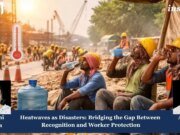
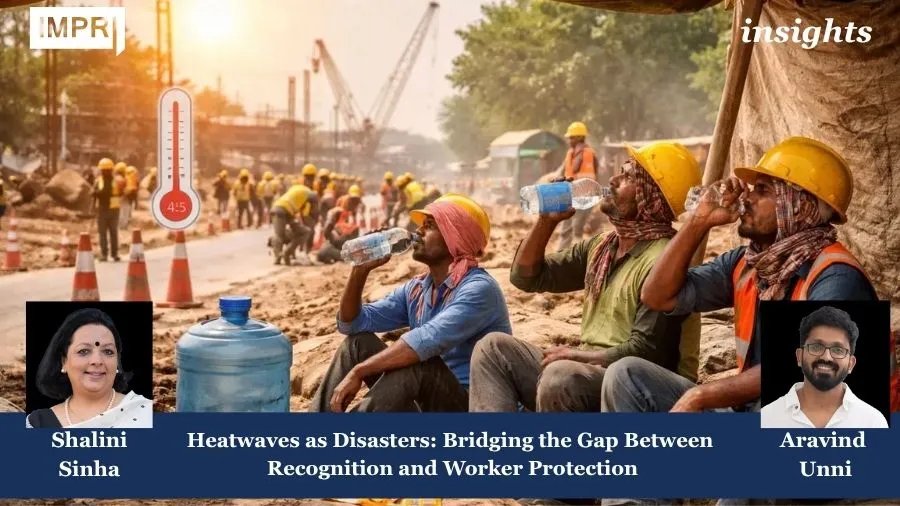
Every year, over 450 million workers, many of them migrants, engaged in agriculture, construction, street vending, sanitation, and transport are exposed to dangerous heat levels. Now that India has notified heat as a disaster, its success must be measured by whether fewer workers are forced to choose between their health and wages.
The Union government on August 4, 2026, informed the Lok Sabha that heatwaves have been included in the list of notified natural calamities under the Operational Guidelines for Administration of the State Disaster Response Fund (SDRF) and National Disaster Response Fund (NDRF) for 2026–31. The government pronounced that a policy framework for providing relief assistance through these state and national funds is now in place and heat-wave mitigation projects are eligible under Disaster Mitigation Funds.
This is of course a positive development. And much on the expected lines, especially after the 16th Finance Commission’s recommendations earlier this year. Historically, heatwaves have been managed mainly through advisories, seasonal warnings, and Heat Action Plans (HAPs), Declaring heatwaves as a disaster has now opened options for financing response and mitigation efforts at a scale previously hard to access. Until now, heatwaves were largely a state responsibility, with SDRF spending capped at 10% for locally severe events not on the national list. The notification removes this cap, unlocks both state and national funds, and enables national support during severe heatwave crises.
As we break new temperature records every season, it is essential to ensure that this disaster funding reaches the most affected communities and workers who face heat-related challenges daily and address the systemic issues that have long undermined heat governance in Indian cities.
What Changes with the Disaster Notification
The most obvious change is the resource allocation. That will lead to more HAPs and more allocations to heatwaves. The financial envelope is significant: ₹1.64 lakh crore has been allocated to SDRFs across states for 2026–31, while a further ₹79,406 crore has been earmarked at the national level for NDRF and NDMF. Of the national corpus, 75% – around ₹59,555 crore – is earmarked for NDRF. But these are five-year, multi-hazard funds, not dedicated heat funds. The real question is how much will actually be prioritised for heat, and how much will affected workers and communities.
The government’s own data illustrate the scale of the problem and the limits of how financial flows may unfold.
As of July 26, 2026, there had been a cumulative 4,853 cases of heatstroke, and a mere 20 confirmed deaths from heatstroke since March 1, 2026. The numbers matter, and that heat mortality is grossly undercounted. Recent literature suggests many thousands may be losing their lives and thousands of working hours lost. Studies have highlighted how heat compounds existing inequalities for urban informal workers through poor health, higher medical costs, income loss and rising coping costs amid inadequate housing and social protection.
Many cities and states have introduced Heat Action Plans (HAPs) to prepare for, respond to, and recover from them. HAPs had been prepared by 23 states, 195 districts and 64 cities. But did the plan automatically translate into a worker having water at a work site, shade at a vending site, a working cooling centre nearby, an early warning that reaches them or income support when working hours are reduced?
The plans themselves have inbuilt gaps that need to be addressed.
Experts have highlighted that the notification can provide HAPs with stronger financial and institutional support and help potentially shift the response from plans and frameworks to concrete action on the ground.
But the key word is “potential.”
The Way Forward: Putting Workers and the Vulnerable Communities at the Centre
The National Disaster Management Authority (NDMA) has done an important part of the job. It has developed the National Heatwave Guidelines, supported the Heat Action Plan framework and issued guidance on protecting informal workers. With heatwaves now notified as natural calamities for 2026–31, the financial and institutional basis for action has also changed. The next phase must move beyond NDMA – to ministries, states and cities.
First, heat must be explicitly treated as an occupational hazard. Over 450 million workers are estimated to face hazardous occupational heat exposure annually, including those in agriculture, construction, street vending, sanitation, transport and other occupations. The Ministry of Labour & Employment (MoLE) should establish an enforceable occupational heat-safety framework covering informal workers – outdoor and indoor; men and women – with exposure thresholds; WBGT-based assessment; work-rest cycles, hydration, shade, ventilation, and adjusted working hours. Heat protection cannot remain advisory; this will mean revisions to labour codes which are blind to heat and climate impacts on workers.
Second, disaster finance may seem large but given the scale of disasters and their distribution across states, it may not amount to much. NDMA should therefore lead in establishing a transparent resource-allocation framework, including indicative allocations for heat response and resilience for workers and communities, while allowing for local priorities. Expenditure and outcomes must be publicly reported, preventing heat finance from becoming another procurement scheme for equipment, consultants and plans.
If extreme heat makes work unsafe and workers lose income, support should not wait for death. At the same time, interventions that lack sufficient evidence – such as heat insurance – should not be rushed into policy. Data must be seen as foundational to heat governance. A common, scientifically robust protocol for identifying heat-attributable deaths and illness is therefore also essential. We cannot build fair financing on weak or inconsistent evidence of who is dying. Science and data must guide how impacts are identified and resources are used.
Third, the priority should shift from producing more HAPs to making them local, funded and accountable. NDMA has recommended measures for informal workers in a much-needed advisory in 2025. The next step is to fast-forward these pilots with communities and demonstrate what works and broaden the repertoire on heat resilience actions. Ward and neighbourhood – level action should identify workers, communities, with workers’ organisations, unions, women’s groups and community organisations involved in design, implementation and monitoring.
Fourth, NDMA has played its role; now Ministry of Housing Urban Affairs (MoHUA) must step up for cities. Much of the impact of heat in cities is shaped by spatiality and urban planning, requiring long-term, sustained action. Rather than depending on disaster funds solely, MoHUA needs to rework its existing schemes and programmes to address heat impacts – whether PMAY-Urban for housing or PM SVANidhi for street vendors. Heat resilience cannot remain a separate project; it needs to be built into mainstream urban development and planning. Cities also need clear nodal responsibility – a heat officer, climate-resilience department and active urban disaster-management authorities – to coordinate departments and track implementation.
Fifth, similarly, MoLE must come forward for workers. The focus must shift from advisories to enforceable, standardised heat-safety norms identifying employers’ liability and income compensation norms. These must prioritise India’s vast informal workforce and address the specific vulnerabilities of women workers. Heat stress should also be integrated into worker welfare, insurance, compensation, and social security provisions, with systems to track heat-related illness, lost working time, and livelihood impacts. The next phase of heat action in India requires more collaborative action across key ministries, with NDMA possibly taking a coordinating and supportive role.
Sixth, however large the funds, institutionalising beneficiary participation in design and implementation is key to addressing last-mile gaps, designing targeted interventions and ensuring sustainability. Networks and collectives of workers need to expand their role and actively participate in local heat governance – bringing workers’ realities into planning, negotiating with local governments for reliable services and ensuring accountability. Clear programming and participation frameworks are needed to enable decentralised, participatory action. For example, the small but positive efforts of IMD should be scaled, with warnings reaching workers in usable languages and formats that trigger concrete measures.
Finally, the 2019 national heatwave guidelines by NDMA are long overdue for a revision. Scientific understanding and India’s experience have evolved, including around humidity, night-time heat, cumulative exposure, occupational heat stress and urban heat islands. A revised framework should move beyond event and temperature-centred approaches towards impact-based, worker-centred and place-based heat governance.
The notification therefore marks not the end, but the beginning of a new phase. NDMA has helped establish the framework. Now MoLE must protect workers, and MoHUA must get cities to act; the states and municipalities must allocate and spend resources, and communities must have a meaningful say in how that money is used.
Conclusion: What Success Should Look Like
The declaration of heatwaves as a disaster is important because it opens up the possibility of changing the way the state responds – it unlocks resources and provide HAPs with a stronger institutional and financial foundation. But resources alone do not deliver relief to workers and communities that are left out of the HAPs. Ultimately, success cannot be measured by the number of HAPs prepared, advisories issued or cooling centres established.
It must be measured by whether fewer workers are forced to choose between their health and wages; whether heat deaths, illness and livelihood impacts are truthfully counted; and whether workers and communities become active actors in shaping, implementing and holding accountable the measures that make their cities more heat resilient.
About the Authors
Aravind Unni is an urban practitioner and researcher working on informality, livelihoods, and inclusive urban planning in Indian cities, and Shalini Sinha is Asia Strategic Lead, Urban Policies Programme, WIEGO, focusing on informal workers, gender, and inclusive urban policies across Asia.
The article was first published in The Migration Story as Heatwaves as disaster: From notification to worker protection on 25th August 2026.
Disclaimer: All views expressed in the article belong solely to the author and not necessarily to the organization.
Read more at IMPRI:
Trump’s Economic Pressure On Iran: Between Coercion And Resilience.
Mecca Agreement: Strategic Fallout Of Strategic Partnerships
Acknowledgement
This article was posted by Mahenoor Imam, Research and Editorial Intern at IMPRI