

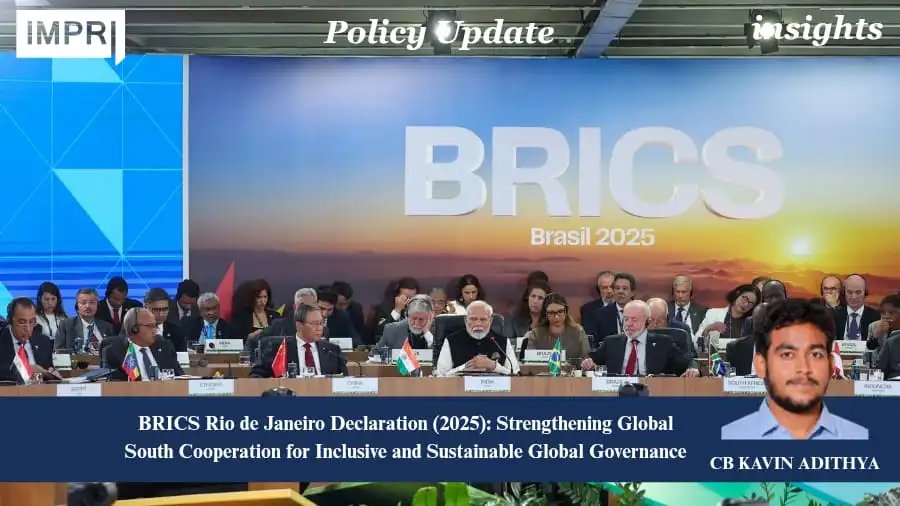
Policy Update
Kavin Adithya C.B.
Background
The XVII BRICS Summit convened in Rio de Janeiro, Brazil, on July 6-7, 2025, resulting in the Rio de Janeiro Declaration. The summit’s theme, “Strengthening Global South Cooperation for a More Inclusive and Sustainable Governance” (Ministry of External Affairs, 2025), underscored 17 years of BRICS collaboration, leading to 126 commitments and three new frameworks.
This declaration addresses a fragmented global order characterized by increasing unilateral trade measures, escalating military expenditures diverting funds from development, and the inadequacy of Bretton Woods Institutions in reflecting contemporary economic realities.
Key objectives include reforming global governance structures for improved justice, equity, and representation. The declaration also aims to enhance BRICS cooperation in political-security, economic-financial, and socio-cultural domains, while reasserting the Global South’s role in global peace and resilience.
Indonesia joined as the eleventh full member, and ten nations were recognized as partner countries. Initiatives outlined are intended to support Emerging Markets, Developing Countries, and Least Developed Countries, with a particular focus on Africa, Latin America, and the Caribbean.
Functioning
The Declaration is based on principles of mutual respect, sovereign equality, solidarity, and consensus. Its structure includes a Leaders’ Summit, a Sherpa track, and sectoral ministerial tracks.
Politically, the Declaration renews a commitment to reforming the United Nations, including the Security Council, to better represent developing nations. China and Russia have affirmed support for Brazil and India seeking expanded roles in the UN and its Security Council. This was later corroborated by the Minister of State for External Affairs in the Lok Sabha.
Economically, reforms to the Bretton Woods Institutions are proposed to improve their agility and representation. Notably, the 16th General Review of Quotas did not alter existing share distributions.
Sectoral cooperation is organized through three frameworks: the BRICS Leaders’ Framework Declaration on Climate Finance, establishing a five-year plan and supporting Brazil’s Tropical Forest Forever Fund; the BRICS Leaders’ Statement on Global Governance of Artificial Intelligence, presenting a Global South position on equity, safety, and capacity building; and the BRICS Partnership for the Elimination of Socially Determined Diseases, targeting root causes like poverty and exclusion.
BRICS collectively represents roughly 45 percent of the global population and 37 percent of global GDP (PPP). However, persistent challenges include internal disagreements on UNSC reform, a lack of strong enforcement mechanisms, and potential decision-making gridlock if membership expands to twenty-one countries.
Performance
The analysis of the performance of a framework using official statistics can span over a period of two to three years. It has been shown through the Annual Report of the New Development Bank for the year 2024 and its online MIS dashboard that the value of approvals in the financial market exceeded 35 billion US dollars. Furthermore, the volume of disbursements has reported a growth of 15 % throughout 2023-2024. Nevertheless, the Contingent Reserve Arrangement fund that amounted to 100 billion US dollars has been mostly dormant.
According to the 2024 data from the International Monetary Fund (IMF), emerging markets and developing countries compose 58 % of the total world GDP, calculated based on the Purchasing Power Parity (PPP). Nonetheless, their share in the IMF quota is only 39.5 %, which indicates that the 16th General Review of Quotas (GRQ) has not achieved the aims that it had set. The World Bank Shareholding Review 2025, which is co-chaired by Brazil, is currently in process.
The World Bank Annual Report 2024 states that EMDCs’ shareholding in the World Bank is 38.8 %. As for trade, the World Trade Organization’s (WTO) Statistical Review 2024 shows that trade among the BRICS countries increased from 435 billion US dollars in 2022 to 562 billion US dollars in 2024. This increase took place even though global trade as a whole slowed down to 2.7 %, a situation attributable to protectionist measures as mentioned in paragraph 13 of the declaration.
In the area of human development, the Food and Agriculture Organization’s (FAO) State of Food Security and Nutrition 2024 report points out that Africa is the only region where the number of undernourished people has gone up, with the figure reaching 281.6 million over the last fifteen years. This trend continues even in countries such as Ethiopia, which are still regarded as Least Developed Countries (LDCs) according to Gross National Income (GNI) per capita, even though they have experienced significant economic growth at times.
Impact
The effect of a declaration is both normative and substantive. It provides a clear boost to a reformed inclusive multilateral system based on the principles enshrined in the UN Charter for global governance and it locks in a mention of India’s aspiration for permanent membership, thus boosting India’s lobbying efforts through G4 and L.69 Group in the Inter-Governmental Negotiations process.
For Africa the stakes are high and paragraph 30 contains the following rare mandate language on the consideration of new ways to support African Union peace support operations as the mention of conflict hotspots in Sudan, the Great Lakes and the Horn of Africa and the (central) role of the AU. The African delegation spoke with one voice to support Palestine, condemn aggression and unite behind Iran, added the final text.
The declaration also affects the climate and food security via the endorsement of Tropical Forest Forever Fund and by means of the Global Alliance to Fight Hunger and Poverty suggested under Brazil’s G20 presidency and the BRICS Grain Exchange suggested during Russia’s chairmanship, which, it is argued, would assist Africa in attaining food sovereignty. In the digital space, the AI governance statement addresses the digital divide with Africa’s banking digitalization sitting alongside rural exclusion from basic services.
Emerging Issues
Several emerging issues require immediate attention.
- First, the reform of the United Nations Security Council (UNSC) has remained largely rhetorical, with no agreed timeframe for initiating text-based negotiations within the framework of the Intergovernmental Negotiations (IGN) process. This situation calls for BRICS to develop a joint draft resolution and for India to secure support for L.69 on this matter.
- Second, governance reform at the International Monetary Fund (IMF) is at an impasse as the deadline for the 17th General Review of Quotas (GRQ) approaches. Opposition from major shareholders may arise regarding proposals to increase basic votes for low-income members in order to enhance balanced representation. A new quota formula based on GDP purchasing power parity and a vulnerability index, as advocated by the BRICS Rio Vision for IMF Reform, alongside strengthening the New Development Bank (NDB) as an alternative, has been suggested.
- Third, maintaining unity and coherence among BRICS’ eleven members and ten partners,who possess divergent interests, presents a significant challenge. Introducing variable geometry and establishing a dedicated BRICS-Africa Working Group could offer potential solutions.
- Fourth, climate financing efforts lack clearly defined capitalization targets. Aligning the Forest Fund with the outcomes of COP30 in Belem and advancing the operationalization of the Grain Exchange are critical steps.
- Fifth, the absence of a monitoring mechanism, given the large volume of 126 commitments, raises concerns about implementation gaps. Establishing a BRICS Implementation Dashboard under the Sherpa track could address this issue.
Way Forward
The Rio Declaration signifies a new stage for BRICS, indicating that the organization is moving beyond its solely economic setting and establishing itself as an alternative manager of the “just, inclusive” world order. Regarding its participation, India focused on tightly interacting with the Global South Summit leadership and advocating for a number of important requests related to the World Trade Organization reform, fairness in terms of the World Health Organization, and climate finance.
According to the Ministry of External Affairs of India, addressed to the Parliament, India actively pursues its right to obtain a permanent membership position in an improved and enlarged UN Security Council through both bilateral and multilateral diplomacy.
The actual effectiveness of the declaration will be judged according to the progress achieved in terms of its key goals, such as changing quotas in line with real facts by 2027, achieving implementation of climate finance commitments, contributing to African Union peacekeepers, and introducing AI policy guidelines. If these goals are accomplished, global governing institutions stand a chance to become more democratic, representative, and responsive to the kind of challenges the world is facing today, as it is described in paragraph 5 of the declaration.
Important Link and Reference
About the Contributor
Kavin Adithya C.B. is a Research and Editorial Intern at IMPRI (Impact and Policy Research Institute). He is currently pursuing an M.A. in International Relations at Loyola College, Chennai. His academic and research interests include International Relations, International Political Economy, Defence and Security Studies, Public Policy, Geopolitics, and Human Rights. He is passionate about analysing contemporary global affairs and strengthening his research and policy analysis skills through academic writing and public policy engagement.
Acknowledgement
The author sincerely expresses gratitude to the reviewers and the editorial team for their valuable comments, constructive suggestions, and continuous guidance throughout the preparation of this article. Their insightful feedback significantly enhanced the clarity, organisation, and analytical quality of the manuscript. The author also acknowledges the support and encouragement received during the research and writing process, which contributed to the successful completion of this work.
Reviewers: Ashi Verma and Nayanshi Jain. The author sincerely thanks the reviewers for their valuable time, careful evaluation, and constructive comments. Their insightful suggestions have helped improve the quality, clarity, and overall presentation of this article. He greatly appreciates their thoughtful feedback and the opportunity to revise the manuscript accordingly.
Disclaimer: All views expressed in the article belong solely to the author and not necessarily to the organization.
Read more at IMPRI:
Pradhan Mantri Dhan-Dhaanya Krishi Yojana (2025): Assessing Convergence-Based Agricultural Reforms
National Mission on Cultural Mapping (2017): Weaving India’s Heritage into a Digital Tapestry