








Policy Update
Simona Miriam Hughes
Background:
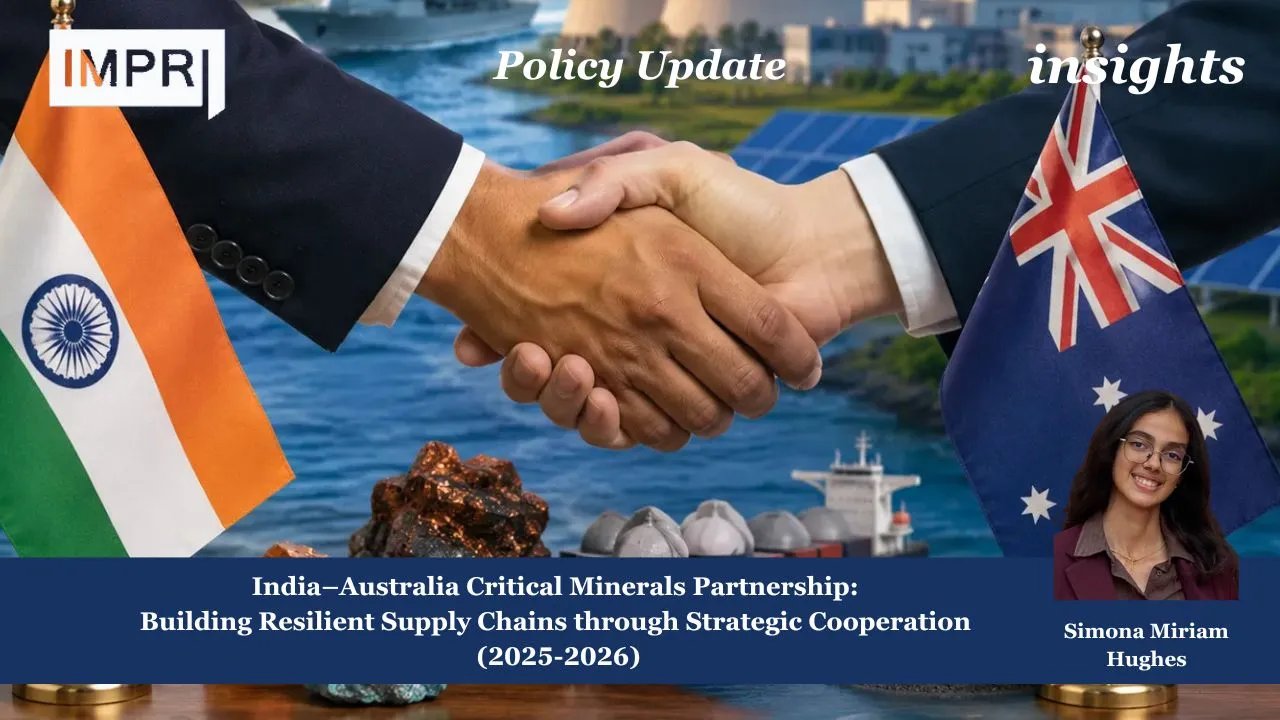
Critical Minerals such as Lithium, Cobalt, Nickel, Graphite and rare earth minerals have become indispensable for clean energy technologies, electric vehicles, semiconductors, defence manufacturing and advanced digital industries. Securing access to these minerals has emerged as one of the strategic priorities of many countries, as global supply chains have become vulnerable to geopolitical tensions. India and Australia have consequently deepened their cooperation, recognising that Australia’s abundant mineral reserves complement India’s expanding manufacturing sector and ambitious energy transition goals.
The bilateral partnership has evolved since the signing of the Memorandum of Understanding on Critical Minerals in 2020, which was then followed by the India-Australia Economic Trade Agreement (ECTA) in 2022 as well as the Australia-India Critical Minerals partnership. These initiatives have expanded cooperation across exploration, mining, processing, research and investment while simultaneously reducing tariff barriers and encouraging greater participation of private and public stakeholders. Australia’s position as a leading producer of lithium and other strategic minerals, combined with India’s growing demand for battery materials and renewable energy infrastructure, acts as a strong foundation for long-term economic collaboration.
The partnership has also gained greater strategic importance through multilateral platforms. In May 2026, India, Australia, Japan and the United States launched the Quad Critical Minerals Initiative Framework, establishing a coordinated approach towards diversified supply chains, investment mobilisation, regulatory cooperation and recycling of critical minerals. The framework reflects the Quad countries’ shared objective of building secure and resilient supply chains while reducing excessive dependence on concentrated sources of supply.
Functioning:
The India-Australia Critical Minerals framework functions through a combination of bilateral agreements, investment mechanisms, research collaboration and regional initiatives. The Australia-India ECTA facilitates trade by eliminating tariffs on several critical minerals, including cobalt, nickel, manganese, titanium and zirconium. At the same time, the Australia-India Critical Minerals Investment Partnership promotes joint investments in mining projects and also supports long-term supply arrangements between Australian resource companies and Indian Manufacturers.
The QUAD Critical Minerals Initiative further expands this cooperation up to US$20 billion in public and private investment in mining, processing, recycling and supply-chain infrastructure. The framework also promotes regulatory cooperation, geological mapping, technology sharing, streamlined permitting procedures and coordinated action against unfair market practices. Recycling of electronic waste and recovery of valuable minerals have also become integral components of the initiative to promote circular supply chains and resource efficiency.
In July 2026, both the countries elevated their cooperation through the Australia-India Partnership on Cyber, Critical Technologies and Supply Chains (PACTS). Under its Supply Chains pillar, the agreement integrates critical minerals cooperation with broader technology, semiconductor and cybersecurity initiatives. This institutional architecture promotes collaboration among governments, universities and research organisations all while strengthening trusted supply chains across the Indo-Pacific.
Performance:
Over the past three years, India and Australia have expanded the institutional framework supporting critical minerals cooperation. Five lithium and cobalt projects were identified under the Australia-India Critical Minerals Investment Partnership for detailed due diligence, while the India-Australia Critical Minerals Research hub and the subsequent research partnerships have strengthened collaboration in mineral exploration, extracting, processing and recycling. The launch of the QUAD Critical Minerals Partnership in 2026, further demonstrates the growing political commitment to developing resilient and diversified supply chains.
Simultaneously, Australia has strengthened its domestic policy framework through the Critical Minerals Strategy 2023-2030, the National Battery Strategy, the Future Made in Australia Plan and updated Critical and Strategic Minerals Lists. These reforms have enhanced Australia’s capacity to serve as a reliable supplier while creating greater opportunities for Indian Investment and downstream manufacturing. India has complimented these efforts through the National Critical Minerals Mission, Production Linked Incentive (PLI) schemes and strategic mineral block auctions, which collectively support domestic processing and manufacturing capabilities.
Recent policy developments indicate a shift from policy announcements to implementation. The PACTS framework, QUAD initiative and the proposed Critical Minerals Corridor demonstrate that cooperation has expanded beyond raw material trade towards integrated value chains involving processing, advanced manufacturing, recycling and technology development.
Impact:
The partnership has a great impact on economic security by reducing dependence on highly concentrated global supply chains, especially those dominated by China. Diversified access to lithium, cobalt, graphite, nickel and rare earth elements supports India’s transition to renewable energy, electrical vehicle manufacturing, semiconductor production and defence modernisation while providing Australia with stable long-term market exports and downstream investment opportunities.
Beyond bilateral trade, the partnership strengthens regional resilience across the Indo-Pacific. The QUAD Framework, the PACTS and the proposed India-Australia Critical Minerals Corridor support trusted supply-chains, technological collaboration and coordinated investment among like-minded partners. These initiatives also contribute to broader regional objectives such as clean energy deployment, industrial competitiveness and strategic autonomy.
Recent stakeholder consultations organized by the IEEFA indicate broad consensus that the partnership has evolved from securing access to mineral resources towards developing integrated value chains covering exploration, processing, refining, battery manufacturing, recycling and advanced materials. This evolution also positions India and Australia as important contributors to regional economic resilience and sustainable industrial growth.
Emerging Issues:
Although the Critical Minerals Partnership has evolved over the years, it still continues to face certain issues. Few of the challenges are listed below:
- High dependence on China for mineral processing and refining continues to create supply-chain vulnerabilities.
- Large-scale processing and refining projects require significant patient capital and long-term financing mechanisms.
- Commercial projects require stronger long-term offtake agreements to provide investment certainty.
- Regulatory procedures, environmental approvals and permitting remain time-consuming across jurisdictions.
- Technology collaboration must shift from knowledge transfer towards joint commercial innovation.
- Critical mineral processing requires a larger skilled workforce in metallurgy, battery technologies and advanced manufacturing.
- Recycling infrastructure and circular economy frameworks remain underdeveloped despite growing demand.
- ESG compliance and sustainable mining standards require greater harmonisation without creating unnecessary barriers.
- Greater participation from the private sector is necessary to complement government-led initiatives and accelerate investment.
Way Forward:
India and Australia should accelerate implementation of the proposed Critical Minerals Corridor linking Australian mining operations with Indian processing, refining and manufacturing facilities. Dedicated financing mechanisms, strategic stockpiles and long-term commercial agreements should support commercially viable projects while encouraging greater participation from private investors. Joint investments should increasingly focus on downstream industries including batteries, semiconductors, renewable energy equipment and defence manufacturing.
Future cooperation should prioritise joint research and development, advanced mineral processing technologies, battery recycling, digital geological mapping and workforce development. Expanding university–industry partnerships, Centres of Excellence and collaborative research programmes will strengthen innovation while building the skilled workforce required for future mineral value chains.
Finally, India and Australia should continue leveraging regional platforms such as the Quad while promoting common standards on responsible mining, ESG practices, traceability and transparent supply chains. Through sustained policy coordination and long-term investment, the partnership can become a cornerstone of resilient Indo-Pacific critical mineral governance and support both countries’ economic security, energy transition and strategic autonomy.
Selected References and Important Links:
Centre for Social and Economic Progress. (2025, April 17). India–Australia cooperation: Critical minerals for economic security. https://csep.org/blog/india-australia-cooperation-critical-minerals-for-economic-security/
East Asia Forum. (2025, August 18). An India–Australia mineral partnership is critical for resilience. https://eastasiaforum.org/2025/08/18/an-india-australia-mineral-partnership-is-critical-for-resilience/
Institute for Energy Economics and Financial Analysis. (2026). Charting the India–Australia critical minerals partnership. https://ieefa.org/node/19771
Ministry of External Affairs, Government of India. (2025, November 22). Joint statement by the Government of India, the Government of Australia and the Government of Canada (November 22, 2025). https://www.mea.gov.in/bilateral-documents?dtl/40321/Joint_statement_by_the_Government_of_India_the_Government_of_Australia_and_the_Government_of_Canada_November_22_2025
Ministry of External Affairs, Government of India. (2026, May 26). Quad Critical Minerals Initiative Framework among India, Australia, Japan and the United States. https://www.mea.gov.in/bilateral-documents?dtl/41235/Quad+Critical+Minerals+Initiative+Framework+Among+India+Australia+Japan+And+The+United+States
Press Information Bureau, Government of India. (2026, July 9). Australia–India Partnership on Cyber, Critical Technologies and Supply Chains (PACTS). https://www.pib.gov.in/PressReleaseDetail.aspx?PRID=2282692®=46&lang=1
About the Contributor:
Simona Miriam Hughes is a research and editorial associate intern at IMPRI. She is currently pursuing her Master’s degree in International Relations at Loyola College and has worked in several Non Governmental Organisations during her Undergraduate years. She has attended the 2025 Global Citizenship programme which is associated with the Washington DC university.
Reviewers:
Viksha A and Akshat Jangid
Disclaimer:
The content in the article belongs solely to the author and not exactly related to the organization.