









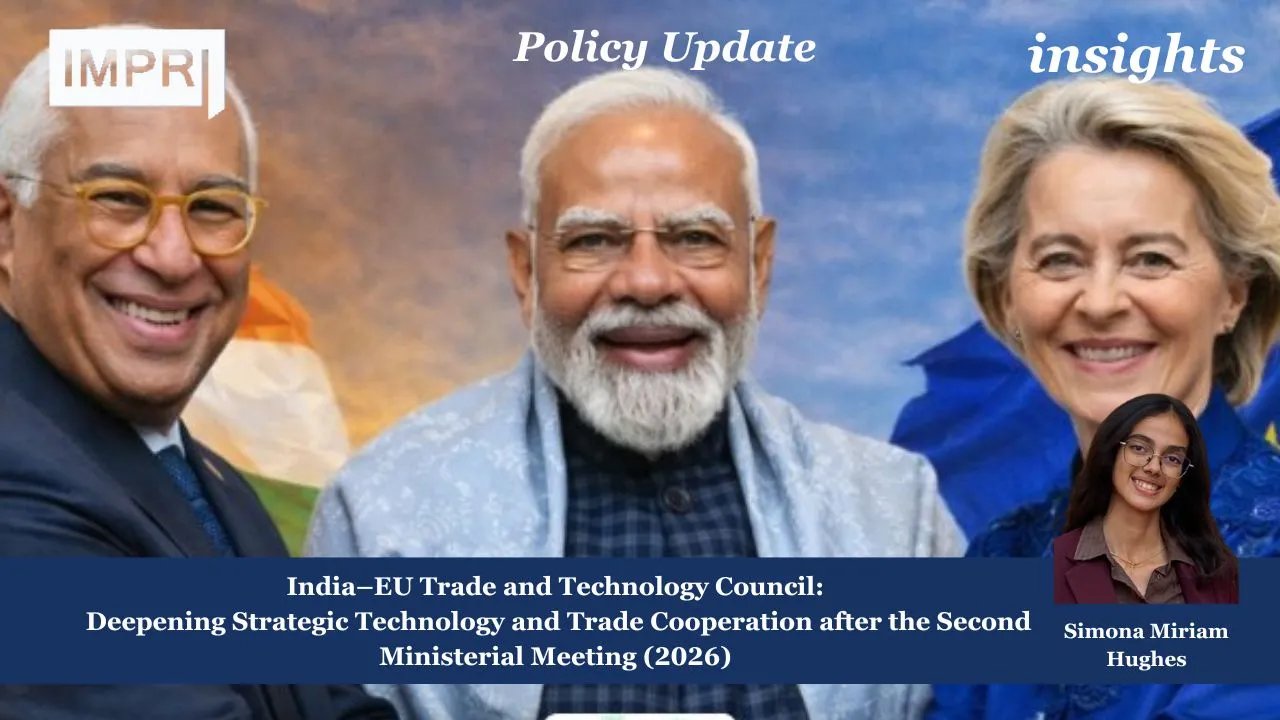
Policy Update
Simona Miriam Hughes
Background
The India-EU Trade and Technology Council (TTC) was established in 2022, to deepen cooperation between India and the European Union in the domains of trade, technology and geopolitics. The Council was designed in order to address emerging challenges such as supply chain vulnerabilities, digital transformation, critical technologies and green disruptions. The first TTC meeting was held in Brussels in 2023 and the second meeting was held in New Delhi in February 2025.
The TTC has also become an important component of the broader India–EU Strategic Partnership. The second meeting placed broader emphasis on artificial intelligence, semiconductors, high-performance computing, 6G, green hydrogen and resilient value chains, indicating a shift from broad diplomatic dialogue towards sector-specific cooperation. This trajectory was reinforced by the 16th India–EU Summit held in January 2026, which identified technology, innovation, economic resilience and sustainable development as major areas of cooperation. Thus, the TTC increasingly functions as a bridge between India’s technological ambitions and European expertise, investment and regulatory capabilities.
Functioning
The TTC functions through three Working Groups, which provide the institutional structure for cooperation. The first focuses on “Strategic Technologies, Digital Governance and Digital Connectivity”, covering areas such as AI, semiconductors, quantum technologies, 6G and digital public infrastructure. The second focuses on “Green and Clean Energy Technologies”, focusing on renewable hydrogen, electric mobility, batteries and other clean technologies. The third deals with “Trade, Investment and Resilient Value Chains”, covering sectors such as pharmaceuticals, agri-food and clean technologies, while also addressing technical barriers to trade and supply-chain vulnerabilities.
The functioning of the TTC combines political-level ministerial engagement with technical cooperation between officials, researchers, businesses and other stakeholders. The second ministerial meeting held in February 2025 was significant because it sought to translate broad commitments into concrete cooperation, including research partnerships and work on semiconductors, AI and resilient supply chains. The third meeting in July 2026 expanded this approach further through initiatives such as cooperation on EV charging technologies, startup partnerships and India’s proposed association with Horizon Europe. This demonstrates an increasing emphasis on moving from policy dialogue towards practical implementation.
Performance
The performance of the TTC can be calculated through the growth of India–EU economic relations as well as developments in the fields of technology and research cooperation. India–EU merchandise trade has expanded substantially, with India’s exports to the EU reaching approximately US$75.85 billion in 2024–25, while total merchandise trade reached around US$136.54 billion. The European Union also remains one of India’s largest trading and investment partners. These trends provide a favourable economic environment for the TTC and demonstrate the increasing importance of the India–EU relationship beyond traditional diplomatic cooperation.
Technology cooperation has also produced measurable developments. Joint India–EU research initiatives have supported projects in areas such as renewable hydrogen, marine pollution and EV battery recycling, with around €60 million committed to collaborative research over four years. Cooperation has additionally expanded into AI, semiconductors, high-performance computing and 6G. However, the performance of the TTC should not be measured only through agreements and announcements. Several initiatives remain in the negotiation, pilot or early implementation stage, making it important for future assessments to examine whether these commitments generate actual investment, technology transfer, research outputs and commercial partnerships.
Impact
One of the major impacts of the TTC has been the expansion of India–EU relations from conventional trade towards strategic technology cooperation. Collaboration in AI, semiconductors, quantum technologies, HPC and 6G can strengthen India’s technological ecosystem by providing opportunities for joint research, knowledge exchange and access to European expertise. At the same time, European companies and research institutions can benefit from India’s large digital market, skilled workforce and expanding innovation ecosystem. This makes the TTC relevant not only to governments but also to universities, startups and private industry.
The TTC is also contributing to cooperation on the green transition and economic security. Joint work on green hydrogen, EV batteries, charging infrastructure and clean technologies can support India’s sustainability objectives while opening new opportunities for European technology and investment. Meanwhile, cooperation on pharmaceuticals, agri-food, semiconductors and clean-energy supply chains can help both sides diversify sources of critical inputs and reduce vulnerability to geopolitical disruptions. In this sense, the TTC is gradually becoming an instrument for building a more resilient and strategically connected India–EU economic relationship.
Emerging Issues
A major emerging issue is the implementation gap between political commitments and actual outcomes. The TTC has produced an expanding number of initiatives, but several remain at the stage of dialogue, negotiation or pilot projects. Hence, there is a need for clearer implementation timelines, measurable indicators and regular monitoring of outcomes.
Another challenge is regulatory divergence, particularly in areas such as AI governance, digital regulation, sustainability standards and the EU’s Carbon Border Adjustment Mechanism (CBAM). These differences could increase compliance costs for Indian exporters, particularly smaller businesses, and potentially limit the benefits of closer trade relations. At the same time, cooperation in critical technologies such as semiconductors requires substantial investment, skilled manpower and long-term research capabilities. Addressing these challenges will require greater regulatory dialogue, capacity-building, joint R&D and stronger participation from Indian and European industries.
Way Forward
The future of the TTC should focus more on moving from commitment to implementation. India and the EU should establish measurable targets and timelines for major initiatives in AI, semiconductors, clean technology, digital connectivity and resilient supply chains. The proposed strengthening or upgrading of the TTC can provide an opportunity to introduce stronger monitoring mechanisms and greater participation from businesses, startups, universities and research institutions. India and the EU could focus on strengthening the TTC by introducing periodic assessments of whether individual commitments are generating measurable research, investment, technology-transfer and trade outcomes.
The TTC should also be closely connected with the broader India–EU Free Trade Agreement and Strategic Partnership. While the FTA can improve market access, the TTC can address the technological standards, digital regulations, innovation requirements and supply-chain issues that determine whether businesses can fully benefit from that market access. In the longer term, deeper cooperation in AI, semiconductors, 6G, quantum technologies, green hydrogen and digital public infrastructure could help establish an integrated India–EU technology and innovation ecosystem, strengthening both sides’ competitiveness and strategic autonomy.
Selected References and Important Links
Ministry of External Affairs, Government of India. (2026, July 15). 3rd India–EU Trade and Technology Council meeting.
MEA – 3rd India–EU Trade and Technology Council Meeting
European Commission. (2026, July 15). Joint statement on the third meeting of the EU–India Trade and Technology Council.
European Commission – Joint Statement
European Commission. (2026, July 15). EU and India strengthen strategic partnership with third Trade and Technology Council.
European Commission – Third TTC Meeting
Press Information Bureau, Government of India. (2026, July 13). Press release on India–EU economic and trade cooperation.
Press Information Bureau – India–EU Cooperation
Ministry of External Affairs, Government of India. (2026, January 27). India–EU Joint Statement on the State Visit of the President of the European Council and President of the European Commission to India and the 16th India–EU Summit (January 25–27, 2026).
MEA – India–EU Joint Statement
Council of the European Union. (2026, January 27). India–EU Joint Statement on the State Visit of H.E. Mr. Antonio Costa, President of the European Council, and H.E. Ms. Ursula von der Leyen, President of the European Commission, to India, and the 16th India–EU Summit (25–27 January 2026). Council of the European Union.
Council of the European Union – Joint Statement PDF
European Commission. (2025, February 28). Joint statement on the second meeting of the EU–India Trade and Technology Council. European External Action Service.
EEAS – Second India–EU TTC Joint Statement
About the Contributor:
Simona Miriam Hughes is a research and editorial associate intern at IMPRI. She is currently pursuing her Master’s degree in International Relations at Loyola College and has worked in several Non Governmental Organisations during her Undergraduate years. She has attended the 2025 Global Citizenship programme which is associated with the Washington DC university
Acknowledgement:
The author would like to thank IMPRI and the reviewers for their valuable feedback and continuous support and encouragement in all the activities up until now
Reviewers:
Kavin Aditya CB and Sneha Sharma
Disclaimer:
The content in the article belongs solely to the author and not exactly related to the organization