




Policy Update
Asmatwali
Background
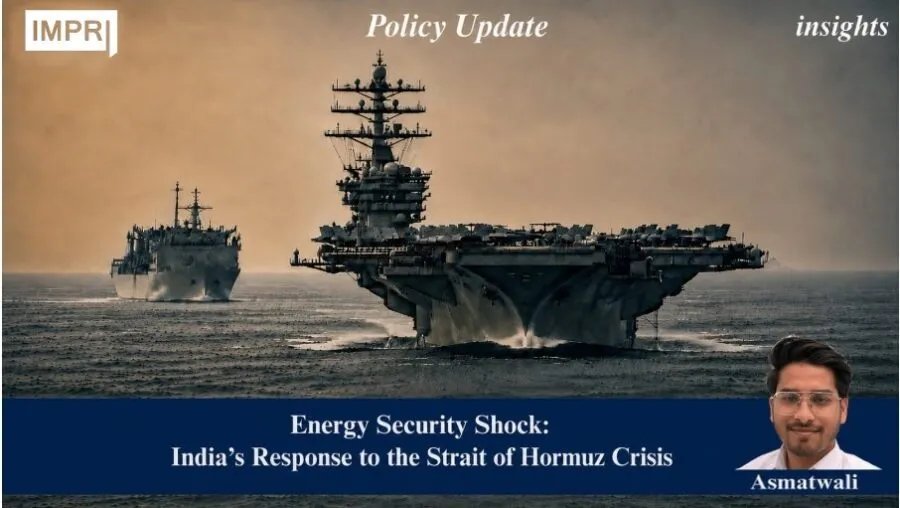
Following the outbreak of a US-Israel military campaign against Iran on 28 February 2026, Iranian forces declared the Strait of Hormuz “closed”, attacking merchant vessels and laying sea mines to enforce the blockade (Wikipedia contributors, 2026a). The Strait, through which roughly a fifth to a quarter of the world’s seaborne oil trade and about a fifth of global liquefied natural gas (LNG) shipments normally pass, saw shipping traffic collapse by more than 90 percent within days, prompting force majeure declarations by Qatar Energy, Kuwait Petroleum Corporation and Bahrain’s Bapco Energies, and a sharp drop in Iraqi crude production (Wikipedia contributors, 2026a; Congressional Research Service, 2026).
For India, which imports close to 88 per cent of its crude oil, around 51 per cent of its natural gas and nearly 60 per cent of its liquefied petroleum gas (LPG) requirements, the closure represented what the International Energy Agency described as the largest supply disruption in the history of the global oil market (Organiser, 2026; Observer Research Foundation, 2026).
The Indian crude oil basket price rose sharply, reaching USD 113.57 per barrel by 11 March 2026, up from a range of USD 62-70 earlier in the fiscal year, while Brent crude surged beyond USD 120 per barrel at the peak of the crisis (India Briefing, 2026; Organiser, 2026). Unlike Japan and South Korea, which held strategic reserves covering 180-254 days of net imports, India’s Strategic Petroleum Reserve stood at only 5.33 million tonnes, providing roughly nine to ten days of cover, well below International Energy Agency benchmarks (Organiser, 2026).
India’s energy security snapshot (2026 Hormuz crisis)
| Metric | Value |
| Crude oil import dependency | 88% |
| Natural gas import dependency | 51% |
| LPG import dependency | 60% |
| Strategic Petroleum Reserve cover | 9–10 days |
| IEA recommended benchmark | 90 days |
| Japan / South Korea reserve cover | 180–254 days |
| Crude sourcing countries (decade earlier → 2026) | 27 → 40+ |
| Non-Hormuz crude sourcing share (decade earlier → post-closure) | 55% → 70% |
| Indian crude basket price (baseline → peak) | USD 62–70 → USD 113.57 |
| Brent crude peak | USD 120+ |
| Retail fuel price rise (India vs. global average) | 7% vs. 25–30% |
| Excise duty cut costs to the exchequer | ₹1.1 lakh crore |
| Current account deficit (before → after) | USD 95bn → USD 120bn |
| Rupee depreciation | to 93/USD |
Functioning
India’s response functioned through a coordinated, cross-ministry mechanism led by the Ministry of Petroleum and Natural Gas, working with the Ministry of External Affairs, the Ministry of Finance, and shipping and fertiliser authorities. A 24×7 control room was set up to monitor petroleum stocks and fuel availability nationwide, with the government confirming on 11 March 2026 that inventories of petrol, diesel and aviation turbine fuel (ATF) remained sufficient to manage short-term disruption (India Briefing, 2026).
On pricing, the government cut excise duty on petrol and diesel by ₹10 per litre from 26-27 March 2026 to shield consumers from the international price spike, while simultaneously imposing an export levy of ₹21.5 per litre on diesel and effectively ₹29.5 per litre on ATF to discourage exports of scarce domestic fuel (Press Information Bureau, Government of India, 2026a; DD News, 2026).
To manage scarcity in natural gas and LPG, the Ministry invoked the Essential Commodities Act, 1955 and the LPG (Regulation of Supply and Distribution) Order, 2000, ring-fencing 100 percent of natural gas supply for domestic piped natural gas and CNG transport while capping industrial and commercial consumption, and notified a new Natural Gas and Petroleum Products Distribution Order, 2026 on 24 March 2026 for time-bound pipeline expansion (PIB, 2026a; PIB, 2026b). More than 3,700 anti-hoarding raids were conducted in a single day, alongside show-cause notices and the suspension of 27 LPG distributorships, while commercial LPG allocation to states was progressively restored from 20 to 50 per cent as supply stabilised (PIB, 2026b).
On the external and maritime side, the Ministry of External Affairs activated a control room and helplines for Indian nationals in the Gulf, with roughly 675,000 passengers travelling from the region to India since 28 February 2026, while the Directorate General of Shipping repatriated more than 1,320 Indian seafarers from vessels in the western Persian Gulf (PIB, 2026b). Indian oil marketing companies and gas companies simultaneously worked to secure crude cargoes and LNG shipments from alternative sources, drawing on relationships with Saudi Aramco, ADNOC and Qatar Energy built over the preceding years (India Narrative, 2026; Akashvani News, 2026).
Performance
India’s crude sourcing diversified from around 27 countries a decade earlier to more than 40 countries by 2026, with non-Hormuz sourcing rising from about 55 per cent to 70 per cent of crude imports within weeks of the closure, drawing on the United States, Russia, West Africa and Fujairah in the UAE (India Narrative, 2026; Akashvani News, 2026). A Ministry of Petroleum and Natural Gas Joint Secretary told an inter-ministerial briefing in New Delhi that India’s crude supply remained secure, with oil marketing companies securing cargo volumes exceeding what would normally have arrived through the Strait, and gas companies procuring new LNG cargoes from alternative sources (Akashvani News, 2026).
The fiscal cost of this shock absorption was substantial: the Ministry of Petroleum and Natural Gas estimated combined daily under-recovery for oil marketing companies at around ₹2,400 crore at the peak, with per-litre losses reaching roughly ₹105 on diesel and ₹24 on petrol by early April, while the excise cut alone was estimated to cost the exchequer close to ₹1.1 lakh crore for the fiscal year (ORF, 2026).
Despite this, retail fuel prices in India rose by only about seven per cent over the crisis period, compared with a global average of 25-30 per cent, and India avoided formal fuel rationing altogether (India Narrative, 2026). Speaking at the inauguration of the HPCL Rajasthan Refinery Limited on 4 July 2026, Prime Minister Narendra Modi described India’s response as reflecting timely assessment, decisive policymaking and the constructive use of diplomatic partnerships, noting that cooking gas supplies remained uninterrupted and that predictions of an energy collapse had proved unfounded (Organiser, 2026).
Impact
The crisis exposed India’s structural dependence on a single maritime chokepoint and a single import region, even as it demonstrated the resilience built through a decade of supplier diversification, refining flexibility and digital distribution monitoring (India Narrative, 2026).
Macroeconomically, full-year GDP growth reached 7.7 per cent, ahead of forecasts, and manufacturing expanded 10.7 per cent, suggesting the shock did not derail real economic activity; instead, its principal casualty was the external account, with the current account deficit widening from around USD 95 billion to USD 120 billion, driven almost entirely by the higher oil import bill (ORF, 2026). The rupee depreciated a further 4.9 per cent to around 93 per dollar, prompting the Reserve Bank of India to spend an estimated USD 46 billion on reserve smoothing, rather than defending the currency’s decline (ORF, 2026).
Beyond fuel, the disruption to Gulf urea and ammonia exports, which together account for 30-45 percent of global supply, caused a roughly 30 percent shortfall in India’s domestic urea production in March 2026 due to gas-supply caps on fertiliser plants, before allocations were raised back toward 90 percent of the six-month average by April (Food and Agriculture Organization, 2026; PIB, 2026b). The episode also reinforced India’s strategic interest in Iran’s Chabahar Port and in connectivity routes that reduce dependence on any single Gulf chokepoint, even as the conflict itself constrained the port’s normal operations during the acute phase of the crisis (India Briefing, 2026).
Emerging Issues
i. Thin strategic reserves: India’s Strategic Petroleum Reserve, covering only nine to ten days of net imports, remains far below the 90-day benchmark recommended by the International Energy Agency and the reserves held by Japan, South Korea and China (Organiser, 2026).
ii. Fiscal sustainability of price shielding: The excise-duty cuts and export levies that shielded consumers came at an estimated annual cost of over USD 12-14 billion in foregone revenue and oil-marketing-company losses, a burden that is not indefinitely repeatable in future shocks (ORF, 2026; FAO, 2026).
iii. Persistent chokepoint concentration: Despite diversification to over 40 source countries, a significant share of India’s crude and the bulk of its LPG imports remained tied to Gulf supply and Hormuz transit, leaving the country exposed to any renewed closure (Wikipedia contributors, 2026b; India Briefing, 2026).
iv. Fragility of the reopening: The Strait’s reopening followed a fragile ceasefire, with the US President publicly signalling in its immediate aftermath that the truce could collapse, underscoring that the underlying geopolitical risk had not been resolved (ORF, 2026).
v. Food security spillovers: The fertiliser and urea supply shock demonstrated that energy security and food security are tightly linked through Gulf-sourced natural gas feedstock, widening the policy scope beyond fuel alone (FAO, 2026).
Way Forward
India’s experience during the Hormuz crisis demonstrates that energy resilience cannot be built during a crisis; it depends on institutional readiness accumulated well in advance, including diversified crude sourcing, refining flexibility, and coordinated inter-ministerial governance mechanisms (India Narrative, 2026). Building on this, India should prioritise expanding its Strategic Petroleum Reserve capacity toward the International Energy Agency’s 90-day benchmark, deepen the Quad’s Indo-Pacific energy-security cooperation and pursue eventual IEA membership, and continue diversifying crude and LNG sourcing away from Gulf concentration (Organiser, 2026).
At the same time, the fiscal costs of the 2026 shock-absorption strategy, including the excise cuts and oil-marketing-company under-recoveries, suggest a need for a more calibrated and sustainable price-stabilisation mechanism, alongside accelerated investment in domestic gas production, city-gas distribution, and alternative fertiliser feedstocks to reduce the compounded fuel-and-food vulnerability exposed by this crisis (PIB, 2026b; FAO, 2026). Sustained diplomatic engagement with Gulf partners such as Saudi Aramco, ADNOC and Qatar Energy, alongside continued investment in connectivity corridors such as Chabahar Port, will remain central to insulating India’s energy security from future disruptions along this critical chokepoint (India Narrative, 2026; India Briefing, 2026).
References
1. Akashvani News (News on Air), Prasar Bharati. (2026, July). India secures 70% of crude oil imports outside Strait of Hormuz: Petroleum Ministry. Government of India. https://newsonair.gov.in/india-secures-70-of-crude-oil-imports-outside-strait-of-hormuz-petroleum-ministry/
2. Congressional Research Service. (2026). Iran conflict and the Strait of Hormuz: Impacts on oil, gas, and other commodities. Library of Congress, United States Congress. https://www.congress.gov/crs-product/R45281
3. DD News, Prasar Bharati. (2026, March 27). Relief for oil marketing companies as Government cuts excise duty on petrol, diesel. Government of India. https://ddnews.gov.in/en/relief-for-oil-marketing-companies-as-government-cuts-excise-duty-on-petrol-diesel/
4. Food and Agriculture Organization of the United Nations. (2026, April 28). Triple squeeze: How the Strait of Hormuz crisis hit India’s fuel, fertilizer, and agricultural exports. https://www.fao.org/india/news/detail/triple-squeeze/en
5. India Briefing. (2026, April 2). Strait of Hormuz & India’s oil supply: Import dependencies & mitigation measures. https://www.india-briefing.com/news/indias-oil-supply-hormuz-diversification-strategy-43381.html/
6. India Narrative. (2026, July). The strait that didn’t break India: How a decade of preparation defied the Hormuz crisis. https://www.indianarrative.com/opinion/the-strait-that-didnt-break-india-how-a-decade-of-preparation-defied-the-hormuz-crisis/
7. Observer Research Foundation. (2026, July). How India survived history’s biggest oil shock. https://www.orfonline.org/research/how-india-survived-history-s-biggest-oil-shock
8. Organiser. (2026, July 6). From Hormuz to resilience: How India rewrote the rules of energy security. https://organiser.org/2026/07/06/368294/bharat/from-hormuz-to-resilience-how-india-rewrote-the-rules-of-energy-security/
9. Press Information Bureau, Government of India. (2026a, March 21). Government’s preparedness and response following the closure of the Strait of Hormuz. Ministry of Petroleum and Natural Gas. PRID 2243369. https://www.pib.gov.in/PressReleasePage.aspx?PRID=2243369
10. Press Information Bureau, Government of India. (2026b, April 4). Consolidated update on measures taken in view of the closure of the Strait of Hormuz. Ministry of Petroleum and Natural Gas. PRID 2248934. https://www.pib.gov.in/PressReleasePage.aspx?PRID=2248934
11. Wikipedia contributors. (2026a, July 16). 2026 Strait of Hormuz crisis. Wikipedia. https://en.wikipedia.org/wiki/2026_Strait_of_Hormuz_crisis
12. Wikipedia contributors. (2026b, July 15). 2026 Iran war fuel crisis. Wikipedia. https://en.wikipedia.org/wiki/2026_Iran_war_fuel_crisis
About the Contributor
Asmatwali is a research and editorial intern at IMPRI. He is a scholar in the Department of West Asian and North African Studies at Aligarh Muslim University. Earlier, he worked on two project reports based on semi-structured interviews for the think tank JINF, Japan.
Acknowledgment
I am writing to express my sincere gratitude to IMPRI (Impact and Policy Research Institute) for providing me with the opportunity to prepare this policy update article and for fostering a rigorous learning environment that connects research with public policy practice. I also extend my sincere thanks to Rakhi Kumari & Ayan Bordoloi for their valuable feedback, useful suggestions, and support in shaping this article in the required policy-update format.
Disclaimer
All views expressed in the article belong solely to the author and do not necessarily represent the views or policies of the organisation.
Read more at IMPRI:
Research, Development and Innovation (RDI) Scheme: Strengthening India’s Innovation Ecosystem