







Policy Update
Harshini S
Background
The Quadrilateral Security Dialogue (Quad), comprising Australia, India, Japan, and the United States, has emerged as a prominent minilateral platform for promoting peace, stability, and prosperity in the Indo-Pacific. Initially conceived in 2007 and revived in 2017, the Quad has progressively broadened its agenda from maritime security to include critical and emerging technologies, resilient supply chains, cybersecurity, infrastructure, climate action, health security, and humanitarian assistance. Operating as an informal and consensus-based partnership rather than a military alliance, the Quad seeks to uphold a free, open, inclusive, and rules-based Indo-Pacific while respecting international law, sovereignty, and territorial integrity (Ministry of External Affairs [MEA], 2026a).
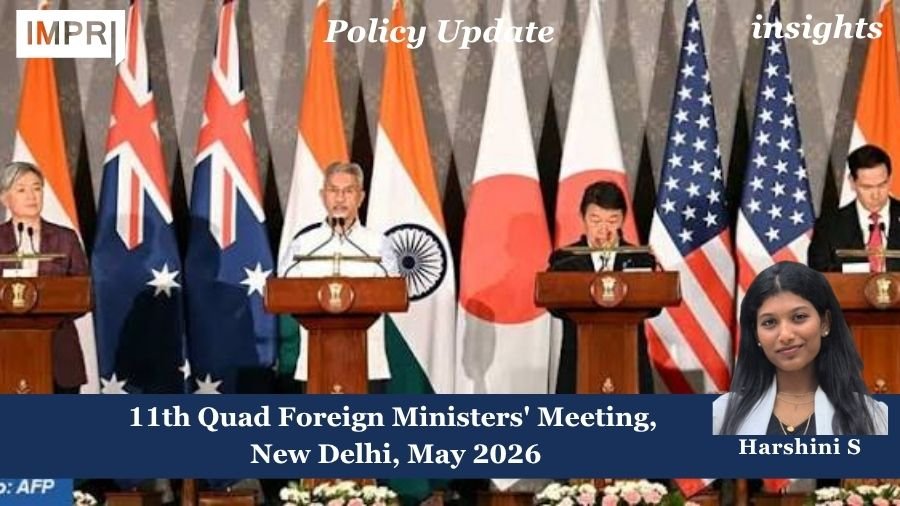
The 11th Quad Foreign Ministers’ Meeting, held in New Delhi in May 2026, took place amid an increasingly complex strategic environment marked by geopolitical competition, maritime tensions, disruptions to global supply chains, and the growing importance of emerging technologies. Hosted by India, the meeting brought together the Foreign Ministers of the four member states to review the implementation of existing Quad initiatives and to strengthen cooperation in areas of mutual strategic interest. The Joint Statement reaffirmed the Quad’s commitment to supporting ASEAN centrality, ensuring freedom of navigation and overflight, promoting adherence to international law, and delivering practical solutions that enhance regional resilience and sustainable development across the Indo-Pacific (MEA, 2026a; U.S. Department of State, 2026).
Beyond addressing conventional security concerns, the meeting reflected the Quad’s continued evolution into an implementation-oriented partnership focused on delivering regional public goods. The ministers reviewed progress under initiatives such as the Indo-Pacific Partnership for Maritime Domain Awareness (IPMDA), cooperation on critical and emerging technologies, secure and resilient supply chains, disaster preparedness, and counterterrorism. Scholars argue that this functional expansion has strengthened the Quad’s legitimacy by shifting its emphasis from strategic balancing to practical cooperation in addressing shared regional challenges (Pant & Basrur, 2023). Consequently, the New Delhi meeting reinforced the Quad’s role as a flexible mechanism capable of responding to both traditional and non-traditional security challenges while supporting an inclusive regional order (MEA, 2026b).
Functioning
The Quad functions through a flexible institutional framework that relies on regular consultations rather than legally binding commitments. Its activities are coordinated through Leaders’ Summits, Foreign Ministers’ Meetings, Senior Officials’ Meetings, and multiple Working Groups dedicated to priority sectors such as maritime security, critical technologies, climate, health, infrastructure, cybersecurity, and space. Decisions are reached through consensus, allowing members to coordinate policies while retaining strategic autonomy. This flexible governance structure enables the Quad to adapt its priorities according to emerging regional challenges without creating formal treaty obligations (MEA, 2026a).
During the 11th Foreign Ministers’ Meeting, the ministers reviewed the progress achieved under existing Quad initiatives and reaffirmed their commitment to translating previous commitments into measurable outcomes. Particular emphasis was placed on strengthening maritime domain awareness through the Indo-Pacific Partnership for Maritime Domain Awareness (IPMDA), promoting secure and trusted telecommunications, advancing cooperation on semiconductors and critical minerals, enhancing cybersecurity resilience, and improving coordination in humanitarian assistance and disaster relief (HADR).
The ministers also reiterated support for the rules-based maritime order, particularly the principles of freedom of navigation and peaceful settlement of disputes consistent with the United Nations Convention on the Law of the Sea (UNCLOS). These discussions reflected the Quad’s increasing emphasis on practical cooperation rather than declaratory diplomacy (MEA, 2026a; Ministry of Foreign Affairs of Japan [MOFA], 2026).
Another notable feature of the meeting was its focus on strengthening partnerships with regional institutions and Indo-Pacific countries. The Joint Statement reaffirmed support for ASEAN centrality, the Pacific Islands Forum, and other regional mechanisms, underscoring that the Quad complements rather than competes with existing institutions. The ministers also stressed the importance of enhancing regional capacity through infrastructure development, disaster resilience, clean energy transitions, and technology cooperation.
As observed in recent scholarship, the Quad’s effectiveness increasingly depends on its ability to deliver tangible developmental outcomes alongside strategic cooperation, thereby reinforcing its credibility among regional partners (Smith, 2024). By prioritizing implementation, institutional coordination, and regional engagement, the 11th Foreign Ministers’ Meeting demonstrated the Quad’s maturation into a comprehensive platform for addressing multidimensional challenges across the Indo-Pacific.
Performance
The 11th Quad Foreign Ministers’ Meeting highlighted the growing emphasis on implementation and continuity in Quad cooperation. Rather than introducing entirely new initiatives, the ministers assessed the progress of ongoing programmes launched through previous Leaders’ Summits and Foreign Ministers’ Meetings. The Joint Statement noted continued cooperation in strengthening maritime security, promoting trusted and resilient supply chains, advancing critical and emerging technologies, enhancing cybersecurity, supporting infrastructure development, and addressing transnational threats such as terrorism and illegal maritime activities. This reflects the Quad’s gradual transition from a consultative forum to a platform delivering practical regional outcomes (Ministry of External Affairs [MEA], 2026a).
One of the notable areas of progress was the Indo-Pacific Partnership for Maritime Domain Awareness (IPMDA), which continued to expand regional maritime surveillance capabilities by providing near real-time satellite-based information to partner countries. The ministers reaffirmed their commitment to enhancing maritime governance, combating illegal, unreported and unregulated (IUU) fishing, and supporting the capacity of Indo-Pacific states to monitor their exclusive economic zones. Alongside maritime cooperation, the meeting reviewed progress in promoting secure telecommunications, resilient semiconductor supply chains, critical minerals cooperation, and responsible governance of emerging technologies. These initiatives demonstrate the Quad’s efforts to strengthen regional resilience against both economic and security-related disruptions (MEA, 2026a; U.S. Department of State, 2026).
The meeting also reflected sustained institutional engagement through regular ministerial consultations and sectoral Working Groups. Scholars argue that the Quad’s effectiveness increasingly depends on consistent implementation rather than the announcement of new initiatives. By maintaining continuity across successive meetings and expanding practical cooperation in non-traditional security sectors, the Quad has strengthened its credibility as a long-term regional partnership. Nevertheless, the absence of legally binding commitments means that implementation largely depends on the political commitment and domestic priorities of individual member states, making regular monitoring and coordination essential for achieving tangible outcomes (Pant & Basrur, 2023; Smith, 2024).
Impact
The outcomes of the 11th Quad Foreign Ministers’ Meeting reinforced the Quad’s contribution to maintaining a stable, secure, and rules-based Indo-Pacific. By reaffirming support for freedom of navigation, respect for international law, and peaceful settlement of disputes, the ministers strengthened the normative foundations of the regional order. The continued emphasis on the United Nations Convention on the Law of the Sea (UNCLOS) and opposition to unilateral attempts to alter the status quo underscored the Quad’s commitment to preserving an open maritime environment essential for international trade and regional stability (MEA, 2026a; Ministry of Foreign Affairs of Japan [MOFA], 2026).
Beyond security, the meeting enhanced the Quad’s role as a provider of regional public goods. Cooperation in maritime domain awareness, disaster preparedness, cybersecurity, health security, climate resilience, and infrastructure development contributes directly to strengthening the institutional and developmental capacities of Indo-Pacific countries. These initiatives complement existing regional mechanisms by addressing shared challenges through technical assistance, capacity-building, and knowledge sharing rather than military commitments. Such practical cooperation has improved the Quad’s acceptance among regional partners and reinforced its image as a constructive platform for inclusive regional development (Australian Department of Foreign Affairs and Trade [DFAT], 2026).
The meeting also carried broader geopolitical significance by demonstrating the continued strategic convergence among the four member states despite differences in their national priorities. As scholars observe, the Quad has evolved into a flexible framework capable of balancing strategic deterrence with functional cooperation, thereby contributing to regional resilience without assuming the characteristics of a formal alliance (Medcalf, 2020; Pant & Basrur, 2023). The New Delhi meeting therefore strengthened confidence in the Quad’s long-term relevance and reaffirmed its role in promoting a secure, prosperous, and inclusive Indo-Pacific through sustained diplomatic engagement and practical cooperation.
Emerging Issues
- Absence of a formal institutional structure: As an informal strategic partnership, the Quad operates through consensus without a permanent secretariat or legally binding commitments. While this provides flexibility, it can slow implementation and limit accountability. Establishing stronger coordination and periodic progress reviews could enhance policy continuity (Pant & Basrur, 2023).
- Divergent strategic priorities among members: Although all four countries share a vision for a free and open Indo-Pacific, their national security priorities and economic interests differ. These differences may influence the pace of cooperation in areas such as technology, trade, and regional security. Greater policy harmonization through regular ministerial and working group consultations can help sustain collective momentum (Smith, 2024).
- Implementation and resource constraints: Many Quad initiatives, including maritime capacity-building, infrastructure development, and technology partnerships, require sustained financial resources and technical expertise. Effective implementation depends on long-term political commitment and closer collaboration with regional partners and multilateral institutions (MEA, 2026a).
- Balancing strategic competition with regional inclusivity: The Quad has consistently maintained that it supports an inclusive Indo-Pacific and complements ASEAN-led mechanisms. However, perceptions that the grouping primarily serves as a strategic counterweight to China may create apprehensions among some regional states. Continued engagement with ASEAN, the Pacific Islands Forum, and Indian Ocean partners through transparent and development-oriented initiatives can reinforce the Quad’s inclusive approach (MOFA, 2026).
- Addressing emerging technological and non-traditional security challenges: Rapid developments in artificial intelligence, cyber threats, critical technologies, and supply chain vulnerabilities require deeper coordination among Quad members. Expanding cooperation on digital governance, cybersecurity standards, and critical infrastructure protection will be essential to address future security and economic risks (U.S. Department of State, 2026).
Way Forward
The 11th Quad Foreign Ministers’ Meeting reaffirmed the grouping’s evolution into a comprehensive platform addressing both strategic and developmental priorities in the Indo-Pacific. Going forward, the Quad should prioritize the effective implementation of existing initiatives by strengthening coordination among its Working Groups, establishing measurable timelines, and regularly reviewing progress. Sustained political commitment from all four members will be essential to translate ministerial declarations into tangible regional outcomes (MEA, 2026a).
Future cooperation should focus on expanding maritime domain awareness, resilient supply chains, critical and emerging technologies, cybersecurity, clean energy, and disaster resilience while strengthening partnerships with ASEAN, the Pacific Islands Forum, and other regional stakeholders. Enhancing capacity-building programmes, promoting transparent infrastructure financing, and supporting smaller Indo-Pacific states through technical assistance can further strengthen regional confidence in the Quad’s constructive role (DFAT, 2026; U.S. Department of State, 2026).
As geopolitical and technological challenges continue to evolve, the Quad’s long-term relevance will depend on its ability to remain flexible, implementation-oriented, and responsive to regional priorities. By promoting adherence to international law, strengthening regional resilience, and delivering practical public goods, the Quad can continue to contribute meaningfully to a free, open, inclusive, and prosperous Indo-Pacific while reinforcing the rules-based international order (Medcalf, 2020; Pant & Basrur, 2023).
References
Australian Department of Foreign Affairs and Trade. (2026). Quad Foreign Ministers’ Meeting, New Delhi, May 2026. https://www.dfat.gov.au/international-relations/regional-architecture/quad
Medcalf, R. (2020). Indo-Pacific Empire: China, America and the contest for the world’s pivotal region. Manchester University Press.
Ministry of External Affairs. (2026a, May). Joint Statement of the 11th Quad Foreign Ministers’ Meeting, New Delhi. https://www.mea.gov.in/bilateral-documents?dtl/41233/Quad_Foreign_Ministers_Meeting_Joint_Statement_May_26_2026
Ministry of External Affairs. (2026b, May). Factsheet: 11th Quad Foreign Ministers’ Meeting. https://www.mea.gov.in/bilateral-documents?dtl/41234/Factsheet_Quad_Foreign_Ministers_Meeting_in_New_Delhi_May_2026
Ministry of Foreign Affairs of Japan. (2026, May). Quad Foreign Ministers’ Meeting. https://www.mofa.go.jp/fp/nsp/page1e_000396.html
Pant, H. V., & Basrur, R. (2023). The Quad and the Indo-Pacific: Origins, evolution and future prospects. International Affairs, 99(2), 573–591.
Smith, J. M. (2024). The Quad’s evolving role in Indo-Pacific governance. The Pacific Review, 37(1), 45–67.
U.S. Department of State. (2026, May). Joint Statement from the Quad Foreign Ministers’ Meeting, New Delhi. https://www.state.gov/releases/office-of-the-spokesperson/2026/05/joint-statement-from-the-quad-foreign-ministers-meeting-in-new-delhi
About The Contributor
Harshini S is a research intern at IMPRI. She’s pursuing M.A.( International Relations) from Loyola College, University of Madras as of May, 2026. Belonging from a humanities background, she has developed strong critical thinking, research skills and creative writing skills. Her interest lies in Strategic studies, Human Rights and Public Policy.
Acknowledgment
The author extends sincere gratitude to C. B. Kavin Adithya, Viksha A and IMPRI team for their expert guidance and constructive feedback throughout the process.
Reviewers
The article was reviewed by C. B. Kavin Adithya and Viksha A
Disclaimer
All views expressed in the article belong solely to the author and not necessarily to the organisation.
Read more at IMPRI
The Great Green Wall in 2026: Advancing Climate Adaptation and Global Climate Governance in Africa
16th India-Japan Annual Summit Joint Statement – New Delhi (July 2026)