








Policy Update
Harshini S
Background
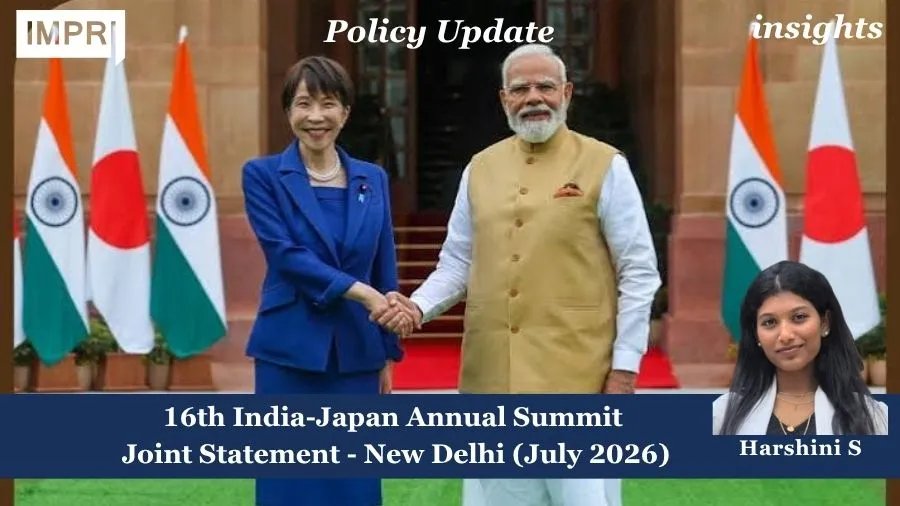
The 16th India–Japan Annual Summit, held in New Delhi on 2 July 2026, represents a significant milestone in the evolution of the India–Japan Special Strategic and Global Partnership. Hosted by Prime Minister Narendra Modi and attended by Japanese Prime Minister Sanae Takaichi during her first official visit to India, the summit reaffirmed both countries’ commitment to strengthening bilateral cooperation in response to an increasingly uncertain international environment.
The Joint Statement, titled “Advancing a Partnership of Strategic Convergence and Trust for Shared Growth, Prosperity and Resilience,” reflects the shared determination of India and Japan to transform their long-standing partnership into one capable of addressing contemporary geopolitical, economic, technological and security challenges. The summit reviewed progress made since the previous annual meeting and outlined an ambitious roadmap for cooperation in defence, economic security, artificial intelligence, semiconductors, resilient supply chains, clean energy, infrastructure and regional security (Ministry of External Affairs [MEA], 2026; Ministry of Foreign Affairs of Japan [MOFA], 2026).
The India–Japan partnership has undergone a remarkable transformation over the past two decades. The relationship was first elevated to a Global Partnership in 2000 and subsequently upgraded to a Special Strategic and Global Partnership in 2014 during the tenure of Prime Ministers Narendra Modi and Shinzo Abe. Since then, annual summits have become the principal mechanism for reviewing bilateral cooperation, setting strategic priorities and introducing new initiatives across multiple sectors.
Unlike traditional diplomatic engagements that focus primarily on political dialogue, the India–Japan summit process has evolved into a comprehensive institutional framework encompassing security, trade, investment, infrastructure, innovation, education, digital governance and people-to-people exchanges. The 2026 summit further consolidates this trajectory by expanding cooperation into emerging domains such as economic security, trusted technology ecosystems, artificial intelligence governance and critical mineral supply chains, demonstrating that the partnership is adapting to changing global realities (MEA, 2026; VIF, 2026).
The strategic rationale for strengthening India–Japan relations has become increasingly compelling in recent years. The Indo-Pacific has emerged as the principal theatre of geopolitical competition, characterised by maritime disputes, strategic rivalry among major powers, disruptions in global supply chains and growing concerns regarding economic coercion and technological dependencies. Both India and Japan share a common vision of maintaining a Free, Open and Inclusive Indo-Pacific (FOIP) based on respect for international law, freedom of navigation, peaceful settlement of disputes and ASEAN centrality.
Consequently, the 16th Annual Summit emphasised the importance of enhancing strategic coordination to preserve regional stability and strengthen rules-based international order. Rather than functioning as a military alliance, the India–Japan partnership seeks to build resilience through economic cooperation, technological collaboration, maritime security and institutional capacity building, thereby contributing to regional peace and prosperity (MOFA, 2026).
Economic considerations also constitute a central pillar of the partnership. Japan has consistently remained one of India’s largest development partners through Official Development Assistance (ODA), infrastructure financing, industrial investment and technology transfer. Japanese assistance has played a transformative role in flagship projects such as the Delhi Metro, Dedicated Freight Corridor, Mumbai–Ahmedabad High-Speed Rail, industrial corridors and urban infrastructure development. Simultaneously, India has emerged as an attractive destination for Japanese manufacturing firms seeking to diversify production networks and build resilient supply chains.
The 2026 Joint Statement therefore places considerable emphasis on enhancing investment flows, expanding industrial cooperation, strengthening semiconductor ecosystems, securing critical minerals, promoting digital transformation and improving connectivity between the two economies. These priorities align closely with India’s objectives under Make in India, Digital India, Atmanirbhar Bharat and the vision of Viksit Bharat 2047, while complementing Japan’s economic security strategy and industrial competitiveness agenda (MEA, 2026).
A notable feature of the 2026 summit is its strong emphasis on economic security. Recognising that economic resilience has become inseparable from national security, both governments adopted the India–Japan Joint Declaration on Economic Security Cooperation, which provides a framework for collaboration in semiconductors, artificial intelligence, critical minerals, pharmaceuticals, clean energy technologies and information and communication technologies.
The leaders welcomed progress in military exercises, defence dialogues and information-sharing mechanisms while emphasising the need to deepen cooperation in response to evolving regional security challenges. Furthermore, both governments condemned terrorism in all its forms and reaffirmed the necessity of ensuring accountability against terrorist organisations and their supporters, reflecting increasing convergence on regional security issues (MEA, 2026).
Another important dimension of the summit concerns people-to-people connectivity and knowledge partnerships. Both leaders recognised that sustained strategic cooperation requires stronger societal linkages through higher education, scientific research, cultural exchanges, skill development and mobility programmes.
Functioning
The implementation of the commitments made under the 16th India–Japan Annual Summit Joint Statement is supported by a comprehensive institutional architecture that has evolved over more than two decades of bilateral engagement. Rather than functioning as a single policy or programme, the India–Japan Special Strategic and Global Partnership operates through multiple political, economic, security, technological and developmental mechanisms that ensure continuity in cooperation irrespective of changes in government or the international environment.
The Annual Summit serves as the apex decision-making platform, while ministerial dialogues, joint working groups, intergovernmental committees, business forums and research partnerships collectively translate summit commitments into policy outcomes. This institutional framework enables regular monitoring, implementation and evaluation of agreed initiatives, making the partnership one of India’s most structured bilateral relationships (Ministry of External Affairs [MEA], 2026; Ministry of Foreign Affairs of Japan [MOFA], 2026).
At the political level, the Annual Summit between the Prime Ministers of India and Japan provides strategic direction for the entire partnership. Decisions taken during the summit are subsequently implemented through consultations involving foreign ministers, defence ministers, commerce ministers, finance ministries and specialised agencies. The India–Japan Foreign Ministers’ Strategic Dialogue, Defence Ministerial Dialogue, Economic Dialogue and the 2+2 Ministerial Dialogue involving foreign and defence ministers constitute the principal institutional mechanisms for reviewing progress and resolving implementation challenges. These forums ensure that bilateral cooperation is not confined to ceremonial engagements but is supported by regular policy coordination and institutional follow-up (MEA, 2026).
A major feature of the partnership is its emphasis on whole-of-government coordination. Various ministries in both countries are assigned responsibility for implementing sector-specific commitments. In India, the Ministry of External Affairs coordinates the overall partnership while working closely with the Ministry of Commerce and Industry, Ministry of Defence, Ministry of Electronics and Information Technology, Ministry of Railways, Ministry of New and Renewable Energy, NITI Aayog and the Department for Promotion of Industry and Internal Trade (DPIIT).
On the Japanese side, implementation involves the Ministry of Foreign Affairs, Ministry of Economy, Trade and Industry (METI), Ministry of Defence, Japan International Cooperation Agency (JICA), Japan External Trade Organization (JETRO) and the Japan Bank for International Cooperation (JBIC). This inter-ministerial coordination enables the partnership to address issues ranging from infrastructure financing to semiconductor manufacturing and defence technology collaboration (MOFA, 2026).
Economic cooperation under the partnership functions through an extensive institutional framework designed to facilitate trade, investment, industrial development and business collaboration. The India–Japan Joint Committee on Commerce and Trade, supported by DPIIT, JETRO, Invest India and industry associations, serves as the principal platform for identifying investment opportunities, addressing regulatory bottlenecks and promoting industrial cooperation.
Japanese companies investing in India receive facilitation through Japan Industrial Townships (JITs) established across multiple states, including Gujarat, Rajasthan, Tamil Nadu, Andhra Pradesh, Karnataka and Maharashtra. These industrial townships provide integrated infrastructure, simplified administrative procedures and logistics support aimed at attracting Japanese manufacturing investment. According to DPIIT, the JIT initiative has become an important mechanism for expanding Japanese industrial presence beyond traditional metropolitan centres and promoting regional manufacturing ecosystems (DPIIT, 2025).
Infrastructure cooperation remains one of the most visible operational pillars of the partnership. The implementation model relies heavily on Official Development Assistance (ODA) provided by Japan through JICA. Unlike conventional development assistance, Japanese ODA combines concessional financing with technology transfer, institutional capacity building and long-term technical cooperation. Major projects supported through this framework include the Mumbai–Ahmedabad High-Speed Rail (MAHSR) project, the Delhi–Mumbai Industrial Corridor, the Western Dedicated Freight Corridor, metro rail systems in Delhi, Chennai, Bengaluru, Ahmedabad and Mumbai, as well as urban water supply, sanitation and smart city projects. Project implementation is monitored jointly by Indian ministries, JICA officials, state governments and executing agencies through periodic review mechanisms to ensure timely execution and financial accountability (JICA, 2025).
The 2026 Joint Statement significantly expands cooperation in economic security, reflecting the changing nature of international political economy. Both governments adopted the India–Japan Joint Declaration on Economic Security Cooperation, establishing an institutional framework for collaboration in resilient supply chains, critical minerals, semiconductors, pharmaceuticals, advanced manufacturing, clean technologies and strategic industrial ecosystems. This framework functions through dedicated government-to-government consultations, private sector engagement and joint research initiatives involving universities and industrial research organisations. It also encourages greater coordination between industrial policy institutions and investment promotion agencies to reduce dependence on concentrated supply chains and improve resilience against external shocks (MEA, 2026).
Semiconductor cooperation has emerged as one of the most important components of the partnership. The functioning of this initiative involves coordination between India’s India Semiconductor Mission (ISM), Japan’s Ministry of Economy, Trade and Industry (METI), research institutions, universities and private companies engaged in chip design, fabrication equipment and semiconductor materials. The initiative complements India’s broader semiconductor manufacturing strategy while allowing Japanese firms to diversify production networks and strengthen supply chain resilience (METI, 2026).
Digital transformation and Artificial Intelligence (AI) cooperation have become central pillars of bilateral engagement. The operational framework includes joint research programmes, collaboration between academic institutions, industry partnerships, policy dialogue on AI governance and capacity-building initiatives. Cooperation extends to digital public infrastructure, cybersecurity, quantum technologies, high-performance computing and emerging technologies. (MOFA, 2026).
Defence and security cooperation functions through an increasingly sophisticated network of military exercises, policy consultations, logistics arrangements and defence industrial engagement. The annual Dharma Guardian army exercise, JIMEX naval exercise and participation in the Malabar Naval Exercise provide opportunities for operational coordination and interoperability. The Acquisition and Cross-Servicing Agreement (ACSA) facilitates reciprocal logistical support between the armed forces of both countries during exercises and humanitarian missions. The summit also reviewed progress in defence equipment and technology cooperation, including discussions on co-development and co-production in selected defence sectors. Institutional engagement is further strengthened through regular interactions between the National Security Secretariats, defence ministries, armed forces and defence industries (MEA, 2026).
Maritime cooperation occupies a prominent place in the operational architecture of the partnership. Both countries have expanded collaboration in Maritime Domain Awareness (MDA), coast guard cooperation, search and rescue operations, humanitarian assistance and disaster relief (HADR), anti-piracy operations and regional maritime capacity building. These initiatives are implemented through regular naval consultations, information-sharing mechanisms and practical exercises in the Indian Ocean Region and the wider Indo-Pacific. The Joint Statement reaffirmed support for international maritime law, particularly the United Nations Convention on the Law of the Sea (UNCLOS), while emphasising freedom of navigation and overflight as essential principles of regional stability (MOFA, 2026).
Unlike partnerships driven primarily by security concerns, the India–Japan relationship integrates economic development, technological innovation, democratic governance and regional stability into a single comprehensive framework. Consequently, the functioning of the partnership reflects an evolving model of strategic cooperation that seeks to address both traditional and non-traditional security challenges while supporting sustainable economic growth and resilience in the Indo-Pacific (VIF, 2026; MOFA, 2026).
Performance
The performance of the India–Japan Special Strategic and Global Partnership during the last two to three years demonstrates a gradual transition from a relationship primarily centred on infrastructure financing and development cooperation to one encompassing economic security, advanced technology, defence industrial collaboration, resilient supply chains and regional strategic coordination.
One of the strongest indicators of the partnership’s performance is the sustained expansion of bilateral trade. According to the Ministry of Commerce and Industry, Government of India, bilateral merchandise trade between India and Japan has remained resilient despite global economic uncertainties and disruptions in international supply chains.
During 2024–25, bilateral trade exceeded USD 25 billion, with Japan continuing to rank among India’s leading economic partners in East Asia. India’s exports to Japan largely comprised petroleum products, organic chemicals, iron and steel, seafood, textiles, engineering goods, pharmaceuticals and agricultural products, while imports from Japan were dominated by machinery, electrical equipment, automobiles, transport equipment, electronic components, industrial robots, precision instruments and specialised manufacturing technologies (Ministry of Commerce and Industry, 2025).
Although trade volumes have steadily increased over the past decade, both governments acknowledged during the 2026 summit that the present level of trade remains significantly below its estimated potential considering the size and complementarity of the two economies (MEA, 2026).
Investment cooperation has emerged as one of the most successful pillars of bilateral relations. According to the Department for Promotion of Industry and Internal Trade (DPIIT), Japan remains among the largest foreign investors in India, with cumulative Foreign Direct Investment (FDI) exceeding USD 43 billion between April 2000 and March 2025. Japanese investments are concentrated in automobiles, industrial manufacturing, electronics, renewable energy, logistics, chemicals, financial services, telecommunications and urban infrastructure.
Major Japanese corporations such as Suzuki, Toyota, Honda, Mitsubishi, Hitachi, Toshiba, Panasonic, Fujitsu, NEC and NTT have significantly expanded their operations in India, contributing to employment generation, technology transfer, industrial diversification and manufacturing competitiveness. The continued confidence of Japanese investors reflects improvements in India’s investment climate, infrastructure development, production-linked incentive (PLI) schemes and manufacturing ecosystem, although businesses continue to seek greater regulatory predictability and faster administrative approvals (DPIIT, 2025).
Infrastructure cooperation continues to represent the flagship component of India’s partnership with Japan. Japan’s Official Development Assistance (ODA), implemented through the Japan International Cooperation Agency (JICA), has financed several transformational infrastructure projects across India. The most prominent among these is the Mumbai–Ahmedabad High-Speed Rail (MAHSR) Project, commonly referred to as the Bullet Train Project. During the last two years, significant progress has been achieved in civil construction, bridge development, tunnel excavation, rolling stock preparation, station design and technology transfer initiatives.
According to JICA’s implementation reports, substantial portions of civil works have entered advanced stages of construction, particularly in Gujarat, while implementation in Maharashtra has accelerated following improvements in land acquisition and intergovernmental coordination (JICA, 2025). Beyond high-speed rail, Japanese assistance has also supported metro rail systems in Delhi, Chennai, Bengaluru, Ahmedabad, Mumbai, Nagpur and other urban centres, contributing significantly to sustainable urban transport and regional connectivity.
Another area demonstrating considerable progress is industrial cooperation. The Japan Industrial Townships (JITs) initiative, established to facilitate Japanese manufacturing investment, has expanded across multiple Indian states, including Gujarat, Rajasthan, Tamil Nadu, Karnataka, Andhra Pradesh and Maharashtra. These industrial townships provide integrated infrastructure, simplified administrative procedures and dedicated facilitation mechanisms to attract Japanese manufacturing enterprises. According to DPIIT and Invest India, Japanese companies have increasingly diversified investments beyond automobile manufacturing into electronics, precision engineering, food processing, industrial machinery and green technologies. Nevertheless, occupancy rates across some industrial townships remain uneven due to varying levels of state-level implementation capacity, land availability and local infrastructure readiness (DPIIT, 2025).
The Production Linked Incentive (PLI) schemes introduced by the Government of India have further strengthened bilateral industrial cooperation. Japanese firms have emerged as important participants in sectors such as advanced electronics, battery manufacturing, telecommunications equipment, specialty steel, renewable energy components and semiconductor ecosystems. The 16th Annual Summit recognised the importance of aligning India’s industrial policy with Japan’s Economic Security Strategy to promote resilient manufacturing ecosystems and reduce dependence on concentrated supply chains. This convergence is expected to accelerate future investments in advanced manufacturing, robotics, battery technologies, electric mobility and digital infrastructure (MEA, 2026).
Semiconductor cooperation has become one of the defining features of bilateral engagement over the past three years. Following the signing of the India–Japan Semiconductor Cooperation Memorandum in 2023, both governments have expanded cooperation through institutional partnerships involving India’s India Semiconductor Mission (ISM), Japan’s Ministry of Economy, Trade and Industry (METI), research institutions, universities and private sector companies.
The 2026 Joint Statement reaffirmed commitments to strengthening semiconductor manufacturing, developing skilled human resources, promoting collaborative research and ensuring resilient semiconductor supply chains. Japanese companies specialising in semiconductor manufacturing equipment, advanced materials, precision machinery and chip design have shown increasing interest in India’s emerging semiconductor ecosystem. These initiatives complement India’s broader semiconductor policy and support diversification of global semiconductor production networks (MOFA, 2026).
Performance in defence and security cooperation has also strengthened considerably. India and Japan have expanded the frequency and sophistication of bilateral and multilateral military exercises, including Dharma Guardian, JIMEX and the Malabar Naval Exercise involving Australia and the United States under the Quadrilateral Security Dialogue (Quad). The operationalisation of the Acquisition and Cross-Servicing Agreement (ACSA) has improved logistical interoperability between the armed forces of both countries during military exercises, humanitarian assistance and disaster relief operations. Maritime Domain Awareness (MDA), coast guard cooperation, information sharing, anti-piracy operations and naval consultations have become regular components of bilateral defence engagement. (MEA, 2026).
People-to-people exchanges have also recorded encouraging progress. The number of Indian students pursuing higher education in Japan has increased steadily, supported by scholarships, university collaborations and academic mobility programmes. Simultaneously, India’s participation in Japan’s Specified Skilled Worker (SSW) programme has expanded, reflecting Japan’s growing demand for skilled workers in sectors such as healthcare, construction, manufacturing, agriculture, hospitality and information technology. The LOTUS Programme, jointly supported by both governments, has facilitated scientific research collaboration, faculty exchanges and innovation partnerships between leading universities and research institutions. Cultural diplomacy initiatives, language education programmes and tourism promotion have further strengthened societal engagement between the two countries (MOFA, 2026).
Impact
The 16th India–Japan Annual Summit (2026) represents a significant milestone in transforming the India–Japan Special Strategic and Global Partnership from a relationship primarily focused on infrastructure financing and economic assistance into a comprehensive strategic partnership encompassing economic security, defence, emerging technologies, supply chain resilience, climate action and regional governance.
The Joint Statement reflects the increasing strategic convergence between both countries in responding to evolving geopolitical uncertainties, technological competition and global economic fragmentation. By institutionalising cooperation across diverse sectors, the summit has strengthened India’s Act East Policy while simultaneously advancing Japan’s vision of a Free and Open Indo-Pacific (FOIP) founded upon the principles of international law, freedom of navigation, peaceful dispute resolution and ASEAN centrality (Ministry of External Affairs [MEA], 2026; Ministry of Foreign Affairs of Japan [MOFA], 2026).
One of the most significant impacts of the summit is the formal recognition of economic security as a central pillar of bilateral cooperation. The adoption of the India–Japan Joint Declaration on Economic Security Cooperation reflects a shared understanding that economic resilience, technological competitiveness and secure supply chains have become integral components of national security. Through this declaration, both governments committed themselves to collaborative initiatives in semiconductors, critical minerals, pharmaceuticals, batteries, digital infrastructure, artificial intelligence, clean energy technologies and resilient industrial ecosystems. This framework enables both countries to reduce vulnerabilities arising from excessive dependence on geographically concentrated production networks while strengthening trusted supply chains capable of withstanding geopolitical and economic disruptions (Prime Minister’s Office [PMO], 2026; MEA, 2026).
The summit has considerably advanced India’s industrial development agenda by aligning Japanese investment and technological capabilities with flagship national initiatives such as Make in India, Digital India, National Semiconductor Mission and Viksit Bharat 2047. Japanese firms have expanded investments beyond traditional sectors such as automobiles and transport infrastructure into advanced manufacturing, renewable energy technologies, battery production, electronics, robotics, artificial intelligence and semiconductor ecosystems. The establishment of the Next Generation Mobility Partnership (NGMP) is expected to promote collaboration in electric mobility, railway modernisation, logistics, shipbuilding, aviation and smart transportation systems, thereby strengthening India’s manufacturing competitiveness and export capacity while simultaneously supporting Japan’s strategy of supply chain diversification (PMO, 2026; Ministry of Economy, Trade and Industry [METI], 2026).
In March 2026, Japan further committed approximately JPY 275.9 billion in new ODA loans covering healthcare, urban transport, agriculture and environmental sustainability projects, reaffirming its long-term commitment to India’s socio-economic development (Japan International Cooperation Agency [JICA], 2026; Press Information Bureau [PIB], 2026).
Technology cooperation constitutes another transformative outcome of the summit. The Joint Statement on Cooperation in the Field of Artificial Intelligence elevates bilateral engagement from conventional digital cooperation to strategic collaboration involving research, innovation, computing infrastructure, AI governance, talent development and industry partnerships. The accompanying Memorandum of Cooperation between India’s IndiaAI Mission and Japan’s GENIAC Initiative establishes institutional mechanisms for collaborative research, computing resource sharing, startup collaboration and policy dialogue. (PMO, 2026; METI, 2026).
The summit has also significantly strengthened bilateral cooperation in semiconductor manufacturing, an area increasingly recognised as critical for economic security and technological sovereignty. Building upon earlier semiconductor cooperation agreements, both governments committed to expanding research collaboration, workforce development, manufacturing partnerships, investment facilitation and resilient semiconductor supply chains. This cooperation complements India’s Semiconductor Mission while enabling Japanese firms specialising in semiconductor equipment, advanced materials and precision manufacturing to participate in India’s emerging semiconductor ecosystem. In the long term, such collaboration is expected to reduce dependence on concentrated semiconductor production centres and strengthen resilience within global electronics value chains (MEA, 2026; METI, 2026).
Defence and maritime security cooperation has similarly witnessed considerable strengthening following the summit. Both countries reiterated their commitment to maintaining a Free, Open and Inclusive Indo-Pacific, promoting maritime security, strengthening interoperability between their armed forces and enhancing cooperation in humanitarian assistance, disaster relief, maritime domain awareness and coast guard operations. The continued expansion of military exercises such as JIMEX, Dharma Guardian and the Malabar Exercise, together with implementation of the Acquisition and Cross-Servicing Agreement (ACSA), contributes towards improving operational coordination between the defence forces of both countries. Furthermore, discussions on defence industrial cooperation and technology co-development have laid the foundation for expanding indigenous defence manufacturing and strategic technological collaboration in the coming years (MEA, 2026; MOFA, 2026).
Climate change mitigation and clean energy transition have emerged as important dimensions of the bilateral partnership. The summit resulted in several initiatives promoting cooperation in green hydrogen, battery technologies, renewable energy, carbon neutrality, energy resilience and circular economy practices. The India–Japan Cooperative Biogas for Growth Initiative (CBG Initiative) seeks to establish nearly one thousand cooperative biogas plants across India, thereby promoting rural income generation, waste management, renewable energy production and sustainable agriculture. (PMO, 2026; Ministry of Petroleum and Natural Gas, 2026).
The summit has also generated significant impact in the area of critical minerals cooperation. The Memorandum of Cooperation on Geology and Mineral Exploration facilitates collaboration in geological surveys, mineral exploration technologies, research partnerships and sustainable mining practices relating to lithium, cobalt, nickel, rare earth elements and other strategically important minerals. Such cooperation supports India’s objective of reducing dependence on imported critical minerals while simultaneously contributing to Japan’s long-term resource security. Given the increasing importance of these minerals for electric vehicles, renewable energy systems, battery manufacturing and semiconductor production, this partnership carries considerable strategic and economic significance (PMO, 2026; Ministry of Mines, Government of India, 2026).
Healthcare cooperation has likewise expanded substantially. The Memorandum of Cooperation on Pharmaceuticals and Medical Devices strengthens bilateral collaboration in pharmaceutical manufacturing, medical technologies, Active Pharmaceutical Ingredients (APIs), regulatory harmonisation and healthcare innovation. Lessons learned during the COVID-19 pandemic demonstrated the importance of resilient pharmaceutical supply chains and diversified manufacturing capacities. (PMO, 2026).
Beyond strategic and economic dimensions, the summit has strengthened people-to-people relations, recognising that long-term partnerships require societal engagement alongside governmental cooperation. The declaration of 2027 as the India–Japan Year of Shared Horizons, commemorating seventy-five years of diplomatic relations, is expected to promote educational exchanges, scientific collaboration, cultural diplomacy, tourism, language learning, youth engagement and academic partnerships. Such initiatives enhance mutual understanding, facilitate knowledge exchange and build enduring institutional linkages between universities, research institutions, industries and civil society organisations in both countries (MOFA, 2026).
From a broader geopolitical perspective, the 16th Annual Summit has reinforced the strategic architecture of the Indo-Pacific by demonstrating that India and Japan remain committed to promoting a rules-based international order, resilient regional connectivity, transparent infrastructure financing, sustainable development and democratic governance. (Vivekananda International Foundation [VIF], 2026).
Emerging Issues
Despite the considerable progress achieved through the 16th India–Japan Annual Summit, several structural and implementation-related challenges continue to affect the effectiveness of the Special Strategic and Global Partnership. While the summit introduced new initiatives across economic security, critical technologies, infrastructure, defence and clean energy, the successful realization of these commitments depends on overcoming institutional, regulatory, financial and geopolitical constraints. The following emerging issues and corresponding policy suggestions are derived from the Joint Statement, official government documents and recent policy analyses.
| Emerging Issue | Policy Suggestion |
| Bilateral trade remains below its full potential despite strong political relations. India–Japan merchandise trade remains relatively modest compared to the size of both economies, reflecting underutilisation of the India–Japan Comprehensive Economic Partnership Agreement (CEPA). Non-tariff barriers, regulatory differences and limited product diversification continue to restrict trade expansion (Ministry of Commerce & Industry, 2025; MEA, 2026). | Both governments should undertake a comprehensive review of CEPA, simplify customs procedures, harmonise standards, reduce non-tariff barriers, expand market access for agricultural and pharmaceutical products and encourage greater participation of MSMEs through trade facilitation programmes. |
| Implementation delays in infrastructure projects continue to affect project timelines. Large-scale projects such as the Mumbai–Ahmedabad High-Speed Rail Project have experienced delays due to land acquisition challenges, environmental clearances, intergovernmental coordination issues and procedural bottlenecks (JICA, 2026; PIB, 2026). | India should strengthen project management mechanisms, improve Centre–State coordination, accelerate land acquisition processes through stakeholder consultations and establish dedicated fast-track monitoring systems for strategic infrastructure projects. |
| Defence industrial cooperation has not yet translated into substantial co-production or co-development projects. Although political commitment remains strong, regulatory complexities, export control regulations, technology transfer restrictions and procurement procedures continue to constrain defence manufacturing partnerships (MEA, 2026; MOFA, 2026). | Both countries should establish a dedicated Defence Industrial Cooperation Roadmap with simplified procurement mechanisms, joint research funding, industry partnerships and clearer frameworks for technology transfer and intellectual property protection. |
| Semiconductor cooperation faces challenges related to financing, skilled manpower and technological capabilities. Semiconductor manufacturing requires high capital investment, advanced technology, specialised human resources and long-term industrial planning (METI, 2026; India Semiconductor Mission, 2026). | India and Japan should jointly establish semiconductor research centres, expand university collaborations, create specialised workforce development programmes and encourage private-sector investment through targeted incentives and joint venture models. |
| Supply chain resilience initiatives remain at an early stage of implementation. While both governments have agreed to strengthen resilient supply chains for critical minerals, pharmaceuticals, batteries and advanced manufacturing, implementation frameworks are still evolving (PMO, 2026). | Develop sector-specific implementation plans with measurable timelines, encourage greater participation from private industry and institutionalise annual reviews of supply chain resilience initiatives under the Economic Security Dialogue. |
| Japanese investments continue to face regulatory and administrative challenges in India. Investors frequently highlight concerns relating to taxation, contract enforcement, logistics costs and regulatory uncertainty despite improvements in the investment climate (JETRO, 2025; DPIIT, 2025). | India should continue improving the ease of doing business through regulatory simplification, digital single-window clearance systems, faster dispute resolution mechanisms and improved logistics infrastructure. |
| People-to-people exchanges remain below their potential. Although educational and cultural cooperation has expanded, the number of Indian students in Japan and Japanese students in India remains comparatively low relative to other major bilateral partnerships (MOFA, 2026). | Expand scholarships, academic mobility programmes, language training initiatives, mutual recognition of academic qualifications and collaborative research grants while strengthening university partnerships under the India–Japan Science and Technology framework. |
| Emerging technology governance requires stronger institutional coordination. Cooperation in Artificial Intelligence, cybersecurity, quantum technologies and digital governance requires common regulatory approaches and trusted technology ecosystems (PMO, 2026; METI, 2026). | Establish a permanent India–Japan Emerging Technologies Forum involving governments, academia, industry and research institutions to coordinate policy development, ethical standards, innovation and technology governance. |
| Critical minerals cooperation requires diversification beyond bilateral arrangements. Growing global competition for lithium, cobalt, rare earth elements and nickel may affect long-term resource security for both countries (Ministry of Mines, 2026). | Strengthen joint investments in overseas mineral exploration, promote recycling technologies, develop strategic reserves and expand cooperation with trusted third-country partners such as Australia under the Supply Chain Resilience Initiative (SCRI). |
| Regional geopolitical uncertainties may affect implementation of long-term initiatives. Rising geopolitical competition, maritime tensions, technological restrictions and global economic volatility continue to create uncertainties for bilateral cooperation in the Indo-Pacific (MEA, 2026; VIF, 2026). | Both governments should institutionalise regular strategic dialogues, enhance Quad cooperation in non-traditional security areas, strengthen maritime domain awareness and promote inclusive regional partnerships while maintaining strategic autonomy and adherence to international law. |
The emerging issues indicate that while the India–Japan Special Strategic and Global Partnership has acquired significant strategic depth, the effectiveness of future cooperation will depend on improving implementation efficiency, strengthening institutional coordination, expanding private-sector participation and ensuring that summit commitments are translated into measurable outcomes. Addressing these challenges through sustained policy reforms and enhanced bilateral coordination will be critical for realizing the long-term objectives articulated in the 16th India–Japan Annual Summit Joint Statement (MEA, 2026; MOFA, 2026).
Way Forward
The 16th India–Japan Annual Summit demonstrates that the India–Japan Special Strategic and Global Partnership has entered a new phase characterised by strategic convergence, technological collaboration, economic resilience and shared responsibility for maintaining peace and stability in the Indo-Pacific. While the summit introduced several ambitious initiatives covering economic security, artificial intelligence, semiconductors, defence cooperation, clean energy, critical minerals, healthcare and connectivity, the long-term success of these initiatives will ultimately depend on effective implementation, institutional coordination, sustained political commitment and active participation from the private sector. The partnership must therefore move beyond policy declarations towards measurable outcomes that generate mutual economic, technological and strategic benefits (Ministry of External Affairs [MEA], 2026; Ministry of Foreign Affairs of Japan [MOFA], 2026).
One of the foremost priorities should be the effective implementation of the India–Japan Joint Declaration on Economic Security Cooperation. Both governments should institutionalise annual implementation reviews, establish sector-specific monitoring mechanisms and define measurable performance indicators for priority sectors such as semiconductors, critical minerals, batteries, pharmaceuticals, artificial intelligence and digital infrastructure. Creating dedicated implementation units within the existing Economic Dialogue framework would improve coordination among ministries, research institutions and private-sector stakeholders while ensuring timely execution of agreed projects (Prime Minister’s Office [PMO], 2026).
Both governments should therefore undertake a comprehensive review of the India–Japan Comprehensive Economic Partnership Agreement (CEPA) to address non-tariff barriers, improve customs facilitation, simplify regulatory procedures and encourage greater participation of Micro, Small and Medium Enterprises (MSMEs). Expanding cooperation in digital trade, services, e-commerce, fintech, pharmaceuticals, food processing and green manufacturing would further diversify bilateral commercial engagement and enhance economic integration (Ministry of Commerce and Industry, 2025). Digital project monitoring systems, faster environmental clearances, streamlined land acquisition mechanisms and improved dispute resolution processes would significantly enhance project delivery while ensuring optimal utilisation of Japanese Official Development Assistance (JICA, 2026).
The partnership should also prioritise technology-led growth by strengthening institutional cooperation in emerging technologies. Building upon the summit’s Joint Statement on Artificial Intelligence, both countries should establish permanent collaborative research centres involving universities, research institutions, startups and technology companies. Joint investment in quantum computing, advanced robotics, biotechnology, cybersecurity, semiconductor manufacturing and next-generation telecommunications would improve technological competitiveness while contributing to innovation-led economic growth. Simultaneously, collaborative development of ethical standards, AI governance frameworks and digital regulations would reinforce both countries’ commitment to trustworthy and human-centric technological development (METI, 2026; PMO, 2026).
India and Japan should promote joint ventures involving semiconductor fabrication, advanced packaging, research and development, design capabilities, specialised equipment manufacturing and workforce training. Collaboration between the India Semiconductor Mission, Japanese technology firms and leading academic institutions can facilitate technology transfer while supporting India’s objective of becoming an important participant in global semiconductor value chains. (India Semiconductor Mission, 2026; METI, 2026).
Defence and maritime security cooperation should continue to expand in response to evolving regional security dynamics. Both governments should operationalise defence industrial collaboration by encouraging joint research, co-development, co-production and greater participation of private defence industries. Regular military exercises, intelligence sharing, maritime domain awareness, coast guard cooperation, humanitarian assistance and disaster relief initiatives should be further strengthened to enhance interoperability between the armed forces. (MEA, 2026; MOFA, 2026).
The implementation of the India–Japan Cooperative Biogas for Growth Initiative and the Energy Resilience Partnership should be supported through increased financial investments, technological collaboration and private-sector participation. Such initiatives will not only contribute towards achieving climate goals but also strengthen long-term energy security and support sustainable industrial development (Ministry of Petroleum and Natural Gas, 2026). Expanding collaboration with trusted third-country partners through initiatives such as the Supply Chain Resilience Initiative (SCRI) would further strengthen mineral security while reducing dependence on vulnerable global supply chains (Ministry of Mines, 2026).
Finally, both governments should institutionalise comprehensive monitoring and evaluation mechanisms for summit commitments. A publicly accessible annual implementation report prepared jointly by India and Japan could improve transparency, facilitate policy learning and strengthen accountability. Regular engagement with academia, think tanks, industry associations, civil society organisations and state governments would also ensure broader stakeholder participation in implementing bilateral initiatives. Such an inclusive governance approach would enhance policy effectiveness while promoting innovation and responsiveness to emerging challenges (Vivekananda International Foundation [VIF], 2026).
In conclusion, the 16th India–Japan Annual Summit represents a decisive step towards consolidating one of the Indo-Pacific’s most significant strategic partnerships. The summit demonstrates that India and Japan have successfully moved beyond a traditional donor-recipient relationship to establish a comprehensive partnership based on mutual trust, shared democratic values, technological collaboration, economic resilience and common strategic interests.
By effectively implementing the commitments undertaken during the summit, both countries can significantly contribute to regional stability, sustainable economic growth, resilient supply chains, technological innovation and a rules-based international order. As geopolitical competition, technological transformation and economic uncertainty continue to reshape global politics, the India–Japan Special Strategic and Global Partnership is well positioned to emerge as a model of twenty-first century bilateral cooperation that supports not only national development but also peace, prosperity and stability across the Indo-Pacific region (MEA, 2026; MOFA, 2026).
References
Department for Promotion of Industry and Internal Trade. (2025). Fact Sheet on Foreign Direct Investment (FDI): April 2000–March 2025. Government of India. https://www.dpiit.gov.in/static/uploads/2025/11/4128971a6c7fd4a7653ca9e648a5f34b.pdf
Department for Promotion of Industry and Internal Trade. (2025). Japan Industrial Townships. Government of India. https://master-dpiit.digifootprint.gov.in/documents/reports/japanese-industrial-townships-EDOxIzNtQWa
India Semiconductor Mission. (2026). India Semiconductor Mission. Government of India. https://ism.gov.in/
Ministry of Commerce and Industry. (2025). Export Import Data Bank. Government of India. https://tradestat.commerce.gov.in/eidb/commodity_wise_export
Ministry of Electronics and Information Technology. (2026). IndiaAI Mission. Government of India. https://impact.indiaai.gov.in/
Ministry of External Affairs. (2026). 16th India–Japan Annual Summit Joint Statement: Advancing a Partnership of Strategic Convergence and Trust for Shared Growth, Prosperity and Resilience. Government of India. https://www.mea.gov.in/press-releases?dtl/41391
Ministry of Mines. (2025). Critical Minerals Mission. Government of India. https://mines.gov.in/webportal/content/national-critical-mineral-mission
Ministry of Petroleum and Natural Gas. (2026). India–Japan Energy Cooperation. Government of India. https://www.pmindia.gov.in/en/news_updates/joint-statement-between-ministry-of-petroleum-and-natural-gas-of-the-republic-of-india-and-the-ministry-of-economy-trade-and-industry-of-japan-on-energy-resilience/
NITI Aayog. (2025). National Strategy for Artificial Intelligence. Government of India. https://www.niti.gov.in/sites/default/files/2023-03/National-Strategy-for-Artificial-Intelligence.pdf
Press Information Bureau. (2026, July 2). Prime Minister’s visit to India by the Prime Minister of Japan: List of Outcomes. Government of India. https://www.pib.gov.in/PressReleaseDetail.aspx?PRID=2280587®=6&lang=1
Press Information Bureau. (2026). Japan signs ODA Loan Agreements for Infrastructure Projects in India. Government of India. https://pib.gov.in
Prime Minister’s Office. (2026). List of Outcomes: Prime Minister of Japan’s Visit to India for the 16th India–Japan Annual Summit. Government of India. https://www.pmindia.gov.in/en/news_updates/list-of-outcomes-prime-minister-of-japans-visit-to-india-for-the-16th-india-japan-annual-summit/
Prime Minister’s Office. (2026). Prime Minister’s Press Statement during the Joint Press Statement with the Prime Minister of Japan. Government of India. https://www.pmindia.gov.in
Japan International Cooperation Agency. (2025). India Operations and ODA Projects. https://www.jica.go.jp/english
Ministry of Economy, Trade and Industry. (2026). Japan’s Economic Security Policy. Government of Japan. https://www.meti.go.jp
Ministry of Foreign Affairs of Japan. (2026). Joint Statement on the 16th India–Japan Annual Summit. Government of Japan. https://www.mofa.go.jp/files/101054198.pdf
Ministry of Foreign Affairs of Japan. (2026). Japan–India Relations. Government of Japan. https://www.mofa.go.jp/region/asia-paci/india
Asian Development Bank. (2025). Asian Economic Outlook 2025. https://www.adb.org
International Monetary Fund. (2025). World Economic Outlook. https://www.imf.org
Organisation for Economic Co-operation and Development. (2025). Economic Outlook. https://www.oecd.org
Organisation for Economic Co-operation and Development. (2025). Trade and Global Value Chains. https://www.oecd.org/trade
Stockholm International Peace Research Institute. (2025). SIPRI Yearbook 2025. https://www.sipri.org
The World Bank. (2025). World Development Indicators. https://data.worldbank.org
Observer Research Foundation. (2026). India–Japan Relations and the Indo-Pacific. https://www.orfonline.org
Vivekananda International Foundation. (2026). 16th India–Japan Annual Summit: Deepening Strategic Convergence. https://www.vifindia.org/print/14801?slide=%24slideshow%24
About The Contributor
Harshini S is a research intern at IMPRI. She’s pursuing M.A.(International Relations) from Loyola College, University of Madras as of May, 2026. Belonging from a humanities background, she has developed strong critical thinking, research skills and creative writing skills. Her interest lies in Strategic studies, Human Rights and Public Policy.
Acknowledgment
The author extends sincere gratitude to C. B. Kavin Adithya, Simona Hughes and IMPRI team for their expert guidance and constructive feedback throughout the process.
Reviewers
The article was reviewed by C. B. Kavin Adithya and Simona Hughes.
Disclaimer
All views expressed in the article belong solely to the author and not necessarily to the organisation.
Read more at IMPRI
The Great Green Wall in 2026: Advancing Climate Adaptation and Global Climate Governance in Africa
Kiswahili: A Global Language for Peace, Solidarity, and Economic Diplomacy