






Policy Update
Harshini S
Background
Energy security has emerged as a strategic priority for BRICS countries amid rising global energy demand, geopolitical uncertainties, and the accelerating transition towards cleaner and sustainable energy systems. Representing a significant share of the world’s population, energy production, and consumption, BRICS members have increasingly collaborated to promote affordable, secure, and sustainable energy while addressing common challenges such as energy access, climate change, technological innovation, and infrastructure development. The BRICS Energy Platform has consequently evolved into an important mechanism for fostering policy dialogue, technological cooperation, and investment in energy infrastructure among member countries (Ministry of Power [MoP], 2026a).
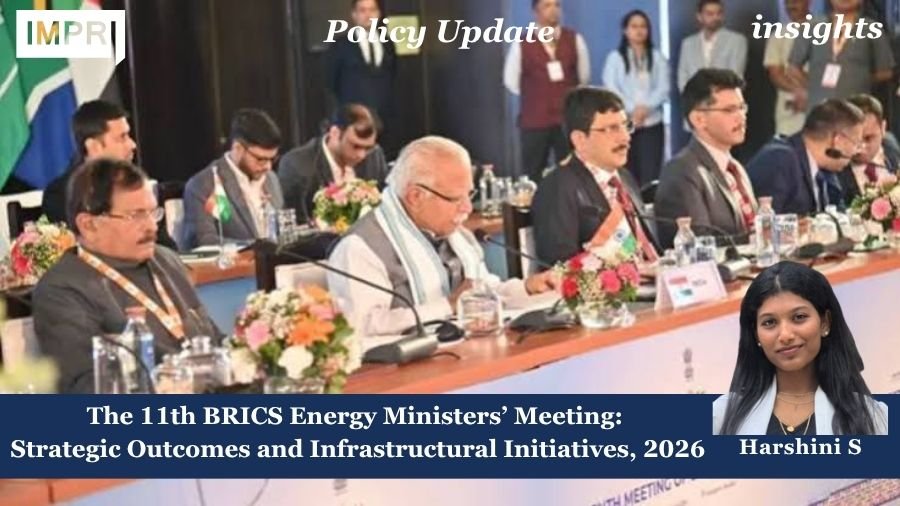
The 11th BRICS Energy Ministers’ Meeting, held in Gurugram, Haryana, on 25–26 June 2026 under India’s BRICS Chairship, was organized around the overarching theme of “Building for Resilience, Innovation, Cooperation and Sustainability (BRICS)”, while the Energy Track adopted the Sanskrit theme “Sarvesham Urjam (Energy for All).” The meeting brought together Energy Ministers and senior officials from all eleven BRICS member countries to deliberate on three priority areas: Energy Security and Sustainability, Energy Access and Equity, and Technology and Innovation. These priorities reflected the collective objective of ensuring resilient energy systems while advancing an inclusive and just energy transition, particularly for developing economies and the Global South (MoP, 2026a; Press Information Bureau [PIB], 2026a).
The Gurugram meeting also served as a platform for India to showcase its progress in renewable energy deployment, green hydrogen, biofuels, smart grids, and digital transformation in the energy sector. The ministers reaffirmed their commitment to strengthening cooperation in clean energy technologies, energy efficiency, resilient infrastructure, and sustainable financing while recognizing the importance of respecting national circumstances and diverse energy pathways. The Joint Statement further emphasized strengthening partnerships for technology transfer, capacity building, and infrastructure investment to support secure, affordable, and sustainable energy systems across BRICS countries, reinforcing the bloc’s growing role in shaping global energy governance (MoP, 2026a; PIB, 2026b).
Functioning
The BRICS Energy Ministers’ Meeting functions as the highest ministerial forum under the BRICS Energy Track, providing strategic direction for cooperation among member countries on energy policy, infrastructure development, technological innovation, and sustainable energy transitions. Its deliberations are supported by the BRICS Senior Energy Officials’ Meetings, technical working groups, expert consultations, and thematic seminars, which facilitate policy coordination and monitor the implementation of agreed initiatives. Prior to the ministerial meeting in Gurugram, India hosted multiple Senior Energy Officials’ Meetings and expert seminars on Artificial Intelligence in the Energy Sector and Carbon Capture, Utilisation and Storage (CCUS), laying the technical foundation for ministerial discussions and recommendations (MoP, 2026a).
During the 11th meeting, the ministers reviewed progress under existing BRICS energy cooperation and adopted measures to strengthen collaboration in renewable energy, electricity systems, clean fuels, energy efficiency, digitalization, and resilient energy infrastructure. Particular emphasis was placed on promoting innovation through emerging technologies such as artificial intelligence, smart energy systems, advanced battery storage, green hydrogen, and carbon management technologies. The ministers also encouraged greater cooperation in research, knowledge sharing, and capacity-building to accelerate sustainable energy transitions while ensuring affordability and energy security for developing economies. These discussions highlighted the importance of balancing economic growth with environmental sustainability through diversified energy portfolios and resilient infrastructure investments (MoP, 2026a; PIB, 2026a).
A notable outcome of the Gurugram meeting was the emphasis on strengthening infrastructural cooperation among BRICS countries. The ministers supported enhanced collaboration in developing resilient power systems, modern transmission networks, cross-border energy connectivity, clean energy infrastructure, and digital technologies that improve grid reliability and operational efficiency. They also acknowledged the role of multilateral cooperation in mobilizing investment, facilitating technology transfer, and promoting innovation-led growth in the energy sector. By integrating infrastructure development with energy security and sustainability objectives, the meeting demonstrated BRICS’ commitment to fostering an inclusive and resilient global energy architecture capable of addressing the evolving needs of both developed and developing economies (MoP, 2026a; PIB, 2026b).
Performance
The 11th BRICS Energy Ministers’ Meeting reaffirmed the bloc’s commitment to strengthening institutional cooperation on energy security, clean energy transitions, and resilient infrastructure. A key outcome of the meeting was the adoption of the BRICS Energy Cooperation Roadmap 2025–2030, which provides a strategic framework for collaboration in renewable energy, energy efficiency, sustainable fuels, digital energy systems, and resilient infrastructure.
The roadmap seeks to enhance policy coordination, facilitate technology transfer, strengthen research collaboration, and promote capacity-building among BRICS members while recognizing the diversity of national energy systems and development priorities (Ministry of Power [MoP], 2026a). The ministers also endorsed the continuation of technical engagements through the Senior Energy Officials’ Meetings and thematic working groups, ensuring that ministerial commitments are translated into practical cooperation.
A notable achievement of the Gurugram meeting was its emphasis on technological innovation as a catalyst for sustainable energy development. The discussions highlighted the growing role of Artificial Intelligence (AI) in optimizing electricity systems, predictive maintenance, demand forecasting, and grid management, alongside emerging technologies such as Carbon Capture, Utilisation and Storage (CCUS), green hydrogen, advanced battery storage, and smart grids. The ministerial deliberations built upon the expert seminars organized during India’s BRICS Chairship, demonstrating a coordinated approach to integrating technological advancements into national energy strategies. The adoption of these initiatives reflects the recognition that innovation is essential for achieving energy security while supporting decarbonization and economic growth (MoP, 2026a; Press Information Bureau [PIB], 2026a).
The meeting further strengthened BRICS cooperation in infrastructure development by encouraging investments in resilient electricity networks, renewable energy projects, digital infrastructure, and cross-border knowledge exchange. Ministers acknowledged that expanding energy infrastructure is crucial for ensuring universal energy access, improving system reliability, and supporting industrial development. Recent scholarship suggests that BRICS countries possess significant potential to shape the global energy transition through coordinated investments, technology partnerships, and South-South cooperation, particularly in renewable energy deployment and infrastructure financing (International Energy Agency [IEA], 2025; Kumar & Anand, 2024). Consequently, the Gurugram meeting reinforced BRICS’ role as an emerging platform for collaborative energy governance and sustainable infrastructure development.
Impact
The strategic outcomes of the 11th BRICS Energy Ministers’ Meeting extend beyond energy cooperation by strengthening the collective role of BRICS in shaping global energy governance. The emphasis on energy security, equitable access, and sustainable development reflects the shared objective of creating resilient energy systems capable of responding to geopolitical uncertainties, climate challenges, and growing energy demand. By advocating an inclusive energy transition that respects national circumstances, the meeting reaffirmed the principle of common but differentiated responsibilities while supporting the energy aspirations of developing economies (MoP, 2026a; PIB, 2026b).
The meeting also has significant implications for infrastructure development across BRICS countries. Commitments to modernizing electricity grids, promoting renewable energy infrastructure, expanding clean fuel production, and integrating digital technologies are expected to enhance energy resilience and improve the reliability of power systems. India’s leadership in showcasing initiatives such as green hydrogen, biofuels, smart grids, and digital energy management further demonstrated how infrastructure modernization can support economic growth while accelerating the transition towards low-carbon energy systems. Such collaborative efforts are likely to strengthen investment opportunities, facilitate technology transfer, and improve energy connectivity among BRICS members (MoP, 2026a).
From a broader developmental perspective, the meeting reinforced BRICS’ contribution to achieving the United Nations Sustainable Development Goal 7 (Affordable and Clean Energy) by promoting universal energy access, clean technologies, and international cooperation. The focus on innovation, capacity-building, and resilient infrastructure complements global efforts to ensure affordable, reliable, sustainable, and modern energy for all.
Scholars have argued that BRICS’ expanding cooperation in renewable energy and sustainable infrastructure has the potential to reshape the global energy landscape by providing alternative models of South-South cooperation and strengthening the voice of emerging economies in international energy governance (IEA, 2025; Sovacool et al., 2022). Therefore, the Gurugram meeting represents an important milestone in advancing collaborative, technology-driven, and sustainable energy partnerships within the BRICS framework.
Emerging Issues
- Diverse energy transitions among BRICS members: BRICS countries exhibit varying levels of dependence on fossil fuels, renewable energy capacity, and technological advancement. While this diversity enables knowledge sharing, it also presents challenges in developing common policy approaches and implementing collective energy commitments. Strengthening flexible cooperation that respects national circumstances while promoting shared objectives can enhance the effectiveness of BRICS energy initiatives (Ministry of Power [MoP], 2026a).
- Financing resilient energy infrastructure: Achieving large-scale investments in renewable energy, smart grids, energy storage, and transmission infrastructure requires substantial financial resources. Many developing BRICS members continue to face financing constraints, making it necessary to strengthen cooperation with multilateral development banks, including the New Development Bank (NDB), and promote innovative financing mechanisms for sustainable infrastructure projects (Press Information Bureau [PIB], 2026b).
- Technology gaps and unequal innovation capacity: Although the meeting emphasized cooperation in artificial intelligence, green hydrogen, carbon capture, and digital energy systems, disparities in technological capabilities among BRICS members may hinder the widespread adoption of advanced energy technologies. Expanding technology transfer, joint research, and capacity-building initiatives will be essential to ensure equitable participation in the energy transition (MoP, 2026a; International Energy Agency [IEA], 2025).
- Balancing energy security with climate commitments: Rapid economic growth and increasing energy demand require BRICS countries to simultaneously ensure affordable energy access and reduce carbon emissions. Balancing conventional energy sources with renewable energy expansion remains a significant policy challenge, particularly for emerging economies seeking inclusive and just energy transitions. Continued investment in diversified energy portfolios and low-carbon technologies can help reconcile these objectives (International Renewable Energy Agency [IRENA], 2024).
- Strengthening implementation and monitoring mechanisms: While the adoption of the BRICS Energy Cooperation Roadmap 2025–2030 provides strategic direction, translating ministerial commitments into measurable outcomes requires regular monitoring, stronger institutional coordination, and periodic evaluation of progress. Establishing clear implementation indicators and expanding technical cooperation among member states would improve accountability and policy effectiveness (MoP, 2026a).
Way Forward
The 11th BRICS Energy Ministers’ Meeting reaffirmed the importance of collaborative energy governance in addressing the interconnected challenges of energy security, sustainable development, and climate resilience. Moving forward, BRICS should prioritize the effective implementation of the BRICS Energy Cooperation Roadmap 2025–2030 through enhanced policy coordination, regular ministerial reviews, and stronger engagement among technical working groups. Sustained cooperation in renewable energy, resilient infrastructure, digital technologies, and clean fuels will be critical to achieving long-term energy security while supporting inclusive economic growth (MoP, 2026a).
Greater emphasis should also be placed on expanding investments in modern energy infrastructure, promoting research and innovation, and strengthening technology partnerships among BRICS countries. Collaborative initiatives in artificial intelligence, smart grids, battery storage, green hydrogen, carbon capture, and digital energy management should be supported through joint research programmes, knowledge-sharing platforms, and capacity-building activities. Furthermore, mobilizing sustainable finance through institutions such as the New Development Bank (NDB) can accelerate infrastructure development and facilitate equitable energy transitions across member states (PIB, 2026b).
As BRICS continues to expand its influence in global energy governance, the grouping has the opportunity to promote a development-oriented and inclusive approach to the global energy transition. By strengthening South-South cooperation, encouraging technological innovation, and supporting affordable and sustainable energy access, BRICS can contribute significantly to achieving Sustainable Development Goal 7 (Affordable and Clean Energy) and the broader objectives of sustainable development. The Gurugram meeting therefore represents an important step towards building resilient, innovative, and future-ready energy systems that address both national priorities and global energy challenges (United Nations, 2015; IEA, 2025).
References
International Energy Agency. (2025). World Energy Outlook 2025. https://www.iea.org/reports/world-energy-outlook-2025
International Renewable Energy Agency. (2024). World Energy Transitions Outlook 2024. https://www.irena.org/Publications/2024/Nov/World-Energy-Transitions-Outlook-2024
Kumar, A., & Anand, N. (2024). Energy transition and infrastructure cooperation in BRICS: Opportunities for sustainable development. Energy Policy, 189, 114208.
Ministry of Power. (2026a, June 26). Eleventh Meeting of BRICS Energy Ministers held on 25–26 June 2026. https://www.brics2026.gov.in/events/eleventh-meeting-of-brics-energy-ministers-held-on-25-26-june-2026/
Press Information Bureau. (2026a, June 26). Eleventh Meeting of BRICS Energy Ministers held on 25–26 June 2026. https://www.pib.gov.in/PressReleaseIframePage.aspx?PRID=2276137®=48&lang=2
Press Information Bureau. (2026b, June 29). Union Minister highlights BRICS Energy Cooperation and Roadmap 2025–2030. https://www.pib.gov.in/PressReleasePage.aspx?PRID=2277751®=3&lang=1
Sovacool, B. K., Hook, A., Martiskainen, M., & Brock, A. (2022). The political economy of decarbonisation: A review of transitions in emerging economies. Energy Research & Social Science, 84, 102365.
United Nations. (2015). Transforming our world: The 2030 Agenda for Sustainable Development. https://sdgs.un.org/2030agenda
About The Contributor
Harshini S is a research intern at IMPRI. She’s pursuing M.A.( International Relations) from Loyola College, University of Madras as of May, 2026. Belonging from a humanities background, she has developed strong critical thinking, research skills and creative writing skills. Her interest lies in Strategic studies, Human Rights and Public Policy.
Acknowledgment
The author extends sincere gratitude to Ameya Satam, C. B. Kavin Adithya, Viksha A and IMPRI team for their expert guidance and constructive feedback throughout the process.
Reviewers
The article was reviewed by Ameya Satam, C. B. Kavin Adithya and Viksha A
Economics
Disclaimer
All views expressed in the article belong solely to the author and not necessarily to the organisation.