





Policy Update
Kavin Adithya C.B.
Background
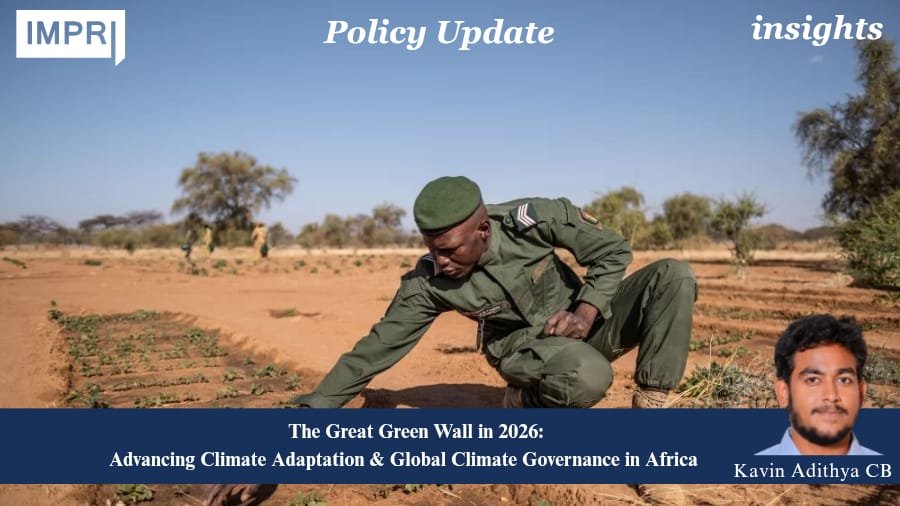
The Great Green Wall (GGW) is among the best environmental success stories in Africa.It was initiated by the African Union (AU) in 2007 as a response to the environmental challenges affecting the continent. It was designed as a green wall of 8,000 km from Senegal to Djibouti.The initiative has gradually evolved from an afforestation programme into an integrated landscape restoration initiative that combines climate adaptation, sustainable livelihoods, and regional environmental governance.
Its implementation relies on community participation, locally adapted restoration practices, and cooperation among participating African countries. There was a need for the Great Green Wall because Africa was facing a desertification process, recurrent droughts, and food shortage problems triggered by inappropriate agricultural practices and mismanagement of forest and natural resources. The environmental challenges were regional and called for a continental response that would promote mutual assistance and collective security.
The continent’s leaders met and decided to initiate measures to address the emerging regional environmental security issues. Thus, the African Union launched the GGW campaign with the objective of restoring natural ecosystems and promoting sustainable development through adaptation and mitigation measures for climate change. The GGW objective focused on rejuvenating 100 million hectares of land, sequestering 250 million tons of carbon, and creating 10 million jobs by 2030. Since its launch, the Great Green Wall has achieved milestones in the attainment of its objectives.
The first milestone was captured by the BRICKS Project that was endorsed by the World Bank’s Sahel and West Africa Program (SAWAP) in 2013.The campaign’s message and goals reached global audiences when world leaders met in Paris in 2021 during the One Planet Summit and pledged USD 14 billion for the campaign.The Great Green Wall covered 22 countries as of 2026 while promoting biodiversity, climate change adaptation, governance, and regional integration beyond environmental restoration.
In general, the Great Green Wall initiative has had a positive effect on the continent by promoting food, water, and job security and adapting climate change through regional collaboration.The initiative has strengthened cross-border knowledge sharing, institutional coordination, and policy cooperation among participating countries.It supports the implementation of the UNCCD, Paris Agreement, 2030 Agenda, and AU Agenda 2063 and is a regional innovation for sustainable development.
Functioning
The Great Green Wall has a multi-layer governance system, which involves the continental authority, national governments, international organisations, and local communities. The African Union Commission (AUC) and the Pan-African Agency of the Great Green Wall (PA-GGW) take responsibility for continental-level coordination, policy formulation, and reporting. They also ensure the participation of all states in the program and cooperation between contributing nations to achieve the set objectives.Participating countries integrate GGW objectives into national policies on forestry, agriculture, climate adaptation, and rural development.
The programs have received support from international organisations such as the United Nations Convention to Combat Desertification, Food and Agriculture Organisation (FAO), World Bank, Global Environment Facility, International Union for Conservation of Nature, and other regional development agencies. These entities offer technical assistance, climate financing, institutional strengthening, research, and evaluation services to the participating countries.
The Great Green Wall restoration program uses an integrated landscape approach to treating the ecological degradation of the Sahel region instead of the traditional tree-planting method. It focuses on rehabilitating farmlands, forests, and water resources through assisted natural regeneration, agroforestry, and integrated watershed management. Other activities include protecting dunes from desertification, constructing rainwater harvesting structures, and growing drought-resistant crops. Local governments, communities, women’s groups, youth, and farmer’s cooperatives participate in the activities by providing input on the most appropriate interventions to undertake.
The program’s impact is evaluated using satellite imagery, geographical information systems, remote sensing technologies, and field surveys. The reports are carried out by independent experts and international organisations such as the World Bank and FAO. The findings indicate that the Great Green Wall has restored several forestlands and facilitated cooperation among nations in the region. Nevertheless, the audit also shows that the program faces several challenges in ensuring long-term sustainability, such as limited resources, inadequate institutional frameworks, and insecurity in some of the targeted states.
Performance
From 2023 to 2026, the Great Green Wall (GGW) entered a results-oriented implementation phase focused on measurable environmental and socio-economic outcomes. Based on the US$14 billion committed at the 2021 One Planet Summit, donors and governments accelerated restoration through the Great Green Wall Accelerator, the Sahel and West Africa Program (SAWAP) and the BRICKS knowledge platform. These initiatives strengthened alignment between states and brought focused financial and technical assistance to priority restoration landscapes.
Restoration efforts seem to have increased in the 22 countries engaged in the program, but they are still varied due to national capacity, security conditions and funding, according to recent programme evaluations.
Countries like Niger, Ethiopia, Senegal, and Burkina Faso have witnessed promising returns with farmer managed natural regeneration, watershed rehabilitation, agroforestry, and sustainable land management. Ethiopia has sustained large-scale watershed restoration,Niger has consolidated community-based natural regeneration. Senegal is still a trailblazer in native Acacia landscape restoration while Burkina Faso has scaled up soil and water conservation techniques in spite of security-related impediments.
Implementation has been increasingly decentralised, institutionally. At the same time, local authorities and community organisations are increasingly being funded through national mechanisms, which means villages, women’s co-operatives and youth collectives are taking forward restoration work based on local need. This change in focus has facilitated better project ownership and less reliance on highly centralized bureaucratic systems.
Despite the impressive achievements, the restoration process faces some challenges that hinder the growth of the campaign in certain countries. Political instability, insecurity, prolonged droughts, and limited institutional capacity continue to slow implementation in several regions. Therefore, independent evaluations of the campaign’s outcomes reveal that the most significant achievements will be realized when restoration efforts result in enhanced ecosystem functions and improved livelihoods while also promoting sustainability.
Figure 1. Great Green Wall 2030 Targets (100 million hectares restored, 250 million tonnes of carbon sequestered, and 10 million green jobs).

Figure 2. Country-wise Core Restoration Area (Million Hectares) for Niger, Sudan, Mali, Chad, Mauritania, Ethiopia, Nigeria, Burkina Faso, Senegal, and Djibouti.

Figure 3. International Financing Commitments for the Great Green Wall (illustrating the mobilization of US$14 billion and the key institutional donors such as the World Bank, GEF, FAO, UNCCD, and other development partners).
Impact
The Great Green Wall is having far-reaching effects by not only improving the environment but also by promoting environmental development in Africa. The campaign’s success in restoring the environment has had positive environmental, social, and economic impacts on the local people and the continent at large. These influences cut across many aspects, including the adaptation to climate change in Africa, conservation, and development, making it one of the most effective environmental campaigns in history.
The Great Green Wall has had positive environmental effects, such as improving vegetation cover, restoring the land’s productivity, controlling soil erosion, and improving water resources in the countries where it has been implemented. The initiative has promoted environmental conservation by restoring the natural vegetation cover, which has improved the retention of moisture while reducing wind erosion. It has, therefore, influenced the number of species that have been recorded in the region due to the presence of vegetation, which has benefited wildlife and the local populations.
The campaign’s positive environmental impact has improved the quality of life for many locals. For instance, it has improved food security, increased water access, and supported sustainable livelihoods through agroforestry and forest farming. The project has created employment opportunities for the locals, especially women and youth, by establishing nurseries, rehabilitating forests, and generating products for local markets. Additionally, the restored environment has enabled the communities to increase their agricultural production and sustain it during times of drought, with little dependence on climate conditions.
The IPCC Sixth Assessment Report (AR6) (2023) identifies Africa as one of the regions most vulnerable to climate change because of rising temperatures, prolonged droughts, erratic rainfall, biodiversity loss, and increasing food insecurity. The report emphasizes that ecosystem restoration, sustainable land management, and nature-based solutions are among the most effective adaptation measures.
The Great Green Wall directly supports these recommendations by restoring degraded landscapes, improving ecosystem resilience, strengthening food systems, and enhancing adaptive capacity across the Sahel.Finally, the Green Great Wall has helped facilitate international collaboration on climate action and sustainability by linking environmental conservation and adaptation to climate change. It has promoted regional co-operation and partnerships in restoring the environment while influencing climate change policies at the local, national, regional, and international levels.
The campaign plays a critical role in realising the Paris Agreement, the UN Convention to Combat Desertification, the UN biodiversity strategy, the African Union Agenda 2063, and several other goals, including the Sustainable Development Goals (SDGs). It has, therefore, helped promote climate change adaptation and sustainable development both regionally and internationally.
Emerging Issues
The Great Green Wall project is threatened by several critical barriers with the potential to derail its development by 2030. Based on the United Nations Convention to Combat Desertification (UNCCD), Food and Agriculture Organization of the United Nations (FAO), and World Bank reports, some of the issues affecting the project’s growth and sustainability must be addressed immediately. The reports identified various critical areas and matters that need the policymakers’ attention. This paper discusses the issues affecting the Great Green Wall’s development and sustainability.
- The first issue affecting the development of the Great Green Wall is the complexity of land administration in many countries. Most nations involved in the project have traditional land ownership systems, making it challenging to identify and register land ownership rights. Additionally, these nations record significant discrepancies in determining land redistribution, utilization, and tenure policies. Therefore, the land administration problem must be addressed because it may cause adverse outcomes such as the exclusion of vulnerable groups and ‘elite capture’ during the land restoration process. Elite capture occurs when influential individuals or groups benefit from restoring community-owned land to take over the resource.
- The second issue affecting the Great Green Wall project is the increasing tension between herders and farm savers in the central Sahel region. The restoration process entails reforestation, which will require the authorities to restrict free herding in some of the targeted areas. The problem will exacerbate if the policymakers do not strategize on how to manage the interactions between farmers, herders, and the restoration activities. Consequently, there are fears that the herders and farmers will create adverse impacts as they confront each other in the central Sahel.
- The third issue is the reliance on external funding for the development of the Great Green Wall project. A significant percentage of the Great Green Wall’s projects are dependent on external financial support. Although some nations pledged to provide funds for the restoration process during the One Planet Summit in 2021, most projects require continuous government support to maintain the restored ecosystems and ensure their sustainability. Additionally, the maintenance and management costs of the restored areas are usually higher than the initial restoration costs. Therefore, the high maintenance and management costs and reliance on external funding may hinder the project’s sustainability and development.
- The fourth issue is the insecurity affecting the central Sahel region that is threatening most of the Great Green Wall projects in Mali, Burkina Faso, Niger, and Chad, which will peak between 2023 and 2026. The Sahel region has been facing persistent violence and political instability, which has hindered the restoration process and the project’s sustainability. Additionally, the violence and instability have disrupted the return of various professionals and experts required to rejuvenate and maintain ecological systems. Therefore, the threat to security in the region is a critical factor affecting the Great Green Wall project’s sustainability and development.
- Another emerging challenge is the increasing intensity of climate extremes, which reduces seedling survival rates, delays ecosystem recovery, and raises restoration costs. Based on the Intergovernmental Panel on Climate Change (IPCC) report (AR6), 2023, rising temperatures and prolonged droughts will adversely affect the restoration process by limiting the survival rates of planted saplings and stressing natural ecosystems. Consequently, climate change will impede the rate at which the Great Green Wall project will develop and become sustainable.
Way Forward
To realize the Great Green Wall’s 2030 vision, the practice needs to pivot from its current project-centric approach and embrace a more comprehensive landscape governance strategy. Although significant progress has been made since its initiation in 2007, there is a need to focus more on sustaining and enhancing the initiatives that have been implemented over the years.
- First, it is essential to institutionalize the Great Green Wall by mainstreaming it in the national climate adaptation, biodiversity, and development agendas of each participating country. This way, the restoration initiatives will be aligned with the Paris Agreement’s Nationally Determined Contributions (NDCs) as well as National Adaptation Plans (NAPs). In addition, it is only logical to extend the financing envelope beyond the current endogenous efforts and promote a more permanent, predictable, and diversified stream of funding from development banks, climate windows, philanthropies, and private companies.
- Second, it will be critical to capitalize on emerging technologies to support restoration efforts. Besides adopting a more comprehensive landscape approach, the Great Green Wall’s stakeholders can leverage satellite imagery, GIS, remote sensing, drones, land registries, and other modern technology to scale up restoration potential, monitor performance, evaluate results, and report on progress transparently. The use of technology can also promote accountability since it makes it possible to generate evidence and take corrective actions if any irregularities are detected during audits or independent assessments.The local communities and stakeholders must play a more significant role in future Great Green Wall initiatives. Their active and authentic participation will increase the rate of success of the restoration endeavors both ecologically and developmentally. This will happen through bolstering the leadership of local government structures, women’s committees, youth organizations, indigenous institutions, farmers, and pastoralist groups while also building their capacities in climate change adaptation and governance.
- Finally, the African Union, UNCCD secretariat, FAO, World Bank, UNEP, and other development partners must continue to support the Great Green Wall’s restoration efforts by facilitating the free exchange of technologies, knowledge, and expertise among stakeholders while also expanding its innovation footprint.By strengthening regional cooperation, science-based policymaking, and community-led restoration, the Great Green Wall can evolve into a global model for ecosystem restoration, climate resilience, and sustainable development.
References
- African Union Commission. (2026). African Union policy frameworks, declarations, and Great Green Wall initiative. https://au.int
- Food and Agriculture Organization of the United Nations. (2025). Forest and Landscape Restoration Mechanism (FLRM): Great Green Wall programme and restoration flagship reports. https://www.fao.org
- Intergovernmental Panel on Climate Change. (2023). Climate change 2023: Synthesis report. Contribution of Working Groups I, II and III to the Sixth Assessment Report of the Intergovernmental Panel on Climate Change. IPCC. https://www.ipcc.ch/report/ar6/syr/
- United Nations Convention to Combat Desertification. (2025). Great Green Wall initiative: Growing a World Wonder and programme documentation. https://www.unccd.int.
- United Nations Environment Programme. (2025). Pan-African Action Plan for Active Mobility (PAAPAM) and sustainable transport reports. https://www.unep.org.
- World Bank. (2024). Sahel and West Africa Program (SAWAP) and BRICKS: Programme documents and implementation reports. https://www.worldbank.org.
- World Bank Independent Evaluation Group. (2025). Evaluation of the Sahel and West Africa Program in support of the Great Green Wall initiative. https://ieg.worldbankgroup.org
About the Contributor
Kavin Adithya C.B. is a Research and Editorial Intern at IMPRI (Impact and Policy Research Institute). He is currently pursuing an M.A. in International Relations at Loyola College, Chennai. His academic and research interests include International Relations, International Political Economy, Defence and Security Studies, Public Policy, Geopolitics, and Human Rights. He is passionate about analysing contemporary global affairs and strengthening his research and policy analysis skills through academic writing and public policy engagement.
Acknowledgement
The author sincerely expresses gratitude to the reviewers and the editorial team for their valuable comments, constructive suggestions, and continuous guidance throughout the preparation of this article. Their insightful feedback significantly enhanced the clarity, organisation, and analytical quality of the manuscript. The author also acknowledges the support and encouragement received during the research and writing process, which contributed to the successful completion of this work.
Disclaimer: All views expressed in the article belong solely to the author and not necessarily to the organisation.
Reviewers: Rathin and vibha sethi for I sincerely thank the reviewers for their valuable time, careful evaluation, and constructive comments. Their insightful suggestions have helped improve the quality, clarity, and overall presentation of this article. I greatly appreciate their thoughtful feedback and the opportunity to revise the manuscript accordingly.
Read more at IMPRI:
IndiaAI Mission’s FutureSkills Pillar: Building India’s AI-Ready Talent Pipeline
Kiswahili: A Global Language for Peace, Solidarity, and Economic Diplomacy