






Policy Update
Gayathry Sanjay Balaram
Background
Imagine falling asleep in what should be the safest place on earth, your own home, beside your parents. By morning, your life is gone because a snake entered your house and bit you while you slept. This is not a hypothetical scenario. It is a tragic reality in Kerala. In April 2026, an eight-year-old boy in Thrissur died after a venomous snake bit him while asleep, while his younger brother was left in critical condition following the same incident.
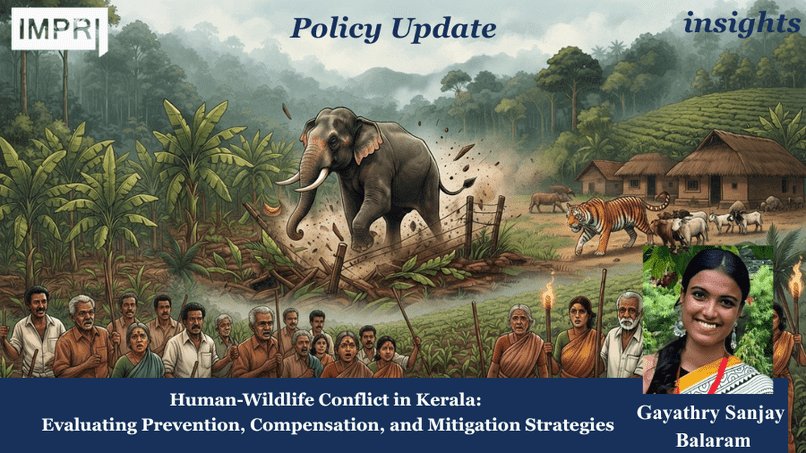
This tragedy is far from an isolated event. It is one among numerous human-wildlife conflict incidents reported across Kerala over the past year, reflecting a disturbing rise in encounters between people and wildlife. Traditionally, such conflicts were largely confined to the state’s forest-fringe districts and hill regions where communities have long coexisted with ecologically sensitive landscapes. However, recent years have witnessed a worrying shift. Wildlife sightings and attacks are increasingly being reported in villages, towns, and even urban neighbourhoods, blurring the once-clear boundaries between human settlements and natural habitats.
Kerala’s extraordinary biodiversity is one of its greatest ecological assets. Nearly one-third of the state’s geographical area is under forest cover, and the Western Ghats, recognised as a global biodiversity hotspot, support a remarkable diversity of flora and fauna. Yet, rapid urbanisation, habitat fragmentation, infrastructure expansion, climate variability, and changing land-use patterns have intensified interactions between humans and wildlife. Elephants raid crops and enter residential areas, wild boars damage farms, leopards stray into populated localities, monkeys disrupt urban life, and snakes increasingly find their way into homes. Consequently, human-wildlife conflict has evolved from a challenge affecting forest-edge communities into a statewide public policy concern.
As these incidents become more frequent and geographically widespread, Kerala faces the difficult task of balancing biodiversity conservation with public safety. The challenge is no longer simply preventing wildlife from entering human settlements but designing policies that enable sustainable coexistence while minimising the risks to both human lives and wildlife.
Functioning
Kerala has adopted a comprehensive and multi-layered framework to manage human-wildlife conflict by combining institutional coordination, technological innovation, habitat management and community participation. The Department of Forest and Wildlife serves as the nodal agency responsible for implementing prevention, mitigation and compensation measures across the state in coordination with local self-government institutions, the Kerala State Disaster Management Authority and other line departments.
The state’s emergency response system is anchored by a 24×7 State Emergency Operating Centre (SEOC), supported by 36 divisional emergency centres and Rapid Response Teams (RRTs) deployed across conflict-prone districts. These teams respond to wildlife emergencies, rescue stranded animals, assist affected communities and help minimise damage caused by wildlife entering human settlements. Local Self Government heads and secretaries have also been designated as honorary wildlife wardens to strengthen coordination between the Forest Department and local communities.
Prevention remains central to Kerala’s conflict mitigation strategy. The state has installed solar fencing, solar hanging fencing, elephant-proof trenches, railway fencing and elephant barriers to reduce wildlife intrusion into agricultural lands and residential areas. At the same time, habitat restoration measures such as the development of water bodies, fodder resources and native fruit-bearing plantations seek to improve the availability of food and water within forests, thereby reducing the movement of wildlife into human settlements.
Technology plays an increasingly important role in wildlife management. Artificial intelligence-enabled cameras, animal intrusion detection systems, drones and early warning systems are used to monitor wildlife movement and alert nearby communities. The M-StriPES mobile application enables real-time patrolling and monitoring by forest officials, while the ONAG digital dashboard records and analyses wildlife-related incidents to support evidence-based decision-making.
Kerala has also adopted a mission-based approach through initiatives such as Mission Real-Time Monitoring, Mission Food-Fodder-Water, Mission Sarpaka, Mission Solar Fencing, Mission Public Sensitisation and Mission Tribal Knowledge. These initiatives focus on wildlife monitoring, snakebite prevention, expansion of protective infrastructure, public awareness and the integration of indigenous knowledge into conflict mitigation strategies.
Recognising that human-wildlife conflict cannot be eliminated entirely, the state has established compensation and rehabilitation mechanisms for victims of wildlife attacks. Financial assistance is provided for human deaths, injuries, crop losses, livestock losses and property damage. The Navakiranam rehabilitation initiative also supports the voluntary relocation of families living in high-conflict areas. Through this integrated framework, Kerala seeks to balance biodiversity conservation with the protection of human lives and livelihoods.
Performance
Kerala has significantly strengthened its institutional and financial response to human-wildlife conflict over the past few years. Budgetary allocations for conflict mitigation have steadily increased from ₹22 crore in 2021-22 to ₹25 crore in 2022-23, ₹30.85 crore in 2023-24 and ₹48.85 crore in 2024-25. In 2025-26, the state allocated ₹192 crore for conflict prevention measures and announced the expansion of Rapid Response Teams to improve emergency response in vulnerable districts. An additional special fund of ₹110 crore has also been earmarked to strengthen mitigation infrastructure and improve preparedness.
Figure 1. Government Budget Allocation for Human-Wildlife Conflict Mitigation in Kerala (2021–22 to 2025–26)
Source: Kerala State Planning Board; Kerala Budget Documents.
The state’s investment has translated into the expansion of preventive infrastructure and technological interventions. Solar fencing, elephant-proof trenches, artificial intelligence-enabled surveillance systems, early warning mechanisms and real-time monitoring platforms have been deployed across conflict-prone regions. The government has also strengthened compensation and rehabilitation measures by providing financial assistance for human fatalities, injuries, crop losses, livestock deaths and property damage. Initiatives such as Navakiranam have facilitated the voluntary relocation of vulnerable families living in high-conflict areas, while enhanced assistance has been extended to victims of snakebites and other wildlife-related incidents.
Despite these interventions, recent data indicate that human-wildlife conflict continues to pose a significant governance challenge. According to the Kerala State Planning Board, the state recorded 10,627 human-wildlife conflict incidents during 2023-24, compared with 8,873 incidents in 2022-23. During 2023-24 alone, 76 people lost their lives, 1,603 sustained injuries, 807 livestock deaths were reported, and more than 8,000 incidents of crop and property damage were documented. Compensation claims have also increased steadily over the years, reflecting both the growing frequency of conflicts and greater public reliance on government relief mechanisms.
Figure 2. Reported Human-Wildlife Conflict Incidents in Kerala (2022–23 and 2023–24)

Source: Kerala State Planning Board, Human-Wildlife Conflict in Kerala.
Independent assessments suggest that while Kerala has emerged as one of the leading states in adopting technology-driven and community-based mitigation measures, implementation challenges persist. Habitat fragmentation, degradation of forest ecosystems, delayed completion of mitigation infrastructure and increasing human settlements along forest fringes continue to drive conflict. The persistence of fatalities and rising incident numbers indicate that although the state’s response capacity has improved considerably, existing interventions have not yet addressed the underlying ecological and socio-economic causes of human-wildlife conflict. Sustained habitat restoration, improved inter-agency coordination and long-term landscape-level planning will therefore be critical to enhancing the effectiveness of Kerala’s conflict mitigation framework.
Impact
Kerala’s human-wildlife conflict management framework has strengthened the state’s institutional capacity through improved emergency response, technological innovation and community participation. The expansion of Rapid Response Teams, artificial intelligence-enabled surveillance systems, early warning mechanisms and physical barriers has enabled quicker responses to wildlife incursions in several conflict-prone districts. Compensation and rehabilitation schemes have also provided financial assistance to families affected by wildlife attacks, while habitat restoration initiatives and public awareness campaigns have encouraged greater participation in conflict mitigation and biodiversity conservation.
Despite these interventions, the overall impact has remained uneven as human-wildlife conflict continues to pose a serious threat to lives and livelihoods across the state. In February 2024, the death of a farmer in Wayanad following a wild elephant attack triggered widespread public protests and renewed demands for stronger mitigation measures, faster emergency response and improved coordination between the Forest Department and local authorities. The incident prompted both the Kerala government and the Union Government to review existing conflict management strategies and accelerate preventive interventions.
The challenge is also extending beyond Kerala’s traditional forest-fringe districts. In August 2025, a 64-year-old woman was killed by a wild elephant in Edavanna, Malappuram, after the animal had strayed into human settlements and damaged agricultural land for several days. The incident sparked protests from local residents, who alleged inadequate warning and delayed preventive action by authorities. It highlighted the growing vulnerability of districts that are not typically associated with large forest landscapes and reinforced the need for a statewide conflict mitigation strategy.
Recent academic literature further argues that existing interventions remain largely reactive, focusing on emergency response and compensation after conflict occurs rather than addressing its underlying ecological and social drivers. Habitat fragmentation, degradation of forest ecosystems, invasive species and changing land-use patterns continue to increase interactions between humans and wildlife. While Kerala has emerged as one of India’s leading states in adopting technology-driven and community-oriented mitigation measures, achieving long-term coexistence will require integrated landscape planning, habitat restoration and greater community participation alongside effective emergency response. Overall, the state’s framework has improved preparedness and institutional coordination, but sustained policy reforms remain essential to ensure both public safety and biodiversity conservation.
Emerging Issues
Despite significant investments in technology, infrastructure and institutional reforms, human-wildlife conflict continues to intensify across Kerala. Recent studies suggest that the challenge extends beyond isolated wildlife encounters and reflects deeper ecological, governance and socio-economic issues. While the state has strengthened its response mechanisms, several structural challenges continue to limit the long-term effectiveness of the existing framework and require sustained policy attention.
- Habitat fragmentation and ecological degradation: Expansion of roads, settlements, tourism infrastructure and plantations has fragmented wildlife habitats and disrupted traditional animal movement corridors. The degradation of forests has reduced the availability of natural food and water, forcing wildlife to venture into agricultural lands and residential areas.
- Spread of invasive species: The rapid spread of invasive species such as Senna spectabilis and Lantana camara has displaced native vegetation and degraded forest ecosystems. This has reduced fodder availability for herbivores, increasing the likelihood of elephants, gaurs and wild boars entering human settlements in search of food.
- Changing land-use and cropping patterns: Expansion of agriculture near forest boundaries and cultivation of crops that attract wildlife have intensified crop raiding and increased interactions between people and wild animals.
- Conflict extending beyond forest fringes: Human-wildlife conflict is no longer confined to districts such as Wayanad and Idukki. Incidents are increasingly reported in districts with limited forest cover, indicating that the issue has evolved into a statewide governance challenge requiring coordinated planning across sectors.
- Predominantly reactive management: Existing interventions continue to prioritise emergency response, compensation and post-conflict mitigation. Greater emphasis is needed on habitat restoration, wildlife corridor conservation, scientific land-use planning and conflict prevention.
- Limited community participation: Although local communities bear the greatest costs of human-wildlife conflict, their participation in planning, monitoring and decision-making remains limited. Strengthening community institutions and incorporating indigenous knowledge can improve the sustainability of mitigation efforts.
- Weak inter-departmental coordination: Human-wildlife conflict intersects with forestry, agriculture, disaster management, rural development and local governance. Better coordination among these departments is necessary for timely implementation of mitigation measures and landscape-level planning.
- Need for an interdisciplinary approach: Recent scholarship argues that human-wildlife conflict should not be viewed solely as a conservation issue. It is also a social, economic and governance challenge that requires integrating ecological science with sociology, anthropology, economics and ethics to develop more inclusive and sustainable solutions.
Way Forward
Kerala has developed one of India’s most comprehensive frameworks for mitigating human-wildlife conflict through technological innovation, institutional reforms and community-based interventions. However, the increasing frequency of conflicts demonstrates that the next phase of policy must focus on prevention, ecological restoration and long-term coexistence rather than emergency response alone.
The state should prioritise landscape-level conservation by restoring degraded habitats, removing invasive species such as Senna spectabilis and Lantana camara and protecting wildlife corridors from unplanned development. Mission Food-Fodder-Water should be expanded to improve the availability of natural food and water within forests, thereby reducing the need for wildlife to venture into agricultural lands and human settlements. Development projects in ecologically sensitive areas should incorporate wildlife impact assessments at the planning stage to minimise habitat fragmentation.
Kerala should strengthen its existing technology-driven interventions by integrating artificial intelligence surveillance, GIS mapping and predictive analytics into a unified conflict forecasting platform. Rather than expanding expensive infrastructure across the state, predictive risk mapping can identify high-risk locations and enable Rapid Response Teams to intervene before conflicts occur. Existing SMS-based early warning systems should be expanded and linked with local self-government institutions so that residents receive timely alerts regarding wildlife movement. This approach is financially viable because it builds upon infrastructure that already exists within the Forest Department.
Community participation should become central to conflict mitigation. Panchayats, Eco-Development Committees and tribal communities should be given a greater role in wildlife monitoring, maintenance of mitigation infrastructure and public awareness programmes. Drawing lessons from Namibia’s community conservancy model, Kerala can introduce performance-based incentives for local bodies that successfully maintain solar fencing, reduce conflict incidents and restore degraded habitats. Such incentives are considerably less expensive than repeated compensation payments and encourage long-term stewardship of natural resources.
Agricultural adaptation should complement wildlife management. Scientific crop zoning near forest boundaries, promotion of less wildlife-attractive crops in highly vulnerable areas and pilot projects using low-cost bio-fencing or beehive fences where ecologically appropriate can reduce crop damage while providing supplementary income to farmers. These interventions should be implemented selectively based on local ecological assessments rather than through a uniform statewide programme.
Finally, Kerala should pursue its proposal to introduce a dedicated chapter on human-wildlife conflict mitigation within the Wildlife (Protection) Act, 1972 to strengthen institutional coordination and enable faster decision making during emergencies. The state should also deepen collaboration with Karnataka and Tamil Nadu through joint monitoring, data sharing and coordinated management of transboundary wildlife populations. Periodic policy evaluation, stronger partnerships with research institutions and sustained financial support from both the State and Union Governments will ensure that conflict mitigation remains adaptive to changing ecological conditions. By combining scientific planning, ecological restoration and community participation, Kerala can move towards a resilient and financially sustainable model of human-wildlife coexistence that protects both biodiversity and human well-being.
References
Department of Forests and Wildlife, Government of Kerala. (2025). Human-Wildlife Conflict Mitigation: A Comprehensive Approach. Kerala Calling
State Planning Board, Government of Kerala. (2025). Addressing Issues Related to Human-Wildlife Interactions in Kerala. State Planning Board Report
The New Indian Express. (2026, March 11). Kerala Proposes Dedicated Chapter on Human-Wildlife Conflict in 1972 Act. The New Indian Express Article
The Hindu. (2025). Three-Pronged Strategy to Tackle Rising Human-Wildlife Conflict in Kerala
Department of Forests and Wildlife, Government of Kerala. (2025). Aranyam. Department of Forests and Wildlife, Government of Kerala.
Panthi. (2025). Mitigating Human-Wildlife Conflicts in Kerala: Strategies for Coexistence. Panthi.
Haneefa, P. (2025). Why Kerala Needs Anthrotherology to Handle Human-Wildlife Conflict. SSRN Electronic Journal.
Radhakrishnan, S., & Kala, M. K. (2020). Human-Wildlife Conflict: A Case Study in Kerala. ResearchGate.
Down To Earth. (2025). Conflict in the Backyard: Is Fortress Conservation at the Root of Kerala’s Human-Wildlife Clashes?. Down To Earth.
About the Contributor
Gayathry Sanjay Balaram is a research and editorial intern at IMPRI. She is currently pursuing an MA Dual Degree Program in Public Policy and International Relations from the Tata Institute of Social Science. She completed her undergraduate studies at Banaras Hindu University in Political Science honors.
Acknowledgement
The author extends sincere gratitude to the Impact and Policy Research Institute team for their guidance. The author also extends heartfelt thanks to Riddhi Bimalkumar Suthar and Asmatwali for their constructive reviews and valuable feedback
Disclaimer: All views expressed in the article belong solely to the author and not necessarily to the organisation.
Read More at IMPRI:
Incubating Innovation: A Policy Update on iStart Rajasthan’s Startup Ecosystem