








Policy Update
Paridhi Passi
Introduction
Rural India’s Self-Help Group network has long been the backbone of women’s collective savings and micro-enterprise, but it had never before been linked directly to advanced agri-technology at national scale. The Namo Drone Didi Scheme was designed to make that connection. Prime Minister Narendra Modi launched the scheme through video conferencing on 30 November 2023, with the Government subsequently approving it as a Central Sector Scheme under the Department of Agriculture and Farmers Welfare, in convergence with the Deendayal Antyodaya Yojana, National Rural Livelihoods Mission.
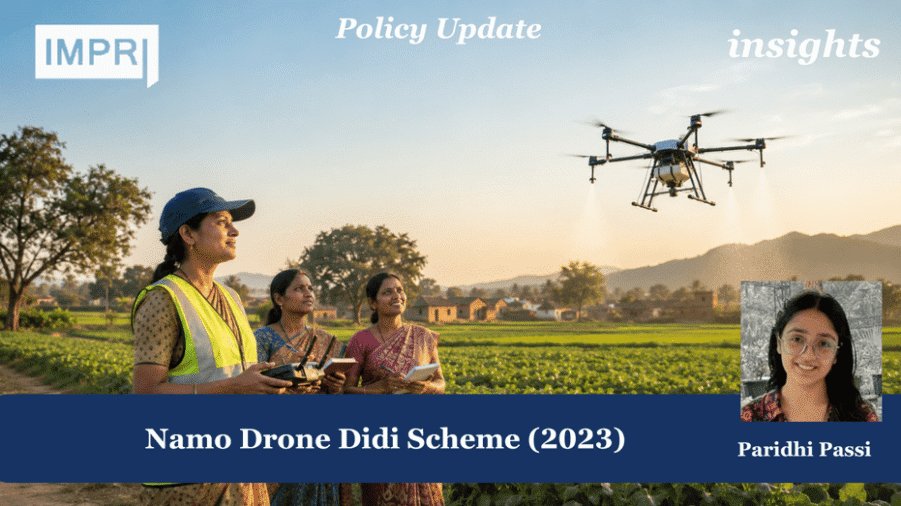
The scheme’s basic premise is straightforward. Women Self-Help Groups are given drones on heavy subsidy, trained to fly them, and then positioned as service providers who rent out drone-spraying services to farmers in their area, earning income while modernising how Indian agriculture applies fertiliser and pesticide. In practical terms, this translates into real time savings on the ground: an economics and viability study conducted on the initial batch of 500 distributed drones found that these drones cover roughly one acre in seven to eight minutes, with flight time on a single battery charge ranging between five and twenty minutes depending on the manufacturer.
Background
Before this scheme, India’s push toward agricultural drone use was scattered across private operators and a handful of pilot programmes, with almost no organised path for rural women to enter this space as owners or operators. The Government approved Namo Drone Didi with an outlay of Rs. 1,261 crore for the period from 2023-24 to 2025-26, targeting 15,000 selected Women SHGs to be equipped with drones. Under the scheme, Central Financial Assistance of 80% of the cost of the drone and accessories, up to a maximum of Rs. 8 lakh, is provided to the selected SHGs, with the remaining amount available as a loan under the National Agriculture Infra Financing Facility, carrying an interest subvention of 3% per year.
The drone package is comprehensive rather than a bare machine: it includes a spray assembly, spare battery sets, a downward-facing camera, an anemometer and pH meter, one year of comprehensive insurance, a two-year annual maintenance contract, and 15 days of training for the drone pilot along with additional training for a drone assistant.
Table 1: Namo Drone Didi Scheme at a Glance
| Parameter | Detail |
| Launch date | 30 November 2023 |
| Implementing period | 2023-24 to 2025-26 |
| Total outlay | Rs. 1,261 crore |
| Drone target | 15,000 (revised operational target: 14,500) |
| Subsidy | 80% of drone cost, capped at Rs. 8 lakh |
| Loan facility | National Agriculture Infra Financing Facility, 3% interest subvention |
| Training | 15-day pilot training, additional drone assistant training |
Source: Press Information Bureau, Government of India.
Figure: Benefits of Namo Drone Didi Scheme
Source: Press Information Bureau, Government of India.
Functioning
The scheme is governed centrally by an Empowered Committee comprising Secretaries from the Department of Agriculture and Farmers Welfare, the Department of Rural Development, the Department of Fertilizers, and the Ministry of Civil Aviation. At the state level, Lead Fertilizer Companies act as the implementing agencies, coordinating with state departments, drone manufacturers, and Cluster Level Federations of SHGs to procure and deliver drones through a transparent process, with ownership resting with the SHGs themselves.
One member of a selected SHG is trained as a certified drone pilot, earning the title of Drone Didi upon completion of the Remote Pilot Certificate. A second member, often a family member with an inclination toward electrical or mechanical repair work, is trained as a drone assistant. States are expected to help each SHG manage between 2,000 and 2,500 acres of drone-based spraying annually, with selection of SHGs based on assessed agricultural demand in the area.
Table 2: Institutional Roles under the Scheme
| Actor | Role |
| Empowered Committee (Centre) | Overall policy governance and coordination |
| Department of Fertilizers | Nodal department for Lead Fertilizer Company coordination |
| Lead Fertilizer Companies | Drone procurement, delivery, training rollout at state level |
| State Governments | SHG selection, demand assessment, handholding support |
| Cluster Level Federations of SHGs | Own the drones, raise supplementary loan finance |
Source: Press Information Bureau, Government of India, Operational Guidelines.
Performance
Progress so far has been measured rather than sweeping. As of the scheme’s most recent parliamentary update, Lead Fertilizer Companies had distributed 1,094 drones to Drone Didis using their own internal resources in 2023-24, of which 500 drones were distributed specifically under the Namo Drone Didi Scheme itself. The remaining allocation of 14,500 drones has been communicated to state governments for phased rollout. Karnataka has emerged as the leading state in training women as certified drone pilots, with Uttar Pradesh and Andhra Pradesh following as the next-highest performing states.
An economics and viability study conducted on the initial batch of 500 distributed drones found that these drones cover roughly one acre in seven to eight minutes, with flight time on a single battery charge ranging between five and twenty minutes depending on the manufacturer. The same study flagged that a majority of Drone Didis found hiring transport vehicles for the drones costly, a finding that has since fed into a supplementary provision under the Sub-Mission on Agricultural Mechanization to fund multi-utility vehicles for drone transport.
Table 3: Drone Distribution Progress
| Metric | Figure |
| Total drones distributed by LFCs (2023-24, own resources) | 1,094 |
| Of which, distributed under the Scheme | 500 |
| Remaining drones allocated to states | 14,500 |
| Leading state in pilot training | Karnataka |
| Area typically covered per acre by drone | 7-8 minutes |
Source: Press Information Bureau, Government of India.
Emerging Issues
The pace of actual drone distribution against the 15,000-unit target remains the scheme’s clearest gap; roughly 500 units placed under the scheme itself, against a multi-year target of 14,500 to 15,000, indicates the rollout is still in an early phase relative to its own timeline. Transport logistics for the drones have also emerged as a genuine operational constraint for many SHGs, as confirmed by the government’s own field study.
Uneven state-level uptake is another concern. Karnataka’s early lead reflects its stronger existing agri-tech ecosystem and SHG federation network, but the same conditions do not exist uniformly across states, meaning the scheme’s benefits may concentrate regionally unless targeted handholding support reaches weaker-capacity states. Battery life and payload limitations of currently deployed drones also constrain the acreage a single Drone Didi can service in a day, directly affecting the income potential the scheme promises.
Beyond this daily ceiling, the recurring operational downtime caused by battery recharging cycles and maintenance needs adds a further, compounding constraint, one that could meaningfully affect the scheme’s scalability and overall effectiveness as the number of operational drones increases.
Way Forward
Scaling distribution toward the full 14,500-15,000 target requires closer monitoring of state-wise allocation timelines, since delays at the Lead Fertilizer Company or state department level directly slow the number of women who can be trained and equipped. Extending the multi-utility vehicle support already introduced under the Sub-Mission on Agricultural Mechanization more widely, rather than leaving it as a supplementary provision, would directly address the transport cost issue flagged in the government’s own evaluation. States lagging behind Karnataka in SHG readiness would benefit from targeted convergence with existing DAY-NRLM capacity-building resources, rather than waiting for organic demand to build.
A public, state-wise dashboard tracking drones distributed, SHGs trained, and acreage serviced would allow the scheme’s own stated targets to be checked against delivery in real time. Given the transport and battery-life constraints already identified, a mid-course technical review of the drone package specifications, in consultation with the Drone Didis actually operating them, would help ensure future units address the frictions surfaced by the ADRTC study rather than repeating them. Finally, since income potential depends on service demand from local farmers, pairing the scheme with farmer-facing awareness campaigns on the benefits of drone-based spraying would help ensure the acreage targets set for each SHG are realistically achievable.
Conclusion
Namo Drone Didi links two of India’s most important rural policy threads, women’s Self-Help Groups and agricultural modernisation, in a single scheme with a clear financial architecture and a defined institutional chain of delivery. Its ambition, 15,000 women equipped as certified drone operators, is significant, and the early state-level leadership shown by Karnataka demonstrates that the model can work where SHG infrastructure is already strong.
The test now is distribution pace: with only a few hundred drones placed under the scheme itself against a 14,500-plus target, and real transport and technical constraints already documented by the government’s own field study, the coming implementation years will determine whether Namo Drone Didi becomes a genuinely transformative rural livelihood programme or remains a promising pilot stretched thin across a large target.
References
- Department of Agriculture & Farmers’ Welfare, Government of India. (2024). Operational Guidelines of Central Sector Scheme “Namo Drone Didi”. Press Information Bureau. https://www.pib.gov.in/PressReleasePage.aspx?PRID=2070029
- Department of Fertilizers, Government of India. (2026). Implementation of Drone Didi Scheme. Press Information Bureau. https://www.pib.gov.in/PressReleasePage.aspx?PRID=2149706®=3&lang=2
- Government of India. (2024). Namo Drone Didi. Lakhpati Didi Portal. https://lakhpatididi.gov.in/power_to_empower/namo-drone-didi/
- Department of Agriculture and Farmers Welfare, Government of India. Namo Drone Didi Scheme Portal. https://namodronedidi.da.gov.in/
About the Contributor
Paridhi Passi is a Research and Editorial Intern at IMPRI and a Political Science (Hons.) student at Daulat Ram College, University of Delhi. Her academic interests lie in public policy and governance.
Acknowledgement
The author extends sincere thanks to the IMPRI team for their guidance.
Reviewed by: Simona Hughes & Rathin Pathak
Disclaimer: All views expressed in the article belong solely to the author and not necessarily to the organisation.
Read More at IMPRI:
Incubating Innovation: A Policy Update on iStart Rajasthan’s Startup Ecosystem
The Jammu and Kashmir Industrial Policy, 2021-30: A Catalyst for Socio-Economic Transformation