








Policy Update
Ameya Satam
Introduction:
QUAD is the diplomatic partnership group of four countries – Japan, India, Australia and the United States, which is also identified as “Quadrilateral Security Dialogue”. This group works with the agenda of keeping the world at peace and keeping the Indo-Pacific open, free, prosperous, and inclusive. QUAD focuses on the fields of health security, climate change, critical and emerging technologies, infrastructure and debt sustainability, cyber security, humanitarian assistance and disaster relief, and strengthening the maritime domain awareness of regional countries. The regular engagements of the QUAD occur through Leaders, Foreign Ministers, QUAD Sherpas, senior officials, and experts (Ministry of External Affairs, 2023).
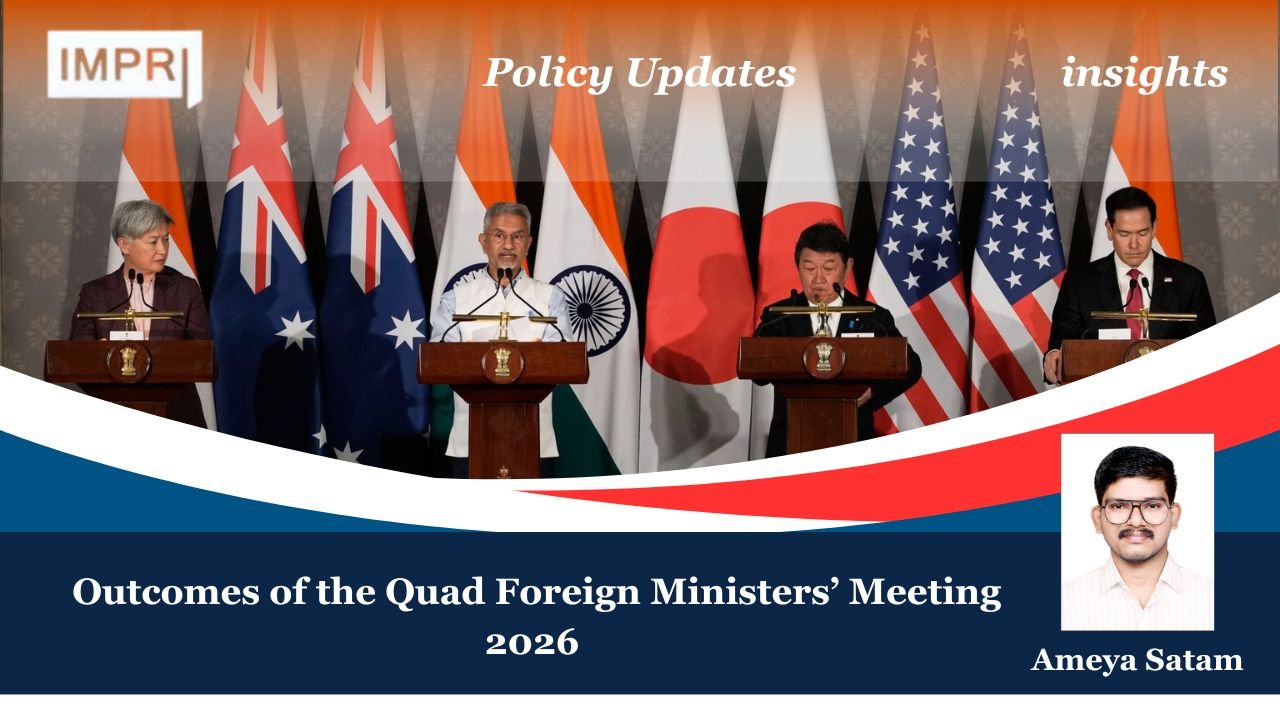
Every year, a meeting of the QUAD Foreign Ministers occurs, and various topics are discussed in it, and new decisions are made. This year as well, the QUAD Foreign Ministers meeting was organized in New Delhi on 26 May, which was hosted by India. In this meeting, the conflict in the Strait of Hormuz and the Red Sea was discussed along with the implications of these conflicts on the Indo-Pacific’s global trade and connectivity.
The Foreign Ministers expressed their concerns over the affairs in the East China Sea and the South China Sea, especially on the militarization in the disputed areas. They reemphasized that the maritime disputes should be settled under the framework of the United Nations Convention on the Law of the Sea (UNCLOS).
The concern over the Myanmar Conflict was also expressed in the meeting. The Foreign Ministers also reasserted their focus on the complete denuclearization of North Korea in compliance with the current UNSCRs and condemned the illegal development of ballistic missiles and weapons of mass destruction and ballistic missile programs by North Korea (Ministry of External Affairs, 2026). They also expressed concern over the malicious cyber activities and IT worker activities by North Korea, as these activities aid North Korea in developing illegal weapons of mass destruction and ballistic missile programs (Ministry of External Affairs, 2026).
Significant Outcomes of the Meeting:
Maritime Security
The QUAD will support the development of a Common Operational Picture (COP) across the Indo-Pacific by building on existing IPMDA efforts. The latest technological developments in Indo-Pacific Maritime Surveillance Collaboration (IPMSC) will strengthen IPMDA. Due to this, the QUAD partners will be able to share real-time information, and they will also be able to provide better quality images of vessels in the Indo-Pacific. India will host the next edition of the Quad-at-Sea Ship Observer Mission. QUAD is going to strengthen cooperation in law enforcement and regulatory engagement, including building partners’ potential to combat online scam centres and associated transnational organized crime.
Economic Prosperity and Security
The QUAD Critical Minerals Framework was announced with the purpose of fostering its vision for fair and diversified critical minerals markets. The QUAD Initiative on Indo-Pacific Energy Security has been launched to work together on energy security and resilience as the global energy settings keep on changing. The QUAD Countries are going to work in collaboration with the Government of Fiji to upgrade port infrastructure and other linked activities in the country (Ministry of External Affairs, 2026). The QUAD Partnership for Cable Connectivity and Resilience is making efforts to confirm that all Pacific Island Forum countries are connected via undersea cables by 2026 to anchor their future in the digital world (Ministry of External Affairs, 2026).
Critical and Emerging Technology
In the upcoming months, the QUAD countries are going to make progress in working on next-generation communications standards. The QUAD partner countries have declared an investment of over $6 million in grants for six international research projects under the Advancing Innovations for Empowering NextGen Agriculture (AI-ENGAGE) initiative (Department of Foreign Affairs and Trade, 2026).
A workshop on digital identity standards will be organized along with a Track 1.5, which will be on the standards workforce development (Ministry of External Affairs, 2026). The Quad and the Pax Silica are collaboratively working on the economic security agenda. QUAD countries are going to deepen their partnerships, which will cover the fields from critical minerals and advanced manufacturing to computing, semiconductors, and trusted networks (Ministry of External Affairs, 2026).
Humanitarian Assistance and Emergency Response
The QUAD countries announced that the Indo-Pacific Logistics Network (IPLN) will be functionalized through a structured series of engagements in Japan, along with a second Tabletop Exercise (TTX) this year (Ministry of External Affairs, 2026). The main reason behind this is to boost the development of Standard Operating Procedures (SOPs), which will speed up their implementation in multi-modal logistics coordination and enhance capabilities in staging, sustainment, and operations. QUAD partners are also providing training to the health professionals to support them during public health emergencies such as disease outbreaks. Tools necessary for helping the people and the region are also being given.
Importance:
Emerging technology and Unmanned systems may be used by the QUAD for the development of a COP across the Indo-Pacific, which will integrate all positioning data for ships, aircraft, satellites, and verified intelligence into one dynamic interface. Unmanned systems like the small Unmanned Aerial Systems (sUASs), medium and long-range Unmanned Aerial Systems (UASs), Unmanned Surface Vessel (USV) and Autonomous Underwater Vehicles (AUVs) may be used for the smooth functioning of COP, which will strengthen the IPMDA.
Emerging technologies like AI, cloud computing, machine learning, and other concepts could be used to turn data into actionable intelligence. The development of a COP is necessary along with technological developments in IPMSC, as these developments will help the Quad countries to cooperate more easily for the maritime security of the Indo-Pacific region.
India hosting the next edition of the ‘Quad-at-Sea Ship Observer Mission’ will strengthen India’s MAHASAGAR vision, and it will support India’s broader vision of Indo-Pacific Oceans Initiative (IPOI). It will aid the countries in joint readiness, domain awareness, and interoperability in the region. This mission will help to notice the unlawful activities at sea.
The launch of the “QUAD Critical Minerals Framework” will strengthen the supply chain cooperation in mining, processing, and recycling. The Quad countries are going to invest USD 20 billion in government and private sector funding, which will aid the supply chains of critical minerals (Cha, 2026). The QUAD Critical Minerals Initiative will help the QUAD partner countries to note down the projects that are being carried out by companies that are headquartered in the QUAD Partner countries.
Stephen Nagy points out that China controls 90% of the global rare earth material supply (as cited in Kim, 2026), the QUAD countries’ collaborative supply chain rearrangements depict a well-planned move to counterbalance China’s regional dominance. This move will reduce the reliance of the QUAD countries on China for rare earth material supplies. For example, Japan is targeting countries like Vietnam and Malaysia for investment in expanding the production capacity of critical minerals.
The investment by the QUAD countries in the upgradation of Fiji ports will strengthen surveillance capabilities and real-time information sharing in the region. Earlier, China had expressed its interest in developing the ports in Fiji, but the QUAD’s timely declaration of investment in the ports’ development has benefited the QUAD countries by restricting China’s influence (Firstpost, 2026).
Deepening of the QUAD countries in the critical and emerging technology sectors gives India a great chance of showcasing its digital governance skills, software capabilities, and enlarging its manufacturing goals (Wadhwa, 2026). Plus, India also has the knowledge of market scale and market depth. India will also have grants for capital, processing know-how, trusted industrial ecosystems, and supply chain unification without necessitating India to give up its diplomatic freedom. Collaboration on Next-Gen Communication Standards will focus on boosting Telecommunications, and collaboration in Open RAN technical standards will focus primarily on 6G standards development (Department of Foreign Affairs and Trade, 2026).
Workshop on Digital Identity Standards will create a technical “translation guide” to intensify cross-border interoperability (Department of Foreign Affairs and Trade, 2026). This project’s main goal is to make sure that QUAD countries and their private sector companies can work with each other without any disruption, with a shared understanding of their digital identity standards. Under the Advancing Innovations for Empowering NextGen Agriculture (AI-ENGAGE) initiative, the tools that will be developed under the research projects will be useful for farmers for better crop yields, pest management, and food security, which will be achieved through technology innovations.
The use of artificial intelligence, robotics, and sensing to transform agriculture and support farmers in the Indo-Pacific through this initiative is the main motive of the QUAD countries.The TTX hosted by Japan will train partner countries to coordinate and give rapid responses to civilians during natural disasters like earthquakes, storms, volcanic eruptions, etc. This exercise may also bring some pressure on China as it is going to be hosted in Japan, which is very close to the East China Sea.
Challenges:
A strained relationship between India and the United States due to Trump’s claim of conciliating the India-Pakistan conflict, which happened in May 2025. Afterwards, the Trump administration levied 50% tariff on India because India continued Russian crude oil imports (Kuriyama & Aoki, 2026). A U.S. submarine attacked and sank an Iranian naval vessel, which had participated in an Indian Navy exercise. This incident ruined India’s image in front of Iran, on which India is dependent for crude oil imports, as the Strait of Hormuz has been blocked by Iran.
The QUAD Summit has not been held since September 2024. If no QUAD Summit gets organized in this whole year, then Japan, India and Australia may feel that the Trump administration doesn’t take the QUAD group seriously. Critics are also highlighting that the QUAD group is becoming irrelevant and it is on the way to extinction, as the QUAD Summit has not happened for more than a year.
Protecting its neutral image, China has claimed the QUAD group is an exclusive grouping that targets a third country. China claimed this because the QUAD countries pointed out the disputes related to the South China Sea and the East China Sea.
Conclusion:
The QUAD countries should organize the QUAD Summit as soon as possible. If the QUAD Summit is organized in Japan, then it may pressurize China on the Taiwan issue. If the President of the U.S., Donald Trump, visits India in the upcoming months, then it may be fruitful for the relations between the U.S. and India.
Developing a COP will strengthen IPMDA because it will become easy for the QUAD countries to identify Chinese vessels in the East China Sea, South China Sea and the Indian Ocean region which may restrict Chinese activities like creating artificial islands, submarine deployments, etc. Information Fusion Centre – Indian Ocean Region (IFC-IOR) can play a critical role in securing the IOR. Training partner countries to potentially combat the online scam centres and associated transnational organized criminal activities like trafficking in persons, drug trafficking, sexual extortion, illicit financing, and other forms of cybercrime will benefit in strengthening cybersecurity and human security. Cyber attacks are common in the Indo-Pacific, and China’s involvement in these attacks is often observed.
The QUAD Initiative on Indo-Pacific Energy Security may create opportunities for investing in those countries that have disputes with China. Japan, Australia and India may help to increase the influence of the QUAD as some countries are not comfortable with the U.S. as an option to China. Collaboration in critical and emerging technology will help the QUAD countries to be dominant in this field against China. Collaborative creation of critical and emerging technology will support the QUAD partner countries to advance in A.I., semiconductors, 5G, 6G, etc on the same speed.
References:
- Ministry of External Affairs. (2026, May 26). Quad Foreign Ministers’ Meeting Joint Statement (May 26, 2026). Government of India. https://www.mea.gov.in/bilateral-documents.htm?dtl/41233/Quad+Foreign+Ministers+Meeting+Joint+Statement+May+26+2026
- Ministry of External Affairs. (2023, October). Brief on Quadrilateral Security Dialogue (Quad). Government of India. https://www.mea.gov.in/Portal/ForeignRelation/Quad_brief_October_2023.pdf
- Business Standard. (2026, May 30). What is Quad? https://www.business-standard.com/about/what-is-quad
- U.S. Naval Institute. (2026, April). Unmanned systems, the Coast Guard, and maritime domain awareness. Proceedings, 152(4). https://www.usni.org/magazines/proceedings/2026/april/unmanned-systems-coast-guard-maritime-domain-awareness
- News On Air. (2025, June 30). Quad nations launch first-ever ‘At Sea Observer Mission’ to boost maritime cooperation. Prasar Bharati. https://newsonair.gov.in/quad-nations-launch-first-ever-at-sea-observer-mission-to-boost-maritime-cooperation/
- Department of Foreign Affairs and Trade. (2026, May 26). Factsheet: Quad Foreign Ministers’ Meeting in New Delhi (May 2026). Australian Government, Minister for Foreign Affairs. https://www.foreignminister.gov.au/minister/penny-wong/media-release/factsheet-quad-foreign-ministers-meeting-new-delhi-may-2026
- The Economic Times. (2026, May 27). Aiming at China, Quad announces massive $20 billion critical minerals framework. https://economictimes.indiatimes.com/industry/indl-goods/svs/metals-mining/aiming-at-china-quad-announces-massive-usd-20-bn-critical-minerals-framework/articleshow/131331741.cms?from=mdr
- Cha, M. (2026, May 27). ‘Quad Targets China,’ direct hit on South China Sea dispute… pushes for $20 billion critical minerals investment. The Asia Business Daily. https://www.asiae.co.kr/en/article/2026052708523951519
- Kim, F. (2026, April 29). Indo-Pacific partners reconfigure supply chains to counter China’s critical minerals leverage. Indo-Pacific Defense FORUM. https://ipdefenseforum.com/2026/04/indo-pacific-partners-reconfigure-supply-chains-to-counter-chinas-critical-minerals-leverage/#:~:text=Allies%20and%20Partners%20are%20reshaping,on%20China%2Dcontrolled%20critical%20minerals.%20Adding
- Firstpost. (2026, May 28). Fiji sees Quad port initiative as boost for billion-dollar Suva redevelopment plan. https://www.firstpost.com/world/fiji-sees-quad-port-initiative-as-boost-for-billion-dollar-suva-redevelopment-plan-14015816.html
- Wadhwa, A. (2026, May 28). The Quad Foreign Ministers’ Meeting in New Delhi: A timely reappraisal. Vivekananda International Foundation. https://www.vifindia.org/article/2026/may/28/The-Quad-Foreign-Ministers-Meeting-in-New-Delhi-A-Timely-Reappraisal
- Kuriyama, H., & Aoki, S. (2026, May 28). Tokyo, Canberra should deepen relations to level equivalent to alliance. The Japan News / The Yomiuri Shimbun. https://japannews.yomiuri.co.jp/politics/defense-security/20260528-329596/
- India-West. (2025, December 17). Quad conducts first field exercise for Indo-Pacific disaster response. https://indiawest.com/quad-conducts-first-field-exercise-for-indo-pacific-disaster-response/
- Mondschein, J. (2026, May 29). Quad’s vital role endures despite challenges. Mirage News. https://www.miragenews.com/quads-vital-role-endures-despite-challenges-1682856/
- The Economic Times. (2026, May 29). Quad rejects bloc confrontation, focuses on development in Indo-Pacific, says MEA. https://economictimes.indiatimes.com/news/india/quad-rejects-bloc-confrontation-focuses-on-development-in-indo-pacific-says-mea/articleshow/131391070.cms?from=mdr
- Sharma, A. (2025, September 10). Indo-Pacific responses to Chinese cyber hegemony. Observer Research Foundation. https://www.orfonline.org/expert-speak/indo-pacific-responses-to-chinese-cyber-hegemony
About the Contributor
Ameya Satam is a Research & Editorial Intern at IMPRI specializing in International Relations and Strategic Studies. He completed his post-graduation in International Relations at Sikkim University, focusing on Indo-Pacific geopolitics and India–US cooperation, and is dedicated to analyzing regional security frameworks to inform evidence-based policy discourse.
Acknowledgement
I would like to extend my sincere gratitude to Mr.Suheb Syed, Ms.Simona Hughes and IMPRI India for their guidance and support.
Disclaimer: All views expressed in the article belong solely to the author and not necessarily to the organization.