





Policy Update
Sneha Sharma
Introduction & The Global Existence
- World MSME Day
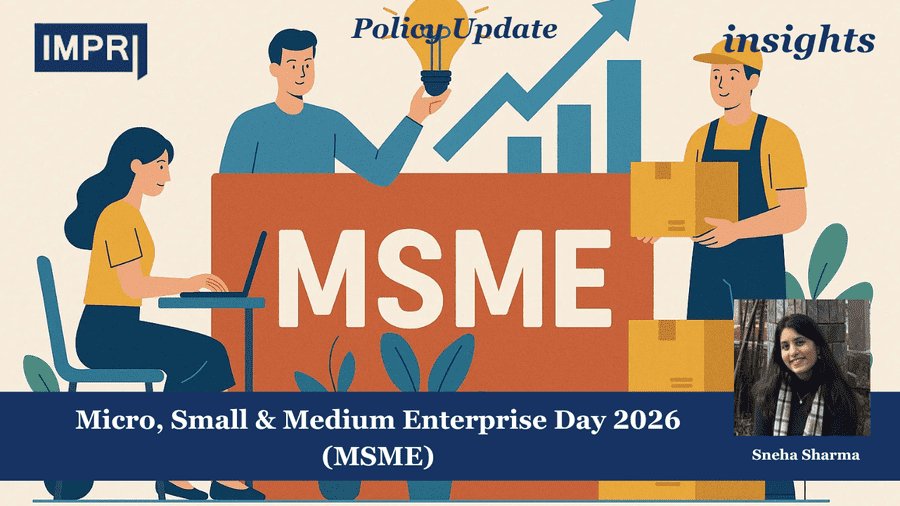
World MSME Day owes its existence not to symbolism but to built-on deliberate consensus. On 6 April 2017, the United Nations General Assembly adopted Resolution A/RES/71/279, designating 27 June as Micro, Small, and Medium-sized Enterprises Day. The resolution was co-sponsored by 54 member states, together representing more than five billion people. It was seen as a chance for giving priority to cross-regional development in emerging economies.
The institutional rationale behind the designation was explicit: the UN intended the day to function as an advocacy and accountability instrument for the 2030 agenda. The day raises awareness of the contributions of MSMEs to achieving the UN sustainable development goals, with two SDGs carrying particular weight on this mandate.
- SDG 8 (Decent work and economic growth) – MSMEs are seen as primary job givers to new entrants into the labor force, particularly as given by the UN’s own projection that 600 million new jobs will be needed by 2030 to absorb the growing global workforce.
- SDG 9 (Industry, Innovation, and Infrastructure) – Positioning MSME as the diffusion layer through which industry, innovation, and infrastructure are fueled.
- The 2026 International Lens
The 2026 observance arrives under the theme “Human-Centered Entrepreneurship in an AI-Driven Future,” the focus of this year’s International Forum on MSMEs. The forum places human-centered entrepreneurship at the center of the AI transformation, on the premise that technology only serves its purpose if it serves people. The United Nations Industrial Development Organization is holding an MSME Day 2026 celebration at the Vienna International Centre on 25 June, bringing together government, MNCs, and private sector representatives to anchor the same theme in industrial policy terms.
The theme responds to a structural anxiety that the AI wave, unlike previous waves of digitalization, could bypass or actively displace the smallest and most labor-intensive enterprises unless deliberately designed to include them. MSMEs account for 90% of businesses, 60-70% of employment, and roughly 50% of GDP worldwide, making them simultaneously the most consequential and the most exposed segment of the global economy to any technological discontinuity that does not center their realities.
In the era of an AI-driven future, India’s own MSME story carries particular weight. With one of the largest MSME bases in the world, India is not just commemorating World MSME Day, but it is also using it as a platform to work on what human-centered entrepreneurship looks like at scale.
The Indian Landscape & The ‘Udyami Bharat’ Paradigm
- Legal and Structural Definition
India’s MSME classification is built on the MSMED Act, 2006. Which applies a composite criterion an enterprise must satisfy both an investment threshold and a turnover threshold to qualify for a given category. The criteria are deliberate; it prevents enterprises from gaming temporary dips in turnover to retain smaller category benefits while protecting genuinely falling firms from being penalized on a single bad year.
The threshold was substantially revised for the first time since 2020. Presenting the union budget 2025-26, finance minister Nirmala Sitharaman announced that investment and turnover limits for classification of all MSMEs would be enhanced to 2.5 times and 2 times, respectively, with effect from 1 April 2025.
| Category | Investment (Plant & Machinery/Equipment) | Annual Turnover |
| Micro | Up to ₹2.5 crore | Up to ₹10 crore |
| Small | Up to ₹25 crore | Up to ₹100 crore |
| Medium | Up to ₹125 crore | Up to ₹500 crore |
Source : Ministry of Micro, Small , & Medium Enterprises (MoMSME), Govt. of India
The policy logic behind this revision was explicitly framed around scale and survival pressure. This revision has given more power to the MSMEs to achieve higher technological upgradation and better access to capital, giving them confidence to grow and generate employment. The revision was needed as the 2020 framework was becoming too tight, pushing a lot of MSMEs out of the status simply due to inflation-linked growth and not genuine graduation into a competitive tier.
- Commemoration as Policy Action : Udayami Bharat – MSME Day
India does not celebrate 27 June as a passive observance as in the UN calendar. Since the Ministry of MSME began formally marking this day, it has been used as the occasion for the policy rollout platform for new schemes, portals, and reports for building commemoration with delivery.
- 2023 – The Udyami Bharat MSME day event at Vigyan Bhawan saw the unveiling of the Champions 2.0 portal and a mobile app for geo-tagging cluster projects and technology centers. Organizing MSME idea hackathons and a dedicated hackathon track for women entrepreneurs.
- 2024 – The ministry launched the MSME team scheme, with an outlay of Rs. 277 crore to support five lakh micro and small enterprises through digital onboarding, logistics, and packaging support alongside the Yashasvini campaign for formalizing women-led enterprises in partnership with NITI Aayog.
- 2025 – President Droupadi Murmu presided over the event, where the ministry launched a new online dispute resolution portal aimed at addressing delayed-payment disputes and released a special postage stamp marking 25 years of the Credit Guarantee Fund Trust for Micro and Small Enterprises (CGTMSE), which by then had sanctioned over 1.18 crore credit guarantees worth nearly ₹9.8 lakh crore.
| Year | Initiative / Portal Launched | Number of Users Onboarded | Portal Utilisation Metrics | Scheme Outcomes & Impact |
| 2023 | Champions 2.0 Portal & Mobile App | Over 7.83 crore total micro and small units integrated across formal registers by early 2026. | Real-time geo-tagging of cluster projects and technology centers. | Enhanced localized project tracking; introduced dedicated ideation tracks explicitly for women entrepreneurs. |
| 2024 | MSME TEAM Scheme & Yashasvini Campaign | Targets 5 lakh micro and small enterprises for digital transition. | Multi-agency onboarding channels driven via NITI Aayog partnerships. | Structured financial outlay of ₹277 crore providing digital onboarding, logistics, and packaging infrastructure. |
| 2025 | Online Dispute Resolution Portal (Samadhaan/Delayed Payments) | Over 2.18 lakh applications filed since its structural inception. | Resolves commercial transaction blockages; handles an approximate total volume of ₹48,000–₹50,000 crore in claimed backlogs. | Successfully disposed of or actioned cases, managing a critical cash-flow pipeline; backed by Section 43B(h) income tax enforcement. |
Source : Ministry of Micro, Small & Medium Enterprises (MoMSME), Govt. of India
The Ministry of MSME acts as the nodal architect, setting the annual theme, timing scheme launches, and convening the flagship Delhi event. Small Industries Development Bank of India (SIDBI), as the apex refinancing and development institution for this sector, operationalizes much of the credit side architecture announced on these occasions, like schemes, funds, refinancing windows, and Non-Banking Financial Companies (NBFCs) disburses them. State-level industry chambers like the Confederation of Indian Industry (CII), Federation of Indian Chambers of Commerce & Industry (FICCI), and Associated Chambers of Commerce and Industry of India (ASSOCHAM) and their regional centers run parallel celebrations and policy conclaves that localize the narrative.
The effect of all center and state-level commemorations triggers simultaneous activity across the central ministry, the financial apex institution, and subnational industry bodies, creating a large impact on MSMEs and the economy in general.
Strategic National Targets & Milestones
- Macroeconomic Anchors & GDP Goals
The economic survey 2025-26 tabled in Parliament by Finance Minister Nirmala Sitharaman records that MSMEs currently account for approximately 35.4% of manufacturing, around 48.58% of exports, and 31.1% of GDP with over 7.47 crore enterprises employing more than 32.82 crore people, making MSMEs the second-largest employer after agriculture. The Ministry of MSME set a target that MSME will contribute 50% of the GDP by 2025; this gap is still stark.
The export picture is more rewarding; as per the set target of 50%, we are able to achieve 48.58% of merchandise export by 2025. On 2 January 2026, the govt. launched two interventions under the export promotion mission specifically to strengthen MSME exports: a 2.75% interest subvention on pre- and post-shipment credit and collateral guarantee support of up to 85% through CGTMSE. India’s MSMEs already punch above their weight in trade, where credit and working capital interventions can move the needle quickly, but converting that into a proportionate share of domestic GDP is a structural, not a financing, problem.
- Formalisation and Financial Inclusion Targets
Formalization of MSMEs is one of the fastest wins India has achieved. Registered enterprises on the Udyam registration portal and Udyam Assist platform combined crossed 7.83 crore by 28 February 2026, up from just 0.79 crore in FY22, a near tenfold jump in four years driven almost entirely by deliberate platform design.
The design has split the formalization push into two deliberately different doors. The main Udyam Registration Portal serves businesses that already hold PAN and (where applicable) GST — essentially the “already-formal-adjacent” segment. For everyone else street vendors, household production units, and tiny workshops without PAN or GST, the government built the Udyam Assist Platform (UAP), which was launched in March 2023 and onboarded through banks and other designated agencies rather than self-registration.
To date, more than 1.50 crore unique informal microenterprises have been registered through UAP by over 145 designated agencies, the clearest evidence yet that India’s “missing” informal economy is reachable, provided the registration channel meets it where it already banks rather than expecting it to navigate a self-service portal.
On the credit side, the architecture is shifting from passive eligibility to mandate flow. The Trade Receivables Discounting System (TReDS), allowing MSMEs to sell their verified invoices to financiers for advance and collateral-free payments, was brought down from ₹500 crore to ₹250 crore annual turnover, thus mandating another 22 Central Public Sector Enterprises and approximately 7,000 other companies to become members of this system until the end of the compliance period.
The first results prove that the lever works well; the TReDS processed 41.6 lakh invoices worth ₹1.38 lakh crore during FY24 only, showing a 62% increase in terms of the number of invoices and an 80% increase in their total value compared to the last fiscal year. The latest budget, 2026-27, made further improvements, introducing mandatory TReDS settlement of CPSE purchases, mandatory invoice discounting through CGTMSE, integration of GeM-TReDS, and TReDS receivable securitization.
Also operating in parallel to TReDS is the Account Aggregator framework, along with the RBI’s Public Technology Platform for Frictionless Credit, which enables lenders to pull information on GST and banking transactions, as well as tax filings of a small business, provided that there is consent given by the borrowers to get unsecured credit based on the data.
Relevance in India – Opportunities and Vulnerabilities
- The socio-economic safety value
The scale at which MSMEs provide employment in India is huge. With over 7.47 crore enterprises employing more than 32.82 crore persons, the sector holds its position as the second largest employer after agriculture. The National Manufacturing Mission, India’s large industry flagship, targets generating 143 million jobs by 2035.
The absorption of jobs is geographically uneven in a way that is itself informative. The average MSME varies sharply by state, having around 7 workers per firm in Maharashtra compared with 16 in Telangana and 13 in Karnataka. It reflects the kind of localized, small-footprint industrialization MSME policy is meant to encourage for enterprises. Combined with rapid expansion of the Udyam Assist Platform into semi-urban and rural areas, the sector is doing more to reach India’s geographic and demographic margins.
- The Structural Paradox
The formalization tells the story of horizontal growth. But there is a big “missing middle” in the vertical movement; when the enterprises are moving from micro to small and from small to medium and beyond, it is said to be the biggest weakness of the entire MSME story.
As of February 2026, 24.89% of registered MSMEs were trading enterprises, while services and manufacturing accounted for 36.22% and 20.89%, respectively, which means fewer enterprises are actually engaged in production. Within the registered enterprises, the category distribution compounds the problem across all Udyam data by social category, gender, and enterprise type; the micro category consistently accounts for somewhere around 90% of all, with small and medium making low-digit shares.
According to the McKinsey Global Institute’s analysis, India’s manufacturing operates at just 14% of large company productivity compared with 32% in administrative services, which is far less than many developing nations like Mexico and Brazil. McKinsey estimates that raising MSME productivity to top-quartile levels relative to large companies is worth roughly 10% of GDP in emerging economies, with at least one analysis sizing India’s specific uplift at approximately 10.5% of GDP, a figure that, notably, would single-handedly close most of the gap to the 50% GDP target.
While in developed economies, firms start out as micro enterprises but end up growing into large firms, India’s MSME life cycle shows that most firms enter through micro enterprises and stay that way without growing. This has been because of various constraints such as sudden jumps in compliance and tax requirements when they reach category thresholds, collateralized lending, lack of access to technology and management capabilities, and till recently, the classification system itself that made it difficult to grow.
Closing the gap is less a matter of registering more firms; India has demonstrated it can do that at extraordinary speed and more a matter of redesigning the credit, compliance, and market-access architecture so that registration becomes a launchpad rather than a ceiling.
- The Gender Dimension in Indian MSMEs
While the push for formalization has spurred on horizontal growth, bridging the gender gap becomes an indispensable prerequisite for creating inclusive economic growth. There are several challenges faced by businesses owned by women in both their financing and scaling up. According to the data gathered from different sectors, the gap in formal credit is at its peak when talking about the credit gap of the women-led MSMEs, who experience a credit gap of 35 percent – the largest among other ownership types.
In order to combat these gender disparities and ensure mainstreaming of women-led informal businesses, special policy measures have been implemented as part of recent World MSME Day celebrations. The Yashasvini campaign, implemented in 2024 in cooperation with NITI Aayog, is solely aimed at helping to formalize women-led enterprises and develop them. It is crucial to overcome these gender-based obstacles since it is necessary for the MSME sector to be capable of moving women entrepreneurs from the micro-subsistence level to small and medium scales.
Structural Supporting System
- Credit Chasm & Delayed payment architecture
SIDBI’s May 2025 sector study estimates India’s overall MSME finance demand at Rs. 123 lakh crore with addressable debt of Rs. 64 lakh crore against formal debt supply of only Rs. 34 crore. The gap is sharpest for medium enterprises, 29%, and women-owned MSMEs, 35%.
Concerning late payments, Section 43B(h) of the Income Tax Act (effective April 2024) has tightened enforcement by allowing payments to be considered tax deductible if they have been made and if they are late by more than the 15/45 day period stipulated by the MSMED Act. However, enforcement is far from ideal.
As of July 2025, data from Lok Sabha reveals that there are a little over 2.18 lakh applications made on the Samadhaan portal since 2017; there is still ₹22,363.40 crore worth of pending cases out of an approximate total amount claimed of ₹48,000–50,000 crore. This figure is still far from the estimated ₹30 lakh crore credit gap and even more exaggerated claims of an ₹11 lakh crore backlog. This is because of the lower rate of adoption; one of the studies found that the portal covers less than 1% of eligible enterprises and around 1.3% of delayed payment cases.
- Digital Public Infrastructure & Tech Integration
There is a global theme for 2026 – AI in service of human-centered entrepreneurship has a concrete Indian answer and not just a slogan. ONDC has over 3 lakh sellers onboarded across 400+ cities by 2026, with rural orders from farmers, artisans, and small sellers up 11-fold in FY26 alone. The MSME-TEAM scheme is funding ONDC onboarding for 5 lakh small enterprises. The AI isn’t replacing the small seller here; it’s the thing levelling discovery against platforms with far bigger marketing budgets.
The vernacular layer runs through Bhashini, India’s government-backed language AI stack. It now handles about 300 million translations a month, reduced its cost per request by 46% year-on-year to about ₹3.07, and is integrated into 47 government portals and 120 startups, providing the underlying infrastructure that allows a Udyam registration form, a GST filing, or an AI-powered sales assistant to work in the trader’s own language and not in English.
- Formalization of schemes’ ecosystem
RAMP (Raising and Accelerating MSME Performance), rather than being a scheme, is the institutional mechanism through which most MSME schemes are channelled. Through an expenditure budget of ₹6,062.45 crore and assistance from the World Bank, RAMP seeks to improve MSME governance, market and finance accessibility, CGTMSE efficiency, and delayed payments. 34 States/UTs have submitted their investment plans under RAMP, and in February 2026, RAMP helped to establish the Udyami Bharat Portal and the MSME Technology Transfer Platform. In other words, RAMP does not constitute another program in addition to CGTMSE, ZED, and TReDS but is the financial/governance mechanism by which these programs can reach the micro-businesses stuck at the bottom rung of the MSME ladder.
Policy Recommendations
- From collateral-based to cash-flow-based lending
The credit gap is fundamentally a collateral problem; most MSMEs are creditworthy on cash flow but unbankable on assets. Parliament’s own standing committee on finance has recommended the sector move decisively toward cash flow based lending, replacing physical asset collateral with information-based assessment of actual revenue and repayment capacity, building on the account aggregator framework and the pilot success of SAHAY-GST. The infrastructure already exists to an extent; now there is a need for mandate adoption by public sector banks, who still default to collateral-first underwriting out of institutional habit rather than necessity.
Streamlining compliance and tax rationalisation
Three moves that can help this threshold classification problem, RAMP’s state investment Plans already approved across 34 states/UTs into genuine harmonization of state-level labor, land, and inspection compliance rather than leaving each state to interpret central thresholds independently. GST simplification, which the economic survey 2025-26 credits with improving both compliance and price competitiveness.
- Regions; clusters and testing infrastructure for export readiness
Addressing the “missing middle” problem requires shared infrastructure; individual micro and small units cannot build alone. Schemes like SFURTI already exist to regenerate traditional industry clusters, and RAMP’s newly launched MSME technology transfer platform is designed to extend this further, giving smaller exporters access to testing facilities, IP commercialization support, and technology upgrades that would otherwise be out of reach individually. Priority is infrastructure adjustment, rather than thinly going across all the districts.
Way Forward
None of these can work in silos. Cash-flow lending cannot generate growth where a compliance burden has already stifled businesses, and export clusters cannot do much for enterprises that fail to self-finance on account of their receivables. Taken together, however, these measures reflect a paradigm change: from a policy design focused on keeping MSMEs alive through guarantees, subsidies, and mass registration drives to one that aims to help them grow.
This will indeed be the true measure of whether the theme of World MSME Day 2026 holds any meaning for India. “Human-centered entrepreneurship in an AI-driven future” cannot simply mean protecting 6.5 crore micro-enterprises from disruption; it has to mean helping the best among them, those very enterprises, as per estimates by McKinsey, which can reduce India’s GDP productivity gap by 10% and access the requisite credit, regulatory freedom, and infrastructure to grow into the small and medium enterprises that Indian aspirations necessitate.
Thus viewed, MSMEs stop being a sector to be protected and become one of the driving forces of Viksit Bharat. Moving ahead, a future-oriented policy vision must transition from merely protecting MSMEs to actively accelerating their growth in an AI-driven economy. This involves fostering a “human-centered entrepreneurship” ecosystem that harmonizes technological disruption with regulatory freedom, customized credit access, and targeted cluster-based upgrades to ensure smaller enterprises become primary drivers of national growth.
References
DD News. (2025, June 27). From innovation to inclusion: India celebrates MSME Day with a focus on sustainability. https://ddnews.gov.in/en/from-innovation-to-inclusion-india-celebrates-msme-day-with-a-focus-on-sustainability/
Department of Commercial Taxes, Ministry of MSME. (n.d.). Performance of SSI sector [State-wise per-unit employment data]. https://www.dcmsme.gov.in/ssiindia/performance.htm
Government of India, Ministry of Micro, Small and Medium Enterprises. (2026, February 25). 5th National MSME Council reviews progress of World Bank–supported RAMP Programme [Press release]. Press Information Bureau. https://www.pib.gov.in/PressReleasePage.aspx?PRID=2232474
IBEF. (2025, June 27). President of India, Ms. Droupadi Murmu, to preside over ‘Micro, Small and Medium Enterprises (MSME) Day’ on June 27, 2025. India Brand Equity Foundation. https://www.ibef.org/news/president-of-india-ms-droupadi-murmu-to-preside-over-micro-small-and-medium-enterprises-msme-day-on-june-27-2025
IBEF. (2026). Economic Survey 2025-26, analysis and key findings. India Brand Equity Foundation. https://www.ibef.org/economy/economic-survey-2025-26
International Council for Small Business. (2026). MSME Day 2026. https://icsb.org/icsb-events/msme-day/
McKinsey & Company. (2024). Small enterprises, big productivity gaps [Chart]. https://www.mckinsey.com/featured-insights/sustainable-inclusive-growth/charts/small-enterprises-big-productivity-gaps
McKinsey Global Institute. (2024, May). A microscope on small businesses: The productivity opportunity by country. McKinsey & Company. https://www.mckinsey.com/mgi/our-research/a-microscope-on-small-businesses-the-productivity-opportunity-by-country
Ministry of Commerce and Industry, Government of India. (2026, January). Two key interventions launched to strengthen MSME exports under Export Promotion Mission [Press release]. Press Information Bureau. https://www.pib.gov.in/PressReleasePage.aspx?PRID=2210874
Ministry of Finance, Government of India. (2025, February 1). Investment and turnover limits for classification of all MSMEs to be enhanced to 2.5 and 2 times respectively [Press release]. Press Information Bureau. https://www.pib.gov.in/PressReleasePage.aspx?PRID=2098389
Ministry of Finance, Government of India. (2026, January 29). MSMEs remain backbone of India’s industrial economy: Economic Survey 2025-26 [Press release]. Press Information Bureau. https://www.pib.gov.in/PressReleasePage.aspx?PRID=2219984
Ministry of Micro, Small and Medium Enterprises. (2023, June 27). ‘Udyami Bharat – MSME Day’ to be celebrated at Vigyan Bhawan on 27th June, 2023 [Press release]. Press Information Bureau. https://pib.gov.in/PressReleaseIframePage.aspx?PRID=1934952
Ministry of Micro, Small and Medium Enterprises. (2025, December). Year End Review 2025: Ministry of Micro, Small & Medium Enterprises [Press release]. Press Information Bureau. https://www.pib.gov.in/PressReleasePage.aspx?PRID=2209712
PRS Legislative Research. (2022, April 8). Strengthening credit flows to the MSME sector [Standing Committee report summary]. https://prsindia.org/policy/report-summaries/strengthening-credit-flows-to-the-msme-sector
PRS Legislative Research. (2026, January 29). Economic Survey 2025-26 [Report summary]. https://prsindia.org/policy/report-summaries/economic-survey-2025-26
SIDBI. (2024, March). Registrations of informal micro enterprises on Udyam Assist Platform cross 1.50 crore [Press release]. Press Information Bureau. https://www.pib.gov.in/PressReleasePage.aspx?PRID=2011262
SIDBI. (2025, May). Understanding the Indian MSME sector: Progress and challenges. Small Industries Development Bank of India. https://www.sidbi.in/uploads/Understanding_Indian_MSME_sector_Progress_and_Challenges_13_05_25_Final.pdf
United Nations. (2026). Micro-, Small and Medium-sized Enterprises Day. https://www.un.org/en/observances/micro-small-medium-businesses-day
World Union of Small and Medium Enterprises. (2026, June). WUSME at the United Nations MSME Day 2026 Celebration.
https://www.wusme.org/wusme-news/wusme-at-the-united-nations-msme-day-2026-celebration/
About the Contributor
Sneha Sharma is a recent graduate from the University of Delhi with a strong interest in the development sector relating to education, labour force, gender and public policy. She is currently a Research and Editorial Intern at IMPRI Impact and Policy Research Institute, where she contributes to policy update articles and research focused on strategic affairs and policy initiatives.
Acknowledgement
The author extends her sincere gratitude to Ameya Sushilchandra Satam, Riddhi Bimalkumar Suthar, and the IMPRI team for their invaluable guidance throughout the process.
Disclaimer: All views expressed in the article belong solely to the author and not necessarily to the organisation.
Read More at IMPRI:
Pradhan Mantri Janjatiya Unnat Gram Abhiyan (PM-JUGA)
This article was posted by Pallavi Lad, a Research and Editorial Intern at IMPRI.