









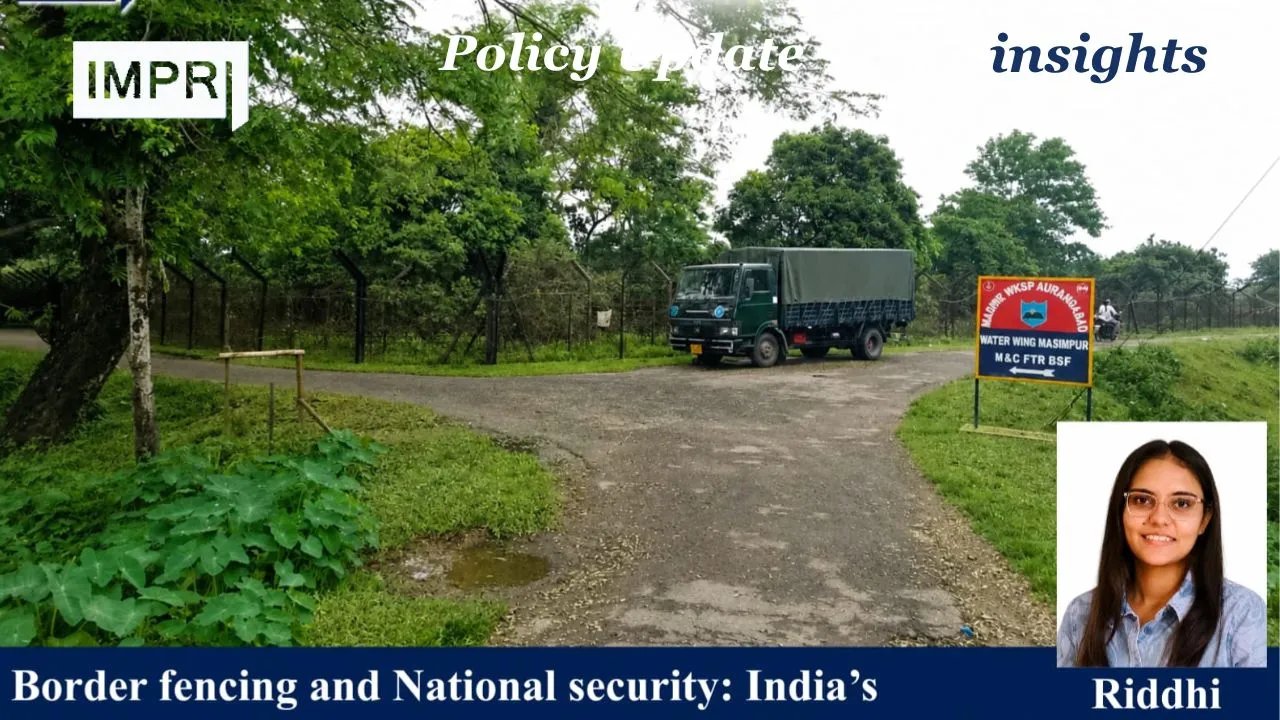
Policy Update
Riddhi Suthar
Background
India’s border fencing policy with Bangladesh is a component of a larger national border management plan that aims to prevent illegal infiltration, control cross-border mobility, boost territorial security, and reduce transnational crimes. The Border Security Force (BSF) is responsible for implementing the policy, which is primarily overseen by the Ministry of Home Affairs.
The India–Bangladesh border stretches approximately 4,096.7 km across the states of West Bengal, Assam, Meghalaya, Tripura and Mizoram, making it India’s longest international land border. In 1986, the Government of India formally initiated border fencing along selected stretches of the India–Bangladesh border. The fencing programme expanded significantly during the 1990s as border-related security concerns deepened.
India expedited border infrastructure building after the Border Security Force and Bangladesh Rifles (now known as Border Guard Bangladesh) clashed in 2001. A major diplomatic breakthrough occurred through the implementation of the India–Bangladesh Land Boundary Agreement in 2015, which resolved 162 enclaves affecting more than 50,000 residents. Since 2018, India has increasingly shifted toward technology-driven border management.
The policy emerged due to multiple interconnected security concerns. The Government of India describes the objective of border management as securing borders against “hostile elements” while facilitating legitimate trade and movement. The primary objectives of the policy are to improve surveillance and enhance border infrastructure. The major beneficiaries and stakeholders of the border fencing strategy are residents of border districts, Border Security Forces, State governments in eastern and northeastern India and traders using formal border trade infrastructure.
Recent Ministry of Home Affairs reports and parliamentary discussions indicate that 850–900 km of the border remains unfenced due to difficult terrain, riverine geography, dense habitation near the zero line, land acquisition delays and objections raised in certain sectors by the Border Guard Bangladesh (BGB).
Functioning
The India–Bangladesh border is approximately 4,096.7 km long, making it India’s longest international land border. India’s border fencing policy is implemented by the Ministry of Home Affairs and operationally managed by the Border Security Force (BSF). The policy functions through a multi-layered border management system, including:
Physical fencing: Physical fencing is generally constructed around 150 yards from the international boundary under India-Bangladesh border protocols. According to the Ministry of Home Affairs Annual Report 2024–2025, about 3,232.218 km of the border has been fenced, while the West Bengal government handed over an initial 75 acres of land to the BSF for fencing work. Around 52.98 km of the Assam-Bangladesh border remains unfenced, particularly in the Dhubri sector due to the Brahmaputra chars.
Meghalaya has achieved over 82% fencing coverage, with recent efforts focused on a vulnerable 31-km stretch in West Jaintia Hills. Tripura, sharing around 856 km of border with Bangladesh, is among the most successfully fenced northeastern sectors. Mizoram shares approximately 318 km of border, of which around 162.9 km remains unfenced because of difficult geography.
Border Roads: Border roads along the Bangladesh frontier include patrol tracks, embankment roads, flood-protection roads, and fencing-access roads constructed by the Border Roads Organisation. In Tripura, which is surrounded by Bangladesh on three sides, these roads connect Agartala to key Integrated Check Posts (ICPs) for India–Bangladesh trade. Border roads also improve BSF access to remote sectors of Meghalaya. The ICP at Sutarkandi in Assam is strategically significant, with around 20 trucks crossing daily, while Mizoram requires the most terrain-intensive road engineering due to its difficult geography and BSF mobility needs.
Floodlighting system: Floodlighting systems along the Bangladesh border aim to improve night surveillance, with projects approved by the Ministry of Home Affairs at an estimated cost of approximately ₹1,327 crore. West Bengal receives the highest priority for floodlighting, while Assam requires it due to difficult riverine areas along the Brahmaputra. Around 314.4 km of floodlighting has been completed in Meghalaya, and approximately 667.8 km of the Tripura border is floodlit, making it one of the most secure sectors. In Mizoram, only 51.11 km of floodlighting has been completed because of poor infrastructure connectivity.
Border Outposts: Border Out Posts (BOPs) are permanent operational bases of the Border Security Force along the India–Bangladesh border that manage surveillance, patrol coordination, and rapid response operations. Under the Ministry of Home Affairs’ modernisation plans, “smart BOPs” are being integrated with the Comprehensive Integrated Border Management System (CIBMS), drone feeds, laser sensors, and real-time surveillance systems, with additional BOP construction approved under the CIBMS and Border Infrastructure Development Programme.
Surveillance technology: India has increasingly shifted toward “smart border management” since 2018. In 2024, BSF launched a special electronic surveillance project to monitor over 600 vulnerable unfenced gaps across the India–Bangladesh border. In 2025, the BSF deployed around 5,000 body-worn cameras, Biometric recording devices and night-vision-enabled monitoring systems along the Bangladesh border. In the Sundarbans region, the BSF sought assistance from the DRDO to deploy Drones, Coastal radars and Satellite-based monitoring systems along a vulnerable 113-km riverine stretch.
Intelligence coordination: multiple agencies cooperate, including BSF, State police forces, IB, NCB, Customs authorities and military intelligence agencies. The 56th Director General-level conference between the Border Security Force (BSF) and Border Guard Bangladesh (BGB) was held in August 2025. In February 2025 India and Bangladesh agreed to establish a new BSF–BGB “hotline” for faster intelligence sharing
Performance
Over the last few years, the policy has shown measurable progress in physical fencing, smart surveillance deployment and contraband interception, although implementation gaps remain due to terrain, diplomatic sensitivities and land acquisition delays. About 3,232–3,240 km of the border had been fenced by early 2025, representing nearly 79% completion. According to the Ministry of Home Affairs (MHA). There is still roughly 864 km of unfenced border, of which about 174 km were deemed impractical due to marshlands and riverine topography.
West Bengal carries the highest operational burden. Performance has improved through gradual land transfer and renewed fencing projects. However, around 51 km in the North 24 Parganas district remains unfenced and 24 additional acres are required for completion in the Bongaon sector. BSF territorial control has been strengthened and open-border movement has decreased because of the fencing program.
More than 90% of sensitive BSF sectors in Tripura are connected through patrol roads and fencing-access roads. Tripura has one of the highest densities of border roads per kilometre among northeastern states. The most important smart-fencing initiative is BOLD-QIT (Border Electronically Dominated QRT Interception Technique) implemented in the riverine sectors of Assam where the system covers approximately 61 km of difficult Brahmaputra riverine terrain where physical fencing is impossible. However, maintenance costs are high and Sensor performance declines during floods and monsoon conditions
One measurable indicator of the effectiveness of India’s Bangladesh border management policy is contraband seizure data. According to data presented by the Ministry of Home Affairs in Lok Sabha in March 2025, the Border Security Force (BSF) seized contraband worth approximately ₹461.07 crore in 2024 along the India–Bangladesh border, marking the highest annual seizure in the last decade. According to Union budget data in 2026–27, border infrastructure and management allocation reached approximately ₹5,576.51 crore, including around ₹5,266 crore capital expenditure. The Intelligence Bureau experienced one of the sharpest funding increases. IB capital expenditure reportedly increased to approximately ₹2,549 crore. Impact
According to the Parliamentary data cited in 2025 indicated that since 2014, approximately 18,851 infiltrators had been apprehended specifically along the India–Bangladesh border. During coordinated operations in Tripura in early 2025, the BSF arrested 19 Bangladeshi nationals and Four Bangladeshi individuals were captured in a single intelligence-based operation in May 2025 as a result of BSF operations in Meghalaya. The BSF seizure along the Bangladesh border in 2024 included narcotics, cattle, fake Indian currency notes (FICN), gold, yaba tablets, arms and human trafficking-related interceptions.
Meghalaya emerged as a major anti-smuggling operational zone in 2025. Between April and July 2025, BSF seized 622 cattle valued at more than ₹6 crore Additional contraband worth over ₹1.3 crore, including yaba tablets, cannabis, liquor, garments and electronic goods. The rise in seizures suggests that improved fencing, floodlighting and intelligence coordination have increased detection capability. Technology-driven border management has also led to major fiscal expansion. Union Budget 2026–27 allocated approximately ₹5,576.51 crore for border infrastructure and management, including nearly ₹5,266 crore in capital expenditure focused heavily on surveillance infrastructure, smart systems and border modernisation.
The Smart surveillance deployment has significantly improved operational response time. Meanwhile, integration of sensors and command systems allows “Quick Reaction Teams” (QRTs) to respond rapidly to intrusion alerts, especially in Assam’s char regions and unfenced riverine gaps. The Sutarkandi Integrated Check Post illustrates the dual strategic and economic role of border infrastructure. According to the Land Ports Authority of India data, in 2025–26 cargo movement in Sutarkandi again increased to approximately 40,390 consignments, while trade volume stood near ₹242.30 crore.
The fencing construction near the zero line has periodically generated diplomatic tensions. The policy therefore operates within a delicate balance between sovereign security concerns and the need to preserve stable bilateral relations with Bangladesh. Fencing has also disrupted traditional patterns of mobility, agriculture and informal trade. In many villages, residents face restricted access to farmland located between the fence and the international boundary.Rising financial allocations demonstrate the Indian state’s broader shift toward technologically intensive and intelligence-driven border governance.
Emerging issues
Border fencing and road projects have faced repeated delays because of land acquisition disputes and environmental challenges. Despite major progress in fencing the border, around 850–900 km of stretches remain difficult to fence due to rivers, chars, marshlands and dense habitation. Vulnerable sectors in Assam and West Bengal continue to witness illegal crossings and smuggling. Unregulated migration raises concerns regarding demographic pressure, forged documentation and internal security vulnerabilities.
The India–Bangladesh border remains a major route for cattle smuggling, narcotics, fake currency and human trafficking. India maintains around 1,100+ Border Outposts along the Bangladesh border, yet manpower pressure remains high in remote sectors. Fencing close to the zero line and cross-border firing incidents occasionally create tensions with Bangladesh. Thousands of residents living near the border face restricted movement, Farmers in border villages frequently require security clearance to access agricultural land beyond the fence.
Way Forward
The Ministry of Home Affairs (MHA) and Border Security Force (BSF) should prioritise climate-resilient fencing infrastructure. State administrations should create fast-track land acquisition mechanisms for strategic infrastructure. The government should promote border-area development schemes to ensure local communities perceive security projects as beneficial rather than restrictive. AI-enabled monitoring systems and integrated command centres should be used for real-time threat detection. Expanding financial investigations targeting smuggling syndicates and money laundering networks and deploying advanced cargo scanning and surveillance systems at Integrated Check Posts (ICPs) to prevent illegal trade. Promote indigenous border technology development under the “Make in India” initiative. Additionally, training BSF personnel in AI-enabled surveillance and cybersecurity systems.
References
Ministry of Home Affairs. (2016). Annual report 2015–16. https://www.mha.gov.in
Centre for Social and Economic Progress. (2021). Fencing, security and border management: The Indian experience. https://csep.org/publications/fencing-security-and-border-management-the-indian-experience/
Deccan Herald. (2025). BSF seized Rs 461 crore of contraband on India-Bangladesh border in 2024: Govt. https://www.deccanherald.com
Ministry of External Affairs. (2015). Land boundary agreement between India and Bangladesh booklet. https://www.mea.gov.in/Uploads/PublicationDocs/24529_LBA_MEA_Booklet_final.pdf
- Ministry of Home Affairs. (2024). Annual report 2023–24. https://www.mha.gov.in
- Ministry of Home Affairs, Border Management-I Division. (n.d.). Border Management-I Division. Government of India. https://www.mha.gov.in/en/divisionofmha/border-management-i-division
- News On Air. (2025, February 4). Over 3,232 km of India-Bangladesh border fenced. https://newsonair.gov.in/over-3232-km-of-india-bangladesh-border-fenced-says-mos-for-home-nityanand-rai/
- Observer Research Foundation. (2021). Integrated check posts on the India-Bangladesh border: A field survey and brief analysis. https://www.orfonline.org
- Open Government Data Platform India. (2022). State/UT-wise length of border roads laid by Border Roads Organisation. https://data.gov.in
- Press Information Bureau. (2019). Union Home Minister launches smart fencing on Indo-Bangladesh border. https://pib.gov.in/PressReleasePage.aspx?PRID=1584860
- Press Information Bureau. (2025a). Government strengthens smart fencing and BOLD-QIT system on Indo-Bangladesh border. https://pib.gov.in
- Press Information Bureau. (2025b). Over 3,232 km of India-Bangladesh border fenced, says MoS for Home Nityanand Rai. https://pib.gov.in
- The Times of India. (2025). BSF apprehends four Bangladeshi infiltrators in Meghalaya. https://timesofindia.indiatimes.com
- The Times of India. (2026a). Bengal hands over 75 acres to BSF for fencing border. https://timesofindia.indiatimes.com
- The Times of India. (2026b). India-Bangladesh border fencing work begins in West Bengal’s Siliguri after land transfer to BSF. https://timesofindia.indiatimes.com
- Department of Economic Affairs. (2026). Annual reports 2025–26. Ministry of Finance, Government of India. https://dea.gov.in/annual-reports/annual-reports-2025-26
About the Contributor
Riddhi Suthar is a researcher and policy enthusiast with interests in public policy, governance, international relations, maritime affairs, and strategic studies. Their work focuses on evidence-based policy analysis, geopolitical developments, and emerging global challenges, with particular attention to India’s strategic and developmental priorities. She is engaged in analytical writing, policy research, and academic discussions related to governance, security, and international affairs.
Acknowledgement
The author extends sincere gratitude to the IMPRI team for their expert guidance and constructive feedback throughout the process.
Reviewed by Gautham Shine and Shreeya Dixit
Disclaimer
All views expressed in the article belong solely to the author and not necessarily to the organisation.
Read More at IMPRI:
India’s ESG Reporting Shift: What BRSR Core Means for Indian Businesses