






Policy Update
Madhu Swaraj
Background
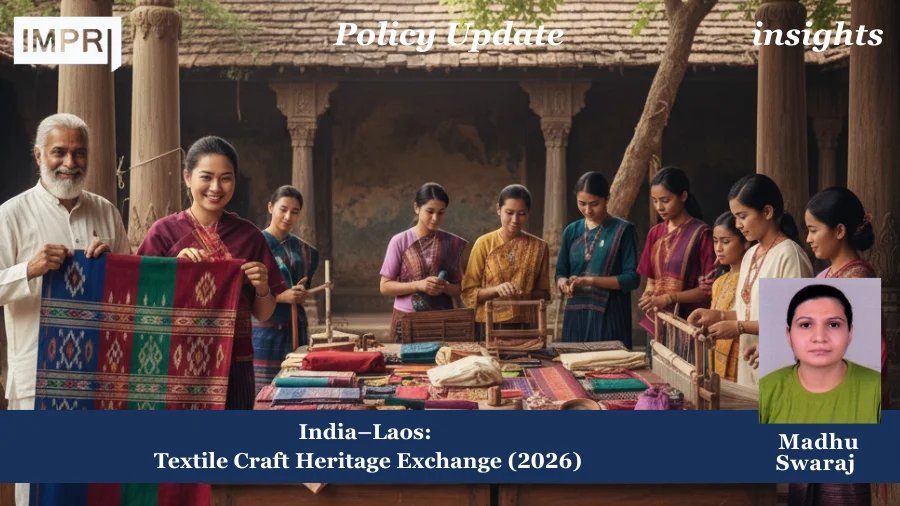
The textile connection between India and the Lao People’s Democratic Republic (PDR) is rooted in a shared civilizational tapestry that spans over a millennium. Both nations view textiles not merely as commodities but as profound storytellers of cultural identity, spirituality, and social status. Historically, the exchange began through the spread of Buddhism and the migration of the Tai people, who carried weaving traditions from the Yunnan region into the Mekong Valley.
In India, the handloom sector is a primary pillar of rural economy and cultural heritage, characterized by diverse regional techniques like Ikat (Odisha/Telangana) and Zari work. Similarly, in Laos, weaving is a foundational domestic art, where the Sin (traditional tubeskirt) serves as a canvas for intricate motifs inspired by nature and the spiritual world. Formal diplomatic relations established in 1956, and more recently the Mekong-Ganga Cooperation (MGC), have provided the institutional framework for revitalizing these ancient “silk routes” through modern craft exchange.
Source: https://share.google/pKMTiCgKEWdgMaKiI
Functioning
The exchange operates through a multi-tiered framework involving government initiatives, non-governmental organizations (NGOs), and artisan cooperatives.
- Institutional Framework: Under the MGC and bilateral cultural agreements, India provides technical assistance and “Quick Impact Projects” (QIPs) focusing on rural development and heritage preservation in Laos.
- Knowledge Transfer: Workshops often focus on shared techniques such as Ikat (known as Matmi in Laos). Indian experts share advancements in natural dyeing and loom efficiency, while Lao artisans contribute their expertise in supplementary weft techniques (Chok) and intricate silk-reeling.
- Artisan Exchange Programs: Organizations like the Lao Handicraft Association and India’s National Institute of Fashion Technology (NIFT) facilitate residencies where weavers observe each other’s “finger-dance” over the threads, blending Indian motifs (like the paisley) with Lao mythical creatures (like the Siho—half-lion, half-elephant).

Source: https://share.google/Rmgg9uGWr3j046ICD
Performance
The performance of this exchange is measured by the increased visibility of “Indo-Lao” fusion textiles in the global boutique market.
- Economic Viability: Handicrafts currently account for nearly 15% of Laos’ industrial output, with textile exports being a significant contributor. Collaborative exhibitions in New Delhi (e.g., Indie Haat) and Vientiane have successfully opened niche markets for high-end, sustainable fabrics.
- Skill Standardization: There has been a documented improvement in the quality of silk yarn produced in Lao clusters following training sessions on Indian reeling technology. Conversely, Indian designers have increasingly adopted the Lao “supplementary weft” style to create contemporary home décor, showcasing the adaptability of these heritage crafts.
As of early 2026, the India–Laos Textile Craft Heritage Exchange has evolved from purely cultural diplomacy into a tangible economic driver. Bilateral trade between the two nations reached $112.6 million in the 2023–24 period, marking a significant 23.4% growth following a post-pandemic recovery. Within this framework, India’s exports to Laos include specialized textile components such as knitted or crocheted fabrics ($96,170) and man-made staple fibers ($6,990), while Laos primarily exports high-value raw materials and finished artisanal goods to India.
A pivotal development in late 2024 and 2025 has been the implementation of Quick Impact Projects (QIPs) under the Mekong-Ganga Cooperation; currently, 26 QIPs have been initiated, with 10 newly signed in late 2024 focusing on socio-economic development and artisanal capacity building. These initiatives are supported by India’s Duty-Free Tariff Preference (DFTP) scheme, which facilitates the entry of Lao hand-woven textiles into the Indian market, and recent MoUs between the Indian Chamber of Commerce (ICC) and the Lao National Chamber of Commerce and Industry (LNCCI) aimed at digitizing craft supply chains and fostering youth entrepreneurship in the heritage sector.

Source: https://share.google/XO6dHsn6HRYd8vxDK
Impact
The impact of this heritage exchange extends beyond economic metrics into the realms of social empowerment and cultural diplomacy.
- Empowerment of Women: In both nations, the textile sector is the second-largest employer after agriculture, primarily supporting women. The exchange has provided Lao women with better market access through Indian-assisted digital marketing platforms.
- Heritage Preservation: By framing textiles as “living traditions” rather than museum pieces, the exchange has incentivized younger generations to learn traditional weaving.
- Strengthening “Act East” Policy: For India, the textile exchange is a vital tool of soft power, reinforcing the “India-ASEAN” partnership through shared aesthetic values and inclusive growth rather than just infrastructure-led dominance.
Emerging Issues
Despite the successes, several challenges threaten the continuity of this exchange:
- Mass Production Competition: Both Indian and Lao artisans face severe pressure from cheap, machine-made replicas that mimic traditional Ikat and Matmi patterns at a fraction of the cost.
- Generational Shift: Younger populations in urban centers (like Vientiane or Mumbai) are increasingly moving toward modern occupations, leading to a “skill gap” where the most complex patterns risk being lost with the aging masters.
- Climate Change & Materials: The availability of natural raw materials, such as wild silk and organic dyes (indigo, madder), is declining due to environmental degradation and shifting land-use patterns in the Mekong and Gangetic regions.

Source: https://share.google/x7nS02S5cWJ6Y8fja
Way Forward
To ensure the longevity of the India–Laos textile heritage, a strategic shift toward innovation and protection is required:
- Geographical Indication (GI) Collaboration: Joint efforts to secure GI tags for specific regional weaves can protect artisans from counterfeit products.
- Digital Archiving: Utilizing AI and digital tools to archive “forgotten patterns” ensures that even if a technique pauses, the mathematical blueprints of the weaves remain accessible.
- Sustainable Value Chains: Transitioning to “Net-Zero” production models—using solar-powered looms and closed-loop water systems for dyeing—will position Indo-Lao textiles as leaders in the global sustainable fashion market.
- E-Commerce Integration: Expanding the “Pehchan” ID card system (India) to include Lao artisans on shared B2B platforms could streamline global exports.
References
- ASEAN-India Centre (AIC). (2024). Mekong-Ganga policy brief: Situating the MGC in an evolving Indo-Pacific regional order. https://aseanindiacentre.org.in/sites/default/files/Publication/MKG%20PB-Feb%202024.pdf
- Asian Development Bank. (2025). Asian development outlook (ADO) April 2025. https://www.adb.org/sites/default/files/publication/1044336/asian-development-outlook-april-2025.pdf
- Chauhan, A., & Kumar, D. (2025). Bridging tweets and traditions: Exploring cultural dialogue between Northeast India and Southeast Asia on X. Shodhaamrit Research Journal, 2(2), 129–139. https://shodhaamrit.gyanvividha.com/wp-content/uploads/2025/10/Anshul-Chauhan-Dr.-Dheeraj-Kumar-Shodhaamrit-Vol-2Issue-2-ISSN-3048-9296O-3049-2890P-July-Dec.-2025pp-129-139.pdf
- Findly, E. B. (2011). A protective spirit in Lao-Tai textiles: The Pii Nyak and its Indian antecedents. Journal of Lao Studies, 2(2). https://www.laostudies.org/system/files/subscription/JLS-v2-i2-Nov2011-findly.pdf
- Liu, A., Baines, E., & Ku, L. (2022). Slow fashion is positively linked to consumers’ well-being: Evidence from an online questionnaire study in China. Sustainability, 14(21), 13990. https://doi.org/10.3390/su142113990
- Ministry of External Affairs (MEA), Government of India. (2002). Annual report 2001-2002: Bilateral relations and sectoral cooperation. https://www.mea.gov.in/Uploads/PublicationDocs/164_Annual-Report-2001-2002.pdf
- Phanthanivong, S. (2007). From the village house to the urban markets: The evolution of silk production in Laos. University of Nebraska-Lincoln Digital Commons. https://digitalcommons.unl.edu/cgi/viewcontent.cgi?article=1400&context=tsaconf
- Research and Information System for Developing Countries (RIS). (2007). Mekong economic corridors: Asia’s new lifelines (Mekong-Ganga Policy Brief No. 2). https://www.ris.org.in/sites/default/files/2021-09/mkg_no_2_Oct_2007%20%281%29.pdf
- Singh, S. (2022). India’s soft power diplomacy in the Mekong sub-region. International Journal of Emerging Knowledge Studies, 2(11). https://ijeks.com/wp-content/uploads/2024/01/IJEKS2-11-010.pdf
- Thammawat, K. (2018). Embroidered Laotian textiles: From the heart and soul, together with fate, to the creative cultural way. Veridian E-Journal, 11(3). https://he02.tci-thaijo.org/index.php/Veridian-E-Journal/article/download/145624/107519/388910
About the Contributor:
Madhu Swaraj is a Research Intern at IMPRI.
Acknowledgement: The author extends sincere gratitude to the IMPRI team for their expert guidance and constructive feedback throughout the process.
Disclaimer: All views expressed in the article belong solely to the author and not necessarily to the organization.
Read more at IMPRI:
Empowering India’s Youth: Rashtriya Yuva Sashaktikaran Karyakram (RYSK)