








Policy Update
Mansi Tirthani
Background
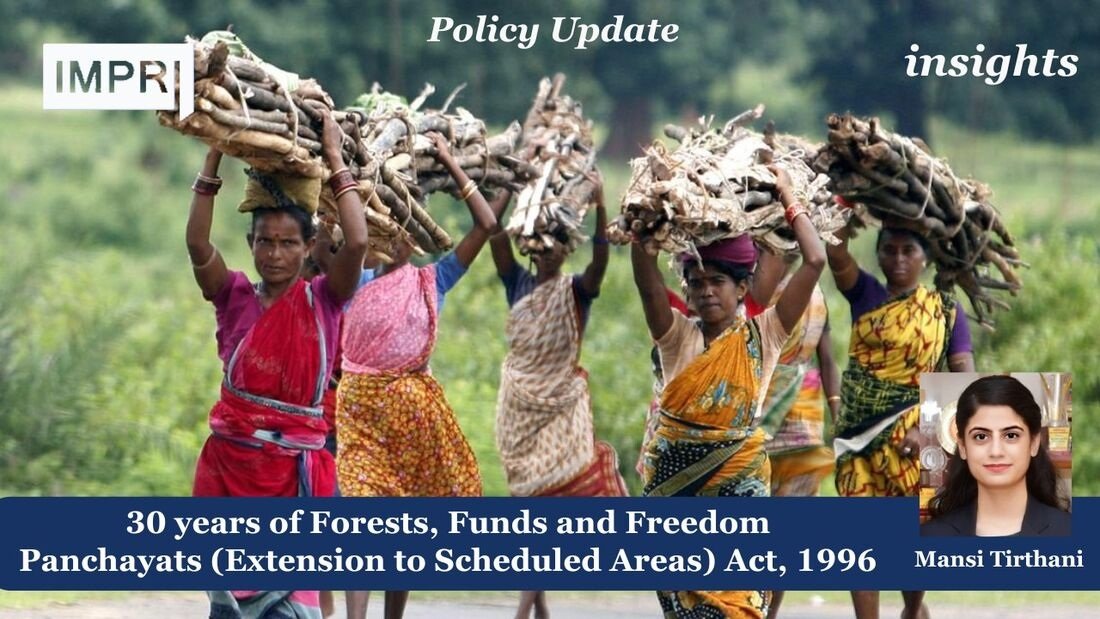
The year 2026 marks three decades since the Indian Parliament enacted the Provisions of the Panchayats (Extension to Scheduled Areas) Act, 1996, popularly known as PESA Act. Passed on December 24, 1996, this landmark legislation was considered historic in Indian governance.
For the first time, the Indian state recognized the right of tribal communities residing in the Fifth Schedule areas to govern themselves through their traditional systems. By converting the concept of local self governance into statutory provisions, PESA aimed to create village republics where marginalized communities could protect their ecosystem, custom and economic rights from external exploitation.
For legal extension for vulnerable zones, the Central Government constituted a high level committee headed by the tribal leader and parliamentarian, Dileep Singh Bhuria. Submitted in 1995, the Bhuria Committee Report highlighted that despite constitutional protections, tribal populations were facing marginalization due to land alienation, debt traps by moneylenders and displacement by state-led industrial projects. The committee argued that the most effective bulwark against tribal unrest and economic dispossession was the legal empowerment of the community itself.
Based on recommendations, Parliament passed the PESA Act in 1996. The objective of the Act was to extend Part IX of the Constitution to the Scheduled Areas across ten states, by fundamentally altering the balance of power in favor of the grassroots village assembly.
Functioning
The significant feature of PESA is that it shifts the local governance away from the Gram Panchayat and places it with the Gram Sabha, the assembly of all adults residing in a specific hamlet. The legislation assumes that a village is an entity which is capable of managing internal affairs. Under the statutory framework of the Act, the Gram Sabha is granted legal powers, which can be divided into three areas:
Resource and Environmental: The Gram Sabha has the right to be consulted before the state government initiates any land acquisition for development or infrastructure projects in Scheduled Areas. It holds ownership over Minor Forest Produce (MFP) including economic items and possesses the exclusive power to plan and manage minor water bodies. Its prior recommendation is mandatory for the grant of licenses or mining leases for minor minerals.
Social Safeguards and Conflict Resolution: The Gram Sabha is empowered to enforce the prohibition or regulation of the sale and consumption of any intoxicants. It possesses the statutory authority to prevent the alienation of land in Scheduled Areas and to take corrective steps to restore any unlawful tribal land. It is also tasked with regulating local money-lending practices that historically trapped tribal households in cycles of debt.
Administrative Oversight: The law places village-level institutions and state functionaries from school teachers and healthcare workers to agriculture and revenue officers under the direct administrative control and monitoring of the Gram Sabha.
To protect political agency at the institutional tier, PESA mandates that at least 50% of seats across all levels of Panchayats in Scheduled Areas must be reserved for Scheduled Tribes and 100% of the positions of Panchayat Chairpersons must be occupied by ST representatives.
Performance
The performance of PESA over the last 30 years presents a fragmented landscape characterized by staggered compliance and uneven state enthusiasm. Because the implementation of PESA relies on state-level amendments to existing Panchayati Raj laws, the actual baseline operationalization of the law was delayed for years.
While central rules and model guidelines were drafted to speed up execution, several states took over two decades to operationalise State PESA Rules. For instance, Chhattisgarh and Madhya Pradesh only finalized and notified their state-level PESA rules in the latter half of 2022, while Jharkhand and Odisha remained trapped in prolonged inter-departmental consultations for decades.
Impact
Despite implementation gaps, the impacts of PESA on India’s tribal fabric are undeniable. The law has served as a protection mechanism against commercial exploitation. Macro-level environmental studies shows that in regions where PESA elections were actively conducted and ST political representation was formalized, annual forest tree canopy cover increased by an average of 3%, accompanied by a clear reduction in local deforestation rates.
By empowering indigenous communities with land rights, PESA gave them leverage to resist destructive open-cast mining and unsustainable commercial pressures, demonstrating that local democratic representation directly correlates with enhanced environmental preservation.
Socially, the Act led to the political awakening among tribal populations, particularly among tribal women who gained formal access to public decision-making spaces. The statutory requirement for local consultation transformed the Gram Sabha from an obscure administrative forum into a lively site of democratic expression. In several land conflicts across central India, local communities successfully deployed the text of the PESA Act to challenge arbitrary land handovers to corporate entities, thus uphold the supremacy of the Gram Sabha’s consent framework.
Issues
Problem of conflicting laws
The primary loophole hampering PESA is that while state Panchayati Raj Acts were amended, parallel colonial-era or centralized subject laws governing forest management, mining and land revenue were never harmonized. The Indian Forest Act of 1927 and the Wildlife Protection Act of 1972 continue to hold discretionary powers with the state Forest Department bureaucracy. In practice, forest officers exercise control over forest access, treating the Gram Sabha as a subordinate body and neutralizing its ownership over minor forest produce.
Ambiguous wording
The language of the central PESA Act contains damaging ambiguities. For instance, the Act uses the word “consulted” when referring to land acquisition, rather than mandating “prior informed consent”. District administrations exploit this terminology by sending notices to Panchayats (at the Block or District level) while bypassing the grassroots Gram Sabhas altogether.
Administrative Overlap
The rise of Parallel Bodies has weakened the local self-rule. State governments set up ad-hoc Joint Forest Management Committees or development agencies that report to district collectors. These bodies receive direct state funding and manage resources independently, reducing the Gram Sabha to a mere rubber-stamp institution. Even infrastructure projects are fast-tracked via Benami land transactions or informal mortgages, creating an undercurrent of dispossession that formal village records fail to capture.
Operational Constraints
Gram Sabhas in interior regions lack basic administrative support, trained accountants or digital tools. Gram Sabha meetings are frequently called without advance notice and official documentation is presented in state languages rather than local tribal dialects, preventing meaningful participation by the forest dwellers.
Way Forward
To ensure that the PESA Act does not remain a “spirit without a body,” India must adopt a proactive, multi-pronged structural reform agenda as the law enters its fourth decade:
Mandatory Legislative Harmonization: The Ministry of Panchayati Raj, in coordination with the Ministry of Environment, Forest and Climate Change, must execute a legislative overhaul to harmonize conflicting Central and State laws. Overriding amendments must be inserted into the Mines and Minerals (Development and Regulation) Act and various Forest Conservation Acts to state that their provisions are subject to the primary jurisdiction of the PESA Gram Sabha.
Upgrading Consultation to Consent: Parliament should consider an amendment to PESA to replace the ambiguous term with the absolute definition for all land acquisition, displacement, and industrial extraction activities within Scheduled Areas.
Institutional Capacity Building and Delineation: State governments must implement the delineation of Gram Sabhas down to the individual hamlet level, moving away from the large, unwieldy revenue-village model. Dedicated financial administrative assistance must be provided directly to Gram Sabhas, alongside training programs conducted in native tribal languages to demystify complex legal and financial procedures.
Strengthening Independent Oversight: Governors should establish independent monitoring cells to review PESA violations directly, ensuring that annual governance reports submitted to the President serve as rigorous, clear evaluations of ground realities rather than curated bureaucratic updates.
By taking these steps to bridge the gap between progressive policy design and daily implementation, India can honor the true intent of the PESA Act securing the livelihoods, cultural identities, and ecological inheritances of its indigenous populations while realizing the democratic ideal of the true Village Republic.
References
Datta, S. (2021). Making decentralisation work: A comparative ethnographic analysis of forest conservation and village governance in West Bengal, India. Conservation and Society, 19(4), 205–217. https://doi.org/10.4103/cs.cs_20_81
Gulzar, S. (2024). Can political representation boost forest conservation? VoxDev. https://voxdev.org/topic/energy-environment/can-political-representation-boost-forest-conservation
Philip, P. M. (2024). Traditional tribal governance systems and formal Gram Panchayats of Madhya Pradesh in the context of the PESA Act, 1996 (Working Paper No. 580). Institute for Social and Economic Change. https://www.isec.ac.in/wp-content/uploads/2024/12/WP-580-Prakash-M-Philip-Final.pdf
Prasad, D. V. (2024). Missing soul of little republics: A study of Gram Panchayat in Fifth Scheduled Areas. Studies of Tribes and Tribals, 22(1), 57–68. https://www.arfjournals.com/image/catalog/Journals%20Papers/SAAN/2024/No.%201/07.pdf
Rao, P. T. (2023). Assessment of implementation of Panchayats Extension to Scheduled Area (PESA) Act in Andhra Pradesh (Research Report). National Institute of Rural Development and Panchayati Raj. http://nirdpr.org.in/nird_docs/srsc/srsc230217-15.pdf
About the Author
Mansi Tirthani is the recipient of the National Award by the President of India for her contributions to community services and good governance. She has been Indian Youth Ambassador to China by Government of India to analyse startup and innovation ecosystem. Currently serves with the Research and Editorial team with IMPRI, where her work centers on evidence-based policies analysis. With commitment to advancing welfare governance she brings together data analysis, strategic communication and development to impact research and policy.
Acknowledgement:
The author extends sincere thanks to the IMPRI team for their guidance.
Disclaimer:
All views expressed in the article belong solely to the author and not necessarily to the organization.
Reviewed by
Pragya Raghav
Ameya
Read More at IMPRI
Right to Walk Urban governance challenge or opportunity for municipalities?