


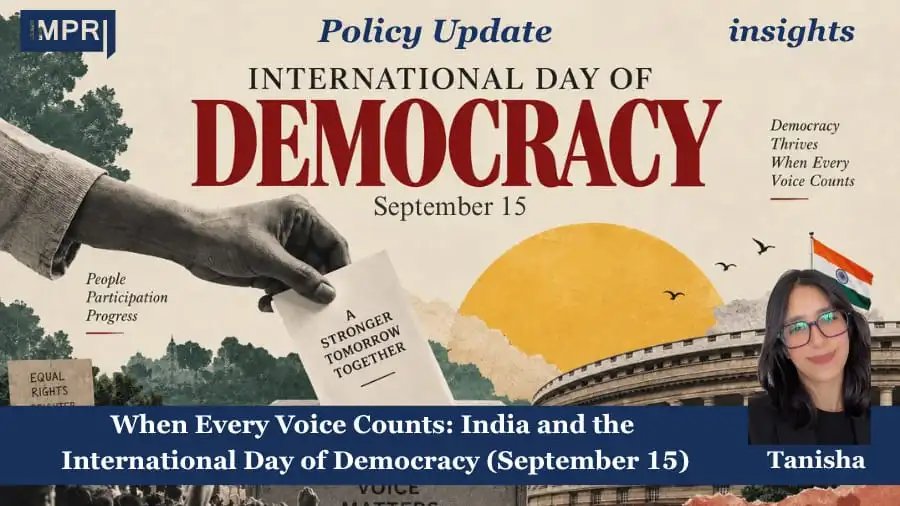
Policy Update
Tanisha
Background
The UN General Assembly created this observance by consensus on 8 November 2007, through Resolution 62/7, moved by Qatar during a debate on new and restored democracies. The date it picked, 15 September, was not random: it marks ten years to the day since the Inter-Parliamentary Union adopted its Universal Declaration on Democracy in 1997. The first Day of Democracy was held in 2008 (United Nations General Assembly, 2007).
Each year carries its own theme. For 2026, it is “When every voice counts, democracy delivers.” The UN’s flagship event, hosted by the UN Democracy Fund at UN Headquarters, is built around deliberative democracy: citizens assemblies, and what it takes to bring a wider range of voices into decisions that affect them. This year also marks the Fund’s twentieth anniversary; it has backed more than a thousand civil-society projects since it was set up (United Nations, 2026).
India has spent the last few years pushing its own framing onto this conversation. Since the 2023 G20 presidency, and the Parliament 20 Summit held in New Delhi that year, the government has repeatedly described the country as the “Mother of Democracy,” arguing that Indian traditions of consultative government predate the term itself. Addressing the Summit for Democracy the same year, Prime Minister Modi told fellow leaders that “India’s economic growth is the best advertisement for democracy,” and that “democracy can deliver” (Prime Ministers Office, 2023). This piece sets that framing against what India’s own election and local-government data show.
Functioning
India elects governments at three levels. Parliament and the state legislatures are elected directly under universal adult suffrage, and supervised by the Election Commission of India, an independent constitutional body under Article 324. Below that sits a third, constitutionally mandated tier: Panchayati Raj Institutions in rural India and municipal bodies in urban India, created by the 73rd and 74th Amendments in 1992 and supervised by State Election Commissions rather than the ECI.
The Constitution treats this local tier differently on one count: women representation. Article 243D reserves at least a third of panchayat seats, and a third of chairperson posts, for women. Twenty-one states have gone beyond that floor and legislated 50 percent reservation in their own Panchayati Raj Acts (Ministry of Women and Child Development [MWCD], 2025). Parliament has no such reservation in force yet. The Constitution (106th Amendment) Act, 2023, the Nari Shakti Vandan Adhiniyam, rotationally reserves a third of Lok Sabha and state assembly seats for women, but its commencement is tied to the delimitation exercise that follows the first Census after the Act took effect (MWCD, 2025).
Performance
The 2024 Lok Sabha election, held over seven phases between 19 April and 1 June, remains the largest exercise of its kind anywhere: 97,97,51,847 registered electors, up 7.43 percent on 2019, and 64,64,20,869 votes cast (Election Commission of India [ECI], 2024). Table 1 sets some of the headline numbers against the previous election.
| Metric | 2019 | 2024 |
|---|---|---|
| Registered electors | 91,19,50,734 | 97,97,51,847 |
| Votes polled | 61.40 crore | 64.64 crore |
| Female share of electorate | 48.09% | 48.62% |
| Female contesting candidates | 726 | 800 |
| Third-gender registered electors | 39,075 | 48,272 |
| Third-gender turnout | 14.64% | 27.09% |
| PwD registered electors | 61,67,482 | 90,28,696 |
Table 1. Lok Sabha election, 2019 versus 2024. Source: Election Commission of India (2024).
Two figures inside that data are worth pulling out. Female turnout, at 65.78 percent, again ran ahead of male turnout at 65.55 percent, only the second time that has happened in a Lok Sabha election (ECI, 2024). And turnout among registered third-gender electors nearly doubled between the two elections (ECI, 2024).
Representation tells a different story once the count moves from voters to winners. The 18th Lok Sabha has 75 women members, about 14 percent of the House; the Rajya Sabha has 42, about 17 percent (MWCD, 2025). Panchayati Raj Institutions look nothing like either number: close to 14.5 lakh women hold elected office there, about 46 percent of all PRI representatives nationwide (MWCD, 2025).
Figure 1. Share of women members, by elected tier. Source: Ministry of Women and Child Development (2025).
Impact
On these numbers, India’s grassroots democracy is unusually inclusive by international standards, and the government has said as much, calling the scale of women’s participation in panchayats without parallel anywhere in the world (MWCD, 2025). That gives the country a genuine data point to set against the “Mother of Democracy” framing: real numbers on turnout, on women voting more than men do, on third-gender participation climbing fast off a low base.
But the inclusion built into panchayats stops at the state line. A third of panchayat seats are reserved by the Constitution itself, and half in most states by their own law. Parliament has no equivalent in force. The 106th Amendment fixes that on paper, but ties its own start date to a delimitation exercise that has not yet happened, so the gap between village-level parity and national representation has no fixed closing date.
Emerging Issues
- The reservation has a law but no election year attached to it. The 106th Amendment’s commencement depends on delimitation, which itself depends on a Census that has already run past its usual cycle. Parliament cannot currently say which general election the one-third reservation will actually apply to.
- Turnout gains have not translated into more women contesting. Only 800 of 8,360 candidates in the 2024 Lok Sabha election were women, about 10 percent, barely up on 1957’s 3 percent (MWCD, 2025). The reservation debate has moved faster than the candidate pipeline it is meant to widen.
- The UN’s 2026 theme is built around deliberative democracy, citizens’ assemblies, and bringing a wider range of voices into routine decision-making. India already has a structural equivalent in the gram sabha, the open village assembly every adult resident can attend, but the day’s international framing rarely gets applied to it. Whether gram sabhas are strengthened or left to run on paper is arguably the more India-specific version of this year’s UN theme.
Way Forward
- Attach a fixed election year to the 106th Amendment’s commencement, rather than leaving it open-ended against a delimitation exercise with no confirmed date.
- Extend panchayat-style capacity-building programmes, such as the Sashakt Panchayat-Netri Abhiyan, to women considering a Lok Sabha or Assembly run specifically, rather than only to those already in local office, given how flat the candidate share has stayed since 2019.
- Track how often gram sabhas actually meet and function, not only how many reserved seats exist on paper, if the goal is to hold up panchayats as India’s working model of deliberative democracy.
- Keep publishing granular, disaggregated election data of the kind the ECI released for 2024. That kind of transparency is a sturdier argument for India’s democratic credentials than any slogan.
References
- Election Commission of India. (2024, December 26). Proactive disclosure of extensive data sets of the world’s largest election [Press release]. Press Information Bureau, Government of India. https://www.pib.gov.in/PressReleasePage.aspx?PRID=2088064
- Ministry of Women and Child Development. (2025, July 30). Government is promoting greater participation of women in local governance and political leadership roles [Press release]. Press Information Bureau, Government of India. https://www.pib.gov.in/PressReleasePage.aspx?PRID=2150216
- Prime Minister’s Office. (2023, March 29). PM addresses Summit for Democracy [Press release]. Government of India. https://www.pmindia.gov.in/en/news_updates/pm-addresses-summit-for-democracy/
- United Nations. (2026). International Day of Democracy. https://www.un.org/en/observances/democracy-day
- United Nations General Assembly. (2007, November 8). General Assembly declares 15 September International Day of Democracy [Press release GA/10655]. https://press.un.org/en/2007/ga10655.doc.html
About the Contributor
Tanisha is a Political Science graduate (BA Hons, University of Delhi; MA, IGNOU), currently pursuing a Diploma in Conflict Transformation and Peacebuilding, with research interests spanning international relations, environmental governance, and gender studies. She is keen to build a career in policy research.
Acknowledgements
The author sincerely expresses gratitude to the reviewers Prisha Sachdeva and Kaustav Majumdar for their valuable comments, constructive suggestions, and continuous guidance throughout the preparation of this article. Their insightful feedback significantly enhanced the clarity, organisation, and analytical quality of the manuscript. The author also acknowledges the support and encouragement received during the research and writing process, which contributed to the successful completion of this work.
Disclaimer: All views expressed in the article belong solely to the author and not necessarily to the organisation.
Read more at IMPRI:
Digital Development Compass 2026: Reading India’s Digital Governance
Coal Gasification Financial Incentive Scheme (CGFIS): Promoting Clean Energy and Self-Reliance