








Policy Update
Mahenoor Imam
Introduction
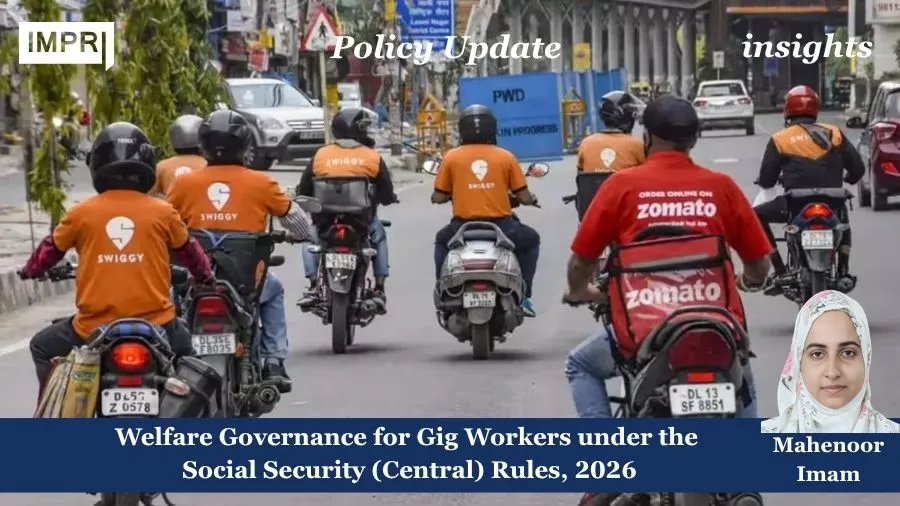
Most of us order food and book cabs without thinking much about the person on the other end of the app. There are a lot of them. NITI Aayog (2022) counted 7.7 million gig and platform workers in 2020-21, about 6.7% of India’s non-agricultural workforce, and expected 23.5 million by 2029-30.
These workers are not employees in law, they had no enforceable claim to accident cover, health benefits, maternity benefits or pension. Protection existed only where a platform chose to offer it, or where a worker voluntarily enrolled in a general unorganised-worker scheme such as PMSBY or PM-SYM — both routes discretionary, thinly funded and unconnected to the platform’s liability. That changed on 8 May 2026, when the Ministry of Labour and Employment notified the Social Security (Central) Rules, 2026 and put deadlines on promises that had been sitting in a law since 2020 (MediaNama, 2026).
This article asks what the Rules require, how far they have got, and what is still missing.
Background
The Code on Social Security, 2020 was the first central law to define a gig worker, a platform worker and an aggregator. Section 2(35) defines a gig worker as a person who performs work or participates in a work arrangement and earns from such activities outside a traditional employer-employee relationship.
Section 2(61) defines a platform worker as a person engaged in platform work, which Section 2(60) in turn describes as a work arrangement outside a traditional employer-employee relationship in which organisations or individuals use an online platform to access others to solve specific problems or provide specific services in exchange for payment.
Section 2(2) defines an aggregator as a digital intermediary or marketplace that connects a buyer or user of a service with the seller or service provider, with nine categories of aggregator listed in the Seventh Schedule — ride sharing, food and grocery delivery, logistics, e-marketplaces, professional services, healthcare, travel and hospitality, content and media services, and a residual category for other goods and services platforms.
Chapter IX lets the government make welfare schemes covering life and disability cover, accident insurance, health and maternity benefits and old-age protection. Section 114(4) sets the aggregator’s share at 1% to 2% of annual turnover, capped at 5% of what it pays its gig workers. Section 141 creates a Social Security Fund.
The Code then sat unused for five years. It came into force on 21 November 2025 (JSA, 2026). Draft rules followed in December, and the final Rules on 8 May 2026 replaced twelve older sets, including the ESI (Central) Rules of 1950 (MediaNama, 2026).
Two states had already moved. Rajasthan legislated in 2023; Karnataka’s Act was notified on 12 September 2025 with effect from 30 May 2025 (Lexology, 2025). Both built a welfare board meant only for gig workers. The Centre did not, and that difference runs through everything below.
Functioning
The Rules work less like a welfare scheme than a compliance system. The government does not reach the worker. It reaches the aggregator, and makes the aggregator responsible for putting the worker on record.
Registration. Rule 48 requires every aggregator to register on the Shram Suvidha portal and upload all workers already engaged with it within 45 days, which meant by 21 June 2026, through an API rather than by hand (Lexplosion, 2026). After that the duty is continuous: new workers registered in real time or daily, exits reported. Workers aged 16 and above can also register themselves using Aadhaar, which generates a Universal Account Number and a digital card on e-Shram (Anhad Law, 2026). The number travels with the worker between cities and apps. But a worker who lets their details go stale can lose eligibility, so part of the burden sits with them.
Eligibility. Registration alone earns nothing. A worker needs 90 days with one aggregator, or 120 across several, in the previous financial year (Indian HRM, 2026). The days need not be consecutive, and eligibility must be earned again each year (Corporate Professionals, 2026). Since the portal record is the only proof of days worked, a rider splitting the week between two apps qualifies only if both platforms report the engagement.
Money. Schemes are funded by the Centre, the states and the aggregators together. The aggregator pays 1% to 2% of turnover, capped at 5% of payments to workers, whichever is lower.
This part is not running. Section 114(5) leaves the start date of contributions to a notification that has not come, and no rate has been fixed inside the band (Taxmann, 2026). The full list of what was notified on 8 and 9 May 2026 covers construction cess, vacancy reporting, interest on late payment, prosecution and inspectors. None of it touches gig workers (Cyril Amarchand Mangaldas, 2026). The registration machinery is live and enforceable; the fund it feeds has no inflow.
Enforcement. Rule 49 sets the calendar: self-assessment in Form XX by 30 June, final return in Form XXI by 31 October, refunds claimed electronically (Taxmann, 2026). Late payment draws 12% simple interest, and failure to register brings in the Code’s penalties. Enforcement runs through Inspector-cum-Facilitators drawn from serving ESIC officers (Cyril Amarchand Mangaldas, 2026).
Oversight. The National Social Security Board sits on top. Section 6(9) lets it act for gig and platform workers, and in that role it takes in five aggregator representatives, five worker representatives, the Director General of ESIC and five state representatives (PRS Legislative Research, 2020).
The Rules rotate the aggregator seats across the Seventh Schedule categories, fix a quorum of six for gig matters, and allow expert committees (MediaNama, 2026). But the Board is chaired by the Union Labour Minister and runs to around thirty-one members (PSA Legal, 2021). Those ten seats are nominated blocs inside a government-led body, not two sides of a table. The Board advises. It does not settle disputes, and it is not a gig workers’ welfare board.
Performance
Identification has improved. e-Shram, running since August 2021, held about 31.89 crore unorganised workers by August 2026 (Blitz India, 2026). Gig registration rose from over 5 lakh in December 2025 to around 12 lakh by June 2026, with 20 aggregators on the portal including Zomato, Swiggy and Uber (The Tribune, 2026).
Around 12 lakh gig workers are on the register. The Economic Survey estimates the workforce at roughly 1.2 crore. The two figures are built differently and cover different years, so they do not yield an exact coverage rate — but the gap is an order of magnitude, and it is the gap, not the ratio, that matters.
The spread across states is uneven. A Rajya Sabha reply gave figures as on 23 January 2026 (MediaNama, 2026).

Two things stand out. Bihar sits third with 1,09,207 registered platform workers, ahead of Delhi (49,479), Karnataka (37,871) and Tamil Nadu (31,654), not where platform work concentrates. Two possible explanations: CSC-led registration drives, since Bihar also ranks second in overall e-Shram enrolment; or state attribution by home address, given Bihar’s out-migration. Neither is confirmed. Uttar Pradesh, with the country’s largest e-Shram base at about 8.45 crore, has far fewer platform workers per lakh of registrations than Maharashtra (DD News, 2026). Big totals are not deep coverage.
The framework in three stages: workers registered, aggregators complying and benefits delivered. There is decent evidence on the first, partial evidence on the second, and none on the third.
Impact
The real change is recognition. A gig worker now has a legal category and a number that belongs to them rather than to the platform. The Standing Committee on Labour treated that as the foundation and asked that engagement itself be linked to registration (ANI, 2026).
Income has not changed. e-Shram brings no minimum wage, no paid leave, no gratuity, no notice before removal. Irregular earnings, long hours, sudden deactivation and decisions made by an algorithm are untouched by Rules that are about who is on a list and who pays into a fund.
Even the insurance is potential rather than actual. Cover follows only when schemes are notified under section 114, and none had been by mid-2026 (Taxmann, 2026). A worker who registered in June has a card and no claim.
Comparison- Central Rules (2026) vs Karnataka Act (2025)
| Central Rules, 2026 | Karnataka Act, 2025 | |
| Dedicated gig board | No — shared National Social Security Board (S.114(6)); status unconfirmed | Yes — constituted, with platform and union members |
| Contribution | 1–2% of turnover; rate and date unnotified | 1–5% welfare fee per payout; notified near 1% |
| Registration | Rule 48: 45-day bulk upload, real-time API reporting | Board-issued unique ID |
| Eligibility gate | 90/120 days | None |
| Deactivation | Not covered | 14 days’ notice, written reasons, listed grounds |
| Contract terms | Not covered | Fair and transparent; 14 days’ notice of change |
| Payment | Not covered | Weekly minimum; deductions itemised |
| Grievance redressal | Not covered | Internal committee with Board-level appeal |
| Money reaching workers | Not yet | Fee notified, under legal challenge |
The Centre has built a registration and financing design. Karnataka has built an employment-standards design. A worker in a state without its own law gets only the first.
Emerging Issues
- Section 114 fixes a band of one to two per cent of annual turnover, capped at five per cent of payments to gig workers, but the operative rate awaits a government notification that has not come (Taxmann, 2026). Without a number and a start date, the Social Security Fund has no inflow. Aggregators cannot provision for the liability, and the Board cannot cost any scheme against a corpus that does not yet exist. Eligibility is therefore accruing to workers against an unfunded promise.
- Ninety days with one aggregator, or a hundred and twenty across several, presumes a stable relationship with a platform. Much gig work is seasonal, supplementary or spread across three apps at once, and a worker doing seventy days each on three platforms clears neither threshold despite working continuously. The test also imposes a stricter bar on multi-platform work than single-platform work, which inverts the logic of protecting the most precarious. Crucially, it depends wholly on aggregators reporting engagement days accurately, with no independent verification.
- Under the Rules, failure to keep particulars current — address, occupation, mobile number, skills — can render a worker ineligible for notified benefits (Anhad Law, 2026). The burden of maintaining a live government record thus falls on the least-resourced party in the arrangement. Gig workers change cities, switch platforms and change phone numbers frequently; many have limited digital literacy. A design that penalises administrative lapses will exclude precisely the mobile, low-income workers the framework was written for.
- The Rules set out the Board’s gig configuration in detail — five aggregator representatives, five worker representatives, five experts, a quorum of six for gig matters, and the power to form expert committees. What is not publicly visible is whether members have been notified, whether the Board has convened, or whether any committee has been formed. Karnataka is the cautionary precedent: without a functioning board, registration cannot begin and scheme notifications cannot issue. Constitution on paper and operation in practice are different things.
- Karnataka levies a welfare fee on each payout to a gig worker, capped per transaction; the Centre will levy on annual turnover. The two are calculated on different bases, and nothing yet establishes whether one offsets the other. Platforms have already challenged parts of the Karnataka Act in court (Lexology, 2025), and other states are still drafting. A nationally operating aggregator therefore faces cumulative and unpredictable obligations, with the answer likely to emerge from litigation rather than from policy.
- The Periodic Labour Force Survey still records gig workers under self-employed or own-account categories and cannot isolate platform work. Every headline figure is an estimate — NITI Aayog’s 2022 projection of 23.5 million by 2029-30, or the Economic Survey’s roughly 12 million for 2024-25. Coverage claims therefore rest on a guessed denominator: twelve lakh registrations against an estimate that could be materially wrong either way. The Rules concede the problem by empowering Board committees to estimate the workforce.
- Statutory obligations have not been matched by fiscal provisioning. Assessments of Budget 2026-27 find little dedicated allocation for the welfare machinery the Code creates, and nothing for the enforcement capacity the labour codes now require — inspection, monitoring and grievance redressal (Jindal Policy Research Lab, 2026; Policy Circle, 2026). Recognition, being administratively cheap, has advanced; funded delivery has not. Without money attached to the institutions, the framework risks remaining a registration exercise rather than a welfare system.
Way Forward
- Section 114 sets a band of one to two per cent of turnover, but the operative rate remains unnotified. The Fund therefore has no determinate revenue. Aggregators cannot budget, the Board cannot design schemes, and a worker completing ninety days gains eligibility for benefits nobody has funded. Notification converts architecture into entitlement.
- Twenty aggregators had registered by June 2026, none having uploaded its full workforce. Beyond that, nothing is public. Rule 48 already captures the data through APIs, so the Ministry should publish monthly, per platform, workers uploaded against workers engaged. Visibility would drive compliance faster than further deadline extensions.
- The dashboard counts registrations alone, so a worker who has received nothing appears identical to one whose claim was paid. Add three fields: contributions collected, claims filed and settled, grievances resolved. These answer whether the system works, and auditors will eventually demand them. Registration is an input, not an outcome.
- Eligibility requires ninety days with one aggregator, or a hundred and twenty across several. Critics argue multi-apping makes both unreachable, but nobody holds the distribution of engagement days to prove it. A full year of platform reporting will supply it. If genuine workers fall below both, count aggregate days instead.
- PLFS classifies gig workers as self-employed and cannot isolate platform work. The figures in circulation are a 2022 NITI projection and an Economic Survey -estimate, not counts. Coverage is therefore a fraction with a guessed denominator. Adding one PLFS question on platform-sourced work would settle this better than regulator estimates.
- State levies in Rajasthan and Karnataka stack on top of the central contribution, with no principle on offsetting. Karnataka faces litigation; other states are still drafting. The Board, seating aggregators, workers and states together, should resolve this through guidance rather than leaving it to courts — a fair first test of whether it functions.
Overall, India has done the hard legal part. Gig workers exist in statute, with a definition, a portable number and a fund waiting for them. The 2026 Rules turned that into deadlines aggregators can be penalised for missing, which is more than the Code managed on its own.
References
- Government of India. (2020). The Code on Social Security, 2020 (Act No. 36 of 2020). India Code, Legislative Department. https://www.indiacode.nic.in
- Ministry of Labour and Employment. (2026, May 8). The Social Security (Central) Rules, 2026 (G.S.R. 344(E)). The Gazette of India, Extraordinary, Part II, Section 3, Sub-section (i). https://www.staffnews.in/2026/05/the-social-security-central-rules-2026.html
- Ministry of Finance. (2026). Economic Survey 2025-26. Government of India. https://www.indiabudget.gov.in/economicsurvey/
- Ministry of Labour and Employment. (n.d.). e-Shram: National Database of Unorganised Workers. https://eshram.gov.in
- NITI Aayog. (2022). India’s booming gig and platform economy: Perspectives and recommendations on the future of work [Policy brief]. Government of India. https://www.niti.gov.in/sites/default/files/2023-06/Policy_Brief_India’s_Booming_Gig_and_Platform_Economy_27062022.pdf
- PRS Legislative Research. (2020). Legislative brief: The Code on Social Security, 2020. https://prsindia.org
- Lexology. (2025, November 28). Karnataka Platform Based Gig Workers (Social Security and Welfare) Act, 2025. https://www.lexology.com/library/detail.aspx?g=73adb91d-1c16-4a0d-926b-01eb4be563f2
- Lexplosion Solutions. (2026, June 5). Aggregators under Social Security (Central) Rules, 2026 to complete onboarding and API integration with e-Shram portal by 21st June 2026. https://lexplosion.in/aggregators-under-social-security-central-rules-2026-to-complete-onboarding-and-api-integration-with-e-shram-portal-by-21st-june-2026/
- MediaNama. (2026, January 30). Maharashtra tops platform workers’ registrations on e-Shram, small states show low sign-ups. https://www.medianama.com/2026/01/223-maharashtra-e-shram-platform-workers-small-states-lag/
- MediaNama. (2026, May 12). Gig workers need 90 days of work for social security benefits. https://www.medianama.com/2026/05/223-social-security-central-rules-2026-gig-workers-90-days-work/
- The Tribune. (2026, June 29). 12 lakh gig workers, 20 aggregators registered on e-Shram portal so far: Labour ministry. https://www.tribuneindia.com/news/business/12-lakh-gig-workers-20-aggregators-registered-on-e-shram-portal-so-far-labour-ministry/
ABOUT THE CONTRIBUTOR
Mahenoor is a postgraduate in Political Science from University of Calcutta, Kolkata. She is a former UPSC Civil Services Aspirant. Her interests lie in governance, social equity and welfare policy, with a focus on the gap between policy design and on-ground implementation.
ACKNOWLEDGEMENTS
The author thanks Impact and Policy Research Institute for the opportunity to undertake this Policy Update, and to IMPRI review team Khushi and Prisha Sachdeva for guidance and feedback through the drafting process.
DISCLAIMER
All views expressed in the article belong solely to the author and not necessarily to the organisation.
Read more at IMPRI:
Odisha’s Subhadra Yojana (2024): A State-Level Women’s Cash-Transfer Programme