







Anil Trigunayat
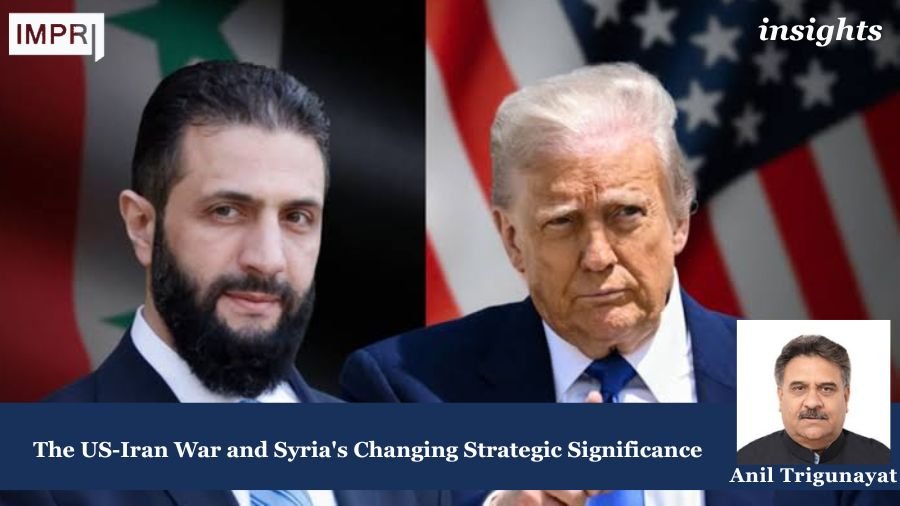
Syrian President Ahmed Al Sharaa, aka Mohammed Al Julani, is trying to navigate a difficult regional dynamic, especially in the Levant, as the conflict continues to escalate on several fronts, from Lebanon to Gaza to Israel to the Gulf Cooperation Council (GCC) and Iran. Through smart diplomacy, Al Sharaa was not only able to divest himself of his past credentials but also endeared himself to President Gaza, who lifted the $10 million bounty on his head. Turkey, Saudi Arabia and some other Arab League countries have helped him enter the mainstream of normal nations, even as their internal dynamics, diverse groups and ethnicities, as well as regional geopolitics, continue to impose ever-new challenges.
The forced removal and departure of former President Bashar Al Assad by the current dispensation in a rather swift operation weakened Iranian and Russian influence in the region. Moscow, despite hosting Assad, opened channels with the Al Sharaa regime early on and has tried to retrieve its strategic heft in Syria, especially understandings with regard to strategic Syrian ports. Damascus chose to be pragmatic and declined to open new adversarial fronts. For them, Iran and Israel remain a major challenge in any case, as both pose threats of destabilisation against their sovereignty and territorial integrity. Hence, a cautious yet firm approach has been adopted.
But the US-Iran-Israel war seems to have dragged them into the gravitational orbit of big- and middle-power competition, as regional players began to weigh their options as to how best to use Syria’s strategic geography and potential pliability. This was started by President Trump himself when he tried to restrain his Israeli, diffident protégé, Netanyahu, from derailing the MoU (Memorandum of Misunderstandings and Violations) with Iran and stopping strikes against Lebanon and Hezbollah, which is the very first clause, condition and red line for Iran. Of course, currently both sides have junked the MoU, as they are escalating the conflict once again. But it still remains a framework to revert to for new talks whenever a ceasefire is achieved.
Trump, decrying excessive violence and bombardment by Israel against Lebanon, especially Hezbollah, has often invoked the erstwhile credentials and not-so-flattering past of Al Sharaa and his extremist outfits and experience to argue that Syrians can better handle Hezbollah than Benjamin Netanyahu, also implying that the Islamists take care of each other and kill each other. Although, overtly, Al Sharaa would prefer not to be dragged into that war and help Israel, which, in any case, has occupied the Golan Heights (recognised by the US and Trump) and is seen as an overbearing, confrontational and coercive power next door with whom finding a modus vivendi will remain a challenge.
But for them, even Hezbollah is a challenge; hence, its decimation is in their interest. Meanwhile, reports indicate that Syria’s security establishment is drawing up plans for possible operations against Hezbollah, if needed, as per Israeli Kan News. A source close to the government notes a clear gap between Damascus’s public stance and behind-the-scenes preparations; forces have been ordered to confront any Hezbollah presence inside Syria. The impact of war in Lebanon is real for Syria.
Al Sharaa’s domestic challenges are still not over, even as the process of regional assimilation moves on. ISIS keeps on chasing and criticising Al Sharaa, accusing him of complicity with the US and Israel, especially after his pompous visit to the White House and his praise of Trump as the harbinger of peace in the region. ISIS accused Muhammad al-Julani of treason, comparing him to figures in Islamic history portrayed as betraying the Muslim nation: Abu Rigal, Ibn al-‘Alqama, Atatürk, al-Samiri, and Balaam.
In an Al-Naba editorial titled “Atatürk in Washington”, ISIS claims al-Julani follows in their footsteps through cooperation with the West and a willingness to hand Syria over to Western and Israeli interests. ISIS stresses that al-Julani has admitted Syria now helps the West fight terrorism and that Turkish support—”the West’s arm in the region”—enabled his rise to power. The group argues his alliance with the West is longstanding, calling him an “international spy” prepared to sacrifice the blood of the mujahideen. It adds that during his Washington visit, Jewish forces struck southern Syria without any response from the new Syrian regime. This is a challenge he will have to ward off with dexterity.
Many observers contend that, since late 2024, Israel has seized the southern Syrian buffer zone, ended the 1974 disengagement accord, backed plans for expanded control, and provoked Druze and other communities to rise up—moves Damascus calls a step towards annexation. Syria, Turkey and Egypt all reject these claims, with Ankara upgrading air defences and Cairo insisting on full Israeli withdrawal. While Israel frames its actions as security measures, affected states view them as expansionism. All three are aligning defence planning, stating they will respond if their sovereignty or territory is targeted.
But the Iran war and the closure of the Straits of Hormuz and Bab el Mandeb have necessitated a speedy diversification of connectivity, pipelines and alternative routes by the UAE, Saudi Arabia, Iraq and others. This was even discussed during the recent visit of the Iraqi Prime Minister to the White House, when Trump supported the 800 km Iraq-Syria pipeline from Kirkuk to the Mediterranean to bypass Hormuz.
Iraq had built a pipeline from Kirkuk to Banias around the Strait of Hormuz three times since 1952. Syria shut the first one in 1982 due to the Iran-Iraq War. Saudi Arabia seized the second. Turkey froze it in arbitration. The US bombed it in 2003. Now a proposed $60 billion pipeline, supported by the US, goes right back through Syria. Even as the diversification might be going on, conflicts of the kind being witnessed cannot ensure unanimity against attacks.
Other examples from the past could be instructive. Iraq also built IPSA through Saudi Arabia in 1989: 1.65 million barrels a day of capacity, purpose-built to dodge Hormuz. Iraq invaded Kuwait one year later. The Saudis shut the line, then expropriated the entire thing in 2001 and converted it to carry gas. The Turkish route, Kirkuk to Ceyhan, lasted longest. It absorbed decades of sabotage, then an arbitration ruling froze it for more than two years, starting in 2023. All three routes worked mechanically.
As for the India Middle East Europe Economic Corridor (IMEEC), given Palestinian statehood and the ongoing Gaza war, as well as Saudi-UAE regional competition and policy differentials, Riyadh had recently proposed that IMEEC could be rerouted through Syria to the Mediterranean, avoiding passage through conflict-prone Israeli ports.
Earlier, in February, reports indicated that Saudi Arabia was seeking to reroute a planned fibre-optic cable project through Syria instead of Israel, as part of the East to Med Data Corridor (EMC), according to a report by Middle East Eye. It remains to be seen what kind of traction this will receive from other players and whether the recently conditional 1+2+3 civil nuclear deal between the US and Saudi Arabia will soften the Saudi stance. India’s National Security Adviser has visited Saudi Arabia several times, and such issues would surely have come up given the geopolitical turmoil in the region.
Hopefully, the Hormuz crisis will dictate the necessity of diversification and the efficient and effective functionality of pipelines and other connectivity projects without being bogged down in geopolitical subversions.
About the Contributor:
Anil Trigunayat is a former Indian ambassador to Jordan, Libya and Malta and a distinguished fellow and head of the West Asia Experts Group at the prestigious Vivekananda International Foundation. He is also a Distinguished Fellow at the oldest Indian think tank, the United Services Institute of India.
This article was first published in Firstpost as The US-Iran war has recast Syria’s strategic role on July 27, 2026.
Disclaimer: All views expressed in the article belong solely to the author and not necessarily to the organisation.
Read More at IMPRI:
BRICS in a Fragmented World: Challenges for India’s Presidency
Global strategy: Why the India-Russia RELOS Pact Matters in a World at War
Acknowledgement:
This article was posted by Vishal Kumar, a Research and Editorial Intern at IMPRI.