






Dolly Kaushik
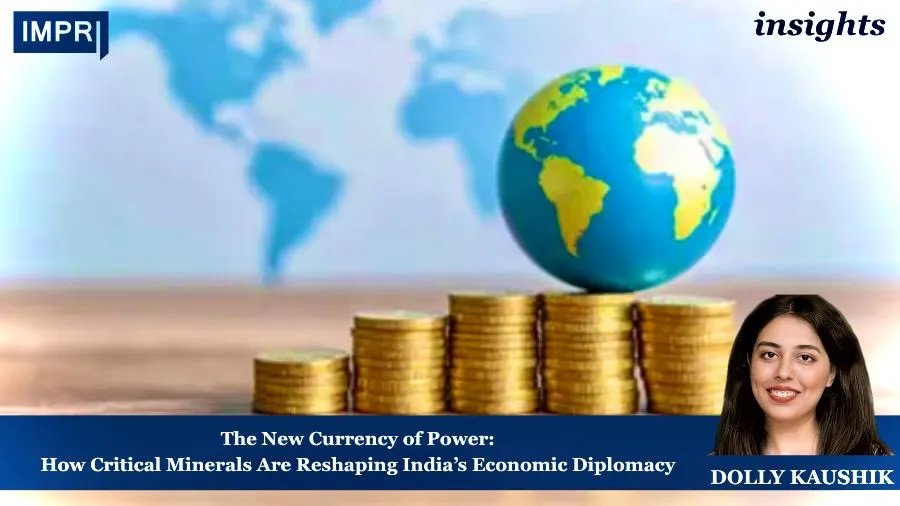
The next contest over strategic power may not be fought over oil alone. Increasingly, it is being shaped by lithium, cobalt, nickel and rare earth elements – the minerals behind electric vehicles, renewable energy, electronics and defence systems. As supply chains for these resources concentrate in a handful of countries, access to critical minerals is no longer simply a mining question. For India, it is becoming a question of economic security and strategic autonomy.
In January 2025, the Union Cabinet approved the National Critical Mineral Mission (NCMM) with a total outlay of ₹34,300 crore over seven years, comprising ₹16,300 crore in government expenditure and an expected ₹18,000 crore from public-sector undertakings and other stakeholders. The Mission strengthens the entire value chain, from exploration and mining to processing, recycling and overseas acquisition, suggesting India is treating critical minerals as more than a conventional mining concern.
The problem is bigger than what lies underground
Critical minerals are becoming strategic because modern economies depend not only on access to raw materials, but on the ability to process and refine them. A country may possess mineral resources and still remain vulnerable if it lacks the industrial capacity or diversified relationships needed to turn those resources into usable inputs.
For India, this coincides with ambitious goals in clean energy, electronics and defence. In fiscal year 2025, Chile alone accounted for about 32 percent of India’s lithium carbonate imports and 41 percent of its lithium oxide and hydroxide imports, underscoring how concentrated India’s exposure remains within even a single mineral. The question is not simply whether India can extract more domestically, but whether it can build supply chains resilient enough to withstand disruption and dependence on any one source.
From domestic capacity to international strategy
The NCMM seeks to strengthen domestic exploration, production, processing and recycling across the value chain. The MMDR Amendment Act, 2026, has further sought to facilitate exploration and development of critical minerals, giving leaseholders greater flexibility for extraction while establishing a more uniform fiscal regime for the sector. But the more revealing part of India’s strategy lies beyond its borders.
Khanij Bidesh India Limited (KABIL), a joint venture among NALCO, Hindustan Copper and MECL under the Ministry of Mines, was incorporated in 2019 to identify, explore, acquire and develop strategic minerals outside India. In Argentina, KABIL has secured exploration and exclusive rights over five lithium brine blocks in Catamarca province, with production expected after 2029, illustrating a shift toward Indian state-backed entities seeking direct presence in overseas resource projects rather than relying solely on conventional trade.
Chile presents a related but distinct case: rather than a KABIL-led project, India’s engagement runs mainly through trade and emerging commercial interest, including reported talks over lithium assets by Coal India. Argentina and Chile together show two routes India is testing: direct overseas equity in one, trade and prospective investment in the other.
This is not simply about finding mines. It is about building relationships across the mineral value chain.
A different kind of economic power
This is where the issue becomes particularly interesting from an international relations perspective. The concept of economic statecraft, associated prominently with David Baldwin, examines how states use economic instruments to pursue strategic objectives. Traditional discussions emphasise economic rewards on one side and restrictions or coercive measures on the other. India’s critical-mineral strategy does not fit neatly into either category.
India is not primarily attempting to coerce another state into supplying minerals, nor simply offering rewards to secure political concessions. Instead, an emerging pattern appears to be taking shape around diversification: strengthening domestic capacity, pursuing overseas mineral assets, and building partnerships with resource-rich and technologically capable countries at the same time.
The India-US relationship illustrates this shift. In May 2026, External Affairs Minister S. Jaishankar and US Secretary of State Marco Rubio signed a bilateral framework on securing supply in the mining and processing of critical minerals and rare earths. On the same visit, the Quad countries committed to mobilising up to $20 billion toward critical mineral projects across the Indo-Pacific, placing mineral security within wider strategic partnerships rather than treating it as an isolated mining issue.
The significance lies in the combination of domestic capacity-building, overseas investment, international partnerships and supply-chain diversification, moving together rather than in isolation. This raises an important question: could diversification itself constitute a form of economic statecraft?
From resource security to strategic autonomy
It would be premature to claim every critical-mineral initiative is automatically economic statecraft; some measures are clearly conventional industrial policy. The analytical question is whether their combination reflects a deliberate effort to expand India’s options and reduce strategic dependence. If India can diversify where it sources minerals, build domestic processing capacity and establish partnerships across multiple countries, vulnerability to disruption by any single supplier falls, making economic relationships part of a broader objective: preserving policy autonomy.
Read through Baldwin’s framework, India’s approach can be understood as economic statecraft oriented less around changing other states’ behaviour and more around reshaping its own strategic constraints. This points toward what may provisionally be described as diversification-based economic statecraft, not an established category in the literature, but a proposition worth testing. Economic statecraft, on this reading, need not mean using economic power against another country; it can also mean using economic instruments to become less vulnerable to the choices of others.
Why this matters beyond mining
Critical minerals sit at an unusual intersection of industrial policy, trade and foreign affairs. The Ministry of Mines is building the domestic foundations of India’s mineral security through the NCMM and legislative reform, while India’s external economic relationships are increasingly becoming part of the same effort.
If India remains dependent on concentrated external supply chains, its ambitions in clean energy, advanced manufacturing and strategic technologies will remain exposed to disruption. But if it can combine domestic capabilities with diversified international partnerships, critical minerals could become a genuine component of India’s broader economic-security strategy. The real question is no longer simply where India’s critical minerals are located, but which relationships can secure them and how those relationships strengthen its strategic autonomy.
India may not be rewriting the rules of economic diplomacy yet, but its critical-mineral strategy offers an increasingly important test of whether diversification itself can become a tool of statecraft.
References
Baldwin, D. A. (2020). Economic statecraft (New ed.). Princeton University Press.
https://press.princeton.edu/books/paperback/9780691204420/economic-statecraft
Institute for Defence Studies and Analyses. (2026, July 21). India, Chile and the lithium supply chain.
https://idsa.in/publisher/issuebrief/india-chile-and-the-lithium-supply-chain
Khanij Bidesh India Limited. (2024, January 15). KABIL secures exploration and exclusive rights for five
lithium blocks in Argentina [Press release]. Ministry of Mines, Government of India.
https://www.pib.gov.in/PressReleaseIframePage.aspx?PRID=1996380
Ministry of External Affairs, Government of India. (2026, May 26). India–US framework on securing of
supply in the mining and processing of critical minerals and rare earths [Press release].
https://www.mea.gov.in/pressreleases?dtl/41236/IndiaUS_Framework_on_Securing_of_Supply_in_the_Mining_and_Processing_of_Cri
tical_Minerals_and_Rare_Earths
Ministry of Mines, Government of India. (2026). The Mines and Minerals (Development and Regulation)
Amendment Act, 2026.
https://www.pib.gov.in/FactsheetDetails.aspx?id=150952&NoteId=150952&ModuleId=16
Press Information Bureau, Government of India. (2025, January 29). Cabinet approves National Critical
Mineral Mission to build a resilient value chain for critical mineral resources vital to green technologies
[Press release]. https://www.pmindia.gov.in/en/news_updates/cabinet-approves-national-critical-mineralmission-to-build-a-resilient-value-chain-for-critical-mineral-resources-vital-to-green-technologies-with-anoutlay-of-rs-34300-crore-over-seven-years/
U.S. Department of State. (2026, May 26). Quad Critical Minerals Initiative Framework among the United
States, Japan, Australia and India [Fact sheet]. https://www.state.gov/releases/office-of-thespokesperson/2026/05/quad-critical-minerals-initiative-framework-among-the-united-states-japanaustralia-and-india
About the author
Dolly Kaushik is a postgraduate student of Public Administration with an interdisciplinary
academic foundation in Life Science. Her work explores the geopolitical dimensions of emerging
technologies, global governance, and international affairs. She is currently a research intern a
IMPRI, New Delhi.
Disclaimer: All views expressed in the article belong solely to the author and not necessarily to the organisation.
Read more at IMPRI:
A Grain for Thought: Reflecting on the monitoring system under PM POSHAN
Kabir and the Foundations of Indian Knowledge Systems
Acknowledgement: This article was posted by Manish Prakash Shinde, a Research and Editorial Intern at IMPRI.