







Policy Update
Harshini S
Background
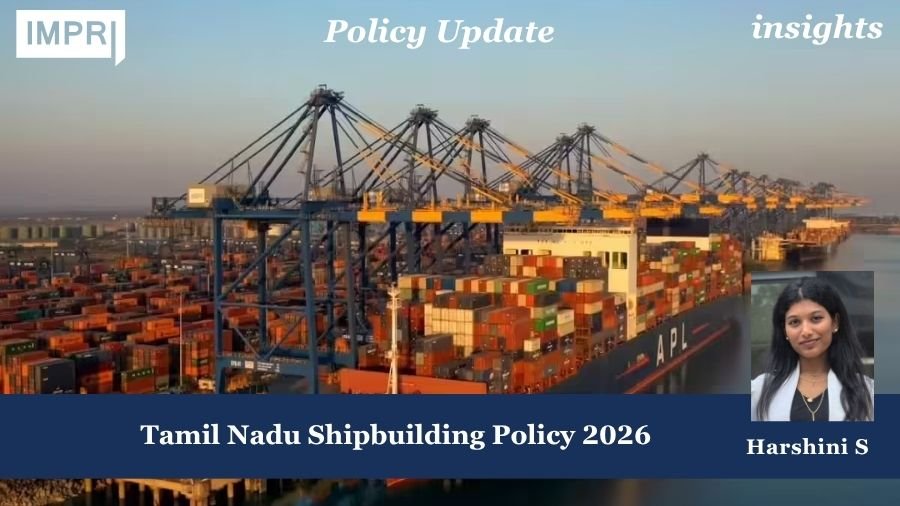
The Government of Tamil Nadu formally announced The Tamil Nadu Shipbuilding Policy 2026 on 04 March 2026 through an official policy document released by the state. The policy was released by Former Chief Minister of Tamil Nadu M.K. Stalin, aiming the state’s commitment to develop a competitive Shipbuilding, Repair, Recycling and Marine manufacturing ecosystem in the state. The main objective of the policy is to strengthen the position of India’s Maritime Economy and strengthen the port-led industrialisation (The Hindu, 2026).
Tamil Nadu has a historical lineage on shipbuilding. Archeological evidence suggests that Tamil maritime activities predate the 3rd Century BCE. Tamil Nadu has its geographical advantage of 1076km coastline and strategic port infrastructure such as VOC Port (Thoothukudi), Chennai Port, and Ennore Port, which creates a strong potential for the development of maritime engineering and industrialisation.
Despite these strengths, India has a limited global share in shipbuilding, which is necessitating a targeted policy intervention to enhance competitiveness and attract domestic and foreign investments (DGMA, 2026). The policy is supported by fiscal commitments outlined in the Tamil Nadu Budget 2026–27, where the government emphasises the development of maritime infrastructure, industrial diversification, sector-specific incentives and industrial ecosystems (Government of Tamil Nadu, 2026b, Point 84).
Functioning
The functioning of the Tamil Nadu Shipbuilding Policy 2026 is focussed on a mixture of financial incentives, infrastructure development and institutional facilitation designed to retaliate against the structural barriers of the sector. Tiered subsidy framework is one of the most significant aspects of this policy and it is structured to incentivise large-scale investments.
The policy emphasises the creation of a Special Purpose Vehicle (SPV) called National Shipbuilding & Heavy Industries Park Tamil Nadu Limited (NSHIPTN) to increase investment and institutional support. Those SPVs would be established under the State Industries Promotion Corporation of Tamil Nadu (SIPCOT) and V.O. Chidambaranar Port Authority (Government of Tamil Nadu, 2026a).
Infrastructure development is another critical pillar of this policy. The role of ports is also equally crucial in this framework. VOC Port is being positioned as a key hub for ship repair and maritime logistics expansion (VOC Port Authority, 2026). The coast of Tamil Nadu has three major ports, seven Government captive ports, and 17 non-major ports , along with fishing harbors and a diverse range of coastal and port-based industries, including nuclear and thermal power plants, refineries and fertilizers units (Government of Tamil Nadu, 2026a).
The policy emphasises human capital development. It recognises the labour-intensive nature of shipbuilding. The policy proposes the establishment of specialised training institutions and skill development programmes(only industry-linked) which aligns with broader national priorities in maritime skill development (DGMA, 2026). Single-window clearances and streamlined regulatory processes are incorporated and included in the policy to increase investment and reduce administrative delays. Sustainability is one of the notable features of this policy. Incentives for Green Shipbuilding technologies, low emission and energy efficient vessels are a significant effort to align industrial growth with environmental considerations.
Performance
Even though, The Tamil Nadu Shipbuilding Policy 2026 is a recent initiative, emerging reports from the official government sources show a strong momentum in terms of infrastructure development, subsidy creation and employment potential. According to a Press Information Bureau (PIB) release (2026), the Government of Tamil Nadu has initiated to develop a greenfield shipbuilding cluster in Thoothukudi through a Special Purpose Vehicle (SPV) formed jointly by the V.O. Chidambaranar Port (V.O.C Port)Authority and SIPCOT (PIB, 2026).
Tamil Nadu’s shipbuilding policy dovetails with national objectives. Maritime Amrit Kaal Vision 2047 aims to increase India’s capacity in global shipbuilding markets (Government of India, Ministry of Ports, Shipping and Waterways, 2023). Tamil Nadu marked significant measures to support Shipbuilding and marine manufacturing in the Interim Budget Estimates 2026-27 (Government of Tamil Nadu, Finance Department, 2026).
The policy made Partnerships with Indian Maritime University, polytechnic colleges, engineering colleges, ITIs and vocational training networks to create a skilled workforce in ship repair, marine engineering and allied services (Government of Tamil Nadu, 2026a; Government of Tamil Nadu, Finance Department, 2026).
According to the Press Information Bureau (PIB), the proposed cluster is expected to provide 55000 employment opportunities. Additionally, The PIB notes that the policy implementation is expected to strengthen industrial supply chains and ancillary industries thereby contributing to broader industrial growth (PIB, 2026). Furthermore, the policy aimed at improving connectivity, promoting MSMEs and reinnovating maritime infrastructure in Tamil Nadu’s coastline.
From a statistical perspective, the policy is not just merely declaratory but is being operationalised by institutional partnerships, employment creation and infrastructure developments. From an analytical perspective, Kaur and Thakur (2026) emphasises that shipbuilding and maritime industrialisation offers significant opportunities for investment and sustainable economic growth. The DGMA highlights the need to expand domestic shipbuilding capacity to improve India’s global competitiveness in maritime industries (DGMA, 2026).
The government expects that coordinated investments in infrastructure and skills will anchor Tamil Nadu’s ascent as a major hub in India’s maritime manufacturing and blue economy landscape. Meanwhile long term outputs like production volume and export growth are yet to emerge. But the current trends show a strong foundation for achieving the policy objectives.
Impact
The Shipbuilding policy 2026 is expected to have a significant impact on Economic growth, Industrial output, Employment generation, Regional development, Coastal development, Blue economy advancement and National significance. The policy is expected to enhance the state’s economic performance by attracting large-scale investments, thereby increasing industrial output and contributing to GDP. The policy intends to provide nearly 55000 employment opportunities and promote regional development particularly in coastal regions like thoothukudi and chennai. The policy contributes to national self reliance by strengthening domestic shipbuilding capacity. The policy aligns with India’s broader blue economy framework. As noted by Kaur and Thakur (2026) investments in maritime infrastructure are critical for long-term economic potential.
Emerging Issues
The policy faces several issues like global competition, high capital requirements and also political factors. One of the emerging concerns affecting the implementation of the Tamil Nadu Policy 2026 is the recent political transition following the 2026 Assembly elections. According to the data from Election Commission of India, no single party secured an absolute majority in the Tamil Nadu elections 2026, resulting in a hung assembly (Election Commission of India, 2026). This evolving political factor can influence the execution or continuity of the policy.
Another important challenge faced by the Tamil Nadu Shipbuilding Policy 2026 is the external competition from established shipbuilding powers such as China, South Korea and Japan. They dominate the industry through advanced technology, large-scale production capacity and integrated supply chains. China accounts for 50% of global ship production whereas South Korea and Japan continue to dominate high-value.
Limitation in coastal and maritime infrastructure required for globally competitive shipbuilding operations is another major challenge for the policy. Coastal infrastructure development requires substantial long-term investment and coordination among multiple agencies. Delays in land acquisition, environmental clearances or infrastructure financing may slow the operationalisation of proposed shipbuilding clusters.
At the same time, the new political forces can lead to greater emphasis on employment generation, industrial growth and regional development, which aligns with the objective of the policy. It is obvious that a political transition creates uncertainty, it also creates an opportunity to strengthen the policy through consensus building and alignment with evolving governance priorities. Co-ordinated efforts across government agencies, private sector stakeholders and regulatory institutions are required to address these challenges.
Way Forward
The policy represents a strategic step towards making the state a key player in the global Maritime industry. The effectiveness of the policy will depend upon how well it is implemented and sustained over time. A cruel aspect in this regard is ensuring policy continuity in between the evolving political dynamics. In sectors like this, long-term investor confidence is closely tied to stable governance and predictable regulatory frameworks (Government of Tamil Nadu, 2026a).
Tamil Nadu must prioritise the development of world-class maritime infrastructure to meet global standards. It also helps to attract large-scale investments. Improving maritime infrastructure and strengthening domestic shipbuilding priorities within India’s broader maritime development framework (DGMA, 2026).
Skill enhancement and workforce preparedness is also critical for long term success of the policy (DGMA, 2026). In addition, encouraging innovation, energy-efficient technology and environmentally responsible maritime practices will improve long-term sustainable industrialisation (Government of Tamil Nadu, 2026a). With continuous policy refinement, the Tamil Nadu Shipbuilding Policy 2026 has the potential to transform the state into a major maritime hub, contributing significantly to industrial growth, employment creation and expanding the blue economy.
References
Directorate General of Maritime Affairs. (2026). Comprehensive maritime sector report 2026. Government of India. https://dgma.gov.in/download/1770014523_6980473bc37b1_comarsem-26-for-dgs-v3-crisp.pdf
Election Commission of India. (2026). Tamil Nadu Assembly election results 2026. Government of India. https://results.eci.gov.in/ResultAcGenMay2026/index.htm
Government of Tamil Nadu. (2026a). Tamil Nadu Shipbuilding Policy 2026. Guidance Tamil Nadu.https://storage.investinginTamilNadu.com/Guidance/Uploads/Documents/tamil_nadu_shipbuilding_policy_2026_.pdf
Government of Tamil Nadu. (2026b). Budget speech 2026–2027 (Point No. 84). Finance Department, Government of Tamil Nadu. https://financedept.tn.gov.in/en/my-documents/2020/07/BS-2026-27-English-FINAL.pdf
Government of India, Ministry of Ports, Shipping and Waterways. (2023). Maritime Amrit Kaal Vision 2047. Government of India. https://www.maritimesector.gov.in/sites/default/files/2023-03/Maritime%20Amrit%20Kaal%20Vision%202047.pdf
Kaur, R., & Thakur, J. (2026). India’s blue economy: Financial prospects and investment strategies. In Infrastructure finance and sustainable governance (pp. 275–292). Springer Nature Switzerland.
Press Information Bureau. (2026). Development of greenfield shipbuilding cluster in Thoothukudi. Government of India. https://www.pib.gov.in/PressReleaseDetail.aspx?PRID=2240067®=6&lang=1
The Hindu. (2026, March 4). CM Stalin releases Tamil Nadu Shipbuilding Policy 2026. The Hindu. https://www.thehindu.com/news/national/tamil-nadu/cm-stalin-releases-tamil-nadu-shipbuilding-policy-tn-agroforestry-policy-2026/article70702876.ece
V.O. Chidambaranar Port Authority. (2026). Press release on maritime and shipbuilding development initiatives. https://www.vocport.gov.in/api/files/news-media/press-release/press-release-1771842268368-929406032.pdf
About The Contributor
Harshini S is a research intern at IMPRI. She’s pursuing M.A.(International Relations) from Loyola College, University of Madras as of May, 2026. Belonging from a humanities background, she has developed strong critical thinking, research skills and creative writing skills. Her interest lies in Strategic studies, Human Rights and Public Policy.
Acknowledgment
The author extends sincere gratitude to the Yashkirti pal, Ameya Satam and IMPRI team for their expert guidance and constructive feedback throughout the process.
Reviewers
The article was reviewed by Yashkirti pal and Ameya Satam.
Disclaimer
All views expressed in the article belong solely to the author and not necessarily to the organisation.
Read more at IMPRI
EU Carbon Border Adjustment Mechanism (CBAM) and India’s Export Competitiveness
SOAR Initiative: Equipping the World’s Largest School-Going Population with AI Readiness.