




Policy Update
Anamika P K
Background
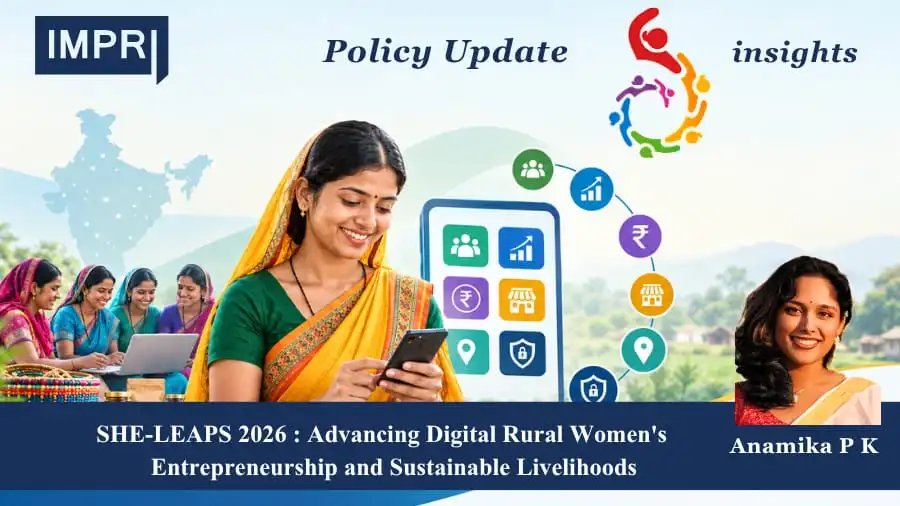
The Self Help Entrepreneur- Livelihoods and Enterprise Application for Prosperity and Sustainability (SHE -LEAPS) was launched on 29th June 2026 at Rashtriya Gramin Vikas Sammelan, in New Delhi. The application, introduced in the context of expanding the Lakhpati Didi target from 3 to 6 crore, aims to strengthen the rural women enterprises associated with Self-Help Groups.
The existing women SHGs already play a significant role in rural women empowerment, yet they are restricted by the challenges such as informality, inadequate funding, and weak market access. Women-led micro-enterprises in the rural locations encounter difficulties also due to limited access to the technologies. Further the absence of adequate real-time performance tracking additionally results in gaps in timely support for the women-led enterprises. SHE-LEAPS was established to address these persistent gaps by strengthening data-driven monitoring, financial access, and market linkages for rural women-led enterprises. It primarily fills the gap in real-time enterprise-level information required for timely and targeted institutional support.
The application has been operationalised with five stated objectives:
- Empower and foster rural women-led enterprises across the country
- Promote the establishment and growth of women-owned rural enterprises.
- Facilitate integration of rural producers with formal value chains.
- Advance financial inclusion and access for SHG households.
- Leverage data-driven approaches to strengthen rural entrepreneurship and decision-making.
Collectively, these objectives reflect the policy’s focus on women’s entrepreneurship, data-driven enterprise development, value-chain integration, sustainable livelihoods, and financial inclusion, with the broader aim of fostering prosperity and self-reliance in rural India. The platform is also intended to strengthen the established Lakhpati Didi Mission through end-to-end tracking of enterprise performance and income growth.
Functioning
The Digital India Corporation, under the Ministry of Electronics and Information Technology (MeitY), will implement SHE-LEAPS through the LokOS platform. SHE-LEAPS however is not an isolated application, it complements the already existing platforms like Livelihoods Organisation and Knowledge Sharing (LokOS) platform, which supports the digital mobilisation, profiling, and management of Self-Help Groups and their members at scale.
SHE-LEAPS function as an unified digital platform for enterprise creation and performance monitoring for the women- led enterprises in the rural geography. It captures the real-time enterprise data and enables monitoring throughout the enterprise journey, improving both the availability of enterprise-level information for monitoring and planning and gives a better visibility into rural economic activities. The platform covers the entire enterprise journey from profile generation to enterprise performance monitoring, extending support to the entrepreneurs at every stage of their entrepreneur journey. The target beneficiaries are primarily rural women associated with SHGs. The platform functions as a facilitator in empowering rural women by supporting enterprise development, livelihood generation and financial inclusion.
While Deendayal Antyodaya Yojana – National Rural Livelihoods Mission (DAY-NRLM) forms the institutional, financial and digital ecosystem within which SHE-LEAPS operates, Digi India Corp and LokOS forms its institutional and technological framework. LokOS, the platform through which SHE-LEAPS is operationalized, serves as a comprehensive digital system that digitises the activities such as capturing and maintaining member records, financial transactions, livelihood activities and tracking convergence initiatives. This facilitates digitizing the functioning of community-based organisations such as Cluster Level Federations, Village Organisations and SHGs, thereby providing a strong foundation for rural development programmes.
Source: Press Information Bureau (2026, July 1), SHE-LEAPS: Digital Empowerment for Lakhpati Didis. https://share.google/pc7vP1NfXkwVDLTZJ
Performance
SHE-LEAPS covers multiple categories of rural economic activities with beneficiaries including both farm and non-farm rural enterprises, rather than limiting the scope of beneficiaries exclusively to one type of enterprise. It is being implemented across 34 States and UTs through the State Rural Livelihoods Missions, with the platform designed to support the monitoring and development of women-led rural enterprises.
As an early indicator of implementation, 11,22,871 SHG enterprises had been registered on the SHE-LEAPS digital platform across 34 States and UTs as of August 2026. The registration figures, however, vary considerably across States, indicating differences in the scale of enterprise onboarding during the initial phase of implementation. The platform also facilitates the collection and monitoring of enterprise-level information, including annual turnover and enterprise continuity, which can support evidence-based planning and timely institutional interventions.
The significance of SHE-LEAPS at this stage therefore lies primarily in establishing a structured, data-driven mechanism for enterprise monitoring rather than in demonstrating measurable long-term outcomes. As implementation progresses, state-wise registration, enterprise continuity, turnover trends and other available indicators can provide evidence for assessing variations in enterprise performance and informing targeted interventions under the broader Lakhpati Didi framework.
Impact
SHE-LEAPS fundamentally intends to support and strengthen the enterprise expansion among rural women associated with SHGs. By providing a unified digital ecosystem for the whole enterprise period- for establishment, monitoring and performance tracking, it enables more informed and sustainable enterprises in rural India. This consequentially facilities millions of rural women to become financially independent and be active contributors to the rural economy and prosperity.
The better access to the authorized digital data will further empower women to understand and analyse the market demands, tracking credit obligations, monitor production patterns, evaluate business performance and profitability for better informed entrepreneurial decision-making. This will eventually enhance the quality and long-term viability of the enterprises, resulting in transformation of women from mere welfare beneficiaries to key economic actors in the rural economies – through employment generation, revitalizing local economies and fostering innovation- driven growth. Over the long term and from a broader perspective, this can potentially encourage younger women from rural locations to choose entrepreneurship as a viable career path.
By enabling multi-level monitoring, the policy can support decision-making at both local and national levels. Along with informed decision making, through digitalizing operational information across multiple sectors, the application will also facilitate evidence-based planning and informed policy making, and enhance institutional governance through systemic and data-driven monitoring. The real time visibility into the economic activities of rural women enterprises further provides scope for policy makers to identify opportunities for tailored interventions and strengthen programme outcomes.
Emerging Issues
SHE-LEAPS, as a recently introduced initiative, holds considerable potential to advance women’s economic leadership and empowerment in rural India. However the implementation of the initiatives faces structural and institutional barriers that hinders its effectiveness and sustainability.
- Data Quality and Monitoring Capacity: The effectiveness of SHE-LEAPS will depend significantly on the regularity, accuracy, and timely updating of enterprise-level information. Inadequate, invalid, or inconsistently reported data could undermine the quality of monitoring, planning, and institutional decision-making.
- Digital Divide and Accessibility: Uneven levels of digital literacy across rural regions may constrain equitable access to the platform. Rural women entrepreneurs have varying levels of access to smartphones, digital devices, and the skills required to use digital applications effectively.
- Digital Infrastructure and Connectivity: Limited access to reliable internet connectivity, particularly in remote rural areas, may create operational barriers to the effective use of SHE-LEAPS. Uneven digital infrastructure could consequently widen existing disparities in access to enterprise information and institutional support.
- Equity in Enterprise Outcomes: Differences in digital access, skills, infrastructure, and institutional support across regions may result in uneven benefits from the platform. Addressing these disparities will therefore be important for ensuring that digital enterprise monitoring translates into more inclusive and sustainable outcomes for rural women-led enterprises.
Way Forward
Taking both possibilities and challenges into consideration, the sustained success of SHE-LEAPS will require a comprehensive approach, consisting of robust institutional mechanisms, enhanced digital accessibility and an enabling entrepreneurial ecosystem that can address the existing constraints and create opportunities for rural women to establish and expand their enterprises. The initiative can be a major step in the rural digital transformation by combining entrepreneurship, digital infrastructure and women empowerment. However this requires the possible challenges in the implementation to be addressed adequately.
- Strengthening Digital Training and Local Facilitation : Digital platforms and technologies alone cannot ensure enterprise growth and desired outcomes. Considering the wide digital divides in rural India and concerns regarding digital literacy among rural women entrepreneurs, sustained, targeted training and mentoring in the use of digital devices and platforms is essential to ensure that the platform becomes equally accessible across the country. A local facilitation centre, associated with local government bodies such as Gram Panchayats and supported by a Community Resource Person, can be established to facilitate application training, address queries, and monitor progress. Regular and dedicated capacity-building programmes aimed at digital literacy and application training are therefore essential prerequisites for the successful implementation of the policy.
- Strengthening Data Quality and Verification : As mentioned above, the accuracy of the data available on the platform is another crucial component in ensuring its efficiency. Clearly defined data-entry and verification protocols need to be established to address possible challenges regarding inaccuracies in the available data. Periodic data audits and field-level verification that complement digital monitoring are essential to avoid data discrepancies and ensure the quality of information available on the platform.
- Strengthening Institutional Monitoring : The monitoring mechanism should extend beyond the registration of enterprises to assess indicators such as enterprise continuity, turnover, access to finance, market linkages, and income progression. This can enable State Rural Livelihood Missions and local institutions to identify enterprises requiring targeted financial, technical, or market-related support.
- Improving Digital Infrastructure and Convergence : Addressing connectivity constraints in underserved rural regions is essential for ensuring equitable access to SHE-LEAPS. Convergence with existing rural digital infrastructure, financial inclusion mechanisms, skill-development programmes, and DAY-NRLM institutions can further ensure that the information generated through the platform translates into timely and targeted enterprise support.
Conclusion
SHE-LEAPS represents a significant policy approach towards institutionalizing women-led entrepreneurship as a central component of rural economic development. Its significance lies in its policy capacity to bring together women empowerment, digital data-driven enterprise development, financial inclusion and rural economies. The transformative potential depends on tackling systemic constraints affecting financial inclusion, digital connectivity, market participation, and the long-term viability of women-led enterprises through integrated and targeted policy measures. Ultimately, given the challenges are addressed substantially, SHE-LEAPS can transform the scattered rural micro enterprises into more resilient and profitable – well connected data driven networks, accelerating the vision of both women empowerment and digitally empowered rural India.
Selected References and Important Links
1.Ministry of Rural Development. (2026, June 29). “Rashtriya Gramin Vikas Sammelan” chaired by Union Minister Shri Shivraj Singh Chouhan charts a shared roadmap for ‘Developed Villages – Developed India’. Press Information Bureau, Government of India.
https://www.pib.gov.in/PressReleaseDetail.aspx?PRID=2279029&lang=1®=3
2.Ministry of Rural Development. (2026, July 1). SHE-LEAPS: Digital Empowerment for Lakhpati Didis: Enabling Data-Driven Growth for Women-Led SHG Enterprises. Press Information Bureau, Government of India.
https://www.pib.gov.in/PressReleasePage.aspx?PRID=2279679&lang=1®=48
3.Ministry of Rural Development. (2026, July 21). Funds for DAY-NRLM. Press Information Bureau, Government of India.
https://www.pib.gov.in/PressReleasePage.aspx?PRID=2287316&lang=1®=48
4.DD India. (2026, July 1). SHE-LEAPS: Driving digital empowerment and enterprise growth for rural women. DD India.
https://share.google/nTMmOYMQZvtoi7dRl
About the Contributor
Anamika P K is a Research and Editorial Intern at IMPRI. She is a postgraduate in Political Science from the University of Hyderabad and a graduate of Ramjas College, University of Delhi. Her research interests include feminist politics, gender, International Relations, Women, Peace and Security, political economy, sustainability, and governance. She is particularly interested in evidence-based, interdisciplinary research and policy analysis that connects questions of power, inequality, and lived experiences with more inclusive, gender-responsive, and socially just policy and governance.
Acknowledgment
The author sincerely expresses gratitude to the reviewers, Ninchen and Sneha Kohli, IMPRI India and the editorial team for their valuable comments, constructive suggestions, and continuous guidance throughout the preparation of this article.
Disclaimer
All views expressed in the article belong solely to the author and not necessarily to the organisation.
Read more at IMPRI:
Telangana State Industrial Project Approval and Self-Certification System (TG-iPASS): 2014