







Policy Update
Yash Kumar
Background
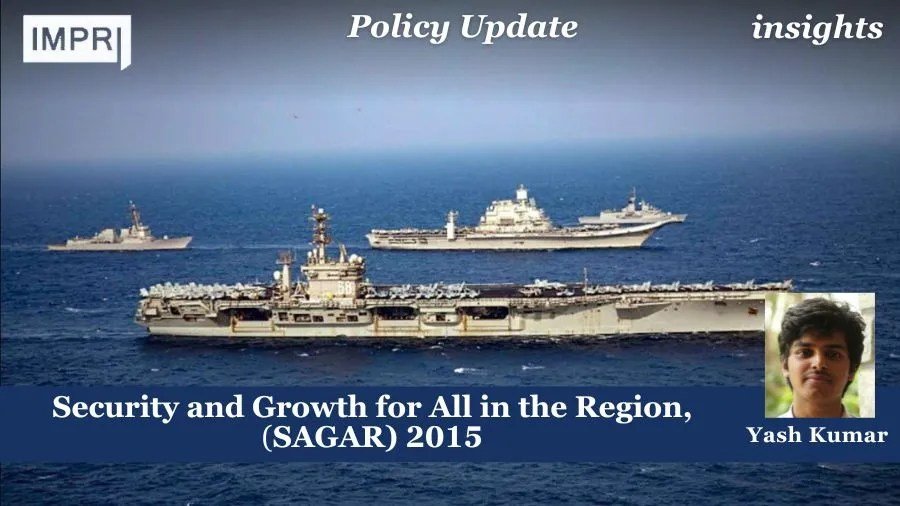
SAGAR, stands for Strategic and Growth for all in the region, was announced by Prime Minister Narendra Modi on March 12, 2015, during his address to the Indian Ocean Rim Association (IORA) The initiative emerged from India’s recognition of the strategic importance of the Indian Ocean Region to its national security and economic interests, as well as the need for a coordinated approach to addressing maritime challenges. SAGAR was conceptualised at a time when the Indian Ocean was witnessing increased geopolitical competition, particularly with China’s expanding maritime presence through its Belt and Road Initiative and “String of Pearls” strategy.
The initiative was designed to position India as a “preferred security partner” and “first responder” in the region while promoting collaborative approaches to regional challenges. The policy is guided by the Indian philosophy of “Vasudhaiva Kutumbakam” (The world is one family), which is mentioned in the Maha Upanishad. The philosophy greatly emphasises inclusivity and mutual benefit. It acts as a geopolitical framework for maritime cooperation, aiming to advance India’s strategic interests while at the same time contributing to a prosperous and stable region.
The primary beneficiaries include:
- Coastal states of the Indian Ocean Region
- Regional maritime security agencies
- Coastal communities are dependent on marine resources.
- Commercial entities utilising Indian Ocean trade routes
- Environmental stakeholders concerned with marine conservation
Later, in June 2019, Prime Minister Modi formally referred to SAGAR as a “blueprint for cooperation” during his address to the Maldivian Parliament, solidifying its status as a cornerstone of India’s foreign policy.
Functioning
SAGAR functions as a multidimensional framework that integrates various aspects of maritime engagement. It operates through several interconnected mechanisms:
India has implemented an Integrated Coastal Surveillance System and sponsored coastal radar systems in numerous IOR countries, including Seychelles, Mauritius, and the Maldives. This forms a network of information-sharing platforms that improve awareness in different situations across the region. Additionally, India provides patrol vessels to littoral states, building their maritime capacity while extending India’s security architecture. The naval component includes the regular bilateral and multilateral combat exercises to improve cooperation and establish standard operational procedures. Joint patrol exercises further reinforce maritime security coordination, particularly in addressing non-traditional threats Such as piracy, terrorism, and trafficking.
SAGAR Mala puts diplomacy at the heart of its efforts to build lasting partnerships. Such diplomatic methods show how India is not merely discussing cooperation but actively shaping it by aligning its maritime vision with regional strategies and global rules. Through such thoughtful diplomacy, SAGAR moves from being a concept to a real force in regional maritime affairs.
Periodic high-level visits, policy dialogues, and participation in forums like the Indian Ocean Rim Association (IORA) and Indian Ocean Naval Symposium (IONS) complement these formal arrangements. These platforms allow India to shape regional consensus on maritime administration. The initiative highlights human resource development through training programs, technical aid, and knowledge transfer. Naval personnel from countries in the Indian Ocean Region will receive specialised training at Indian institutions to create a community of maritime professionals with shared operational experience.
India’s SAGAR framework also includes environmental stewardship, as seen in campaigns like Swachh Sagar and Surakshit Sagar. These efforts highlight India’s deep commitment to fostering a sustainable blue economy by taking up measures to reduce marine pollution and restore coastal ecosystems.
The policy implementation involves multiple Indian Ministries and agencies, with each having different responsibilities:
- Ministry of External Affairs for Diplomatic coordination with all the concerned countries.
- Ministry of Defence and the Indian Navy for Security cooperation between all the concerned countries.
- Ministry of Shipping for developing Maritime infrastructure.
- Ministry of Earth Sciences to conduct Marine research and take measures for environmental protection
- The Coast Guard will provide assistance in case any non-traditional security challenges occur.
Performance (2023-2025)
A notable recent development is the deployment of INS Sunayna as Indian Ocean Ship (IOS) SAGAR in April 2025. The vessel embarked 44 naval personnel from nine friendly foreign countries- Comoros, Kenya, Mozambique, Tanzania, Mauritius, Seychelles, Sri Lanka, Madagascar, and the Maldives- demonstrating multilateral maritime cooperation in action. This deployment represents a significant expansion of SAGAR’s operational footprint. The ship participated in the inaugural India-Africa maritime partnership exercise AIKEYME 25 in Tanzania before arriving at Nacala Port, Mozambique, on April 17, 2025.
During port calls, activities included joint training on Visit, Board, Search and Seizure (VBSS) drills as well as firefighting and damage control procedures, reflecting SAGAR’s emphasis on capacity building. The IOS SAGAR mission is scheduled to conduct port calls at Dar es Salaam, Nacala, Port Louis, Port Victoria, and Male, coupled with joint surveillance of the Exclusive Economic Zones of Tanzania, Mozambique, Mauritius, and Seychelles. This operational pattern demonstrates the initiative’s focus on both capacity building and practical security cooperation.
The Ministry of Earth Sciences successfully conducted the Swachh Sagar, Surakshit Sagar 3.0 campaign on September 21, 2024, organising beach cleanup drives at more than 80 locations across India’s coasts. This initiative removed over 60 tons of waste, including plastic, metal, cloth, rubber, paper, and wood debris. The campaign attracted widespread public participation, including students, NGOs, and community groups, indicating growing awareness of maritime environmental concerns.
The event was notable for high-level participation, including Dr. M. Ravichandran, Secretary of the Ministry of Earth Sciences, and Ms. May-Elin Steiner, Norwegian Ambassador to India, signifying international recognition of India’s maritime environmental initiatives. A significant strategic advancement came with the announcement of Mutual and Holistic Advancement for Security Across the Regions (MAHASAGAR) by Prime Minister Modi during his visit to Mauritius in March 2025. This expansion builds upon SAGAR’s foundation as it enters its second decade, indicating policy maturation and broadening scope.
Impact
This initiative has firmly established India as the Indian Ocean’s “Net Security Provider,” Countering China’s narrative of maritime dominance. By forging strong security partnerships with coastal nations, India has created a strategic space that extra-regional powers might have otherwise occupied. SAGAR has created a solid foundation for countries to cooperate on maritime security. We see this in the rise of joint naval drills, coordinated patrols, and open information sharing. These partnerships spread the workload and strengthen everyone’s ability to handle threats at sea. The coastal radars and surveillance systems network boosts our awareness of maritime activity, so we can quickly respond to piracy or other dangers.
India has gained the trust of its neighbours by focusing on what the region as a whole needs, rather than just forcing its own interests. This approach has strengthened both India’s role in multilateral platforms and its bilateral ties with individual countries. By bringing these relationships together under a single, coherent strategy like SAGAR, India has shown that it is considering long-term conditions and leading with clarity in the Indian Ocean Region.
SAGAR’s efforts to make sea lanes safer don’t just support security—they also make trade smoother and more reliable, which helps regional economies thrive. At the same time, its support for the blue economy promotes the sustainable use of ocean resources, offering long-term benefits for coastal communities that depend on the sea for their livelihoods. Environmental campaigns like Swachh Sagar and Surakshit Sagar have delivered concrete results—cleaner beaches, less marine debris, and greater public awareness of ocean health. Integrating these green measures into maritime policy shows SAGAR’s balanced vision, one that links security, economic opportunity, and environmental stewardship.
Emerging Issues
India faces limits in its ability to execute large-scale maritime projects because financial, human, and infrastructural resources are more constrained than competitors like China. To overcome this, the government can form public–private partnerships. These collaborations will bring in private-sector funding and expertise. India can accelerate port upgrades, shipbuilding capabilities, and coastal technology installations by sharing risks and responsibilities.
The low level of private-sector engagement slows the growth of the maritime.economy. To change this, India should set up dedicated investment forums where businesses and the government meet regularly. Attractive incentive structures—such as tax breaks, equity support, and streamlined approvals—will draw more enterprises into port operations, logistics, and marine technology ventures. Over time, these measures will broaden economic participation and innovation.
China’s “String of Pearls” strategy and its debt-diplomacy initiatives have extended Beijing’s reach across the Indian Ocean. By building a network of port and infrastructure investments through debt financing, China has steadily expanded its reach across the Indian Ocean. By funding projects in Pakistan, Sri Lanka and Myanmar, China is carving out strategic footholds at India’s doorstep. New deep-water terminals and logistics hubs have prompted alarm in India, where analysts warn these facilities could serve dual civilian and military functions, effectively encircling India’s coastline.
To safeguard its sea lanes and regional standing, India is accelerating naval modernisation and nurturing partnerships from the Quad to bilateral ties with coastal states to check China’s growing footprint. To counterbalance this, India should advocate for partnerships defined by transparency, mutual respect for sovereignty, and rigorous cost‐benefit analyses, so no hidden liabilities arise. When collaborations yield concrete returns—new jobs, upgraded ports and roads, or skills training—trust naturally follows, laying the groundwork for enduring ties.
At the same time, non-state actors like pirates, smugglers, and terrorists continue to menace vital sea lanes. Incidents such as the MV *Lila Norfolk* hijacking and recent Houthi missile strikes off Yemen remind us that delay can cost lives and commerce. India can help forge a more resilient security architecture by deepening intelligence-sharing among IOR navies and coast guards and standing up regional coordination centres. These hubs would pool real-time information and fast-track multilateral response forces whenever a crisis erupts. Yet even the best-designed national policies stumble if central and state governments aren’t talking to each other. Tamil Nadu’s objections to the Indian Ports Bill, 2021, illustrate how local voices can derail well-intentioned legislation.
Embedding coastal-state representatives in drafting committees—right from Day 1—would build consensus, accommodate legitimate regional concerns, and smooth the path to implementation. India’s SAGAR vision rightly aspires to shared security and growth, but without sustainable safeguards, it could fuel overfishing or seabed exploitation. Jointly developed regional protocols—with clear monitoring rules and hands-on training—would protect fisheries, marine ecosystems, and mineral deposits. Empowering local authorities to enforce these standards will safeguard livelihoods and biodiversity for future generations.
Finally, too many cooks in the maritime kitchen hamper progress: ministries overlap, agencies duplicate, and projects stall. A dedicated SAGAR Secretariat, endowed with a clear mandate and sufficient authority, could synchronise policies, track milestones, and referee inter-agency disputes. A single, empowered coordination body would accelerate decision-making, boost transparency, and ensure India’s maritime strategy delivers on its promise.
Way Forward
As SAGAR (Security and Growth for All in the Region) steps into its second decade and evolves into the broader MAHASAGAR framework, it’s a good moment to pause and consider where the initiative is heading. The world—especially the maritime world—is changing quickly. For SAGAR to stay valuable and meaningful, it must grow, adapt, and become more grounded in everyday realities.
To start with, SAGAR needs stronger structures. Until now, much of its progress has depended on strong political leadership and high-level meetings. That’s a good beginning—but to make sure the initiative lasts, even when leadership or governments change, India should work toward building formal systems: clear agreements, joint institutions, and written rules. These would help make SAGAR something that’s not just tied to individuals, but built into the region’s long-term plans.
Second, we need to prepare for the new kinds of risks showing up in the maritime space. Today, threats aren’t only about ships and borders. They include things like cyberattacks on ports, illegal fishing, underwater surveillance, and even rising sea levels that affect entire coastlines. India should work with its neighbours to build shared skills and tools to handle these problems, because when countries team up, costs go down and trust goes up. Third, SAGAR should link better with other regional and global efforts. Many programmes are already trying to promote cooperation and sustainability in the Indian Ocean and Indo-Pacific regions, like the Indo-Pacific Oceans Initiative (IPOI) or the UN’s Sustainable Development Goals.
If SAGAR can align with these, it can avoid doing the same work twice and gain more global support, funding, and attention. Fourth, it’s important to track how SAGAR is doing over time. Setting clear goals, collecting data, and reviewing progress regularly will help make sure the initiative stays on track. It also shows partners and citizens that real work is being done and results are being delivered. Finally, SAGAR’s purpose should be about more than just security. Keeping the region safe is crucial, but oceans are also about trade, travel, jobs, culture, and science. Expanding SAGAR’s focus to include these areas will make it more inclusive and appealing to a broader audience. This will also make it easier to involve people beyond government, like researchers, business owners, and local communities.
In the end, SAGAR is about creating a shared future for the Indian Ocean Region—one based on cooperation, not competition. It’s India’s way of bringing countries together around common goals, from security and climate resilience to economic growth and cultural ties. As Prime Minister Modi put it, peace in the region depends on “collective, collaborative, and cooperative approaches.” With a few key changes—more structure, broader partnerships, and a wider vision—SAGAR can grow into a lasting and meaningful part of India’s maritime story, and a strong example of how regional cooperation can really work.
References
- Bhalsagar, I. (2024). India’s Maritime Security: Relevance of SAGAR (Security and Growth for All in the Region) in Achieving India’s Blue Water Ambitions. Phadke Journal of Strategic Studies. https://pjss.viyug.org.in/2024/02/14/indias-maritime-security-ipsha-bhalsagar/
- Choudhary, L. R. (2023, December 19). Assessing India’s SAGAR Plan: Challenges override prospects. South Asian Voices. https://southasianvoices.org/assessing-indias-sagar-plan-challenges-override-prospect
- China’s ‘String of Pearls’ exhibits The Dragon’s Great Game of Loans and Debts. (n.d.). https://www.efsas.org/publications/study-papers/china%E2%80%99s-%E2%80%98string-of-pearls%E2%80%99-exhibits-the-dragon%E2%80%99s-great-game-of-loans-and-debts/
- India believes in “Security and Growth for all in the Region” to focus on cooperative measures for sustainable use of oceans:President Kovind. (n.d.). https://www.pib.gov.in/PressReleasePage.aspx?PRID=1800028
- India’s SAGAR policy in the Indian Ocean region. (2020, December 25). Diplomatist. https://diplomatist.com/2020/12/25/indias-sagar-policy-in-the-indian-ocean-region/
- Indian Navy’s Maiden Initiatives Of Indian Ocean Ship Sagar (Ios Sagar) And Africa India Key Maritime Engagement (Aikeyme). (N.D.). https://www.pib.gov.in/PressReleaseIframePage.aspx?PRID=2114491
- India’s World. (2025, April 4). SAGAR – A decade of India’s maritime vision and the way ahead. India’S World. https://indiasworld.in/sagar-a-decade-of-indias-maritime-vision-and-the-way-ahead/
- Maritime Security: Memorandum Of Understanding (Mou) Between The Information Fusion Centre – Indian Ocean Region (Ifc-Ior) And Regional Coordination Operations Centre (Rcoc). (n.d.). https://www.pib.gov.in/PressReleaseIframePage.aspx?PRID=1901371
- Ministry of Earth Sciences successfully concludes the Swachh Sagar, Surakshit Sagar 3.0. (n.d.). https://www.pib.gov.in/PressReleaseIframePage.aspx?PRID=2057467
- MISSION SAGAR: A major Milestone in India’s Engagement with IOR Countries. (n.d.). Ministry of External Affairs, Government of India. https://www.mea.gov.in/press-releases.htm?dtl%2F32803%2F
- Mission Sagar: India’s helping hand across the Indian Ocean. (n.d.). Ministry of External Affairs, Government of India. https://www.mea.gov.in/press-releases.htm?dtl%2F32678%2FMission_Sagar_Indias_helping_hand_across_the_Indian_Ocean
- Question No-1510 Mission Sagar. (2023). The Minister Of State In The Ministry Of External Affairs. https://www.mea.gov.in/lok-sabha.htm?dtl%2F36934%2FQUESTION+NO1510+MISSION+SAGAR
- Raksha Mantri flags-off INS Sunayna as Indian Ocean Ship SAGAR from Karwar with 44 personnel of nine friendly nations of Indian Ocean Region. (n.d.). https://www.pib.gov.in/PressReleasePage.aspx?PRID=2119246
- Revisitng ‘Sagar’ – India’s Template For Cooperation In The Indian Ocean Region. (2018). National Maritime Foundation. https://maritimeindia.org/revisiting-sagar-indias-template-for-cooperation-in-the-indian-ocean-region/
- SAGAR Initiatives and Andaman and Nicobar Command (ANC). (2022). International Journal for Creative Research Thoughts, Volume 11(ISSN: 2320-2882). https://www.ijcrt.org/papers/IJCRT2311458.pdf
- Sagar Parikrama Yatra Programme. (2024). https://www.pib.gov.in/PressReleaseIframePage.aspx?PRID=2083152
- Schöttli, J. (2019). “Security and growth for all in the Indian Ocean” – maritime governance and India’s foreign policy. India Review, 18(5), 568–581. https://doi.org/10.1080/14736489.2019.1703366
- Singh, A. (2025, April 12). India’s Maritime Pivot: From SAGAR to MAHASAGAR with Africa on sight. The Sunday Guardian Live. https://sundayguardianlive.com/investigation/indias-maritime-pivot-from-sagar-to-mahasagar-with-africa-on-sight
- The SAGAR Vision and India’s Activities in Mauritius. (2024). The Diplomat. https://thediplomat.com/2024/08/the-sagar-vision-and-indias-activities-in-mauritius/
About the Contributor: Yash Kumar is a research intern at IMPRI, pursuing his Bachelor of Arts (Hons) in Economics and Sociology with a minor in Political Science from Christ University, Bangalore.
Acknowledgement: The author would like to thank Ms. Aasthaba Jadeja for supporting and reviewing the article.
Disclaimer: All views expressed in the article belong solely to the author and not necessarily to the organisation.
Read more at IMPRI:
Aajeevika- National Rural Livelihood Mission (NRLM), 2011
Mission Shakti: Advancing Women’s Safety, Security, and Empowerment in India (2022)