







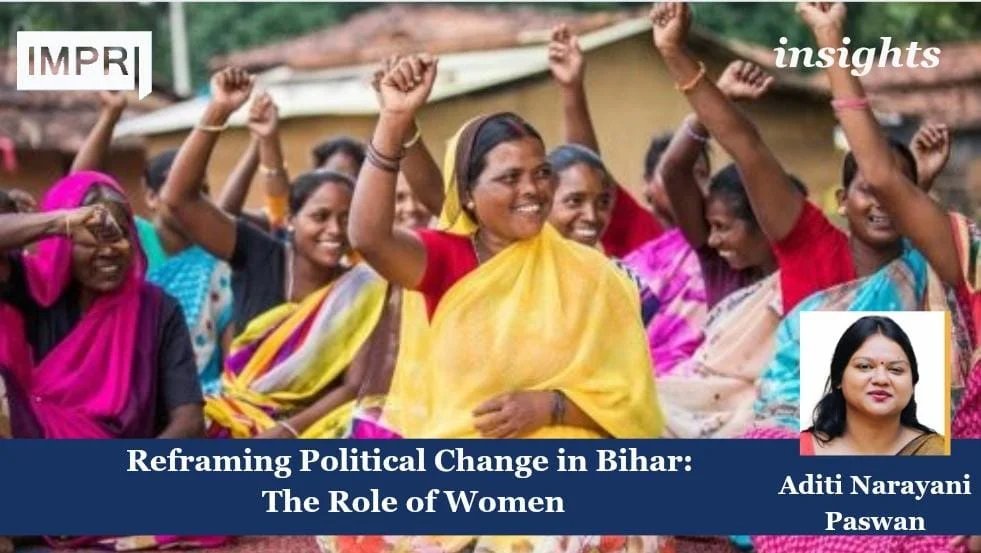
Aditi Narayani Paswan
Women’s active participation in Bihar’s electoral process is a crucial indicator of a deepening democracy. This engagement disrupts traditional gender hierarchies by promoting a fairer distribution of political power and symbolising the expansion of substantive citizenship for women.
In Bihar, where caste and patriarchal structures have historically shaped political participation, women’s increasing visibility and agency in elections reflect broader shifts towards inclusivity and social transformation. Such participation not only underscores formal equality but also represents women’s negotiations for autonomy within the state’s evolving democratic fabric. The defining M-Y combination this time is Mahila (women) and Yuva (youth).
Notably, this election remains wide open, with every contender claiming a strong chance. Though, there is massive anti-incumbency against the Nitish Kumar-led NDA government — issues such as migration and employment are resonating with voters — the women voters are rooting for him. They still view him as an agent of change who may bring about a Badlaav ki Bayaar (a wind of change). From Jeevika and prohibition to improvements in Bihar’s law-and-order situation, his policy measures for women’s empowerment over the past two decades have made him a trustworthy leader.
Despite its challenges, prohibition has contributed to safer households for many women, and they may be reluctant to risk their daughters’ future by voting to end it. The Jeevika initiative, which took shape in the early 2000s, shaped women’s economic independence and livelihoods. Several women and women-led self-help groups (SHGs) are proud to be income taxpayers — a powerful symbol of economic independence and of how women are shaping society at the grassroots.
Jeevika didis are being seen as agents of change in grassroots mobilisation and in fostering political consciousness. They play a critical role in politically empowering women and in ensuring a sustainable upward trajectory from village-level units to state assemblies and Parliament. The programme has helped women establish networks of support, increase their self-esteem and develop a sense of community. By fostering entrepreneurship and facilitating better market access, the programme has contributed to the success of several micro-enterprises and cottage industries in rural areas, thereby increasing women’s participation in economic activity.
Additionally, the programme’s focus on sustainable livelihoods has promoted job opportunities in sectors such as organic farming and resource management, and has fostered environmentally beneficial practices. Improved direct links between rural producers and urban consumers — reducing middlemen and ensuring fairer prices — have raised the incomes of many women, especially Dalit women, enabling investment in healthcare, education and broader socioeconomic development.
All these economic developments have made women active agents of political change, which further serves their interests. They are not merely passive voters. Women also exercise agency by considering factors that affect their households as a whole. Employment and migration are major issues; they are interconnected, since employment opportunities away from home fuel migration.
India’s growth story is being written largely by Biharis — but, regrettably, not in Bihar. A half-century of policy paralysis, neglect by the Centre and rule by satraps has produced the current situation, which can be reversed only through concerted effort and better coordination with the Centre. NiMo (Nitish–Modi) has stitched together a gendered coalition that cuts across caste lines, while others have alternated between free giveaways and caste calculations.
The Aditi Narayani Paswan is an assistant professor of Sociology, Lakshmibai College, Delhi University.
The article was first published in The Indian Express as In Bihar, women are agents of political change on November 7, 2025.
Disclaimer: All views expressed in the article belong solely to the author and not necessarily to the organisation.
Read more at IMPRI:
Reviving India-Canada Ties: The Moment for a Fresh Start and Renewed Strategy (2025)
Acknowledgment: This article was posted by Madhur Thapar, a visiting intern at IMPRI.