






Policy Update
Shailja Singh
Background
Industrial parks form part of industry development. Alongside land, they integrate relevant infrastructure and services and support companies. They can only be successful if there is good infrastructure, along with suitable links, environmental control and industries that can provide ongoing economic benefit.
Recently, Rajasthan has been working to improve both investment and industry infrastructure. Alongside its advantageous location, Rajasthan has access to natural resources, good market links and is positioned to benefit from the Delhi-Mumbai Industrial Corridor. Manufacturing, logistics and industry can thus all potentially thrive in Rajasthan. However, industry can only develop from these strengths if there is suitable land, streamlined consent processes and appropriate infrastructure for industry to operate on a large scale.
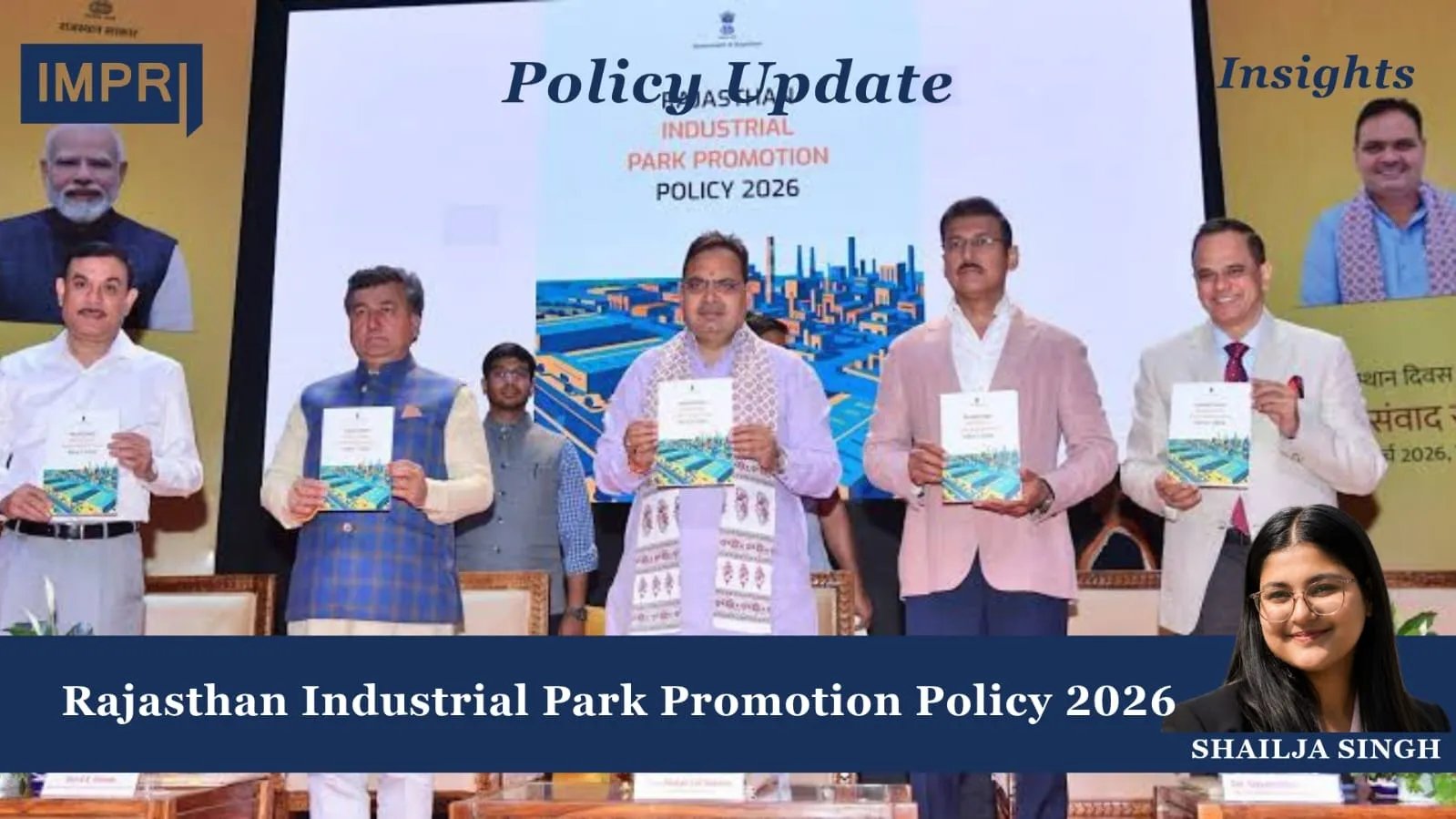
On 6 th March 2026, the Government of Rajasthan published the Rajasthan Industrial Park Promotion Policy 2026. This encourages the development of contemporary industrial parks using private and Public-Private Partnership (PPP) methods. Priority areas include infrastructure, industry variety, resource optimisation and job creation. The policy supports both Rising, Reliable and Receptive Rajasthan and Viksit Rajasthan@2047. [1][2]
It follows the Rajasthan Industrial Development Policy 2019 which has identified industrial parks as a development option. These could be developed using a private land/RIICO investment or RIICO land/private investment approach. Furthermore, the 2024 Modified Budget introduced a Private Industrial Park Scheme. In comparison, the 2026 policy is more detailed and includes information regarding the types of industrial park, qualifying criteria, financial rewards, consent and infrastructure requirements. It further supports the Rising Rajasthan investment drive by offering an infrastructure solution to convert investment into industry development. [2][3]
The policy is valid for five years from being published (or for a shorter period if replaced). It relates to both general and specific industrial parks. Industry sectors covered include manufacturing, processing, logistics, storage, data, Global Capability Centres (GCCs), Business Process Operations (BPOs), Knowledge Process Operations (KPOs) and information and IT enabled services. GCCs are units set up by multi-national or large companies to carry out particular activities (for example technological, financial, analytical, research and engineering) on behalf of, or for the global reach of, their parent company. [1]
Typically, industrial parks should be of a size of at least 50 acres and house 10 or more industrial units. No minimum acreage is indicated for more niche industrial parks, for example those for IT, data or GCCs. Again, this applies to industrial parks wanting to gain advantage from the policy. [1]
Functioning
The policy establishes four development models based on land ownership, developer participation and the role of Rajasthan State Industrial Development and Investment Corporation (RIICO).
Table 1: Development Models under Rajasthan Industrial Park Promotion Policy 2026
Source: Rajasthan Industrial Park Promotion Policy 2026. [1]
These models provide flexibility in land acquisition and project financing. RIICO is the implementing agency for parks on its allotted land, while the Commissioner, Industries and Commerce, is responsible for projects where developers arrange their own land. The Industries and Commerce Department is the competent authority for delineating private industrial park locations under the policy. [1]
Applications and approvals are routed through the RajNivesh single-window system. Developers submit a Detailed Project Report (DPR) outlining project feasibility, investment, infrastructure requirements, environmental compliance, employment potential and implementation timelines. For Model C, the implementing agency evaluates the DPR, and the evaluation report is preferably submitted within 60 days of receiving a complete application. The Commissioner, Industries and Commerce, takes the final decision after considering recommendations of a committee to be constituted for this purpose, preferably within 60 days of receiving the recommendations. The policy does not specify the composition of this committee. The project completion timeline is incorporated in the Letter of Approval (LoA), and committed investments must be made within the timelines approved by the implementing agency. [1]
The policy prescribes common infrastructure requirements, including internal roads, drainage, rainwater harvesting, water and electricity supply, street lighting and public amenities. The government facilitates water and power at the park boundary and road connectivity to the nearest existing paved road. Road construction costs are shared 60:40 between the state government and developer, with the state’s contribution capped at ₹3 crore. [1]
Financial support includes a 20% capital subsidy for common infrastructure, subject to ceilings of ₹20 crore for parks up to 100 acres, ₹30 crore for parks between 100 and 250 acres, and ₹40 crore for parks exceeding 250 acres. The initial phase covers the first ten industrial parks or proposals submitted before March 2027, whichever is earlier, with preference to priority locations under Rajasthan Investment Promotion Scheme (RIPS) 2024. The policy also provides reimbursement of 50% of expenditure on Common Effluent Treatment Plants (CETPs), capped at ₹12.5 crore per park. [1]
Developers may also avail incentives for Common Utility Centres and Plug-and-Play Office Complexes under RIPS 2024. Additional provisions include 100% electricity-duty exemption for captive renewable energy for seven years, 25% stamp-duty and land-conversion-charge exemptions and reimbursements, and support for external infrastructure. These provisions link industrial park development with the state’s broader investment incentive framework. [1][4]
Capital subsidy disbursement is linked to development and occupancy milestones. The first 30% is payable after 50% completion of infrastructure works, subject to third-party verification. The second 30% is payable after the completion certificate and 40% sale or lease of allocable area. The final 40% is released after 80% sale or lease of the total allocable area. This structure links public support with physical development and commercial uptake, although it does not directly require proof that the allotted units have commenced production. [1]
Performance
Following notification of the policy in 2026, implementation is to be evaluated using implementation data not end industrial data such as output and employment.
Rajasthan has pre-existing industrial facilities. Information provided by RIICO indicates that 445 industrial locations have been established. Between the start of 2025 and end-December 2025, 7,654.63 acres of land was purchased. In addition, 19 additional industrial locations were created and 1,499 plots (industrial, commercial, residential and other) were distributed. RIICO spent ₹1,220.99crore on creating industrial locations and received in return ₹2,050.73crore. There are now said to be 446 industrial locations – suggesting there was a variation in the date of the information provided. [5][6]
RIICO also states that in total, over 42,344 industrial units are operating within its industrial locations. These are thought to provide around 1.13 lakh jobs. Unfortunately no data was found on the overall ‘fill rate’ for industrial locations. Certain locations have also seen limited demand for plots. Following two rounds of distribution, RIICO reportedly discounted the price of land in locations which had still not attained a 25% plot distribution rate. Plots were offered for sale at 60% of either the current land price or reserve price – whichever was greater. Therefore, it appears that industrial facilities may not necessarily ensure industrial location demand. [6][7]
In 2025/26, it is estimated that Rajasthan’s industrial sector made up 26.55% of the state’s Gross State Value Added (GSVA) (at current prices). Of this, manufacturing was valued at 40.52%, then construction (35.02%), mining and quarrying (12.42%) and electricity, gas, water and other utilities (12.04%). [5]
Figure 1: Industry-sector GSVA at current and constant prices, Rajasthan
Source: Rajasthan Economic Review 2025–26. Constant-price values are at 2011–12 prices; 2023–24 and 2024–25 are revised estimates and 2025–26 is an advance estimate. [5]
Real output in the industry sector for 2025-26 increased by 7.02%. Output in manufacturing, building and electricity, gas and water and other utilities sectors showed increases of 7.84%, 8.27% and 9.37% respectively. Mining and quarrying saw negative output growth at -1.41%. Unlike the current price data which does take into account price fluctuations, this data therefore offers a better understanding of industry output development. [5]
Following the introduction of the new policy, application and then land grant processes have been enacted. In August 2026, it was reported that 23 applications under model ‘A’ were received for Dausa (ten); Vederlai in Balotra (seven); Bijauli in Dholpur (four); and Mayeja in Bundi (two). [8]
Then, following an electronic tender process on 15 September 2026, the land for three privately owned industrial estate sites totalling around 552 acres in Dausa, Balotra and Dholpur was granted. There were seven bidders for Dausa, five for Balotra and two for Dholpur. The successful developers are anticipated to develop the areas by providing road, water, electricity, sewerage, rain water collection and street light facilities. [9]
While this demonstrates further stages of the policy process, land granting is not synonymous with industrial estate development and operation. Ultimately, success will hinge upon good infrastructure provision, together with high levels of both occupation and output and effective investment.
Impact
The policy has the potential to further develop Rajasthan’s industry. Shared physical and service provision can be provided within an industrial park and so ease business start-up. MSMEs may find it more challenging to source suitable land and services such as electricity, waste disposal and transport.
Private sector involvement and PPPs could also allow the state to lessen its expenditure on industry. Models B and D attempt to utilise both public and private sector resources and skills. Furthermore, in Model D, RIICO’s provision of land can assist in overcoming issues that may occur in land collection. In addition, private sector companies can provide funding and control over infrastructure provision. [1]
Evidence relating to industrial development supports the value of agglomeration. Greenstone, Hornbeck and Moretti (2010) discovered that new large-scale manufacturing companies had positive effects upon the productivity of surrounding businesses. This implies that industrial parks can aid local economic development if they successfully attract operational businesses and establish connections within the economy. [10]
Whilst industrial parks can deliver positive results, ill-conceived infrastructure, misalignment of incentives and/or non-utilisation of space can all cause industrial parks to fail. Institutional, design and implementation factors are therefore crucial (Saleman and Jordan, 2014; World Bank Policy Research Working Paper). [11]
For Rajasthan, the success of industrial parks will hinge upon their ability to attract real businesses that are both operating and providing jobs. Although the policy stipulates a minimum of ten industrial units, this does not necessarily guarantee sufficient job creation, levels of investment and inter-business industry connections. Ideally, companies will develop local supply networks, invest in staff training and provide long-term job opportunities.
In addition, green schemes could be influential. With CETP backing and incentives for captive green energy, developers may wish to include eco-friendly features in their industrial park designs. Given Rajasthan’s water situation, it is especially vital that parks ensure that they can sustainably manage their resources. Without efficient water conservation, re-cycling and rainwater collection alongside water auditing, industries could exacerbate local water system pressure by expanding within highly water demanding areas. [1]
Furthermore, this policy could foster regional development by stimulating establishment of industry outside current industrial hubs. Areas in Dausa, Balotra and Dholpur have been pinpointed as suitable for further industrial development. Nevertheless, regional evenness will be influenced by transport provision, labour skills, market access and industry suitability. Merely providing financial incentives may not be enough to counteract these factors.
Emerging Issues
- Brownfield development – Model B and C brownfield development may encounter title issues, re-development issues and land purchase problems. Availability of land does not always reflect land that is both legally and development ready.
- Cross-cutting infrastructure – Cross-departmental collaboration is necessary to provide water, electricity, road, waste and environmental infrastructure. Poor delivery of such infrastructure can affect the feasibility of even approved parks.
- Low usage and pre-letting – Whilst parks may be approved for and then developed, these areas may not necessarily be used effectively. Where government grants are dependent on the sale or pre-letting of land within an area, there is a risk that land could be sold or pre-let in order to achieve required figures, irrespective of whether factories are then built and/or operated within that area. Consequently, as well as analysing land distribution, attention should also be given to buildings development, activation of business and long-term business operation. [1]
- Developer financial concerns – Developers working under Models A-C might need to fund initial infrastructure development. The initial 30% grant is only disbursed once infrastructure is 50% complete. The subsequent 70% is conditional upon infrastructure completion together with 40% and 80% land sale/ pre-letting. This may pose financial challenges, particularly if there is low industrial demand and/or high borrowing rates. [1]
- MSMEs – cost – Privately developed parks may levy greater land, rental and/or maintenance charges than RIICO developed industrial space. Although the policy does not stipulate particular measures to ensure, or a limit on, the affordability of MSMEs, it is essential that information is provided openly regarding these charges to ensure that smaller businesses are not disadvantaged.
- Environment – Although CETP provision is favourable, water supply, waste management, and renewable energy provision, alongside pollution management, must all be analysed in relation to the industrial mix of a given park.
- Quality of employment – Publicly available information should show the differentials between primary and secondary employment. Furthermore, emphasis should be placed on local employment and on the division between skilled and unskilled labour. Analysis should also determine the lasting extent to which employment is maintained post-business activation.
- Financial governance – Monetary grants and infrastructure assistance constitute public funds. Evaluation of their efficacy should consider not just plans and land distribution but also actual investment, industrial occupation, employment and taxation, as well as wider regional effects.
Way Forward
Rajasthan Industrial Park Promotion Policy 2026 supports private sector involvement in developing industry. It promotes 4 distinct development approaches; shared infrastructure support, green benefits and staged payments – all aiming to overcome issues related to industrial development funding and delivery.
Thereafter there should be a regular review of data relating to industrial park development including ideas, permissions, land allocation, funds pledged and used, infrastructure provision, operating industrial space, utilisation levels and jobs created. Information should also be analysed by district, development approach and industry type.
An ad-hoc joint working group comprising RIICO, Industries and Commerce, power, water, Public Works Department and pollution control bodies could be set up. Specific service delivery targets for electricity, transport, water and environmental services can then be established. This can assist in overcoming challenges associated with external infrastructure provision and further enhance development delivery.
Industrial park developments should be based upon analyses of market need, infrastructure provision, water and power access, labour supply and environmental capacity. Parks should also be designed to meet the needs of specific industries and to encourage local procurement especially for MSMEs. Particular industrial park space (or pre-constructed ‘plug and play’ industrial space) could even be reserved for MSMEs and local supporting businesses, thus further enhancing cost-efficiency and enabling MSMEs to become more effectively embedded within industry networks.
Infrastructure, environmental and industrial performance should all be independently reviewed alongside the payment of benefits. Developers must also reveal information regarding land costs, rental agreements and general maintenance fees. Stage-wise independent reviews can highlight where there are development delays and ensure that public sector funds are delivering extra economic benefit.
Whilst much will hinge upon how effectively Rajasthan is able to utilise its pro-investment policy to establish efficient industrial environments, the recent decision to provide land for 3 industrial parks is a good early move. Long-term policy success will rely upon continuing industrial and job creation together with local networking and sustainable natural resource management. By integrating industrial development with sustainability, regional planning, accountability and MSME involvement, Rajasthan can further bolster its role in achieving Viksit Rajasthan@2047 and India’s wider industrial and economic development aspirations.
References
- Government of Rajasthan. (2026). Rajasthan Industrial Park Promotion Policy 2026. Department of Industries and Commerce. Official policy document.https://riico.rajasthan.gov.in/writereaddata/PoliciesAndGuidelines/05212026162402PMrajasthan-industrial-park-promotion-policy-20261.pdf
- Government of Rajasthan. (2019). Rajasthan Industrial Development Policy 2019. Department of Industries and Commerce. Policy document.https://istart.rajasthan.gov.in/public/Policies/Rajasthan-Industrial-Development-Policy-2019.pdf
- Government of Rajasthan. (2024). Rajasthan Modified Budget 2024–25. Finance Department. Budget document.https://finance.rajasthan.gov.in/docs/budget/statebudget/2024-2025%20%28Modified%20Budget%29/Budget2024-25English.pdf
- Government of Rajasthan. (2026). Industrial Park Promotion Policy 2026: Building a better industrial ecosystem. Chief Minister’s Office. Official release.https://cmo.rajasthan.gov.in/programdetail/237352
- Government of Rajasthan. (2026). Economic Review 2025–26. Directorate of Economics and Statistics. Official report.https://finance.rajasthan.gov.in/docs/budget/statebudget/2026-2027/Economicreviewe.pdf
- RIICO. (2026). RIICO: Industrial infrastructure and production statistics. Rajasthan State Industrial Development and Investment Corporation. Official website.https://industries.rajasthan.gov.in/riico/
- The Times of India. (2026, May 19). RIICO gets nearly 800 applications for 465 plots. News report.https://timesofindia.indiatimes.com/city/jaipur/riico-gets-nearly-800-applications-for-465-plots/articleshow/131183755.cms
- The Times of India. (2026, August 11). RIICO gets 23 proposals for industrial parks under new policy. News report.https://timesofindia.indiatimes.com/city/jaipur/riico-gets-23-proposals-for-industrial-parks-under-new-policy/articleshow/133162020.cms
- ETGovernment. (2026, September 17). Rajasthan clears allocation of 552 acres for new private industrial parks. News report.https://government.economictimes.indiatimes.com/amp/news/economy/rajasthan-clears-allocation-of-552-acres-for-three-private-industrial-parks/134305816
- Greenstone, M., Hornbeck, R., & Moretti, E. (2010). Identifying agglomeration spillovers: Evidence from winners and losers of large plant openings. The Quarterly Journal of Economics, 125(4), 1427–1466. Research paper.https://academic.oup.com/qje/article/125/4/1427/1912418
- Jordan, L., & Saleman, Y. (2014). The implementation of industrial parks: Some lessons learned in India. World Bank Policy Research Working Paper No. 6799. Working paper.https://documents1.worldbank.org/curated/en/583931468269103332/pdf/wps6799.pdf
- Press Information Bureau. (2025). Planning and Establishment of Industrial Parks. Government of India. Official release.https://www.pib.gov.in/PressReleasePage.aspx?PRID=2207690
About the Contributor
Shailja Singh is a Research Intern at the Impact and Policy Research Institute (IMPRI) and a third-year B.A. (Hons.) Political Science student at Lakshmibai College, University of Delhi. Her areas of interest include public policy, governance, international relations and institutional processes.
Acknowledgement
The author sincerely acknowledges the IMPRI team for their guidance, valuable feedback, and continuous support throughout the preparation of this Policy Update.
Reviewers
Anushree Khare and shiva karthik