






Anil Trigunayat
India, which is currently hosting the deposed leader, will have a setback in the short term since in the minds of common Bangladeshis, Sheikh Hasina and India had become synonymous, writes Former Diplomat Amb. Anil Trigunayat.
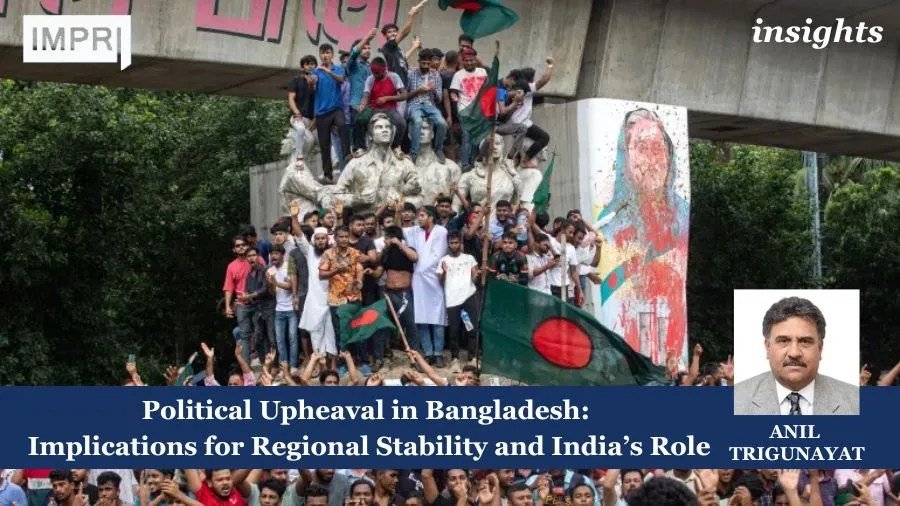
Quick succession of events in Bangladesh saw an abrupt resignation, removal and departure of Prime Minister Sheikh Hasina amidst widespread violent protests. She has been the longest serving lady prime minister in the world and the longest served prime minister in Bangladesh.
Sheikh Hasina left for India on August 5, seeking asylum in the UK and Finland but ultimately remained in India. During her tenure, her administration faced significant stagnation. Accusations of unfair and stolen elections, along with corruption and arrogance, tainted her legacy. The issue of “Quota and Reservations” in government jobs, although addressed by the Supreme Court of Bangladesh, became a point of contention and continued to be problematic after her departure.
The situation escalated with the death of over 300 students and protesters, which marked a turning point when the army refused to fire on the demonstrators. This sequence of events echoed the crises seen in Sri Lanka and Egypt.
General Wakar Uz Zaman, the Army Chief — an appointee and a relative of Sheikh Hasina — who undertook a major reshuffle in the upper echelons of the Army, arranged her safe exit and resignation. Army rule has been imposed. Consultations with political parties held for an Interim government under the guidance of military.
Meanwhile, house arrest of BNP leader Khaleda Zia revoked. A political saga is over as Sheikh Hasina’s son Sajeeb Wajed claimed that her family will no longer come to help Bangladesh driven into an abyss of disorder, expanding Pakistani dragnet and extremism since Jamaat-e-Islami, a banned organisation by Hasina was part of negotiating team with the Army.
Wajed also claimed that Hasina is done with politics. Awami League will have to find a new narrative and acceptable leader. These trends indicate the shape of things to come.
However, the job for the army is not going to be easy either as the Army Chief sought cooperation of the people especially students assuring them of action and investigations into the deaths of so many. Sunday’s vandalism of the office and residence and parliament by the irate and unruly mob will of course be overlooked.
People of Bangladesh especially the youth does not like army rule especially the prolonged one. Hence if the power beyond a point is not transitioned and passed on to the politicians the army will face major challenges domestically and internationally. Moreover, large number of students are not happy with the idea of an army imposed interim government.
Several lists of technocrats and civil society members as potential interim government members are circulating, but these are not acceptable as they are being dictated from above.
Many want Nobel Laureate Muhammad Yunus to lead the transition. He is currently in Paris for the Olympics and has been critical of India’s support to Sheikh Hasina during her reign which he described as “Hasina decided the fate of every election held in Bangladesh”.
“That became unbearable. Now, people have the opportunity to express that and you cannot stop that anymore.” Muhammad Yunus called ‘Bangladesh a free country now’ which gels well with the masses and the opposition. His animus with Hasina is well known.
It has been reported that Pakistanis and ISI might be gloating over the chaos and developments as their hopes to bring about a halt to Bangladesh’s progress and development way ahead of their own, might even come true with prevailing unrest.
USA’s myopic policy in undermining the credibility of Sheikh Hasina might not give them the dividend that they are seeking. After all, they would prefer a BNP led government but will get the radicalised Jamaat as part of the package. This they might honour as a democracy.
India, which is currently hosting the deposed leader, will have a setback in the short term since in the minds of Common Bangladeshis, Sheikh Hasina and India had become synonymous. Even though a close partner and she took care of terror outfits against Indian North East, Sheikh Hasina was well engaged with China as well and followed a balancing of interests policy.
Ironically, India despite being a benefactor for all in the region, remains a factor in the domestic politics of her neighbourhood. India bashing becomes a past time of some political parties which look at India with a coloured prism.
Maldives’s ‘India Out’ campaign by Muizzu’s party went on but post-election reality dictated otherwise. Case of Sri Lanka and Nepal and even Afghanistan are equally instructive where Indian assistance has been sought and appreciated for their own stability. India has believed and followed a policy of empowering and assisting her neighbouring countries through extensive developmental assistance with a non-reciprocal Neighbourhood First Policy.
Meanwhile, mobocracy will be a challenge for the army and any interim government or for that matter even a regular establishment since addressing of structural issues and deficits require a comprehensive strategy.
Bangladesh is an important strategic partner not only bilaterally but in regional and sub regional settings as well especially in SAARC, BBIN and BIMSTEC. All these tend to help our neighbours in a big way through greater investments, connectivity and capacity building assistance.
India’s help in HADR and natural disasters for the people in the region and beyond has been exemplary. But instability in Bangladesh could have repercussions on refugee situation, welfare of 8% of Hindu population, Indian nationals (some 19000), Indian businesses, investments, projects and connectivity which could pose border challenges. Already some reports of attacks on Hindu places of worship and targets are disconcerting.
In recent years India has continued to assist the neighbours like Sri Lanka, Nepal and even Afghanistan and Maldives despite inherent challenges posed by certain political actors. People at the grassroots do understand the import of collaboration with a benign India. Hence the ‘do good’ policy will continue to pay its dividends even if there is a temporary hiatus or not so pleasant relationship which may require certain careful calibration.
There is a fundamental tenet of foreign policy that there are no permanent friends or enemies but only interests. Hence would someone cut the nose to spite the face is the key question. Some might, but rarely and often the pragmatism and realism prevail in the behaviour of states when confronted with the real challenges.
Anil Trigunayat, is a former Indian Ambassador to Jordan, Libya and Malta, and currently heads the West Asia Experts Group at Vivekananda International Foundation.
The article was first published in CNBCTV18 as Bangladesh — why it’s a crisis that’s not beyond reasonable doubt on August 7, 2024
Disclaimer: All views expressed in the article belong solely to the author and not necessarily to the organisation.
Read more at IMPRI:
From Hasina to Yunus: India’s Path to Rebuilding Ties with Bangladesh
Beyond the Middle Income Trap: Addressing India’s Cultural and Structural Growth Barriers
Acknowledgment: This article was posted by Bhaktiba Jadeja, a research intern at IMPRI.