









Manorama Bakshi
Arjun Kumar
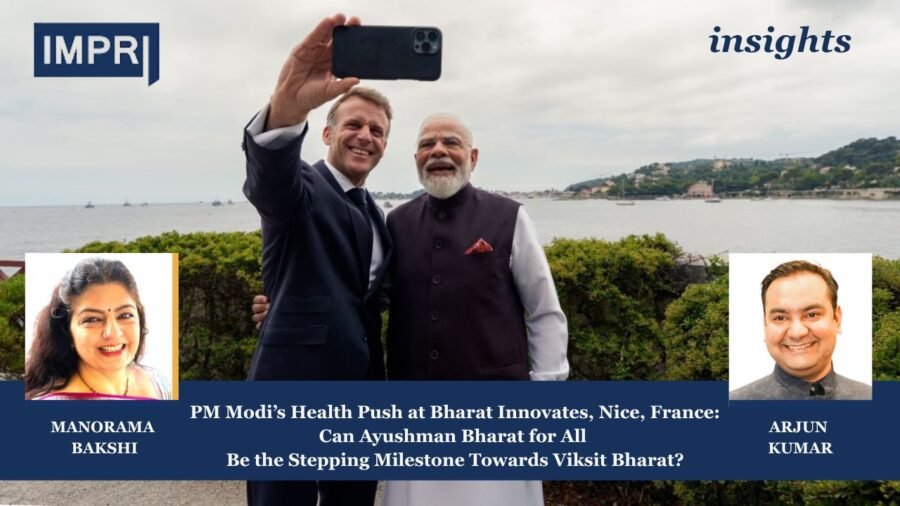
At the historic joint inauguration of Bharat Innovates 2026 in Nice, France, Prime Minister Narendra Modi delivered a resonant address that captured the global innovation spotlight. Speaking alongside French President Emmanuel Macron under the aegis of the India-France Year of Innovation, the Prime Minister declared a profound paradigm for India’s technological rise: “Today, the world is looking towards technologies that are trusted, inclusive, human-centric, and dedicated to the global good. At such a time, India’s priority is clear—Technology for Humanity and Human-Centric Innovation.”
Crucially, the Prime Minister explicitly tied this philosophy to India’s healthcare achievements over the past twelve years, celebrating the collective journey to ensure that quality care becomes a global benchmark for affordability and accessibility. “We feel proud,” he remarked, “when we are known as the nation with the world’s largest healthcare programme, Ayushman Bharat, which provides top-quality healthcare to the most vulnerable.” French President Macron validated this positive momentum with an evocative statement: “The question is no longer if India innovates, but who will innovate with India.”
India’s exceptional performance on the global platform proves that our digital and technological architecture can comfortably go toe-to-toe with advanced Western frameworks. However, this stellar global positioning sharpens the real need for a compassionate internal response. It exposes a vital domestic imperative: our internal socio-economic insulation must match our outward geopolitical prestige, ensuring that we march forward together as one resilient society.
As consistently underscored during recent IMPRI #WebPolicyTalk deliberations on Universal Health Coverage (UHC), a nation’s true development index is measured by the well-being of its people. Transitioning to a comprehensive, inclusive safety net is the only logical pathway to honor the core pledge of the United Nations Sustainable Development Goals (SDGs)—to “Leave No One Behind.” Specifically, SDG Goal 3.8 demands universal access to quality essential healthcare services and absolute financial risk protection, creating a compassionate shield for every citizen.
The 90-Crore ABDM Landmark: A Monumental Foundation for Connected Care
The technical “rails” enabling this massive structural transformation are anchored in the Ayushman Bharat Digital Mission (ABDM). In a historic development for India’s Digital Public Infrastructure (DPI), the mission has officially crossed the landmark milestone of 90 crore active Ayushman Bharat Health Accounts (ABHA). When this initiative was first conceived, it drew immediate confidence from the monumental success of the CoWIN platform during the COVID-19 pandemic, proving that India could scale an agile, secure, and nationwide health-tech response under extreme pressure.
ABDM’s growth has been staggering—rising systematically from 14.7 crore registrations in 2021 to over 90 crore. Crucially, the milestone highlights deep inclusive adoption: women constitute 49.75% of all ABHA holders, signaling that nearly half of India’s digital health identities have been created by women, ensuring gender equity in digital health access. Larger states like Andhra Pradesh have achieved an exceptional 98.5% ABHA saturation, alongside full saturation in territories like Ladakh and Lakshadweep, establishing a shared baseline of digitized care across urban and remote topographies alike.
The Paradox of Progress: Moving from Identity to Active Well-being
However, this massive volume exposes an operational paradox. While the creation of 90 crore IDs is a global benchmark, a distinct awareness gap persists on the ground: qualitative insights reveal that many citizens still confuse pure digital identity registration under ABDM with actual health insurance coverage under PM-JAY. Currently, the digital health account functions mostly for administrative purposes, such as basic database onboarding, verifying subsidy eligibility, or filing backend paperwork.
The immediate path forward requires moving past pure registration toward active, empathetic clinical utility. ABDM must transition into an everyday clinical engine that enables seamless, real-time medical data portability and immediate digital prescriptions. To realize PM Modi’s vision of Technology for Humanity, every district hospital, private health network, and Jan Aushadhi center must be deeply integrated. The citizen must experience the tangible ease of using their ABHA ID in their day-to-day medical encounters, matching the fluid confidence that UPI brought to street commerce, and turning digital infrastructure into an expression of daily care.
The Decentralized Ecosystem: Comprehensive Interventions over the Last 12 Years
As highlighted by Union Health Minister J.P. Nadda and reiterated in leadership addresses, India’s approach over the last 12 years has intentionally moved away from a purely reactive, curative model. It has evolved into a comprehensive framework encompassing preventive, promotive, rehabilitative, and palliative care across multiple interconnected levels, backed by world-class digital public infrastructure and financial protection.
1. Decentralized Preventive Care: Ayushman Arogya Mandir (AAM)
Over 1.86 lakh localized baseline centers have been operationalized nationwide under the philosophy “Arogyam Paramam Dhanam”. These units have re-engineered old, neglected sub-centers into vibrant spaces for Comprehensive Primary Health Care (CPHC), placing preventive and promotive health at the heart of the community. Acting as the primary neighborhood safety net, they offer integrated diagnostics, maternal/child immunizations, and tele-consultations. They have driven a monumental shift toward early intervention—conducting active screenings for 35.3 crore individuals for oral cancer, 16.5 crore women for breast cancer, and over 8.7 crore women for cervical cancer, catching ailments early and spreading a message of proactive health and positivity.
2. Specialized & Structural Growth: Macro Infrastructure & Human Capital
To scale up the tertiary and specialist care grid, the country executed an unprecedented physical expansion, ensuring that advanced clinical care is never out of reach. The number of All India Institutes of Medical Sciences (AIIMS) institutions has scaled from 8 in 2014 to 23, establishing regional hubs for advanced critical care in oncology, cardiology, and neurology. Simultaneously, to address severe systemic human resource gaps and foster a new generation of medical professionals, the network of medical colleges grew from 387 to 820+, pushing undergraduate medical seats to over 1.28 lakh and postgraduate slots to 86,000+, fortifying the healthcare workforce baseline for decades to come.
3. Financial Risk Protection: Pradhan Mantri Jan Arogya Yojana (PM-JAY)
Serving as the secondary and tertiary funding vehicle, AB-PMJAY has recorded an enrollment of over 44.14 crore individual Ayushman Cards created. The scheme targets nearly 40% of India’s economically vulnerable population (roughly 12 crore families) based on targeted eligibility criteria derived from Socio-Economic Caste Census (SECC) deprivation metrics in rural areas and specific occupational profiles (such as domestic workers, sanitation laborers, and street vendors) in urban regions.
The scheme has authorized over 12.03 crore hospitalizations, delivering cashless and paperless treatments worth an astonishing ₹1.80 lakh crore. Backed by a vast, robust network of 36,218 empanelled hospitals (comprising 19,659 public and 16,559 private healthcare settings), PM-JAY has acted as the primary shield protecting citizens from sliding back into poverty due to medical health shocks.
According to verified government records, the massive financial footprint of the scheme is heavily concentrated in saving lives against severe clinical challenges, with the top five diseases consuming the maximum insurance volume being cardiovascular diseases, cancers, kidney ailments requiring dialysis, severe neonatal conditions, and complex orthopedic traumas. On the ground, the scheme has translated into countless lifesaving individual narratives: from daily-wage laborers securing expensive heart-valve replacement surgeries in elite private hospitals without spending a rupee, to informal sector workers receiving complex spinal surgeries that salvaged both their physical posture and their land from predatory medical debts.
4. The Technological Foundation: CoWIN and the ABDM Stack
India’s administrative agility is completely anchored in its homegrown Digital Public Infrastructure (DPI). The bedrock for this was laid during the pandemic by the globally acclaimed CoWIN platform, which executed and tracked billions of automated vaccine doses seamlessly under extreme pressure.
Using CoWIN’s deployment architecture as a proof of concept, the government launched the Ayushman Bharat Digital Mission (ABDM) to construct permanent digital health rails. ABDM has since scaled dramatically, recently crossing the monumental milestone of 90 crore active Ayushman Bharat Health Accounts (ABHA). By creating universal digital health records, ABDM is systematically shifting the ecosystem away from fragmented paperwork, paving the way for complete data portability, instant consent management, and transparent medical histories.
5. The Pradhan Mantri Ayushman Bharat Health Infrastructure Mission (PM-ABHIM)
To ensure this software and digital rail framework is backed by deep physical resilience, the government committed ₹64,180 crore under PM-ABHIM. This represents the largest pan-India scheme designed to build critical health facilities, establish automated diagnostic laboratories in every district, and deploy specialized block-level public health units to handle future epidemic pressures.
6. Slashing Input Costs: Pradhan Mantri Bhartiya Jan Aushadhi Pariyojana (PMBJP)
To structurally address out-of-pocket pharmaceutical inflation, the state constructed a sprawling network of over 14,000 generic drug centers. Offering WHO-GMP compliant therapeutics at 50% to 90% cheaper than branded alternatives, this framework serves as a massive buffer against prescription poverty, while localized caps on coronary stents and knee implants have protected millions from exploitative surgical billing.
The Missing Middle: The Core Policy Blind Spot
Despite generous budgets, the scheme faces persistent structural bottlenecks. The most glaring gap is the crisis of the “Missing Middle.” This massive cohort—comprising nearly 40 to 50 crore citizens—consists of self-employed individuals, informal sector workers, agricultural laborers, and lower-middle-class professionals. They find themselves trapped in an institutional void: they earn just enough to be excluded from traditional, strict Socio-Economic Caste Census (SECC) data or ration card lists, yet they lack the financial capital to afford skyrocketing private health insurance premiums.
Furthermore, real-world utilization is frequently compromised by documentation hurdles, low awareness of dynamic benefit packages, transport challenges in semi-rural layouts, and instances where private healthcare networks hesitate to participate fully due to delayed state reimbursements or fixed pricing packages. When a sudden medical emergency strikes, this middle group is completely unprotected. It is this missing middle that bears the brunt of India’s high out-of-pocket health expenditure, which historically forces millions of households right back into poverty every single year.
The Lifestyle and Preventive Paradigm: PM Modi’s Call for Wellness
To prevent hospital systems from becoming permanently overwhelmed, India’s universal marching orders must place a heavy premium on lifestyle modifications. This forms the cornerstone of the Prime Minister’s consistent domestic push for preventive wellness, centered around the global propagation of Yoga as an everyday practice to naturally lower lifestyle stressors and metabolic conditions.
Addressing the rising epidemiological burden in modern India requires a direct, collective crusade against obesity and non-communicable lifestyle conditions. This calls for a profound behavioral shift in daily nutrition—specifically urging citizens to systematically reduce the intake of refined oils and processed sugars, which act as primary triggers for metabolic and cardiovascular breakdowns. Furthermore, this wellness paradigm broadens the traditional definition of care by elevating mental health into a mainstream public policy conversation, systematically destigmatizing psychiatric care and integrating mental well-being into basic primary networks to build a thoroughly healthy, balanced, and resilient population.
Dismantling Vulnerabilities: Empowering Women, Transgender Communities, and Senior Citizens
Within the typical Indian household, the burden of out-of-pocket medical shocks is profoundly gendered. Women consistently act as primary, yet invisible, caregivers, often neglecting their own health needs until emergencies arise due to a lack of independent financial safeguards. Providing health insurance directly to all women is a transformative tool for socio-economic empowerment. When a woman is universally insured, she gains health autonomy, which structurally shields the entire family unit from care-poverty and sudden financial collapse.
If fiscal constraints require a phased nationwide rollout to systematically reach Ayushman Bharat for All, a highly effective strategy is to prioritize the most vulnerable demographic cohorts first. Covering all women, transgender individuals, and the elder-pool aged 60 and above represents the ideal primary shield.
For transgender individuals, specialized medical access paired with uncompromised clinical safety is a critical milestone for social dignity and structural inclusion. For senior citizens, lowering the blanket insurance threshold to 60+ years extends a continuous lifeline to an entire generation of retired workers and elder citizens who face steep health overheads precisely as their earning capacities diminish. Insulating these core groups first ensures that the foundations of universal care are rooted where they are needed most.
The Grassroots Catalysts: Leveraging State Governments and Local Bodies
To translate this phased, inclusive vision into reality, central, state, and local bodies must act as collaborative catalysts, mirroring the spectacular grassroots mobilization that drove the Pradhan Mantri Jan Dhan Yojana. Much like how local banking correspondents, panchayats, and municipal wards worked in sync to ensure near-absolute financial inclusion, the expansion of Ayushman Bharat relies entirely on decentralized leadership. Many progressive states are already taking the lead by offering advanced levels of inclusions and customization, aggressively adapting package structures to facilitate rare disease treatments, advanced surgical procedures, and customized psychiatric and geriatric well-being frameworks that facilitate true dignity, wellness, and care.
Local bodies—ranging from Urban Local Bodies (ULBs) to rural Gram Panchayats—possess the direct, on-ground networks needed to run intensive saturation camps, resolve identity registration bottlenecks, and issue cards directly at the household doorstep. Empowering these local institutions creates a responsive framework that bridges the last-mile delivery gap, turning a national health policy into a participatory community movement.
State Government Schemes: Innovation and Add-Ons
Where the central framework leaves gaps, various state governments have stepped up with highly innovative local models that act as critical add-ons and laboratories for universal design:
Goa & Rajasthan: Rajasthan’s pioneering legislated models dramatically widened health access by extending subsidized cover to nearly its entire population, effectively breaking the traditional barriers of targeted welfare.
Jammu & Kashmir (The Universal / Ayushman Bharat for All Benchmark): The region has already effectively modeled and implemented an uncompromised “Ayushman Bharat for All” paradigm. Through its universalized local extension (AB-PMJAY SEHAT), J&K executed a brilliant blueprint by covering 100% of its residency pool. This historic intervention proved to the rest of the country that full saturation—rather than filtering households through complex poverty indices—is entirely administratively and financially feasible.
Tamil Nadu (The Integrated Pioneer): Tamil Nadu stands as an exceptional pioneer in healthcare delivery through its historic Chief Minister’s Comprehensive Health Insurance Scheme (CMCHIS). Enrolling over 1.5 crore families, CMCHIS offers a ₹5 lakh annual cover across a massive network of over 1,700 public and private hospitals. Crucially, Tamil Nadu seamlessly integrated its state framework with the central PM-JAY mechanism, successfully generating over 77 lakh unified cards. By streamlining clinical cost packages, offering advanced levels of procedural inclusions, and cutting cross-administrative redundancies, Tamil Nadu has effectively demonstrated how state frameworks can expand the central safety net to insulate locally vulnerable communities.
Is It Time for UHC or “Ayushman Bharat for All”?
The convergence of global expectations, state-level successes, and the historical expansion of the digital health stack brings us to an inescapable policy conclusion: the time for temporary, fragmented, and targeted welfare pilots is over. India is ripe for a comprehensive transition to true Universal Health Coverage (UHC)—an “Ayushman Bharat for All.”
By decoupling public health security from strict poverty-line classifications and anchoring it purely to a residency identifier (such as a Voter ID or national health account), the state can eliminate costly exclusion testing. This structure balances central public health security with localized state models, where a targeted vulnerable base is enriched by universal saturation templates like those in J&K and Rajasthan. This is not just a moral imperative to honor the SDG mandates; it is an urgent economic necessity to shield the missing middle and foster absolute social solidarity.
A Co-operative Federal Model: The Central Base with State Top-Ups
The operational architecture for an “Ayushman Bharat for All” framework can function seamlessly as a Co-operative Federal Model. Under this structure, the central government provides a standardized financial and digital baseline—the fundamental ₹5 lakh shield. State governments can then treat this central allocation as an absolute floor and strategically introduce local “top-ups” to suit regional economic variations.
Whether expanding coverage parameters to encompass special clinical conditions, adjusting empanelment tariffs to onboard premium local private hospitals, or expanding the eligibility ceiling, this base-and-top-up architecture minimizes administrative overlap. This was further strengthened by recent policy shifts aimed at reducing administrative fragmentation by transferring the local operations of Central-run health facilities directly to respective State Health Agencies (SHAs). This cooperative alignment allows the Centre to manage the nationwide technological and underwriting architecture while empowering states to deploy specialized, regional-first additions to maximum effect, creating a unified machinery working toward a shared human goal.
The Democratic Imperative: Building Social Trust and System Accountability
Beyond fiscal numbers and logistics, the ultimate rationale for universalizing Ayushman Bharat lies in its profound socio-political impact: it transforms healthcare into a powerful instrument of democracy, accountability, and deep social trust.
When health coverage is targeted through narrow welfare metrics, it inevitably feels like state patronage—a favor bestowed rather than a sovereign duty. This fragmentation breeds systemic distrust, leaving uncovered citizens feeling abandoned by the administrative apparatus. In contrast, transforming Ayushman Bharat into a residency right fundamentally resets the social contract. It builds Systemic Trust because every citizen—regardless of caste, income, or employment—stands protected under the same sovereign umbrella.
This triggers a health accountability virtuous cycle: universal rights foster citizen ownership, which drives transparent oversight, actively reduces localized rent-seeking, and encourages democratic public audits. An inclusive “For All” ecosystem introduces absolute System Accountability.
When an entire population becomes active stakeholders, the citizen stops acting as a passive, vulnerable recipient and steps up as an empowered consumer. A universal baseline creates a vocal consumer base that naturally demands Quality Service Delivery. Empowered by their digital health ID (ABHA) and guaranteed public backing, citizens will actively audit both public centers and empanelled private hospitals against standard treatment guidelines. This open, democratic oversight severely curtails localized corruption, eliminates asymmetric corporate overcharging, and forces hospital systems to remain highly transparent, responsive, and deeply democratic.
The Governance Continuum: Replicating India’s Mission-Mode Legacy
Universalizing health insurance is the natural evolution of India’s proven track record of population-scale, “Mission-Mode” public deliveries. Over the last decade, the Union Government has systematically transformed lives by securing critical human needs at unprecedented scales, moving seamlessly along a continuum of public delivery:
Food for All (PM Garib Kalyan Anna Yojana): Ensuring uninterrupted food security for over 80 crore citizens.
Housing for All (PM Awas Yojana): Constructing millions of pukka homes to anchor dignity for the marginalized.
Total Sanitation (Swachh Bharat Mission): Achieving near-universal sanitation and driving massive behavioral change.
Education for All (Samagra Shiksha): Unifying national elementary and secondary schooling infrastructure.
Each historic milestone has proven that when political will matches Digital Public Infrastructure, immense delivery scales become a predictable reality. Ayushman Bharat / Health for All is the critical next step in this continuum—the ultimate structural shield for India’s human capital, proving that when the nation decides to march forward together, no barrier is insurmountable.
International Best Practices: Healthcare as a Sovereign Right
Global policy history confirms that the world’s most resilient, high-productivity economies are anchored in universal, non-discriminatory health protection:
The United Kingdom (The NHS Model): Founded on the fundamental premise that healthcare should be an absolute right of residency, entirely decoupled from an individual’s direct purchasing power or current employment status.
Thailand (The Universal Coverage Scheme): Demonstrated beautifully to developing nations that a country does not need to wait to become an advanced economy to guarantee health protection. By moving to an integrated residency entitlement, Thailand systematically crushed the catastrophic “medical debt trap” that previously devastated its agrarian interior.
South Korea: Rapidly scaled a highly efficient single-payer national health insurance framework by standardizing electronic billing systems and unifying public medical registries.
Funding the Transition: The Fiscal Blueprint
A common policy hesitation is the perceived fiscal burden of bankrolling premium pools for a nation of 1.4 billion individuals. Yet, the modern Indian macroeconomy possesses the exact transactional tools required to cover this transition smoothly.
The universal insurance premium costs can be completely absorbed through a strategic blend of optimized state health allocations, targeted wellness cesses, and—most importantly—the consistent, record-breaking expansion of GST collections. The systematic formalization of the economy has provided the state with immense fiscal elasticity. Redirecting a small, calculated fraction of this rising indirect tax yield toward financing universal health insurance premiums will trigger a massive macroeconomic dividend: it directly unlocks trillions in precautionary household savings.
By easing the psychological burden of medical anxiety, families no longer need to practice defensive medical hoarding. This freed capital flows directly back into active domestic market consumption, feeding a virtuous circle where rising GST yields finance UHC premiums, which in turn lowers medical anxiety and stimulates healthy market activity.
Conclusion: The Pillar of Viksit Bharat
As India accelerates along its roadmap toward a centennial developed status, the core guiding light of the Viksit Bharat foundation must be comprehensive health, care, and positivity for all. A nation cannot truly claim developed status if its citizens live under the permanent shadow of potential medical bankruptcy.
PM Modi’s address at Bharat Innovates 2026 reminds us that our technological scale must match our human impact. By shifting our focus to intense clinical utility via the 90-crore ABDM architecture, addressing the structural frictions of the current PM-JAY design, upgrading our Ayushman Arogya Mandirs, and expanding successful regional insurance pilots into a non-negotiable national guarantee within a robust framework of cooperative federalism—Ayushman Bharat for All—we can fulfill our global commitments, insulate the missing middle, and honor the ultimate post-pandemic promise: a resilient, secure, and fundamentally healthy society marching forward together in unity and optimism.
About the Authors
Manorama Bakshi is a distinguished public health expert and policy advocate.
Arjun Kumar is Director, IMPRI Impact and Policy Research Institute, New Delhi.
Disclaimer: All views expressed in the article belong solely to the author and not necessarily to the organisation.
Read more at IMPRI:
The 90-Crore ABDM Mark: What’s Next?
The Real Glass Ceiling: Why the Right to Health is the Material Basis for Nari Shakt
The Portable Social Shield: Anchoring India’s $10-Trillion Ambition in Universal Health Coverage
Acknowledgement: This article was posted by Shreeya Dixit, a Research and Editorial Intern at IMPRI.