







Policy Update
Prisha Sachdeva
Background
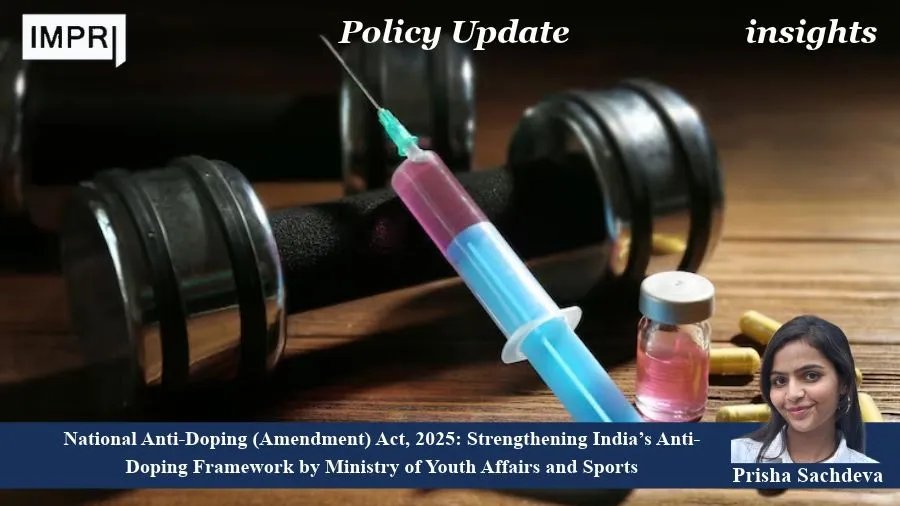
Doping refers to the use of prohibited substances or methods by athletes to artificially enhance their performance in sports. This includes taking banned drugs such as anabolic steroids, stimulants, or hormones, as well as using methods like blood doping or gene doping to gain an unfair advantage over competitors. Doping violates the principles of fair play and sportsmanship, as it gives athletes an artificial edge rather than relying on natural ability, training, and skill. It also poses serious health risks to athletes, including cardiovascular problems, hormonal imbalances, liver damage, and psychological effects
The World Anti-Doping Agency (WADA) maintains a list of prohibited substances and methods that are banned in competitive sports. Athletes who test positive for these substances face sanctions ranging from warnings to multi-year bans, depending on the severity of the violation. In India, the National Anti-Doping Agency (NADA) is responsible for implementing anti-doping rules, conducting tests, and penalising athletes who violate these rules. The National Anti-Doping Act, 2022 and its 2025 amendment provide the legal framework for these activities, ensuring that Indian sport remains clean, fair, and aligned with international standards.
The National Anti-Doping (Amendment) Act, 2025 was therefore introduced to address these gaps by strengthening the operational independence of NADA, improving procedural safeguards for athletes, streamlining dispute resolution, and aligning India’s anti-doping framework more closely with the World Anti-Doping Code and UNESCO obligations. With India recording 260 doping violations in 2024 and 131 in 2025, the amendment seeks to create a more credible, transparent, and effective anti-doping system that can protect clean athletes, deter doping, and restore confidence in Indian sport both domestically and internationally.
Functioning
The National Anti-Doping (Amendment) Act, 2025 functions as a legal and institutional framework to prevent, detect, investigate, and penalise doping in Indian sport. It retains the National Anti-Doping Act, 2022 as the parent legislation while refining the governance structure of India’s anti-doping system.
Institutional Structure
The amended framework operates through three key institutions:
| Institution | Role |
| National Anti-Doping Agency (NADA) | Implements anti-doping rules, conducts testing, investigates violations, and manages results |
| National Board for Anti-Doping in Sports | Oversees NADA and advises the Central Government on anti-doping policy |
| Appeal Panel | Hears appeals against decisions of the Disciplinary Panel |
Key Provisions of the Amendment
The 2025 amendment introduces several important changes:
- Operational independence for NADA: The Director General and members of NADA are now required to be independent of sports federations, the Indian Olympic Association, the Paralympic Committee of India, government departments, and other sports or anti-doping agencies.
- Transfer of Appeal Panel powers: The power to constitute the Appeal Panel has been shifted from the National Board to the Central Government.
- Expanded right to appeal to CAS: More parties, including WADA, the International Olympic Committee, the International Paralympic Committee, international federations, NADA, and affected athletes, can appeal to the Court of Arbitration for Sport (CAS).
- Direct WADA appeal to CAS: WADA can directly appeal to CAS against a final NADA decision if no other party has appealed in India.
- Mandatory WADA accreditation for laboratories: Anti-doping laboratories must be accredited by WADA.
- Review of adverse findings: NADA must review adverse analytical findings and verify whether laboratory, testing, or investigation standards were followed.
How the Anti-Doping Process Works
- Sample collection: NADA conducts in-competition and out-of-competition testing of athletes.
- Laboratory analysis: Samples are analysed in WADA-accredited laboratories.
- Adverse finding review: If a prohibited substance is detected, NADA reviews the finding and verifies procedural compliance.
- Results management: NADA informs the athlete, allows for explanation, and determines whether a violation has occurred.
- Disciplinary proceedings: The Disciplinary Panel hears the case and imposes sanctions where a violation is established.
- Appeals: Decisions can be appealed to the Appeal Panel and, in specified cases, to the Court of Arbitration for Sport.
Beneficiaries
The Act benefits:
- Athletes, by strengthening due process and protecting clean sport.
- Sports federations, by providing a clear anti-doping framework.
- National sports bodies, by improving credibility and international compliance.
- Coaches and support personnel, through clearer accountability standards.
- The wider sporting public, by promoting fair competition and athlete welfare.
Performance
The National Anti-Doping (Amendment) Act, 2025 is a recent legislative reform, so its performance should be assessed in terms of legislative progress, institutional strengthening, and India’s ongoing doping challenge.
Legislative Progress
| Stage | Date |
| Introduced in Lok Sabha | 23 July 2025 |
| Passed by Lok Sabha | 11 August 2025 |
| Passed by Rajya Sabha | 12 August 2025 |
| Presidential assent | 18 August 2025 |
The Act was passed alongside the National Sports Governance Bill, 2025, reflecting a broader legislative effort to reform India’s sports governance and anti-doping ecosystem.
Doping Violations in India
India has topped WADA’s list of doping violators for three consecutive years, reflecting a systemic challenge that goes beyond individual athlete behaviour to include gaps in testing capacity, athlete education, and enforcement
| Year | Doping Violations |
| 2023 | 213 |
| 2024 | 260 |
| 2025 | 131 |
| 2026 (till 13 July) | 78 |
Source – policyedge
The decline from 260 violations in 2024 to 131 in 2025 may suggest early improvement, but it is too early to attribute this directly to the 2025 amendment
Testing Capacity
NADA has increased its testing from approximately 4,000 samples in 2019 to about 8,000 samples in 2025. However, this remains low compared with countries such as China, which tests more than 15,000 athletes annually.[espn]
India’s high number of doping violations, combined with relatively limited testing capacity, indicates that the enforcement challenge remains substantial.
Impact
The National Anti-Doping (Amendment) Act, 2025 is expected to strengthen India’s anti-doping framework by improving institutional independence, procedural fairness, and international credibility.
- Strengthening Institutional Independence
The amendment addresses a key weakness in the earlier framework by insulating NADA’s Director General and members from potential government or sports-body influence. This is important because WADA had raised concerns about government interference in NADA’s functioning.
By improving NADA’s operational independence, the Act is expected to enhance the credibility of India’s anti-doping system and reduce the risk of international non-compliance.
- Improving Athlete Protection and Due Process
The Act strengthens procedural safeguards and streamlines dispute resolution mechanisms. The expanded right to appeal to CAS gives athletes and other stakeholders greater access to independent international review.
The requirement for NADA to review adverse analytical findings and verify compliance with laboratory and testing standards also strengthens athlete protection. This reduces the risk of athletes being penalised due to procedural errors or faulty testing.
- Enhancing India’s International Standing
By aligning India’s anti-doping framework more closely with the World Anti-Doping Code and UNESCO obligations, the Act improves India’s standing in international sport. This is particularly important given India’s high ranking in WADA’s list of doping violations.
A credible anti-doping system is essential for Indian athletes competing internationally, as it protects clean athletes and reduces the risk of sanctions against Indian sport.
- Supporting Clean Sport
The Act provides statutory backing for anti-doping measures across all sports, including testing, results management, education, intelligence, and investigations. This creates a more comprehensive framework for promoting dope-free sport in India.
Emerging Issues
Despite the legislative progress, several challenges remain in implementing an effective anti-doping regime in India.
- High Doping Violations
India has led WADA’s rankings of doping violators for three consecutive years, with the highest positive test rate among major nations. This indicates that legal reform alone will not be sufficient; stronger enforcement, education, and prevention are needed.
- Limited Testing Capacity
NADA’s testing capacity, while improved, remains low compared with other major sporting nations. With approximately 8,000 samples tested in 2025, India’s testing volume is significantly lower than China’s, which tests more than 15,000 athletes annually. This limits the deterrent effect of anti-doping enforcement.
- Implementation of Operational Independence
While the Act mandates operational independence for NADA, translating this into practice requires careful implementation. The appointment process, reporting structures, and day-to-day functioning of NADA must be insulated from political or sports-body influence.
- Laboratory and Testing Infrastructure
The Act mandates WADA accreditation for anti-doping laboratories. Ensuring that India has sufficient WADA-accredited laboratory capacity to handle the volume of samples required for effective testing remains a challenge.
- Athlete Awareness and Education
Many doping violations, particularly among lower-level athletes, may stem from lack of awareness about prohibited substances, supplements, and therapeutic use exemptions. Strengthening athlete education is essential to prevent inadvertent doping.
- Coordination with Sports Federations
Effective anti-doping requires cooperation between NADA, sports federations, coaches, and support personnel. Ensuring that federations comply with anti-doping rules and support testing and education programmes remains an ongoing challenge.
- Enforcement at Grassroots Level
While NADA focuses on elite and national-level athletes, doping at the grassroots and junior levels remains a concern. Extending anti-doping education and testing to these levels is necessary for a comprehensive approach.
Way Forward
To strengthen India’s anti-doping framework further, the government and NADA should focus on the following areas.
- Strengthen NADA’s Institutional Capacity
NADA should be provided with adequate financial, technical, and human resources to expand testing, improve investigations, and enhance results management. Increasing the number of samples tested annually should be a priority, given India’s high doping violation rate.
- Expand WADA-Accredited Laboratory Capacity
The government should invest in expanding WADA-accredited laboratory capacity in India to reduce dependence on foreign laboratories and improve turnaround time for sample analysis. This would also strengthen India’s ability to conduct large-scale testing programmes.
- Enhance Athlete Education
Comprehensive anti-doping education programmes should be conducted for athletes, coaches, and support personnel at all levels. These programmes should cover prohibited substances, supplement risks, therapeutic use exemptions, and consequences of doping.
- Ensure Operational Independence in Practice
The government should establish clear rules and procedures to operationalise the independence of NADA’s Director General and members. This includes transparent appointment processes, protection from political interference, and clear reporting structures.
- Strengthen Coordination with Sports Federations
NADA should work closely with sports federations to ensure compliance with anti-doping rules at all levels. Federations should be required to support testing, education, and investigation efforts.
- Align with Evolving WADA Standards
India should continuously update its anti-doping framework to align with evolving WADA standards and international best practices. This includes adopting new technologies for testing and monitoring, and strengthening intelligence-led investigations.
References
Comptroller and Auditor General of India. (2026). Performance audit report on BharatNet (Report No. 19 of 2026). https://cag.gov.in/webroot/uploads/download_audit_report/2026/19-of-2026-UG-Eng-06a7c90aa5f2901.29659974.pdf
Government of India. (2025). The National Anti-Doping (Amendment) Act, 2025 (No. 26 of 2025). https://prsindia.org/files/bills_acts/bills_parliament/2025/National_Anti_Doping_(Amendment)_Act,_2025.pdf
India Code. (2025). The National Anti-Doping Act, 2022. https://www.indiacode.nic.in/indiacode/bitstream/123456789/22491/1/a2022-15.pdf
Ministry of Youth Affairs and Sports. (2025, August 14). Parliament passes National Sports Governance Bill, 2025 and National Anti-Doping (Amendment) Bill, 2025. Press Information Bureau, Government of India. https://www.pib.gov.in/PressReleseDetailm.aspx?PRID=2156401
Ministry of Youth Affairs and Sports. (2025, November 20). Government strengthens anti-doping framework with enforcement and athlete protection measures. Press Information Bureau, Government of India. https://www.pib.gov.in/PressReleasePage.aspx?PRID=2285647®=3&lang=1
PRS Legislative Research. (2025). The National Anti-Doping (Amendment) Bill, 2025. https://prsindia.org/billtrack/the-national-anti-doping-amendment-bill-2025
PRS Legislative Research. (2025). The National Anti-Doping (Amendment) Bill, 2025 as passed by Lok Sabha. https://prsindia.org/files/bills_acts/bills_parliament/2025/Bill_as_passed_by_LS_National_Anti_Doping_Bill.pdf
The Hindu Centre for Politics and Public Policy. (2022). The National Anti-Doping Act, 2022. https://thc.nic.in/Central%20Governmental%20Acts/National%20Anti%20Doping%20Act%20,2022.pdf
The Policy Edge. (2026, July 20). Lok Sabha Q&A: NADA reports 682 adverse doping findings since 2023. https://www.policyedge.in/p/lok-sabha-qa-nada-reports-682-adverse-doping-findings-since-2023-as-government-expands-prevention-efforts
Associated Press. (2026, April 16). WADA is challenging India to clean up doping issues. https://apnews.com/article/wada-india-doping-97c314a26513195f74067a859bef4970
ESPN. (2026, April 16). WADA challenging India to clean up doping issues. https://www.espn.com/olympics/story//id/48502883/wada-challenging-india-clean-doping-issues
RFI. (2026, April 16). WADA targets India’s performance-enhancing drugs production. https://www.rfi.fr/en/sports/20260416-wada-targets-india-s-performance-enhancing-drugs-production
DT Next. (2026, July 20). India records 78 doping cases till July 15; UP, Punjab top list: Sports Minister in LS. https://www.dtnext.in/amp/story/news/sports/india-records-78-doping-cases-till-july-15-up-punjab-top-list-sports-minister-in-ls
Contributor:
Prisha Sachdeva is a Research & Editorial intern at IMPRI. She’s pursuing a Bachelor’s in psychology (Honours) from the University of Delhi. Her interest lies in cognitive science and human behavior with a focus on evidence-based policy and behavioral research.
Acknowledgement:
The author sincerely expresses gratitude to the reviewers and the editorial team for their valuable comments, constructive suggestions, and continuous guidance throughout the preparation of this article. Their insightful feedback significantly enhanced the clarity, organisation, and analytical quality of the manuscript. The author also acknowledges the support and encouragement received during the research and writing process, which contributed to the successful completion of this work.
Reviewers:
Aditi and Purba
Disclaimer:
All views expressed in the article belong solely to the author and not necessarily to the organisation.