









Policy Update
Simona Miriam Hughes
Background:
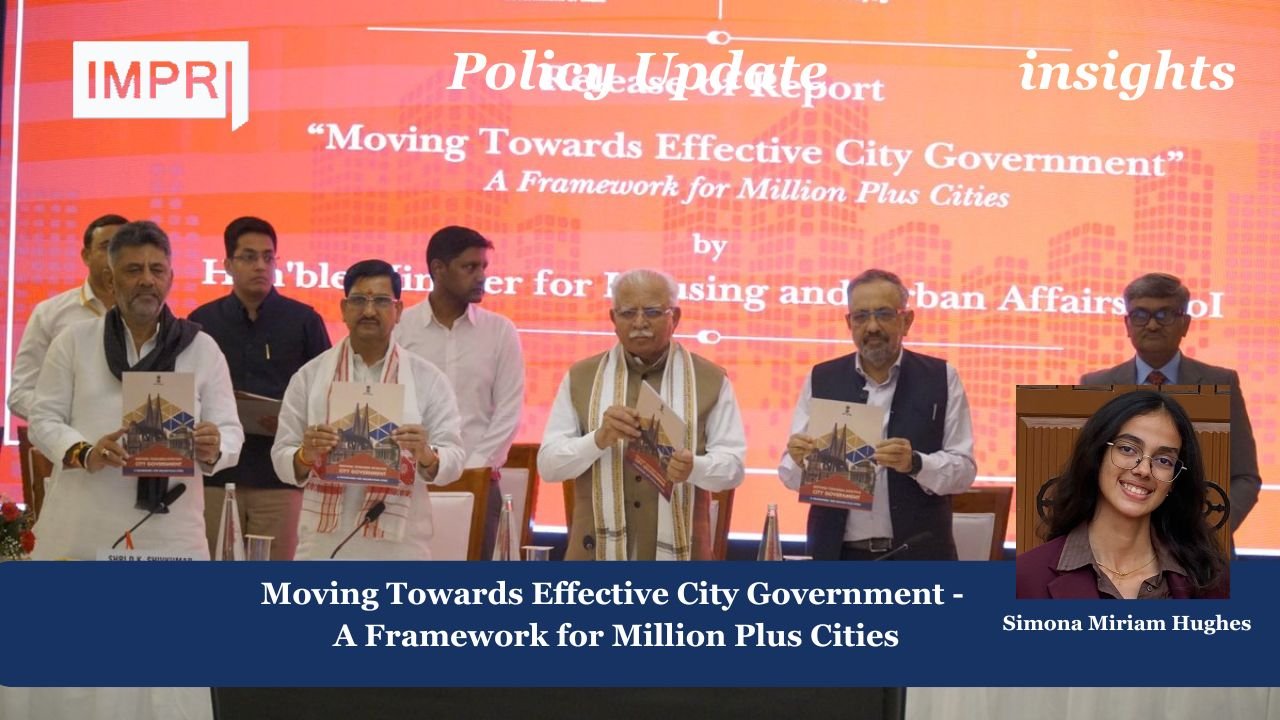
The recent policy reform framework released by NITI Aayog on 25th April 2026 and highlighted through the Press Information Bureau (PIB) focuses on strengthening urban governance in India’s million plus cities. The report titled “Moving Towards Effective City Government – A Framework for Million Plus Cities” proposes structural reforms to improve accountability, service delivery, financial autonomy and political leadership in urban local bodies.
The report then goes on to highlight the importance of urbanisation stating that Urbanisation will be central to achieving the vision of Viksit Bharat @ 2047. According to the report, cities are expected to become engines of economic growth, innovation, employment generation and infrastructure expansion. However, Indian cities face severe challenges including unplanned urban sprawl, migration pressures, climate risks, weak governance structures, fragmented institutions and poor coordination among agencies.
The framework also draws its constitutional basis from the 74th Constitutional Amendment Act 1992 as it recognised municipalities as institutions of local self governance and provided for the devolution of 18 urban functions to ULBs. However, implementation has remained uneven across states as urban governance falls under the State list of the Constitution. As a result, most municipal bodies continue to operate with limited autonomy and inadequate financial and administrative powers.
The reform’s agenda specifically targets India’s 46 million plus cities, which accommodate nearly one-third of India’s urban population and contribute around 60% of the National GDP.
Functioning:
The functioning of the reform model revolves around four major governance reforms. They are as follows:
The committee operates with a directly elected Mayor with a five year tenure co-terminus with the Municipal Council, making the Mayor the executive head of the city council with clearly defined powers and accountability. In the current scenario, most Indian cities have indirectly elected mayors or very short mayoral tenures and this limits leadership continuity. In cities like Mumbai and Bengaluru, executive power rests with Municipal Commissioners rather than elected representatives.
The report also proposes replacing weak Standing Committees with an empowered Mayor-In-Council system where councilors handle sector-specific portfolios such as Water supply, Sanitation, Finance, Urban planning, Public Works and Transport. This decentralised governance model aims to improve functional specialisation, faster decision-making and coordinated urban administration. Together with this, the framework recommends Mandatory Zonal committees, Ward committees and Area Sabhas for citizen participation.
The report proposes bringing together agencies responsible for water supply, transport, urban planning, and sanitation under administrative control of City governments as a means to control fragmentation of service delivery. This includes city specific subsidiaries for service delivery, Mayor led oversight boards, Greater coordination among agencies and better grievance redressal systems.
The framework also highlights the weak fiscal position of the ULBs due to Poor own source revenue generation, dependance on state transfers, weak property tax systems, delayed SFC constitution and implementation. It recommends strengthening State finance commissions by administrating a timely constitution of SFCs, mandatory Action-Taken reports, transparent Grant allocation disclosures and Greater municipal fiscal autonomy.
Performance:
The report provides extensive evidence regarding weaknesses in India’s current urban governance framework. One of the key concerns is limited functional devolution to Urban Local Bodies (ULBs). A Comptroller and Auditor general (CAG) audit cited in the audit reveals that ULBs on average exercise full authority over only four of the eighteen functions envisioned under the 74th Constitutional Amendment, indicating incomplete decentralisation.
Additionally, the report also points to weak revenue mobilisation, as municipal corporations increasingly depend on inter-governmental transfers due to declining own source revenues. Inefficiencies in property tax collection, low user charges and poor financial management have severely constrained municipal finances. As a result, municipal borrowing remains minimal, with only around 162 ULBs achieving investment-grade credit ratings under the AMRUT scheme, while municipal borrowing contributes nearly 2.4% of total municipal receipts nationwide.
Another issue identified is the delay in conducting urban local body elections, with over 61% of ULBs across 17 states experiencing delays in elections, thereby weakening democratic continuity and accountability. In addition, the report also emphasises the problem of institutional fragmentation in cities such as Bengaluru, where responsibilities are divided among multiple agencies- water supply is handled by the state board, transport by a transport cooperation, planning by development authorities and slum rehabilitation by separate agencies. This fragmented structure leads to poor coordination, overlapping responsibilities and diluted accountability in urban governance.
Impact:
If implemented effectively, the proposed reforms can significantly transform governance in India by creating a more efficient, accountable and citizen-oriented administrative system. Directly elected mayors with executive authority can establish clearer accountability structures, enabling citizens to identify who is responsible for urban development and service delivery outcomes.
Likewise, Unified governance under municipal corporations can improve essential urban services such as water management, transport, waste management, urban planning and disaster response through better coordination and streamlined decision-making. Strengthening municipal finances and ensuring predictable fiscal devolution can enhance the fiscal capacity of ULBs, allowing greater investment in infrastructure while reducing dependence on state governments.
Additionally, Stable leadership with fixed tenures can also support long-term urban planning by enabling cities to focus on sustained developmental goals rather than short-term administrative measures. Furthermore, democratic decentralisation through Ward Committees, Area Sabhas and other participatory governance mechanisms can deepen democracy by increasing citizen involvement in urban administration and local decision-making.
Emerging Issues:
Urban governance reforms in India still continue to face several challenges. One such challenge is political resistance, as many state governments remain hesitant to devolve substantial powers and responsibilities to ULBs. Existing Bureaucratic structures also tend to resist institutional reforms that could resist their administrative control. Financial constraints further weaken municipal governance, with ULBs struggling due to weak taxation systems, limited own-source revenue generation and inadequate capacity to access debt markets for infrastructure financing.
Additionally, there is a serious administrative capacity deficit, including shortages of skilled professionals in areas of urban planning, public finance and project management, while many municipalities remain heavily dependent on deputation-based staffing arrangements. Coordination challenges also emerge when attempting to integrate parastatal agencies into municipal governance structures, often leading to institutional conflicts and overlapping jurisdictions.
Furthermore, uneven state level adoption of reforms complicates the implementation process, as urban government frameworks vary significantly across Indian states.
Way Forward:
The Moving Towards Effective City Government framework will act as an important step towards strengthening urban governance in India. The framework especially recognises that achieving the vision of Viksit Bharat @2047 requires empowered, accountable and capable city governments.
The reform thereby seeks to establish cities as genuine institutions of self government by strengthening political leadership, ensuring fiscal decentralisation, improving service delivery, enhancing accountability and encouraging citizen participation.
The phases implementation beginning with million plus cities is bound to create a demonstration effect for smaller urban centres across India. India’s urban governance architecture is said to become more democratic, efficient and responsive to future developmental and climate changes, if states adopt these reforms seriously.
References:
- NITI Aayog, 2026, Moving Towards Effective City Government – A Framework for Million-Plus Cities https://niti.gov.in/sites/default/files/2026-04/Moving-Towards-Effective-City-Government-a-Framework-for-Million-Plus-Cities.pdf
- Ministry of Housing and Urban Affairs – Model Municipal Law, 2003
- RBI, Report on Municipal Finances 2024
About the Contributor:
Simona Miriam Hughes is a research and editorial associate intern at IMPRI. She is currently pursuing her Master’s degree in International Relations at Loyola College and has worked in several Non Governmental Organisations during her Undergraduate years. She has attended the 2025 Global Citizenship programme which is associated with the Washington DC university.
Name of the Reviewers:
This article was reviewed by Ms. Lubina Dua and Ms. Aananya Atri
Acknowledgement:
The author would like to extend her thanks to the whole of the IMPRI team and the reviewers for their feedback and support.
Disclaimer
All views expressed in the article belong solely to the author and not necessarily to the organization.
Read More at IMPRI
How NHRC Advisory 2.0 Transforms Census Data and Civil Rights for Intersex and Transgender Persons
New National Cooperative Policy 2025: Reforming India’s Cooperative Ecosystem