








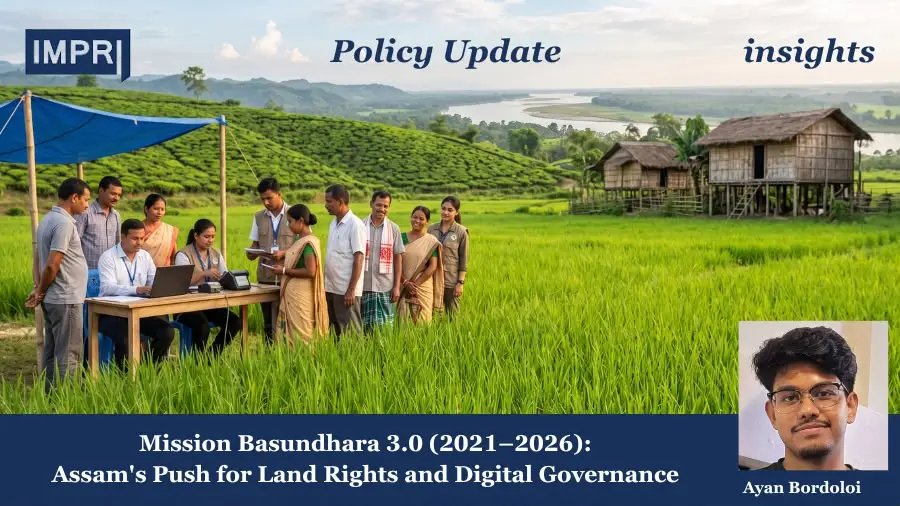
Policy Update
Ayan Bordoloi
Background
The Assam Land and Revenue Regulation, 1886 is a colonial regulation which existed in a land and population very different from the current state of Assam. This system persisted for over 100 years, resulting in a large number of people without any formal rights to the land that they had long cultivated, even when ownership had been passed down through generations, including cultivators, workers in the tea-garden, tribal families and families displaced by floods. A combination of successive erosion of the riverbed of the Brahmaputra and its tributaries and periodic flooding, coupled by the inadequate rate of cadastral survey, added to the problem and large numbers of Assam’s rural population were deprived of legal status in the land, whether Khas (government) or Ceiling Surplus (cadastral surplus) land.A government-appointed committee headed by former Chief Election Commissioner H.S. Brahma, tasked with examining land rights of indigenous people in Assam, found in its 2018 report that close to 90% of the state’s native population lacked formal land ownership documents, and that approximately 8 lakh indigenous families were entirely landless.
In this context, on 2 October 2021, the government of Assam initiated the Mission Basundhara by the Department of Revenue and Disaster Management. The programme’s stated objective was to computerise land records, have land-related services go online and to gradually give formal ownership rights (patta) to eligible occupants. This mission has now passed through 3 phases. Basundhara 1.0 was implemented in 2021-22 and aimed at the basic digitisation and record correction services. Basundhara 2.0, which was implemented on 14th November 2022, added eight new categories of land services and explicitly linked granting land ownership rights to indigenous communities. Basundhara 3.0 is described by the state government as the mission’s third and, for now, most complete wave that aims to include 17 services and new applicants such as small tea, coffee and rubber growers was inaugurated on 20 October 2024 in Srimanta Sankaradeva Kalakshetra in Guwahati.
All three phases are based on proof of indigenous or long-settled residents in Assam, usually since 1951 or since 75 years of their families’ residence in Assam. The requirement of three generation proof has been removed for specific communities like tea-tribe members, Adivasis, Gorkhas, and Scheduled Caste/Scheduled Tribe applicants, and pre-1971 refugees can be accepted on the basis of a refugee certificate issued prior to 25 March 1971 under Basundhara 3.0. The government’s constitution of the mission is based on the term ‘Jati-Mati-Bheti’ (identity, land and homestead), which makes land-title formalisation a necessary and key part of ensuring the socio-cultural identity of indigenous and tribal communities in Assam.
Table 1: How Basundhara 3.0 Changes Eligibility for Key Applicant Categories
| Applicant Category | Basundhara 1.0 / 2.0 Requirement | Basundhara 3.0 Relaxation |
| General indigenous applicants | Proof of residency in Assam since 1951, or 3 generations / 75 years of residence | Requirement unchanged; self-certification accepted, verified case-by-case |
| Tea-tribe, Adivasi, Gorkha, SC/ST | Same 3-generation / 1951 rule as general category | Three-generation proof waived; caste/community certificate sufficient |
| Pre-1971 refugees | Not a distinct category in 1.0 / 2.0 | Eligible on production of a refugee certificate issued before 25 March 1971 |
| Small tea, coffee and rubber growers | Cultivating government land without formal title; ineligible for bank finance | Eligible for settlement of up to 30 bighas (extendable to 75 bighas), enabling institutional credit |
| Urban settlers (premium payment) | Higher premium linked to zonal valuation | Premium rationalised to 3% of zonal valuation; 25% concession for SC/ST, persons with disabilities, and widows without income |
| Residents of char (river-island) areas | Eligible subject to standard residency proof | Continue to be excluded on stated ecological grounds, except in Majuli district |
Source: Compiled from Government of Assam, Mission Basundhara official portal and Land Policy 2019 (as amended).
Functioning
The mission Basundhara 3.0 is implemented through mission mode by the Department of Revenue and Disaster management and applications are filed and monitored through the online portal SewaSetu. The seventeen notified services are categorized into three groups: New services added in Phase 3, services rolled over from Basundhara 2.0, and land-record digitisation services.
- Landless families whose family member does not have any land in the state (indigenous) patta for their homestead land up to 1 bigha.
- Correcting the names and land boundaries mentioned in jamabandi (land register) and changing the ownership of the land after purchasing or inheriting it.
- Division of common land between relatives and availability of the Jamabandi online.
- Transfer of land from Annual Patta to Periodic Patta status with a rationalised premium to be paid, but transfer being for a long term period. Once the land designated to tea cultivation was reclaimed for residential/commercial use and became Myadi Patta. Temporary settlement of erstwhile ‘Bhoodan’ and ‘Gramdan’ land and grants of ownership rights to the occupancy tenants under Assam (Temporary Settled Areas) Tenancy Act, 1971. Settlement of government land by small farmers of tea, coffee and rubber plantation (up to 30 bighas, can be increased to 75 bighas in total) and settlement of hereditary tribal land (up to 50 bighas).
- Acquisition of land in public institutions—government institutions and educational, religious or socio-cultural institutions.
- Basundhara 2.0 cases pending due to lack of clarification reviewed.
Verification is carried out in a multi-institutional layering process. The claim is initially considered at circle level, where the Lat Mandal (village level revenue functionary) plays a key role, and thereafter by a Land Advisory Committee at the district level headed by the Deputy Commissioner (DC) which considers and clears claims, especially in cases where there is any doubt regarding residency. Field verification, which involves a physical visit by the revenue officer to verify boundaries and possession, is still an important and often time-consuming process, particularly in flood-prone and char regions, where access during the monsoon season (June to September) makes these areas inaccessible.
Basundhara 3.0 leverages drone surveys and GIS-based high accuracy mapping and is clearly tied to the Centre’s SVAMITVA initiative for developing cadastral villages from non-cadastral (NC) villages, which have no formal survey. In the financial aspect, there is reduction in premium to be paid for urban land settlement to 3% of zonal value, a further concession of 25% is applicable to those who are Scheduled Caste, Scheduled Tribe, persons with disability who have no regular income, or widows who have no earning family member. A dedicated grievance mechanism has been set up to report requests for undue favours from officials while delivering services, which comprises the grievance section of the RTPS Portal and a toll-free helpline (1800-345-3574).
Performance
If it is measured by the volume of applications that Mission Basundhara has accomplished, it has been one of the most ambitious land administration programs in India. The government claims that it has already disposed of almost eight lakh applications in the first nine months of the launch, and the number of families benefiting from record correction, patta conversion and other services is estimated at around 5.82 lakh, a record number. Basundhara 2.0 is said to have given ownership rights to over 2.29 lakh indigenous families, among which the state government claims that the majority or close to 85% were based on the Scheduled Caste, Scheduled Tribe and Other Backward Class communities.
Figure 1: Scale of applications disposed and beneficiaries covered across the three phases of Mission Basundhara, 2021–2026. Basundhara 3.0 figures are provisional and reflect status as of February 2026; the phase remains open.
The same trend has been continued in Basundhara 3.0. During the programme on 27 February 2026, the Chief Minister distributed pattas to 1,06,905 extra beneficiaries in a single sitting, among which, 44,700 pattas were distributed in Dhemaji district alone. Combined with the two previous steps, the state government says that over the last three years (from the mission’s start in 2021), more than 30 lakh people have been issued with land pattas, while nearly 10 lakh long delayed land disputes have been settled.
Another parallel, and perhaps more significant, thread in Phase 3 is the digitisation of non-cadastral villages, settlements that were never surveyed and so lacked a cadastral map, systematic land record. The SVAMITVA linkage drone mapping has been completed in 769 of Assam’s 903 NC villages and more than 30,000 families have already received pattas based on the newly digitised boundaries.

Figure 2: Status of drone-survey-based digitisation of Non-Cadastral (NC) villages under Mission Basundhara 3.0, as of February 2026.
The government has also projected a fiscal dividend from formalisation: the Chief Minister has estimated that regularising land occupation across the state could generate approximately Rs 1,500 crore in annual land revenue once premium and conversion payments are fully realised — though this figure is a government projection rather than an audited outcome, and its realisation depends on the pace at which annual pattas convert to periodic pattas and settlement premiums are actually collected.
Impact
A patta is a material change in legal and economic relationship for an individual family. A land title makes the informal, insecure occupation into recognized property, which can be sold, mortgaged, bequeathed to family members or serve as collateral for an institutional loan; a path to credit that for thousands of small tea, coffee and rubber growers had been closed since they had been occupying government land without any form of title. Formal settlement also facilitates documentation of a household’s eligibility for other welfare entitlements, as witnessed by both officials and independent trackers; a patta is increasingly used as proof of residence for eligibility for a welfare programme like Orunodoi, which is the direct benefit transfer scheme for women from economically vulnerable households, in Assam.
A digitised non-cadastral village bridges a long-held systemic weakness of Assam’s land administration system – the absence of formal records for hundreds of villages – and has broader implications for dispute resolution, infrastructure planning and disaster compensation that go beyond the patta recipients. The government has also announced that it will eventually introduce digital land passbooks that would allow a landholder to have a single verifiable document that contained all of their land records.
But the allocation of benefits is not the same throughout communities and today this inequity is itself a public story and political issue. District-level reporting by independent media has recorded cases in which the circle officials had given a negative response to the applications for the purpose of cultivating land by Bengali-speaking Muslims, while the applications of the other communities who fulfilled the documentary requirement were accepted. Opposition lawmakers have quoted figures indicating that only 2.5 lakh out of about 13 lakh applications made in a previous tranche have been approved for allotment till now, and that the approvals are skewed in favour of communities in a manner that is not in line with the scheme’s spirit of being administered in a religious and ethnically neutral manner.
Emerging Issues
The Constitution or Assam land laws do not give a formal definition of who is indigenous (khilonjiya) for the purposes of Mission Basundhara. Opposition legislators, and civil-society commentators, have criticised the Chief Minister’s assertions that Bengali-origin Muslims (“Miyas”) are citizens but are not indigenous to Assam, which adds an exclusionary criterion that is not mentioned in the mission’s initial guidelines. The exclusion of residents of char areas (river islands, almost entirely Bengali speaking Muslim cultivators) from settlement under the scheme, on specified ecological grounds, is the general rule; Majuli is the only exception. The fact that the homeless typically face the threat of eviction and homelessness due to erosion and displacement is a major inequity, critics say, because the proposed “landlessness-redress” policy excludes categorical homeless residents of the char.
The processing time for revenue officials is hindered by the difficulties of physical verification, particularly in flood affected and char areas during the monsoon (June – September), and is often extended due to nonverification defects, unrelated to the application itself. Some minor inconsistencies in documentation, such as an utility bill listed under a spouse’s name, not the applicant’s, have also been cited as a problem that can be avoided and reported as a frequent reason for rejections or for documents to hang up. Resolution pendency from Basundhara 2.0: There is a specific “Phase 3” service for the cases which were pending from “Basundhara 2.0” and which are “resolved” in “Phase 3”, which means that some of the “Phase 3” cases are not fresh ones but are backlog of the “Basundhara 2.0”. Adjacent land-policy controversy: The state notification in March 2024, which sought to restrict land sale transactions between persons of different religious communities, on the basis of anti-fraud, was constitutionally dubious and was widely interpreted along with Mission Basundhara as part of a series of land governance practices operating in religious contexts. Around 15% of Assam villages remain un-surveyed as of February 2026 and the Chief Minister has also announced in public that the char areas and the non-tribal population of forest villages will be covered under the future phases of the Basundhara 4.0/5.0.
Way Forward
- Make eligibility requirements legal or binding requirements, such as a clear and non-discretionary definition of indigeneity, to ensure that eligibility decisions are based on published standards, which can be appealed, rather than on case by case administrative or political judgement.
- Establish a rights-based and ecologically appropriate settlement mechanism for char and erosion-affected populations, including land-bank based relocation with title schemes, that would not disqualify people from a claim from being homeless because of displacement by river erosion.
- Provide disaggregated district- and community-wise approval details for each phase on SewaSetu portal or Mission Basundhara portal that can be audited independently to gauge the implementation pattern, thereby building trust for the implementation and administration.
- Develop verification measures that are resilient to monsoons – mobile verification units, geo-tagged photographic evidence or video-based verification – to lessen seasonal delays in verification, especially in flood-prone districts.
- Complete the remaining NC village surveys and complete the promised implementation of digital land passbooks—make the linkage process of SVAMITVA a lasting, updatable record system and not a one-shot mapping activity.
- Improve the linkage between the issuance of periodically issued pattas and formal credit facilities with active sensitisation of nationalised and region rural banks to accept the periodic pattas issued by the Basundhara scheme as collateral for availed credit facilities to the small cultivators to make the realisation of the scheme’s economic vision in reality.
- Create and announce a proposed sequence of the Basundhara 4.0/5.0 phases, particularly for the treatment of char areas and forest-village residents, to give affected populations clarity about when and if their claims will be treated.
Glossary
Key terms from Assam’s land administration system used in this article, defined for readers unfamiliar with the local context.
Annual Patta
A land title granted on a short-term, yearly-renewable basis, typically issued as a first step of settlement. It carries fewer ownership rights than a Periodic Patta and is usually converted to one after payment of a premium.
Bhoodan / Gramdan
Land donated voluntarily by private owners during the mid-20th-century “land-gift” movement led by Vinoba Bhave (Bhoodan: individual land donation; Gramdan: donation of an entire village’s land). Such land was meant for redistribution to the landless but in many cases was never formally settled, leaving occupants without title.
Bigha
A traditional unit of land area used across South Asia. In Assam, one bigha is roughly a third of an acre; land-ceiling and settlement limits under Mission Basundhara (e.g., up to 30 or 75 bighas) are expressed in this unit.
Cadastral Survey / Cadastral Village
A cadastral survey is an official, map-based survey that records the precise boundaries, area and ownership of every land parcel in a village. A village that has undergone this process is a “cadastral village”; one that has not is “non-cadastral” (see NC village).
Ceiling Surplus Land
Land that exceeded the legal landholding ceiling fixed for an individual or family under Assam’s land-ceiling laws and was therefore taken over by the government for redistribution.
Char Areas
Low-lying, unstable river-island and riverbank tracts formed by the Brahmaputra and its tributaries. Char land is prone to erosion and flooding and is home to a large population, most of them Bengali-speaking Muslim cultivators; these areas are generally excluded from land settlement under Mission Basundhara on ecological grounds, except in Majuli district.
Circle (Revenue Circle)
The basic administrative and revenue unit below the district/sub-division level in Assam, headed by a Circle Officer. Land applications under Mission Basundhara are first examined at this level.
Deputy Commissioner (DC)
The senior-most administrative and revenue officer of an Assam district, who heads the district-level Land Advisory Committee that clears contested or doubtful Mission Basundhara claims.
Jamabandi
The official land register (record of rights) that records who holds rights over a particular plot of land, along with details such as area, boundaries and revenue liability. Correcting names and boundaries in the jamabandi is one of the core services under Mission Basundhara.
Jati-Mati-Bheti
An Assamese phrase meaning “identity, land and homestead,” used by the state government as the guiding principle of Mission Basundhara — linking formal land titles to the socio-cultural identity of indigenous and tribal communities.
Khas Land
Government-owned (state) land that has not been settled with any individual, as distinct from privately held or ceiling-surplus land.
Khilonjiya
An Assamese term meaning “indigenous” or “original inhabitant,” used informally in Assam’s political and land-rights discourse. It has no formal legal definition under Assam’s Constitution or land laws, which is a key point of contention in the eligibility criteria for Mission Basundhara.
Land Advisory Committee
A district-level body, headed by the Deputy Commissioner, that reviews and clears land-settlement claims under Mission Basundhara, particularly cases where residency or eligibility is in doubt.
Lat Mandal
A village-level revenue functionary in Assam’s land administration hierarchy, responsible for on-the-ground verification of land claims at the circle level.
Myadi Patta
A form of land title granted when land originally designated for tea cultivation is reclaimed and formally settled for residential or commercial use.
NC (Non-Cadastral) Village
A village that has never undergone a formal cadastral survey and therefore has no systematic, map-based land record. Mission Basundhara 3.0 uses drone and GIS mapping to convert NC villages into surveyed, cadastral ones.
Orunodoi
A direct benefit transfer (cash assistance) scheme run by the Government of Assam for women from economically vulnerable households. A patta is increasingly used as proof of residence to establish eligibility for the scheme.
Patta
A formal legal document issued by the government that grants an individual ownership or occupancy rights over a specific piece of land. Obtaining a patta is the central objective of Mission Basundhara for eligible occupants.
Periodic Patta
A land title with a longer, fixed-term validity and stronger ownership rights than an Annual Patta. Under Mission Basundhara 3.0, Annual Pattas can be converted to Periodic Pattas on payment of a rationalised premium.
Premium (Land Premium)
A one-time payment made to the government, calculated as a percentage of a plot’s zonal valuation, in exchange for regularising or upgrading land rights (for example, converting an Annual Patta to a Periodic Patta, or settling urban land).
RTPS Portal
The Right to Public Services portal, an online Government of Assam platform used, among other things, to host the grievance-redressal mechanism for Mission Basundhara applicants.
SewaSetu
The online government portal through which Mission Basundhara applications are filed, tracked and monitored.
SVAMITVA Scheme
A Government of India initiative (Survey of Villages and Mapping with Improvised Technology in Village Areas) that uses drone surveys to map rural inhabited land and issue property records. Mission Basundhara 3.0’s digitisation of non-cadastral villages is linked to this central scheme.
Zonal Valuation
The government-fixed benchmark value of land in a particular zone or locality, used as the base on which settlement premiums (such as those for urban land) are calculated.
Selected References and Important Links
Committee for Protection of Land Rights of Indigenous People of Assam (H.S. Brahma Committee). (2018). Final Report. Government of Assam. Available at: https://pratidintime.sgp1.digitaloceanspaces.com/2018/05/BRAHMA-COMMITTEEM-Report.pdf
Adda247 Current Affairs. (2024). Mission Basundhara 3.0: Assam’s Push for Indigenous Land Rights. Available at: https://currentaffairs.adda247.com/mission-basundhara-3-0-assams-push-for-indigenous-land-rights/
Apni Pathshala. (2026). Mission Basundhara 3.0 — Policy Brief. Available at: https://apnipathshala.com/mission-basundhara-3-0-in-english/
AssamInfoHub. (2026). Mission Basundhara 3.0 Assam 2026: Apply Online, Check Status, Why Patta Is Not Coming. Available at: https://assaminfohub.com/mission-basundhara-3-0-assam/
AssamInfoHub. (2026). Mission Basundhara 3.0 Status Stuck? What It Really Means and What to Do Next. Available at: https://assaminfohub.com/mission-basundhara-3-0-status-check/
Asom Barta. (2026). Mission Basundhara 3.0 Launched. Available at: https://asombarta.com/mission-basundhara-3-0-launched/
Government of Assam, Department of Revenue and Disaster Management. (n.d.). Mission Basundhara — Official Portal. Available at: https://basundhara.assam.gov.in/
Scroll.in. (2022). Assam CM Is Communalising Scheme to Grant Land Rights, Alleges All India United Democratic Front. Available at: https://scroll.in/latest/1037664/assam-cm-is-communalising-scheme-to-grant-land-rights-alleges-all-india-united-democratic-front
Scroll.in. (2024). Why Assam’s Muslims See Discrimination in the State’s Flagship Scheme for the Rural Landless. Available at: https://scroll.in/article/1063970/why-assams-muslims-see-discrimination-in-states-flagship-scheme-for-the-rural-landless
Scroll.in. (2024). Assam CM Says Muslims Can Get Status of Indigenous Persons If They Return to ‘Original Identity’. Available at: https://scroll.in/latest/1063447/assam-cm-says-muslims-can-get-status-of-indigenous-persons-if-they-return-to-original-identity
Scroll.in. (2025). Behind Wave of Assam Evictions, a Hungry River, and a Land Policy Loaded Against Miya Muslims. Available at: https://scroll.in/article/1085263/behind-wave-of-assam-evictions-a-hungry-river-and-a-land-policy-loaded-against-miya-muslims
The Federal. (2024). Why Himanta’s Enthusiasm over Land Act, Assam Accord Is Raising Eyebrows. Available at: https://thefederal.com/category/states/north-east/why-himantas-enthusiasm-over-land-act-assam-accord-is-raising-eyebrows-150779
The Sentinel Assam. (2024). Editorial: Mission Basundhara and Indigenous Communities. Available at: https://www.sentinelassam.com/more-news/editorial/mission-basundhara-and-indigenous-communities
About the Contributor
Ayan Bordoloi is an intern with IMPRI, currently pursuing his master’s in political science at the University of Delhi. His research interests lie in federalism, tribal governance, and Northeast India’s political landscape.
Acknowledgements
The author extends sincere gratitude to the IMPRI team for their guidance and support along with the reviewers Vyomini Nathwani and Vinit Sharma for their valuable feedback and insights.
Disclaimer:
All views expressed in the article belong solely to the author and not necessarily to the organization