








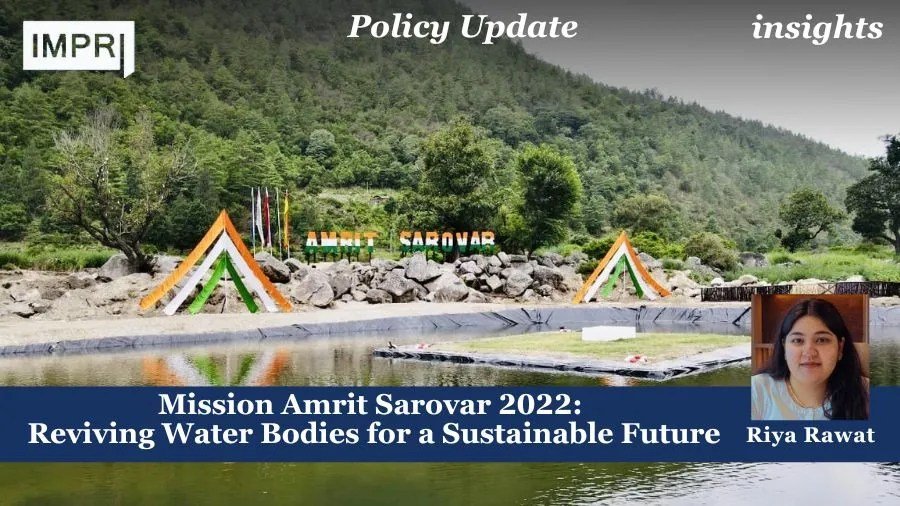
Policy Update
Riya Rawat
Background
Launched on April 24, 2022, as part of the “Azadi ka Amrit Mahotsav,” Mission Amrit Sarovar aims to address the critical water crisis faced by rural India. The initiative symbolizes India’s commitment to sustainable development by creating long-lasting water conservation structures. At its core, the mission is designed to develop or rejuvenate at least 75 Amrit Sarovars (ponds) in each district, commemorating 75 years of India’s independence. These efforts are expected to create approximately 50,000 water bodies nationwide, contributing to water security and community welfare.
India’s water crisis is exacerbated by uneven rainfall distribution, climate change, and over-extraction of groundwater. The mission is not only a practical solution to these challenges but also a symbolic gesture of resilience and collective effort in securing the nation’s water resources. By integrating modern technology with traditional knowledge, Mission Amrit Sarovar aims to create a model for sustainable water management.
Functioning
The mission operates under a “Whole of Government” approach, integrating efforts from multiple ministries, including the Ministry of Rural Development, Ministry of Jal Shakti, Ministry of Panchayati Raj, and others. Bhaskaracharya National Institute for Space Applications and Geo-informatics (BISAG-N) has been engaged as the technical partner, leveraging geospatial technology for site selection, progress monitoring, and performance evaluation.
Each Amrit Sarovar is designed to cover a minimum area of one acre with a water holding capacity of 10,000 cubic meters. Sites are carefully chosen based on parameters like topography, soil quality, and rainwater availability, ensuring optimal ecological and productive utility. Additionally, community participation is central to the mission, with local stakeholders contributing through Shramdaan (voluntary labor) and crowdfunding initiatives.
To ensure effective implementation, the mission employs innovative tools such as the Amrit Sarovar Portal and mobile applications, which provide real-time data on progress and facilitate transparent monitoring. State and district-level committees oversee the execution, addressing challenges and ensuring alignment with mission objectives.
Performance
The mission’s initial target of 50,000 Amrit Sarovar was achieved ahead of schedule on May 10, 2023. States like Uttar Pradesh, Madhya Pradesh, and Karnataka led the effort with over 16,000, 5,800, and 4,000 completed projects, respectively. These achievements highlight the efficacy of collaborative governance and community-driven initiatives.
Technological interventions, including geo-tagging and real-time monitoring via mobile apps, have significantly enhanced the mission’s transparency and efficiency. Moreover, the use of excavated soil for infrastructure projects underscores the mission’s commitment to resource optimization.
Notably, states such as Odisha and Maharashtra demonstrated exceptional performance, leveraging existing local schemes to complement the mission’s objectives. For instance, Odisha’s “Mo Pokhari” program provided a strong foundation for implementing the Amrit Sarovar initiative, contributing to its success in the region.
Impact
Mission Amrit Sarovar has revitalized India’s rural water landscape, ensuring sustainable water availability for irrigation, fisheries, and other livelihood activities. By planting indigenous trees like neem, peepal, and banyan around the ponds, the mission also contributes to ecological restoration. The initiative’s emphasis on community participation has fostered a sense of ownership among local populations, ensuring long-term maintenance of the water bodies.
The mission has positively impacted rural livelihoods by creating opportunities for aquaculture, water tourism, and the cultivation of water chestnuts. As of August 2023, over 59,000 Amrit Sarovars have been completed, directly benefiting approximately 1.12 lakh communities. User groups actively engage in diverse livelihood activities, including agriculture (68%), fisheries (20.5%), and animal husbandry (6.5%), boosting rural incomes and employment opportunities. Additionally, commemorative plantations and symbolic activities conducted at these sites, such as flag hoisting on national days, reinforce a sense of community pride and belonging.
The Sarovars also serve as hubs for community engagement and recreational activities, including picnics, boating, and eco-tourism. Enhanced groundwater recharge has further bolstered agricultural productivity, while efficient use of resources like excavated silt for infrastructure projects exemplifies the mission’s focus on sustainability.
Emerging Issues
Despite its successes, the mission faces challenges, including uneven progress across states and the lack of separate financial allocations. States like West Bengal and Punjab have reported slower implementation, attributed to local governance hurdles and resource constraints. Additionally, maintaining the constructed Sarovars poses a long-term challenge, necessitating robust community involvement and clear ownership frameworks.
Other pressing issues include siltation during monsoon seasons, diminishing the water-holding capacity of the ponds. Furthermore, inadequate integration of the Sarovars into comprehensive ecosystem management plans and insufficient training for local stakeholders have limited the mission’s potential impact. Climate change-induced variability in rainfall also poses risks to the sustainability of these water bodies.
Way Forward
To sustain the mission’s momentum and address the emerging challenges, several measures are essential:
- Strengthening Community Ownership: Establishing robust user groups and promoting awareness campaigns can enhance community participation in maintaining and utilizing the Sarovars effectively.
- Leveraging Public-Private Partnerships (PPP): Encouraging CSR investments and partnerships with private entities can address financial and technical constraints, ensuring sustained efforts for rejuvenation and maintenance.
- Silt Management Programs: Implementing periodic desilting operations and promoting plantations around the Sarovars can mitigate siltation issues and enhance water retention.
- Climate Resilience Measures: Adopting climate-adaptive strategies, such as rainwater harvesting structures and drought-resilient plantations, can ensure the long-term sustainability of water bodies.
- Capacity Building and Training: Training local stakeholders in advanced water conservation techniques and management practices will strengthen implementation and maintenance frameworks.
- Technology Integration: Leveraging AI and IoT-based tools for real-time monitoring and predictive analysis can optimize resource use and address potential issues proactively.
- Incorporating Ecosystem Services: Expanding the mission’s scope to integrate Sarovars into broader watershed management and biodiversity conservation plans will amplify its ecological and social benefits.
Conclusion
Mission Amrit Sarovar exemplifies a transformative approach to water conservation, rural development, and community participation. By achieving its ambitious target of 50,000 Sarovars ahead of schedule, the mission underscores India’s commitment to addressing water scarcity and fostering sustainable development. However, sustaining these gains requires addressing emerging challenges such as regional disparities, siltation, and climate resilience.
The mission’s success lies in its ability to integrate traditional wisdom with modern technology, foster collective action, and align with broader ecological and developmental goals. As India continues its journey towards a sustainable future, Mission Amrit Sarovar stands as a beacon of hope and a blueprint for effective community-driven water management strategies.
References
About the Author: Riya Rawat is a researcher at the Impact and Policy Research Institute (IMPRI), pursuing a second master’s degree in Political Science. With a strong background in public policy, gender studies, and international relations, her research interests focus on policy development, analysis, and global affairs.
Acknowledgment: The author extends sincere gratitude to Dr. Arjun Kumar and Aasthaba Jadeja for their invaluable guidance and support.
Disclaimer: All views expressed in the article belong solely to the author and not necessarily to the organisation.
Read more at IMPRI: