


BACKGROUND
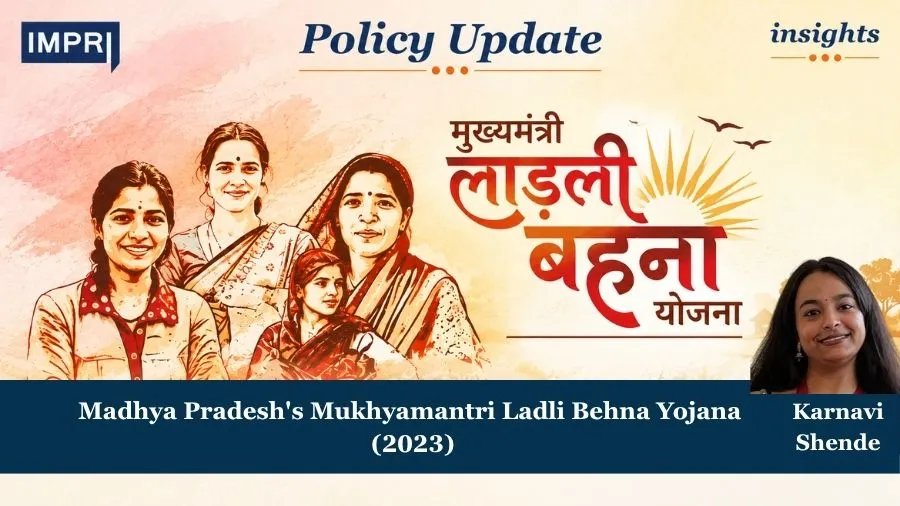
Women’s economic insecurity is shaped not only by low household income but also by unpaid care work, limited control over resources and unequal access to employment. State governments have increasingly responded through direct cash-transfer programmes that place money in women’s bank accounts. Madhya Pradesh’s Mukhyamantri Ladli Behna Yojana is one of the most significant examples of this shift.
The scheme was announced in January 2023 and formally launched on 10 June 2023, when the first instalment of ₹1,000 was transferred to approximately 1.25 crore women (NDTV, 2023). Its stated objectives are to improve women’s health and nutrition, strengthen their economic independence and increase their participation in household decision-making. The official scheme portal describes the programme as an important step towards women’s health, nutrition and economic self-reliance (Mukhyamantri Ladli Behna Yojana, Government of Madhya Pradesh).
At launch, the scheme provided ₹1,000 per month. The monthly assistance was later increased to ₹1,250 and the official portal currently records the benefit as ₹1,500 per month. This progression is important because the scheme’s fiscal cost and household-level value have changed since its introduction (The Hindu, 2025).
By combining a large beneficiary base with regular monthly transfers, Ladli Behna has quickly become one of Madhya Pradesh’s most visible social-protection programmes. Its design reflects a broader policy shift from narrowly targeted pensions and conditional transfers towards universal, women-centric income support. Yet, while cash transfers provide immediate economic security, they remain temporary safety nets that cannot substitute for structural employment and livelihood interventions.
Figure 1: Objectives of Mukhyamantri Ladli Behna Yojana
Source: Reproduced from the official website of Mukhyamantri Ladli Behna Yojana
FUNCTIONING
Institutional design and eligibility
The scheme is aimed primarily at married women, including widows, divorced women and women abandoned by their husbands. Eligibility is determined through a combination of residency, income and asset-based conditions. The age criterion has also evolved. During the initial 2023 enrolment round, the minimum eligible age was 23 years. Subsequently, the government revised the eligibility rules through a government order issued by the Women and Child Development Department on 9 July 2023 and reduced the lower age limit to 21 years, so that current guidelines refer to women aged 21–60 years as eligible for the scheme (Mukhyamantri Ladli Behna Yojana; Women and Child Development Department, Government of Madhya Pradesh, 2023).
The Women and Child Development Department is the nodal department for the scheme. The framework strictly mandates that the applicant must be a permanent/local resident of Madhya Pradesh, which is primarily verified through the state’s Samagra ID system (Samagra Social Protection Registry, Government of Madhya Pradesh. (n.d.). Samagra portal. https://spr.samagra.gov.in/). The official scheme guidelines and portal documentation confirm that any woman whose family’s income exceeds ₹2.5 lakh is ineligible for the scheme.
Beyond income, families are disqualified if they breach certain asset thresholds or background parameters. As outlined by the official guidelines, key exclusion categories include:
- Any family member filing income tax returns.
- Any family member employed as a regular, permanent or contractual worker in government services or receiving a post-retirement government pension.
- The family owning 5 acres or more of agricultural/irrigated land.
- Any family member owning a registered four-wheeler (though tractors are explicitly exempted).
The use of Samagra and other administrative databases allows the government to identify beneficiaries without creating an entirely new welfare-registration system. It can reduce paperwork and facilitate large-scale transfers. At the same time, it makes the scheme dependent on the accuracy of family composition, income records, Aadhaar details and bank information. Women whose marital status, address or family information has changed may face difficulty updating their records.
Application and payment
Registration is primarily assisted, not self-service online. Women must collect a paper form from a Gram Panchayat, Ward Office or Anganwadi camp; a government official or camp operator then enters their details, links Aadhaar and submits the application through a restricted portal. The only feature available directly to beneficiaries online is status tracking using their Samagra ID or application number. This design improves access for women with low digital literacy but can exclude those who cannot reach camps or correct errors in their records.
The benefit is transferred directly to the woman’s bank account. DBT reduces the role of intermediaries and creates an electronic record of the transaction. It can also reduce leakage, provided that the bank account is active, Aadhaar-enabled and correctly mapped for DBT.
A major operational requirement is the consistency of information across records. If the name in the beneficiary database, Aadhaar record and bank account differs, payment may be rejected or delayed. Similar problems can occur when an account is dormant, the Aadhaar–bank mapping is incomplete or the beneficiary changes banks without updating the scheme record. Correction facilities and local support are therefore not secondary features; they are essential to the scheme’s inclusion objective.
Grievance redressal operates mainly through the CM Helpline (181) for payment delays, bank-link issues and rejections, and a dedicated scheme helpdesk (0755-2700800) for technical and registration problems. However, the state’s administrative system allows beneficiaries to address errors through designated offices and camps.
PERFORMANCE
Coverage and payment scale
The first instalment was transferred on 10 June 2023 to approximately 1.25 crore women, marking one of the largest initial rollouts of a state-level women’s cash-transfer programme. The scheme subsequently established a large registered beneficiary base. PRS’s 2026–27 budget analysis records approximately 1.25 crore registered women under the programme (PRS Legislative Research, 2026).
To sustain this scale, the state’s DBT framework uses centralized tracking via the Samagra portal to monitor the flow from “approved” to “paid” beneficiaries . E-KYC and validation camps have been organised to address common bottlenecks like inactive accounts and incomplete Aadhaar–bank mapping. Disbursements are generally scheduled around a fixed date each month, helping create predictability and allowing large-scale processing in a concentrated period.
The financial scaling of the scheme further reflects its status as a core macroeconomic intervention rather than a static pension program. The nominal transfer value has been systematically expanded, transitioning from the initial launch rate of ₹1,000 per month to ₹1,250 and stabilizing at an enhanced tier of ₹1,500 per month by the 2026–27 fiscal cycle. To sustain this growth, the state government aggressively scaled up budgetary support. This massive compounding of state expenditure ensures that the real-world purchasing power of the transfer remains robust against localized household inflation and expenditure shocks.
Fiscal performance
The scheme was designed as a large-scale intervention rather than a narrowly targeted pension. In 2025–26, Madhya Pradesh allocated ₹18,669 crore to Ladli Behna, equivalent to 6.4% of the state’s estimated revenue receipts (Finance Department, Government of Madhya Pradesh 2025 Budget volume-6: Demands for grants 2025–26; PRS Legislative Research, 2025-26). It was reported that the state spent ₹14,734 crore on the scheme in 2023–24 (Finance Department, Government of Madhya Pradesh. (2023). Budget speech 2023–24; PRS Legislative Research, 2023-24). The 2026–27 budget analysis recorded an allocation of ₹23,883 crore, while noting that approximately 1.25 crore women had been registered and that the monthly payment had reached ₹1,500 (Finance Department, Government of Madhya Pradesh. (2026). Budget speech 2026–27; PRS Legislative Research, 2026-27).
These figures demonstrate that Ladli Behna has moved from an election-year announcement to a major, recurring component of the state’s expenditure structure. At the current benefit level of ₹1,500 per month, the annual transfer per woman is ₹18,000. If approximately 1.25 crore women receive the full annual amount, the direct annual liability would be about ₹22,500 crore before administrative costs, payment failures or changes in beneficiary numbers.
It is important to distinguish clearly between this estimated liability and the budget allocation. The ₹23,883 crore figure for 2026–27 is the amount earmarked in the budget, not the actual amount transferred to beneficiaries. Budget allocation and actual expenditure can differ because of variations in the number of active beneficiaries, transaction success rates, timing of disbursements and unspent balances. The calculated liability of around ₹22,500 crore is therefore a useful benchmark to understand the scheme’s fiscal scale, but it should not be read as the exact expenditure in any given year.
The size of the allocation also raises a wider policy question. Cash transfers can provide immediate relief, but their sustainability must be considered alongside spending on health, education, nutrition, employment and rural infrastructure. The relevant comparison is not between welfare and no welfare; it is between different ways of improving women’s long-term economic security.
Figure 2: Budget Allocation to Ladli Behna Yojana, 2023–24 to 2026–27 (₹ crore)

Source: Finance Department, Government of Madhya Pradesh (2023-24, 2025,-26 2026-27); PRS Legislative Research (2023-24, 2025-26, 2026-27).
Administrative performance
The scheme has demonstrated considerable administrative capacity by enrolling and paying a very large number of women within a short period. It is among the largest state-run direct benefit transfer (DBT) programmes in India in terms of beneficiary count, and its rapid scale-up reflects effective coordination between the Women and Child Development Department, district administrations, banks and payment agencies. The use of digital registration, Aadhaar-linked bank accounts and monthly DBT has enabled the state to move from a paper-based, office-centric model to a largely online, traceable system. For many women, especially in rural and remote areas, this has meant regular, predictable cash support without the need for frequent visits to government offices.
Some implementation challenges did emerge during the initial rollout. In March 2023, heavy demand for online registration and KYC verification led to server overload and technical glitches, causing delays in form submission and long queues at MP Online centres and banks. These issues were widely reported in local media and caused temporary inconvenience to applicants (Dainik Bhaskar, 2023).
IMPACT
The immediate effect of Ladli Behna is to provide a predictable source of cash to women who may have limited independent income. The transfer can help with food, medicines, transport, school expenses and small household purchases. It may also help reduce dependence on family members for routine expenditure.
The gender dimension of the scheme is important. Money is deposited in women’s accounts rather than being transferred to the household without a designated female recipient. This can improve women’s visibility in the formal financial system and strengthen their role in household decisions. However, account ownership does not automatically mean control. In some households, male relatives may retain the ATM card, passbook or phone used for banking.
The scheme can also support financial inclusion. Women who previously had limited interaction with banks may begin using accounts, checking balances and resolving DBT problems. Yet this outcome depends on access to banking correspondents, functional mobile connectivity and local assistance, especially in tribal and remote districts. However, a monthly transfer cannot by itself create employment, improve skills or guarantee nutritional security.
EMERGING ISSUES
Exclusion and verification
Income and asset conditions are intended to direct support towards economically vulnerable households. They can also exclude women whose family information is outdated or whose income is difficult to document because they work in the informal economy. Media reports from the initial rollout noted that server overload and technical glitches led to long queues and delayed form submissions, with many applications left pending or rejected due to incomplete or mismatched records (Dainik Bhaskar, 2023). Such bottlenecks disproportionately affect women who cannot easily revisit camps or offices to correct their details.
Payment failures
A woman can be eligible and registered but still not receive the monthly instalment. Common causes include incorrect bank details, inactive accounts, Aadhaar authentication problems, name mismatches and incomplete DBT mapping. These errors are particularly serious for women who depend on the payment for regular household needs.
Fiscal sustainability
The scheme’s rising allocation shows political commitment but also creates a large, recurring liability. The 2026–27 allocation of ₹23,883 crore for Ladli Behna is substantial relative to the state’s revenue resources, and any increase in benefit or coverage would raise costs further. The Chief Minister’s indication that the monthly aid could go up to ₹3,000 points to possible future escalation (The Hindu, 2024).
In the 2026–27 budget, Madhya Pradesh has allocated ₹52,917 crore to education, sports, arts and culture, and ₹24,001 crore to health and family welfare (PRS Legislative Research, 2026). Ladli Behna’s allocation is now almost equal to the entire health budget and amounts to nearly 45% of the combined education allocation. This does not imply that cash transfers are less important than health or education, but it does highlight a trade-off: every additional rupee committed to recurring income support reduces fiscal space for long-term, capital-intensive investments in human development. With state debt already high, sustaining Ladli Behna at this scale will require careful prioritisation and periodic impact evaluation (PRS Legislative Research, 2026; NDTV, 2025).
WAY FORWARD
Transparent Payment Dashboard: Madhya Pradesh should publish a monthly dashboard showing registered, approved, active and paid beneficiaries separately. It should include district-wise payment success rates, rejected transactions, pending cases and reasons for exclusion.
Strengthen Assisted Access: the government should strengthen assisted access. Common service centres, Gram Panchayats, Anganwadi workers, self-help groups and banking correspondents can help women update bank details, complete authentication and understand payment status.
Clear Appeal Mechanism: every rejected or failed application should generate a clear reason and a time-bound correction pathway. Beneficiaries should be able to appeal through local offices, helplines and online channels, with escalation where the problem is not resolved.
Consolidated Eligibility Notification: the state should publish a consolidated eligibility notification whenever the age limit, benefit amount or exclusion conditions change. This would reduce confusion between the rules applicable at launch and the rules applicable to later registration or continuation.
Link to Livelihoods: Ladli Behna should be connected with livelihood and financial-capability programmes. Beneficiaries could receive information on self-help-group membership, skill training, savings, insurance, pensions and enterprise credit. Cash assistance is more likely to produce durable gains when women can use it as a foundation for economic activity.
Annual Independent Impact Evaluation : an independent evaluation should examine the scheme’s effect on household consumption, women’s control over money, debt, savings, employment and access to services. The state should also publish annual expenditure, district-wise success and beneficiary data in a form that distinguishes allocation from actual transfer.
REFERENCES
Dainik Bhaskar. (2023, March 20). Technical faults in the server; online form filling process will start again from Monday. Dainik Bhaskar. https://www.bhaskar.com/local/mp/jabalpur/news/technical-faults-in-the-server-online-form-filling-process-will-start-again-from-monday-131086143.html
Finance Department, Government of Madhya Pradesh. (2025). Budget volume-6: Demands for grants 2025–26. https://finance.mp.gov.in/uploads/budget/Budget_Volume-6-2025-26.pdf
India Today. (2023, June 11). CM Shivraj Chouhan releases ₹1,000 under Ladli Behna Yojana. India Today. https://www.indiatoday.in/india/story/cm-shivraj-chouhan-releases-rs-1000-under-ladli-behna-yojana-in-madhya-pradesh-2391465-2023-06-11
Mukhyamantri Ladli Behna Yojana, Government of Madhya Pradesh. (n.d.). About the scheme. https://cmladlibahna.mp.gov.in/AboutUs.aspx
Mukhyamantri Ladli Behna Yojana, Government of Madhya Pradesh. (n.d.). Frequently asked questions. https://cmladlibahna.mp.gov.in/FAQ.aspx
Mukhyamantri Ladli Behna Yojana, Government of Madhya Pradesh. (n.d.). Official scheme portal. https://cmladlibahna.mp.gov.in/
NDTV. (2023, June 10). Over 1 crore women get Rs 1,000 under Ladli Behna scheme in Madhya Pradesh. NDTV. https://www.ndtv.com/india-news/over-1-crore-women-get-rs-1-000-under-ladli-behna-scheme-in-madhya-pradesh-4111130
NDTV. (2025, February 28). In Madhya Pradesh, Ladli Behna costs soar as state debt hits record highs. NDTV. https://www.ndtv.com/india-news/in-madhya-pradesh-ladli-behna-costs-soar-as-state-debt-hits-record-highs-10763102
PRS Legislative Research. (2025). Madhya Pradesh budget analysis 2023–24. https://prsindia.org/budgets/states/madhya-pradesh-budget-analysis-2023-24
PRS Legislative Research. (2025). Madhya Pradesh budget analysis 2025–26. https://prsindia.org/files/budget/budget_state/madhya-pradesh/2025/MP_Budget_Analysis_2025-26.pdf
PRS Legislative Research. (2026). Madhya Pradesh state budget analysis 2026–27. https://prsindia.org/files/budget/budget_state/madhya-pradesh/2026/Budget_Analysis_2026-27-MP.pdf
The Daily Pioneer. (2025, April 23). Congress criticises delays in Ladli Behna Scheme payments. The Daily Pioneer. http://www.dailypioneer.com/2025/state-editions/cong-slams-bjp-govt-over-delays-in-ladli-behna-scheme.html
The Hindu. (2024, May 12). Will increase Ladli Behna Yojana aid to ₹3,000 a month, says Chouhan. The Hindu. https://www.thehindu.com/news/national/other-states/will-increase-ladli-behna-yojana-aid-to-3000-a-month-says-chouhan/article66954821.ece
The Hindu. (2025, September 12). Madhya Pradesh cabinet approves hike in Ladli Behna monthly allowance to ₹1,500. The Hindu. https://www.thehindu.com/news/national/madhya-pradesh/madhya-pradesh-cabinet-approves-hike-in-ladli-behna-monthly-allowance-to-1500/article70262973.ece
Women and Child Development Department, Government of Madhya Pradesh. (2023, July 9). Order No. 887/1134836/23/50: Mukhyamantri Ladli Behna Yojana – Eligibility and operational guidelines. https://cmladlibahna.mp.gov.in/
ABOUT THE CONTRIBUTOR
Karnavi Shende is a Research and Editorial Intern at IMPRI. She holds a Master’s in Politics, specializing in International Relations, from Jawaharlal Nehru University, New Delhi. Her interests include International Relations, Strategic Studies, Public Policy, Gender, and Human Rights, with a focus on policy research and contemporary governance challenges.
ACKNOWLEDGEMENTS
The author extends sincere gratitude to the reviewers (Pragya Raghav and Tanisha) and the IMPRI team for their expert guidance and constructive feedback throughout the process.
REVIEWED BY
Pragya Raghav and Tanisha
DISCLAIMER
All views expressed in the article belong to the author and not necessarily to the organization.
Read more at IMPRI :
Sovereign Green Bond (SGrB) Framework 2022 – IMPRI Impact And Policy Research Institute