









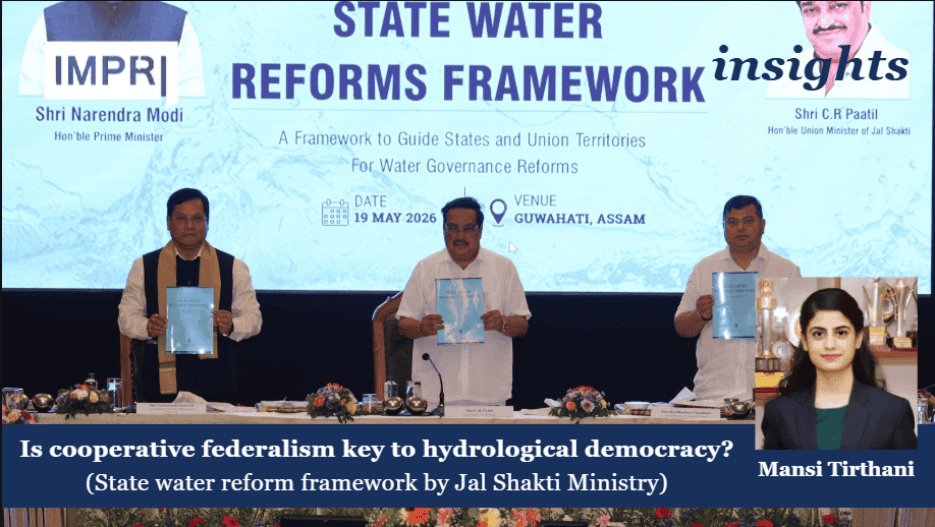
Policy Update
Mansi Tirthani
State water reform framework by Jal Shakti Ministry
Background
India’s water sector stands at an inflection point. Over decades, substantial investments have resulted in the building of vast irrigation infrastructure, hundreds of major dams and a huge network of groundwater monitoring stations. Even today the gap between potential and performance remains wide. India’s rivers, aquifers and water bodies are not merely natural assets. but are lifelines of agriculture, ecosystems and communities of 140cr people. India’s irrigation potential has increased significantly, yet actual utilization remains below capacity. Evidence from the Central Water Commission shows that per capita water availability and groundwater extraction continues to surpass natural water recharge systems.
As India moves towards sustainable water service delivery under Jal Jeevan Mission and Har Ghar Jal, its focus shifts to operation and maintenance, monitoring and evaluation through community participation and data backed governance. This transition will require strengthening of local drinking water service delivery through local governments, particularly Gram Panchayats, as the closest institutions to rural communities. This calls for the strong water data collection at state levels, collation of the data with robust analysis at the state repositories.
| Water reservoirs in 15 states are below 10 years average. Source- Central Water Commission. Data 2024 |
In order to achieve SDG-6 (ensuring universal availability and sustainable management of clean water and sanitation by 2030) the Ministry of Jal Shakti has recently launched a landmark initiative known as State Water Reforms Framework (SWRF) that places States and Union Territories at the core of India’s water governance transformation.
The framework being transparent and participatory empowers the states and UTs to evaluate their current water and sanitation progress by not just identifying systematic gaps but also facilitating them in undertaking the evidence-based decisions to strengthen water governance and long-term water security. This new water policy redesigns center state financial dynamism from a simple fund disbursal mechanism to a collaborative partnership designed that stimulates hydrological democracy at the grassroots level.
Functioning of the Policy
The SWRF functions as a sole benchmarking tool that evaluates States and Union Territories (UTs) towards progressive water sector governance focusing on quantitative methodology rather than qualitative assessment methods. The framework will rank the entire nation on 75 indicators which are classified in 27 dimensions. To ensure fair evaluation and context sensitive comparisons, it classifies States and UTs into three distinct categories following NITI Aayog’s Composite Water Management Index (CWMI) as Himalayan states, Non- Eastern Himalayan states and Union Territories.
Aligning with global best practices like the Asian Development Bank’s Asian Water Development Outlook (AWDO) the SWRF uses a graded performance classification system consisting of five progressive performance bands based on composite scores
- Band I (Score 0-40): Foundational – Reform building blocks being executed.
- Band II (Score 41-55): Developing – Reforms under formulation and early execution.
- Band III (Score 56-70): Progressive – Multiple reforms with measurable traction.
- Band IV (Score 71-85): Developed – Reforms institutionalized and functioning well.
- Band V (Score 86-100): Advanced – Mature, integrated, and adaptive reform systems.
This time the indicators will work on a closed binary (Yes/No) model with pre-defined thresholds to eliminate subjectivity. A Yes response gets a full score whereas a No yields zero. Across 100 point scales equal weight has been assigned to each indicator. The institutional timelines indicate that all reforms must be completed by the end of 2026. States must submit their responses with documentary evidence (dashboard screenshots or administrative record) by Jan 2027. Whereas the state and UT rankings will be released by the ministry in April 2027.
The Five Pillars of Reform
The 75 indicators are organized under five structural core dimensions:
- Policy and Regulation: States and UTs will be assessed on whether they have State Water Policy prioritizing rural drinking water supply and whether they have established a State Water Resources Regulatory Authority (WRRA). To monitor groundwater regulations, protection for industrial pollution, compliance with Interstate River Dispute, sludge and wastewater reuse in line with national frameworks.
- Project Monitoring: Concentrates on live dashboards tracking irrigation projects, formalized operation and maintenance (O&M) policies and mapping and geo-tagging of over 50% of village rural water assets on the central Sujalam Bharat platform.
- Digitalization and Research and Development: It mandates operationalization of State Water Informatics Centres (SWICs). That serves as centralized repositories with aggregating real time data streams from rain gauges, groundwater telemetry wells and satellite platforms followed by synchronization with central databases.
- Infrastructure: It will evaluate resilience, water testing laboratories, sludge treatment facilities, rainwater harvesting networks, and adherence to the Dam Safety Act.
- IEC and Community Engagement: Focuses on behavior change by evaluating state level water awards, educational outreach integrated through State Councils of Educational Research and Training (SCERTs), capacity building of women self help groups (SHGs) and Farmer Producer Organisations (FPOs) and citizen led water audits.
Concerns
Despite its structural rigor the operationalization of the SWRF contains several policy challenges
- Asymmetric institutional and technical capacity: Category II (Himalayan) and Category III (Union Territories) regions often lack the technical workforce where administrative capital is required either to deploy high tech SWIC architectures or extensive Internet of Things telemetry networks. Meeting these identical data ingestion standards before the deadline of December 2026 cut-off date creates serious concerns.
- High performance baseline: Demanding that a state’s Irrigation Potential Utilisation reach minimum 80% of its Irrigation Potential to score marks can penalize states that have suffered from unpredictable monsoon shifts due to climate change.
- Bureaucratic bottlenecks in departmental data synchronization: Merging data fields from separate departments (like minor irrigation, agriculture and urban development) into a single SWIC repository will require rigorous administrative coordination which generally faces resistance from bureaucracy.
- Fiscal friction: If the union capital allocation or scheme extensions under flagship infrastructure programs become tied to a state’s movement through the SWRF performance bands then it may widen the developmental gap between advanced states and struggling regions and may result in straining cooperative federal relations.
Impact
When deployed systematically the intersection of cooperative federalism and the SWRF redefines hydrological democracy across three clear dimensions:
- Information Democracy through Open Data: Centralisation of the SWIC datasets accessible down to the district level and then linking them with national platforms the framework is simply dismantling the information monopolies. Stakeholders like local authorities, water user associations and village bodies will not only gain real time access to the local groundwater extractions and water quality matrices but also it allows them for data driven crop planning and localized water budgeting.
- Shifting from Infrastructure to Accountable Service Delivery: The policy will enforce a significant transition from an asset creation focus to a utility based water service delivery model. Gram panchayats and village water and sanitation committees (VWSCs) are positioned in the manner where they have occupied the position of central owners and managers of rural water supply systems that holds them directly accountable to their local Gram Sabhas.
- Ecological and Environmental Protection: Explicitly tracking environmental flows (E-flows) and obligating Urban River Management Plans (URMPs) refers that the rivers are no longer treated merely as supply lines but as living ecosystems that require strict statutory protection from the center and the state.
- Socio-Economic Well-being: Today independent studies confirm that the deep socio economic returns of transforming water governance in reality. Research by Nobel Laureate Michael Kremer indicates that secure and well-monitored water systems can improve health indicators like reducing child mortality by up to 30% and also declining the overall mortality rate by preventing 1 lakh deaths annually. Further, joint reports by IIM Bangalore and the International Labour Organisation (ILO) justifies that the structured water governance interventions generate 5.99 million direct and 22 million indirect years of employment along with stabilizing rural economies.
Way Forward
To optimize the true potential of the SWRF and sustain long term hydrological security, India’s water governance should continuously evolve towards institutionalizing federal management. Future updates to the framework should look at the past state borders by incentivizing states to jointly manage the shared river systems cooperatively with the center and shared states.
Simultaneously the states must match the macro level compliance efforts with deep fiscal devolution to local governments by ensuring that a fixed percentage of state finance commission grants are channeled directly to Village Water and Sanitation Committees (VWSCs), empowering them with the financial autonomy and grassroots accountability.
Finally, states and UTs must focus on scaling national framework integrations by forming regional guidelines that mirror central mandates like the Safe Reuse of Treated Water (SRTW). This comprehensive alignment will ensure the optimal water resource lifecycle convergence transitioning water management from a regulatory checklist into a sustainable, community driven movement for long term water security uniformly throughout the country.
References
Ministry of Jal Shakti, Government of India (May 2026): Launch of the State Water Reforms Framework (SWRF) for Data-Driven Water Governance. Department of Water Resources, River Development & Ganga Rejuvenation. https://www.jalshakti-dowr.gov.in/static/uploads/2026/05/85e5c5f01ce444a3bc7947d64b05c14d.pdf
Press Information Bureau (PIB), Delhi (March 10, 2026): Cabinet approves extension of Jal Jeevan Mission (JJM) period up to December 2028 with enhanced outlay and restructured implementation focusing on structural reforms under JJM 2.0.
Press Information Bureau (PIB), Delhi (March 31, 2026): Post Cabinet Approval and Compliance with Structural Reforms, Funds Released to States for FY 2025-26 under reform-linked MoUs.
NITI Aayog, Government of India, Composite Water Management Index (CWMI) Report on Competitive and Cooperative Federalism. Per capita water consumption https://iced.niti.gov.in/climate-and-environment/water/per-capita-water-availability
About the Author
Mansi Tirthani is the recipient of the prestigious National President Award for her outstanding contributions to community services. She currently serves with the Research and Editorial team at IMPRI, where her work centers on evidence-based governance and policy innovation. With a strong commitment to advancing gender equity and welfare governance, Mansi brings together rigorous data analysis, strategic communication and development to impact research and policy.
Acknowledgement
The author extends sincere thanks to the IMPRI team for their guidance.
Reviewers
The article was reviewed by Shivani Chauhan and Samyukhta Balachandran
Disclaimer: All views expressed in the article belong solely to the author and not necessarily to the organization.
Read more at IMPRI
Evaluating Mission LiFE within India’s Green Development Agenda
PM-AASHA: Strengthening Farmers’ Income Security through Price Support Mechanisms