






Policy Update
Lubina Dua
Background
When a 7.8-magnitude earthquake struck southern Turkey and northern Syria on 6 February 2023, killing over 50,000 people and flattening entire cities, India was among the first countries on the ground. Within 12 hours, the Indian Army had assembled rescue teams and relief materials. Within 24 hours, Indian Air Force C-17 aircraft were landing at Adana with National Disaster Response Force personnel, dog squads, and a mobile hospital. India named this mission Operation Dost, “friend” in Turkish, Urdu, and several regional languages, a name that carried deliberate diplomatic meaning.
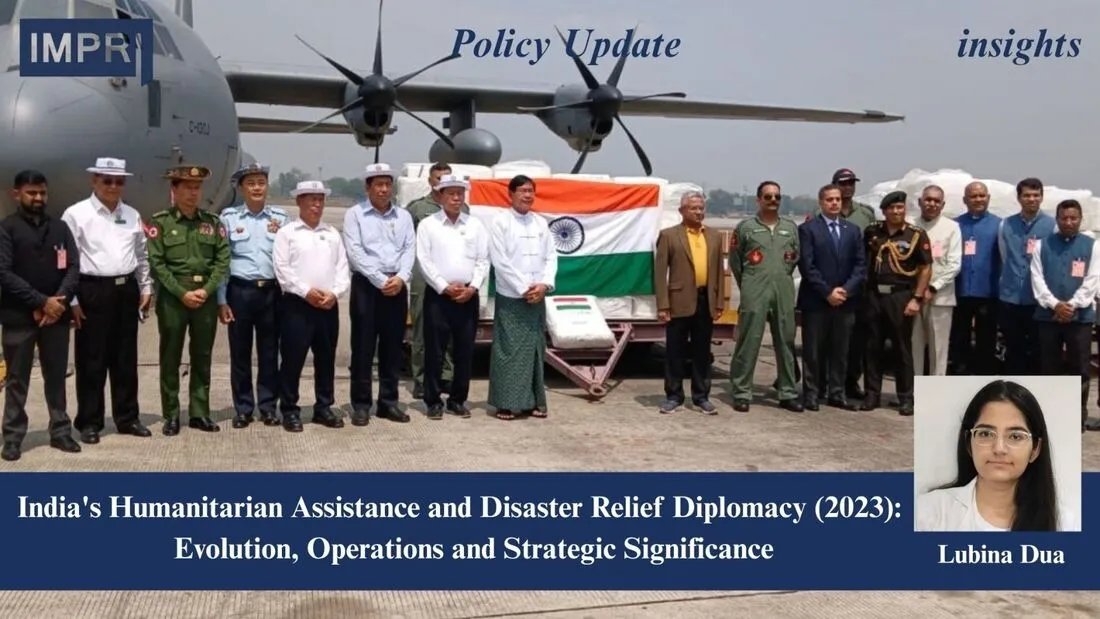
Two years later, on 28 March 2025, a 7.7-magnitude earthquake struck Myanmar’s Mandalay region, killing over 3,700 people and injuring thousands more. India launched Operation Brahma within hours, named after the Hindu God of Creation, symbolising not just emergency relief but a commitment to rebuilding. Six aircraft and five naval ships delivered over 750 metric tonnes of humanitarian aid. An 80-member NDRF team was deployed across more than a dozen sites. A 60-bed field hospital treated over 2,500 patients within two weeks (Ministry of Defence, PIB, 2025).
These two operations are not isolated acts of goodwill. They are expressions of a deliberate and increasingly institutionalised foreign policy posture, India’s Humanitarian Assistance and Disaster Relief (HADR) diplomacy, through which India projects itself as a responsible global actor, a net security provider, and, in the words of MEA Spokesperson Randhir Jaiswal, the region’s “First Responder” (MEA Press Briefing, March 2025).
This article traces the evolution of India’s HADR doctrine, analyses Operations Dost and Brahma as its most significant recent expressions, examines the institutional architecture that enables them, and identifies the structural gaps that remain.
Functioning
The Doctrinal Foundation
India’s HADR diplomacy rests on three interlocking policy pillars: the Neighbourhood First Policy, the SAGAR (Security and Growth for All in the Region) doctrine articulated by Prime Minister Modi in 2015, and the Vasudhaiva Kutumbakam principle of the world as one family. Together, these provide the normative justification for rapid overseas disaster response as an extension of foreign policy.
At the operational level, India’s HADR framework is anchored in the Disaster Management Act, 2005, which designates the National Disaster Management Authority (NDMA) as the apex coordinating body. For international operations specifically, the NDMA’s International HADR Guidelines (October 2024) now provide the first formal codification of India’s overseas response framework, grounded in principles of host-state sovereignty, impartiality, and speed (NDMA, 2024).
A Rapid Response Cell (RRC) was created within the MEA’s Development Partnership Administration IV (DPA IV) in July 2021 specifically to manage HADR operations, coordinating across the NDRF, Indian Armed Forces, Ministry of Health and Family Welfare, Food Corporation of India, and other agencies (MEA Annual Report 2021-22). This whole-of-government model, integrating diplomacy, defence, and civilian agencies under a single operational command, is what enables India to mobilise within hours rather than days.
Table 1: The Institutional Architecture
| Institution | Role in HADR Operations |
| National Disaster Management Authority (NDMA) | Apex coordinating body; issues policy guidelines, including International HADR Guidelines 2024 |
| Ministry of External Affairs (DPA IV/RRC) | Diplomatic coordination, host-country liaison, operational command of overseas missions |
| National Disaster Response Force (NDRF) | Specialised search and rescue, Collapsed Structure Search and Rescue (CSSR) teams, and medical first response |
| Indian Army | Field hospitals, engineering support, heavy rescue, logistics in conflict-adjacent zones |
| Indian Air Force | Strategic airlift using C-17 Globemaster III and C-130J Super Hercules aircraft |
| Indian Navy | Maritime transport of bulk relief material, naval hospital ships, and evacuation |
| Ministry of Health and Family Welfare | Medical supplies, pharmaceutical stockpiles, specialist deployment |
Source: NDMA, MEA Annual Reports, PIB Press Releases
Operational Mechanics
When a disaster occurs, the MEA’s RRC contacts India’s mission in the affected country within hours. The mission assesses requirements and relays them to New Delhi, where the NDMA coordinates deployment decisions with HQ Integrated Defence Staff. The NDRF provides the core search-and-rescue capability, while the IAF provides airlift and the Navy handles bulk cargo and long-distance logistics. Relief material is sourced from pre-positioned HADR pallets maintained by the NDRF, NAFED, and FCI, containing tents, blankets, food packets, medicines, water purification systems, and generators.
Performance
Table 2: India’s Major HADR Operations: A Comparative Timeline
| Operation | Year | Location | Trigger | Key Resources Deployed | Scale |
| Operation Castor / Rainbow | 2004 | Maldives / Sri Lanka | Indian Ocean Tsunami | Naval ships, IAF helicopters, medical teams | Regional |
| Operation Maitri | 2015 | Nepal | 7.8 earthquake | 12 IAF aircraft, 18 helicopters, NDRF; 1,700+ tonnes of aid | Largest overseas HADR at the time |
| Operation Insaniyat | 2017 | Bangladesh | Rohingya crisis | Relief packages including food and medicine | Regional |
| Operation Samudra Maitri | 2018 | Indonesia | 7.5 earthquake + tsunami | IAF aircraft, Indian Navy ships, and medical personnel | Sub-regional |
| Operation Karuna | 2023 | Myanmar | Cyclone Mocha | 4 Indian Navy ships; 40 tonnes of relief material | Sub-regional |
| Operation Dost | 2023 | Turkey / Syria | 7.8 earthquake | 7 IAF C-17 flights; 250+ NDRF personnel; 30-bed field hospital; 135 tonnes aid (Turkey); 6+ tonnes (Syria) | Extra-regional |
| Operation Sadbhav | 2024 | Myanmar | Typhoon Yagi floods | 1 IAF aircraft; 32 tonnes of aid | Sub-regional |
| Operation Brahma | 2025 | Myanmar | 7.7 earthquake | 6 aircraft; 5 naval ships; 80 NDRF personnel; 118-member field hospital; 750+ MT aid; 2,500+ patients treated | Largest naval-air combined HADR to date |
Sources: MEA Annual Reports 2015-2025; PIB Press Releases; Embassy of India Yangon; ICWA, Government of India
Operation Dost: Key Metrics
India’s response to the Turkey-Syria earthquake was notable for its speed and geographic scope, the first major HADR deployment outside India’s immediate neighbourhood at this scale.
- 7 IAF C-17 sorties to Turkey; 7th IAF flight to Syria (Ministry of External Affairs, 2023)
- Over 250 NDRF personnel were deployed with Collapsed Structure Search and Rescue equipment and specialist dog squads (MEA, 2023)
- 30-bed field hospital established in Iskenderun, Turkey, treating over 3,000 patients (MEA, 2023)
- Over 135 tonnes of relief material were delivered to Turkey; over 23 tonnes to Syria across multiple flights (MEA, 2023)
- India-Turkey bilateral trade stood at USD 10.4 billion in FY 2023-24 following the operation, USD 6.65 billion in Indian exports and USD 3.78 billion in imports (IBEF, 2024)
- Garuda Aerospace drones and modified Kisan drones were used to identify survivors under rubble and deliver medications, the first drone-assisted HADR deployment by India (PIB, 2023)
Operation Brahma: Key Metrics
- A 7.7 magnitude earthquake struck Myanmar’s Mandalay region on 28 March 2025, causing over 3,700 deaths (MEA Press Briefing, 2025)
- India was the first country to respond, dispatching the first C-130J within 24 hours, carrying 15 tonnes of supplies (MEA, April 2025)
- 80-member NDRF Urban Search and Rescue team was deployed across 12+ sites in Mandalay (Ministry of Defence PIB, 2025)
- 118-member Indian Army medical task force established a 60-bed Medical Treatment Centre in Mandalay (Ministry of Defence, 2025)
- Over 2,500 patients treated, 65 major surgeries performed, 1,300+ laboratory investigations and 103 X-ray procedures conducted (PIB, April 2025)
- 750+ metric tonnes of relief material delivered through 6 aircraft and 5 naval ships, including INS Satpura, INS Savitri, INS Karmuk, IN LCU 52, and INS Gharial (MEA, April 2025)
- INS Gharial alone delivered 442 MT of food aid, including 405 MT of rice, 30 MT of cooking oil, 5 MT of biscuits, and 2 MT of instant noodles (MEA, April 2025)
- Robotic mules and nano drones were deployed for the first time in an Indian HADR operation, showcasing the integration of emerging technologies into disaster response (Ministry of Defence, April 2025)
Impact
Strategic Soft Power
The most immediate and measurable impact of India’s HADR operations is diplomatic. Turkey had historically aligned with Pakistan on the Kashmir issue and raised the matter at international forums, including the UN General Assembly. Despite this, India responded to the earthquake in Turkey without hesitation, demonstrating that humanitarian action operates outside the logic of bilateral rivalry. Turkish Foreign Minister Mevlut Cavusoglu publicly thanked India, and Turkey’s Ambassador Firat Sunel stated that India was among the first countries to respond (MEA, 2023). This positioned India as a nation capable of rising above geopolitical friction, a significant soft power achievement.
In Myanmar, Operation Brahma deepened engagement with a country India has a complex relationship with, given the military junta’s record on human rights. India’s decision to provide HADR assistance without political conditionality reflects its consistent principle of need-based humanitarian response, distinct from Western approaches that sometimes tie aid to governance conditions. The operation strengthened India’s connectivity interests given Myanmar’s significance to the Act East Policy and the India-Myanmar-Thailand Trilateral Highway.
Neighbourhood First in Practice
India’s Neighbourhood First Policy finds its most concrete operational expression through HADR. Myanmar has been the recipient of at least five major HADR operations from India since 2008: Operations Sahayata (2008), Karuna (2023), Sadbhav (2024), and Brahma (2025) – demonstrating consistent engagement irrespective of political developments within Myanmar. This continuity builds the kind of durable goodwill that formal diplomatic channels alone cannot create.
Technological Advancement
Each successive operation has introduced new capabilities. Operation Dost marked the first use of commercial drones in an Indian HADR deployment. Operation Brahma saw the first deployment of robotic mules for logistics in collapsed urban areas and nano drones for survivor detection. These technologies were previously used only in military combat contexts. This cross-pollination of military technology into humanitarian operations is an important indicator of how India’s defence modernisation is feeding directly into its HADR capability.
International Recognition
India’s HADR posture has earned significant international recognition. PM Modi’s 10-point Agenda on Disaster Risk Reduction, presented at the Asian Ministerial Conference in 2016, included cohesion in international disaster response as a priority. India was among the nations that helped conceptualise the Coalition for Disaster Resilient Infrastructure (CDRI), launched in 2019. The scale of Operation Brahma, the largest combined naval-air HADR operation India has conducted, drew acknowledgement from UN agencies and bilateral partners across Asia.
Emerging Issues
1. Absence of a Dedicated HADR Budget Line: India does not maintain a separate, publicly disclosed budget allocation for overseas HADR operations. Expenditure is drawn from the Contingency Fund, Ministry of Defence allocations, and MEA budgets on an ad hoc basis. During Operation Maitri, the central government spent over INR 117 crore on disaster assistance, with total support, including state governments and NGOs, reaching INR 400 crore (IJFMR, 2024). The absence of a dedicated, pre-approved HADR fund creates friction in rapid deployment decisions.
Suggestion: The Union Budget should establish a dedicated Overseas HADR Reserve Fund under the MEA, with pre-approved drawdown authority for the NDMA, to eliminate financial approval delays during the critical first 72 hours of a disaster.
2. Coordination Opacity and Chain of Command Ambiguity The multiplicity of agencies involved in HADR operations, NDMA, MEA/RRC, HQ IDS, NDRF, armed forces service branches, and MoHFW, while reflecting a whole-of-government strength, also creates coordination complexity. Analysts have noted that decision-making processes in this space are “quite opaque,” with unclear chains of command, particularly when military and civilian agencies need to act simultaneously (Alternatives Humanitaires, 2022). Operation Brahma’s GPS spoofing incident, where IAF C-130J aircraft faced electronic warfare interference in Myanmar’s airspace, highlighted the need for clearer inter-agency protocols under adversarial conditions.
Suggestion: A standing Joint HADR Command, with pre-designated authority structures and regular inter-agency exercises, should be formalised under HQ IDS to reduce decision latency and communication gaps during actual deployments.
3. Post-Disaster Recovery Engagement Gap: India’s HADR operations excel at immediate response but have not yet built sustained post-disaster recovery mechanisms. Field hospitals are typically withdrawn within two to three weeks, and there is no systematic framework for transitioning from emergency relief to medium-term reconstruction support. In Turkey, bilateral trade continued at its pre-earthquake trajectory rather than seeing a significant uplift in infrastructure or reconstruction contracts, suggesting that the diplomatic dividend of HADR operations is not being fully converted into long-term economic partnership (IBEF, 2024).
Suggestion: MEA should develop a structured HADR-to-Development continuum framework that links immediate relief operations with medium-term Development Partnership Administration (DPA) projects, ensuring that the goodwill generated by HADR translates into substantive bilateral cooperation in reconstruction and infrastructure.
4. Geopolitical Constraints on Neutral Humanitarian Space Operation Dost raised important questions about aid delivery in politically complex environments. In Syria, Western sanctions created concerns about whether relief could reach affected populations. India navigated this through bilateral channels and the G20 “One Earth, One Family, One Future” framework, but the episode exposed the absence of a formal Indian policy on humanitarian access in sanctions-affected or conflict-adjacent zones (MEA, 2023). Operation Brahma similarly raised questions about HADR delivery in rebel-held areas of Myanmar, with India’s Embassy coordinating exclusively with the military government.
Suggestion: India should develop a formal Humanitarian Access Policy within MEA’s HADR framework, defining engagement protocols for sanctions-affected contexts and conflict zones, aligned with international humanitarian law principles while respecting bilateral sensitivities.
5. Technology Integration Without Standardisation The deployment of drones, robotic mules, and nano-drones in recent operations has been improvised rather than systematised. There are no standard operating procedures for technology-assisted HADR, no designated technology procurement streams, and no joint testing of emerging technologies in HADR scenarios with partner nations.
Suggestion: NDMA should establish a dedicated HADR Technology Cell, working with DRDO, the private sector, and the Quad partners (given the Quad’s existing disaster response coordination mechanisms), to standardise and field-test emerging technologies for HADR deployment.
Way Forward
India’s Humanitarian Assistance and Disaster Relief (HADR) diplomacy has evolved considerably over the past two decades, transitioning from reactive regional assistance to institutionalised, technology-enabled, and multi-agency humanitarian operations with increasing global reach. Operations Dost and Brahma exemplify this progression, demonstrating India’s capacity to deliver rapid, coordinated, and large-scale disaster response while reinforcing its role as a responsible regional and global stakeholder.
However, sustaining this trajectory will require corresponding institutional reforms. While India’s operational capabilities have expanded significantly, several structural gaps continue to constrain the long-term effectiveness of its HADR framework. The absence of a dedicated budgetary mechanism, persistent coordination challenges across multiple agencies, limited post-disaster recovery planning, and the lack of standardised technology integration indicate that institutional capacity has yet to fully match India’s growing strategic ambitions.
The NDMA’s International HADR Guidelines (2024) represent an important milestone in formalising India’s overseas disaster response architecture. Nevertheless, policy frameworks alone are unlikely to ensure sustained effectiveness without complementary institutional measures, including dedicated financial allocations, clearly defined command structures, and mechanisms that integrate immediate humanitarian relief with long-term reconstruction and development cooperation.
Ultimately, the success of India’s HADR diplomacy should be assessed not only by its ability to mobilise relief rapidly during humanitarian crises but also by its capacity to translate emergency assistance into enduring diplomatic goodwill, strengthened regional partnerships, and sustained development cooperation. As the frequency and intensity of disasters continue to increase, reinforcing the institutional foundations of India’s HADR architecture will be essential to consolidating its position as a reliable first responder and a credible humanitarian partner in the Indo-Pacific and beyond.
References
Alternatives Humanitaires. (2022). India’s humanitarian assistance abroad: A domestic and foreign policy issue. https://www.alternatives-humanitaires.org/en/2022/02/21/indias-humanitarian-assistance-abroad-a-domestic-and-foreign-policy-issue/
Embassy of India, Yangon. (2025). HADR operations—Highlights. https://www.indembassyyangon.gov.in
India Brand Equity Foundation. (2024). Exploring India–Turkey trade and economic relations. https://www.ibef.org
Indian Council of World Affairs. (2024). India’s role as a first responder in its neighbourhood: Humanitarian assistance and disaster relief. https://www.icwa.in/show_content.php?lang=1&level=1&lid=8807&ls_id=14390 (Indian Council of World Affairs)
International Journal of Multidisciplinary Research. (2024). India’s HADR operations in the past decade. https://www.ijfmr.com
Ministry of Defence, Government of India. (2025). Operation Brahma: Field hospital and relief updates. Press Information Bureau. https://pib.gov.in (Press Information Bureau)
Ministry of External Affairs, Government of India. (2019). Annual report 2018–19. https://www.mea.gov.in
Ministry of External Affairs, Government of India. (2021). Annual report 2020–21. https://www.mea.gov.in
Ministry of External Affairs, Government of India. (2022). Annual report 2021–22. https://www.mea.gov.in
Ministry of External Affairs, Government of India. (2023). Operation Dost. https://www.mea.gov.in/press-releases.htm?dtl/36209/Operation_Dost (Press Information Bureau)
Ministry of External Affairs, Government of India. (2025, March 29). Transcript of special briefing on Operation Brahma. https://www.mea.gov.in/media-briefings.htm?dtl/39303/Transcript_of_Special_Briefing_on_Operation_Brahma (Indian Council of World Affairs)
Ministry of External Affairs, Government of India. (2025, April 1). Press brief on Operation Brahma (2000 hrs., April 01, 2025). https://www.mea.gov.in/press-releases.htm?dtl/39317/Press_Brief_on_Operation_Brahma_2000_Hrs_April_01_2025 (Indian Council of World Affairs)
National Disaster Management Authority. (2024). International HADR guidelines. https://ndma.gov.in
News on AIR. (2025). Myanmar earthquake death toll crosses 2,700; India launches Operation Brahma. https://www.newsonair.gov.in
Press Information Bureau. (2025, February 15). Beyond the battlefield: Indian Armed Forces in humanitarian assistance and disaster relief. Ministry of Defence, Government of India. https://pib.gov.in (Press Information Bureau)
Vivekananda International Foundation. (2024). Humanitarian assistance and disaster relief (HADR): India’s journey from 2014 to 2024. https://www.vifindia.org
About the Contributor: Lubina Dua is a policy researcher whose work focuses on governance, institutional design, and evidence-based public policy. She has represented India at the Harvard Conference on Asian and International Relations (HPAIR) and participated in the World Bank Youth Summit.
Acknowledgement:
The author extends sincere thanks to the IMPRI team for their guidance.
Disclaimer:
All views expressed in the article belong solely to the author and not necessarily to the organization
Reviewed by:
Asmatwali, Rashi Kothari
Read More at IMPRI:
Bureau of Energy Efficiency (BEE) (2002)
Solar Charkha Mission: Reviving Khadi Through Renewable Energy