









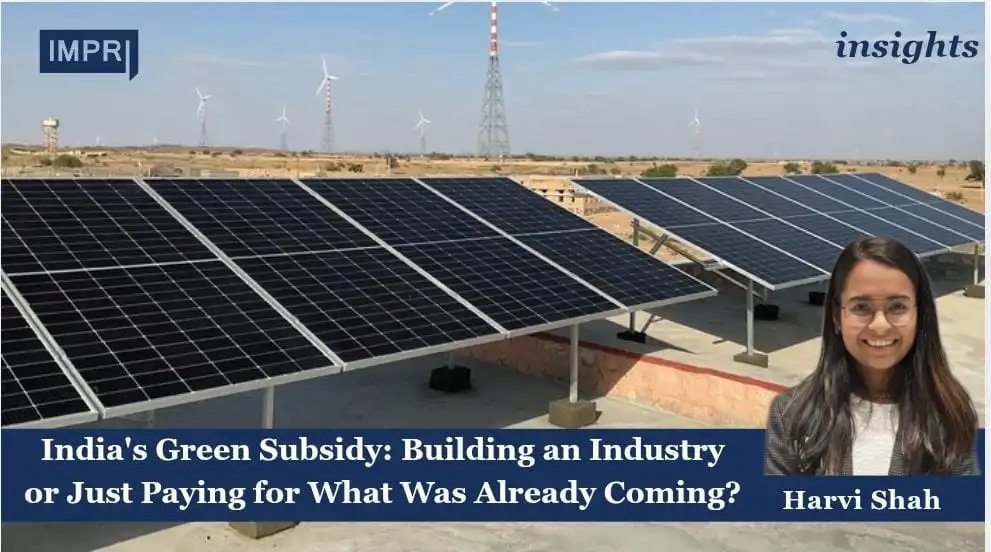
Harvi Shah
In 2020, India rolled out the Production Linked Incentive scheme with a simple pitch: pay manufacturers for every additional unit produced above a baseline, and watch domestic industry grow. That logic was later extended to some of the country’s most climate relevant sectors, including solar photovoltaic modules and advanced chemistry cell batteries, tying manufacturing growth directly to India’s energy transition and its broader push for self reliance under the Atmanirbhar Bharat banner.
On paper, the early results look encouraging. India’s operational solar manufacturing capacity has expanded sharply since 2022, with module capacity reaching around 120 gigawatts and cell capacity nearing 30 gigawatts by mid 2025 (JMK Research & IEEFA, 2025). The country has moved from near total dependence on imported panels to becoming, by some measures, the world’s second largest manufacturer and installer of solar equipment (Larsen, 2026).
But growth numbers alone do not tell us whether the policy is working as designed. The question that matters is this: is the PLI scheme causing manufacturers to invest more than they otherwise would have, or is it simply paying out for expansion that market demand and falling technology costs were already producing? These are very different stories, and they lead to very different conclusions about whether the scheme is good value for public money.
Mathias Larsen’s research on India’s green industrial policy offers a useful lens here (Larsen, 2025). He notes that India has kept direct fiscal spending on green manufacturing relatively narrow and technology specific, leaning instead on state owned enterprises, state owned financial institutions, and distribution companies to absorb much of the financial risk of scaling up renewable energy. The PLI scheme, in this framing, is one piece of a larger financing architecture rather than its main engine. That suggests its real function may be less about supplying the bulk of the capital manufacturers need, and more about derisking specific technologies early on, signalling to investors that the government is committed to a sector.
If that reading is right, the usual critique of production subsidies, that they simply reward activity that would have happened anyway, becomes harder to apply cleanly. A subsidy that shifts investor expectations and crowds in private capital is doing something structurally different from one that just pays for output the market would have delivered regardless. But we cannot know which story is closer to the truth without comparing firms and sectors that received PLI support against similar ones that did not, before and after the scheme’s phased rollout. That comparison is exactly what a difference in differences design, paired with an instrumental variables strategy to account for non random selection into the scheme, is built to provide.
This is where more critical commentary on the scheme becomes useful. Singh and Ray Chaudhuri (2024) argue that despite its stated goal of building globally competitive domestic manufacturing, the PLI scheme has design and structural flaws that risk undermining that objective, and needs closer alignment with India’s actual comparative advantage, including labour intensive manufacturing rather than only capital intensive, import substituting production. A CEEW policy brief adds a related point: even with strong policy support, India’s green manufacturing gains remain concentrated in downstream assembly, held back by demand uncertainty, limited finance access, and continued reliance on imported capital goods (CEEW, 2026). Read together, these pieces suggest the headline capacity figures may sit on top of a shallower industrial base than the growth story implies.
None of this means the scheme has failed. It means we do not yet have strong causal evidence either way, and the policy debate has largely run ahead of the data. That gap matters because the stakes are not small. The scheme represents a significant commitment of public money, and the sunset clauses and incentive structures built into its next phases will shape whether India’s green manufacturing sector matures into something genuinely competitive, or stays dependent on continued state support.
Getting a clearer answer means moving past aggregate capacity figures and looking directly at firm level behaviour: did eligible firms increase investment or output at a different rate than comparable firms that did not receive support, once the phased timing of scheme approvals is properly accounted for? That is the empirical question this project sets out to answer, and it is ultimately the question that determines whether India’s bet on green industrial policy pays off, or simply pays out.
References
Council on Energy, Environment and Water. (2026). India green manufacturing capacity and industrial policy [Policy brief]. CEEW.https://www.ceew.in/publications/india-green-manufacturing-capacityand-industrial-policy
JMK Research, & Institute for Energy Economics and Financial Analysis. (2025). Production Linked Incentive scheme drives robust growth in India’s solar manufacturing sector. IEEFA. https://ieefa.org/articles/production-linked-incentive-scheme-drives-robust-growth-indias-solarmanufacturing-sector
Larsen, M. (2025). Green industrial policy under financial constraints: Insights from India’s state led decarbonization. World Development, 195. https://doi.org/10.1016/j.worlddev.2025.107153
Larsen, M. (2026). Lessons from financing green industrial policy under financial constraints in India [Policy brief]. Grantham Research Institute, LSE. https://www.lse.ac.uk/granthaminstitute/publication/lessons-from-financing-green-industrial-policyunder-financial-constraints-in-india/
Singh, S., & Ray Chaudhuri, B. (2024). Assessing India’s production linked incentives: A case for realignment of objectives. Economic and Political Weekly, 59(49). https://www.epw.in/journal/commentary/assessing-indias-production-linked-incentives.html
About The Author
Graduated with a B.A. in Economics, with a concentration in Data Analysis, from Simon Fraser University. Based in British Columbia, Canada, Harvi is passionate about economic research, data-driven policy, and exploring how quantitative approaches can be used to address contemporary social and economic challenges. As part of her academic work, she conducted independent economic research and presented her research paper at the Canadian Economics Association Conference. She has also participated in international economics-focused academic competitions, including the International Economics Olympiad. Through DAPRF 5.0, Harvi hopes to deepen her understanding of public policy and research while contributing her analytical perspective and learning from a diverse community of fellows.
Acknowledgement
This article was published by Sudeepti Joshi, a Research and Editorial Intern at IMPRI.
Read more at IMPRI:
Uneven Access: Mapping Disparities in Basic Urban Amenities Across Indian Cities