





Policy Update
Asmatwali
Background
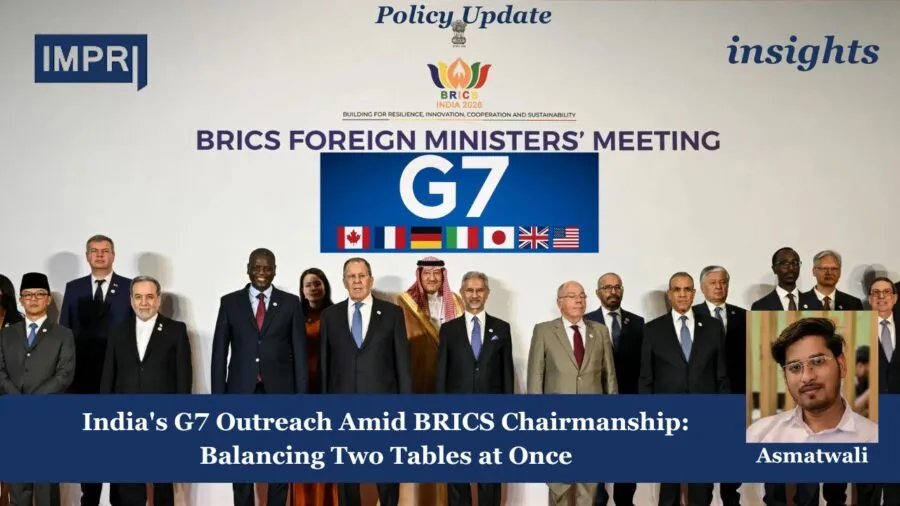
2026 marks a uniquely symmetrical year in India’s multilateral diplomacy: India simultaneously holds the chairmanship of BRICS (Brazil, Russia, India, China, South Africa, plus six newer members including the UAE, Iran, Egypt, Ethiopia, Indonesia, and Saudi Arabia) for the fourth time since 2012, while France holds the presidency of the G7 (Canada, France, Germany, Italy, Japan, the UK, the US, and the EU) for 2026.
India assumed the BRICS chair on January 1, 2026, under the theme ‘Building for Resilience, Innovation, Cooperation and Sustainability’ (BRICS), with the 18th BRICS Summit scheduled for September 12-13, 2026, in New Delhi. Simultaneously, India was invited — for the eighth consecutive year and Prime Minister Modi’s seventh consecutive personal participation — to the G7 Summit hosted by France in Évian-les-Bains from June 15-17, 2026.
This dual positioning is not new in form — India has engaged both blocs for over a decade — but 2026 is distinctive because India is simultaneously the chair of one grouping and a featured guest of the other in the very same calendar year, placing it at the literal centre of both tables during a period of acute global fragmentation: ongoing conflicts in Ukraine and West Asia, mounting trade protectionism (including the US tariffs imposed on India itself), and intensifying debates over de-dollarisation and global economic governance reform.
French President Emmanuel Macron personally invited PM Modi to the Évian Summit, explicitly framing the invitation around the coincidence of India’s BRICS chairmanship and France’s G7 presidency in the same year, and calling for closer India-France coordination on the international agenda ahead of the summit. India’s foreign policy establishment has historically described this kind of engagement with both blocs as evidence of ‘multi-alignment’ — the post-2014 evolution of India’s older ‘non-alignment’ and ‘strategic autonomy’ doctrines, premised on simultaneously deepening partnerships with all major power centres rather than choosing among them.
This article assesses India’s dual engagement across three interlinked dimensions — economic outcomes, diplomatic credibility, and institutional gains — treating the capacity to convert multilateral convening power into concrete structural results as the overarching yardstick of assessment.
Functioning
India’s parallel engagement with BRICS and the G7 operates through distinct but increasingly interlocking institutional tracks.
BRICS Chairmanship Architecture
As chair, India is responsible for setting the annual agenda, hosting the sherpa-level coordination process, chairing ministerial tracks across three declared pillars — political and security, economic and financial, and cultural and people-to-people exchanges — and ultimately hosting the leaders’ summit. India’s 2026 priorities, as articulated by EAM Jaishankar, include the reform of multilateral institutions, counter-terrorism cooperation (including work toward a comprehensive UN convention on international terrorism), AI governance frameworks, food and energy security, and the expanded use of local-currency settlement mechanisms. The BRICS New Development Bank (NDB) and the Contingent Reserve Arrangement (CRA), both products of earlier Indian-chaired summits (2012 Delhi, 2016 Goa), remain key institutional levers India continues to develop during its 2026 term.
G7 Outreach Format
India is not a G7 member but participates through the ‘Outreach Session’ format, alongside other invited partner countries and international financial institutions such as the World Bank and African Development Bank. This format allows India to engage on specific themes — in 2026, ‘Forging New Partnerships and Rebuilding International Solidarity’ — without binding it to G7 communiqués or formal decision-making. India has used this platform consistently since the 2019 Biarritz Summit to position itself as a voice for the Global South in a forum to which it does not formally belong.
Parallel Track Diplomacy
In a structurally significant move, France maintained continuous engagement with India across both the G7 foreign ministers’ track (where Jaishankar met his French counterpart in March 2026, explicitly framed around India’s BRICS chairmanship) and the leaders’ track (Macron’s personal invitation to Modi). This reflects a deliberate Western diplomatic strategy of treating India’s BRICS leadership not as a rival bloc-building exercise, but as a relationship to be actively managed and engaged in parallel, distinct from how Western capitals have historically approached China’s or Russia’s roles within BRICS.
Performance
BRICS Trade and Economic Indicators
| Indicator | Figure |
| India’s total bilateral trade with BRICS nations, 2025 | USD 416 billion (up from USD 289 billion in 2021) |
| India’s trade deficit with BRICS, 2025 | USD 224 billion (widened from USD 117 billion in 2021) |
| India’s exports to BRICS, 2025 | USD 96 billion (~22% of India’s total exports; 3% CAGR 2021-25) |
| India’s imports from BRICS, 2025 | USD 320 billion (43% of India’s total imports, up from 36% in 2021; 12% CAGR) |
| Russia’s import growth to India (CAGR 2021-25) | 61% (largely crude oil driven) |
| BRICS (11-nation) share of global GDP | ~40% |
| BRICS (11-nation) share of global trade | ~26% |
| BRICS (11-nation) share of world population | ~45% |
| Intra-BRICS merchandise exports, 2024 | USD 1.17 trillion (13-fold increase since 2003) |
| Intra-BRICS trade as % of global trade | Only ~5% — far below the bloc’s 27% share of global output |
G7 Engagement Indicators
| Indicator | Figure |
| India’s G7 Outreach Session appearances | 13 (as of 2026) |
| PM Modi’s consecutive personal G7 appearances | 7 |
| G7 share of global GDP (nominal) | ~43% |
| G7 share of global trade | ~30% |
| India’s GDP, 2026 | USD 4.15 trillion nominal (6th largest); USD 18.90 trillion PPP (3rd largest) |
| India’s projected GDP growth, 2026 | 6.5% |
The data illustrates a structural asymmetry underlying India’s ‘two tables’ strategy: BRICS represents India’s larger and faster-growing trade relationship by volume, but with a rapidly widening deficit driven substantially by Russian energy imports; the G7 remains smaller in trade share but represents a relationship of greater technological, financial, and high-value-addition significance, alongside being the source of significant tariff friction in 2025-26 (the US’s 50% tariff being the starkest example).
Impact
Validating ‘Multi-Alignment’ as Operational Doctrine
India’s simultaneous BRICS chairmanship and G7 partner-country role provides the clearest empirical demonstration yet of multi-alignment as a functioning, rather than merely rhetorical, foreign policy doctrine. Unlike Cold War-era non-alignment — which sought equidistance from competing blocs — India’s 2026 posture involves active, deep, simultaneous institutional leadership in one grouping while pursuing substantive engagement in a rival grouping’s core summit process. This validates arguments made by Indian policymakers since 2014 that strategic autonomy in the contemporary era requires engagement with all power centres rather than abstention from any.
This operational doctrine is fundamentally backed by India’s structural weight as a USD 4.15 trillion nominal economy (and the 3rd-largest at USD 18.90 trillion in PPP terms), growing at a projected 6.5% in 2026. This economic leverage has directly translated into a record 13 total G7 Outreach appearances—including 7 consecutive personal invitations for PM Modi—demonstrating that multi-alignment is sustained by indispensable economic realities rather than just diplomatic rhetoric.
Reduced Western Anxiety over BRICS Expansion
France’s framing of the Macron-Modi invitation — explicitly referencing India’s BRICS chairmanship as a point of continuity and engagement rather than concern — signals that Western powers increasingly differentiate India’s role within BRICS from the China-Russia-driven expansion narrative (the addition of Iran, Saudi Arabia, the UAE, Egypt, Ethiopia, and Indonesia since 2024). This differentiation gives India unique leverage: it can credibly present itself simultaneously as a stabilising, moderate voice within BRICS and as a trusted G7 partner, a positioning unavailable to China or Russia.
This differentiation is evidenced by a concrete diplomatic timeline in early 2026: France actively engaged India during the March 2026 Foreign Ministers’ track specifically to coordinate on India’s BRICS chairmanship. Meanwhile, India maintained its independent institutional momentum on separate tracks—such as securing direct Russian endorsement of its counter-terrorism and energy security priorities during the May 2026 BRICS ministerial meetings—proving that Western nations are accommodating rather than resisting India’s dual leadership role.
Platform for Voicing Global South Concerns
PM Modi’s G7 Outreach remarks in Évian — emphasising that many global crises stem from a ‘shortage of trust’ rather than a shortage of resources, and calling for greater developing-country representation in global decision-making — illustrate how India uses the G7 platform to advocate positions more closely associated with the Global South and BRICS agenda (multilateral reform, equitable global governance) directly within G7 deliberations, effectively using one table to advance themes native to the other.
By anchoring its narrative in the structural weight of the newly expanded 11-nation BRICS—which commands 40% of global GDP, 26% of global trade, and 45% of the world’s population—India ensures its advocacy is backed by massive collective leverage. Bringing the reality of a bloc that achieved USD 1.17 trillion in intra-merchandise exports directly into G7 deliberations transforms India’s rhetoric from abstract moral posturing into a concrete reminder of shifting global economic power.
Managing Friction Points in Real Time
The Évian Summit also demonstrated the limits and tensions of this balancing act: Modi’s first in-person meeting with President Trump in sixteen months occurred just days after reported US strikes affecting Indian-crewed vessels during the Iran-related Strait of Hormuz crisis, with EAM Jaishankar separately lodging a strong protest with US Secretary of State Marco Rubio. Modi’s public remarks at the summit referenced the ‘loss of Indian lives’ and trade disruptions from the conflict without directly naming the incident — illustrating how India manages simultaneous economic and security friction with G7 powers even as it engages them diplomatically, without these frictions derailing the broader relationship-building agenda.
Specifically, India had to navigate a severe 50% cumulative US tariff overhang and the geopolitical fallout of the Iran-related Strait of Hormuz crisis, which resulted in a tragic loss of Indian mariners’ lives and severe trade shocks. The real-time management of this friction resulted in concrete outcomes: EAM Jaishankar lodged a direct protest with US Secretary of State Marco Rubio, and PM Modi used his immediate physical proximity to President Trump at the G7 table to forcefully raise the disruptions to trade and Indian lives, demonstrating that high-level summitry is actively leveraged for crisis resolution.
BRICS Institutional Deepening Continues in Parallel
Even as India engaged the G7 in June, its BRICS chairmanship work continued on a separate track — the BRICS Foreign Ministers’ Meeting (May 2026), Sherpa coordination, and Youth Coordination Meeting all proceeded independently of the G7 calendar, with Russia publicly endorsing India’s counter-terrorism and energy security priorities. This parallel institutional momentum underscores that India’s BRICS leadership is a substantive undertaking with its own agenda, not merely a symbolic counterweight used to bolster G7 leverage.
However, this parallel momentum must manage severe internal economic asymmetries: India’s total bilateral trade with BRICS rose to USD 416 billion in 2025 (up from USD 289 billion in 2021), but its intra-bloc trade deficit widened to USD 224 billion. Driven by a staggering 61% CAGR in Russian crude oil imports between 2021 and 2025, these figures show that India’s domestic economic outcomes are closely intertwined with those of its BRICS partners, even as it pursues high-value technological and financial cooperation with the G7.
Emerging Issues
India’s trade deficit with BRICS nations has nearly doubled since 2021 (USD 117bn to USD 224bn), driven substantially by Russian crude imports. As BRICS chair, India must reconcile its rhetorical leadership of ‘Global South solidarity’ with the reality of a deepening, energy-driven trade asymmetry within the bloc itself. Widening BRICS Trade Deficit Undermines South-South Solidarity Narrative:
Despite BRICS nations accounting for 27% of global output, intra-bloc trade accounts for only ~5% of global trade — far below their economic weight. India’s chairmanship year presents an opportunity to advance UNCTAD’s proposed ‘Trade+’ strategies for deeper South-South integration, though institutional capacity constraints within the bloc persist.Intra-BRICS Trade Underperformance:
With Xi Jinping and Putin both expected at the September 2026 New Delhi summit, India must navigate hosting a summit where China and Russia’s preferences (e.g., on de-dollarisation, anti-Western messaging) could overshadow India’s own more moderate, institution-building agenda — testing India’s capacity to set the tone as chair rather than merely host genuinely. China-Russia Dominance Risk within BRICS:
The unresolved US tariff regime (including the 50% cumulative tariff, partly linked to India’s Russian oil purchases) remains a live irritant in India’s G7-adjacent engagement. The Évian interaction between Modi and Trump indicates personal diplomatic engagement continues. Still, no structural resolution has yet emerged — a gap between high-level symbolism and substantive trade relief. US Tariff Overhang on the G7 Track:
Both BRICS (under India’s 2026 agenda) and the G7 (June 2026 Évian agenda) have flagged AI governance as a priority. India is well-positioned to leverage this rare area of substantive overlap — building on its own AI Impact Summit hosted in February 2026 — to construct a genuinely bridging initiative rather than a duplicated, bloc-specific framework.AI Governance — A Genuine Convergence Point:
The Iran-related crisis affecting Indian-crewed vessels and global trade routes demonstrates how volatility in West Asia directly intrudes on India’s G7 diplomacy in real time. India needs clearer crisis-communication protocols for managing such incidents when they coincide with high-visibility multilateral summitry. Strait of Hormuz / West Asia Spillover:
Way Forward
India’s simultaneous stewardship of BRICS and engagement with the G7 in 2026 represents a high-water mark for its multi-alignment doctrine — but sustaining this balancing act requires deliberate, structured effort rather than reliance on goodwill and personal diplomacy alone.
First, India should use its BRICS chairmanship to genuinely advance intra-bloc trade integration and institutional reform (NDB capitalisation, local-currency settlement mechanisms) rather than allowing the September 2026 summit to become a platform primarily for China-Russia messaging on de-dollarisation and anti-Western rhetoric, which would undercut India’s positioning as a moderate, institution-building chair.
Second, India should leverage its unique position as both the BRICS chair and a trusted G7 partner to actively broker the few genuine areas of convergence between the two groupings — AI governance, multilateral institutional reform, and global health security — and build cross-bloc initiatives that few other nations are well positioned to construct.
Third, on the G7 track, India must press for tangible movement on the unresolved tariff dispute with the United States, converting the personal diplomatic capital built through Modi’s seven consecutive G7 appearances into structural trade outcomes, rather than allowing the relationship to remain characterised by symbolism without resolution.
Fourth, India should invest in building a clearer public narrative — both domestically and internationally — that explains multi-alignment not as strategic ambiguity but as a coherent doctrine: India engages every major power grouping on its own merits, advancing Indian and Global South interests within each, without subordinating its sovereignty or strategic autonomy to any single bloc’s agenda.
Ultimately, 2026 offers India a rare structural opportunity: chairing the platform most associated with the Global South while being courted by the platform most associated with the advanced industrial democracies, in the very same year. Whether this translates into durable diplomatic and economic gains — beyond the optics of ‘sitting at two tables’ — will depend on India’s ability to convert convening power into concrete institutional and economic outcomes by the time both summit cycles conclude.
References
1. CSEP (Centre for Social and Economic Progress). (2026, April 21). India’s 2026 BRICS presidency: Key priorities for a multipolar world. https://csep.org/blog/indias-2026-brics-presidency-key-priorities-for-a-multipolar-world/
2. Diplomatie France (Ministry for Europe and Foreign Affairs). (2025, November 12). G7 Canada – Minister’s meeting with his Indian counterpart, Subrahmanyam Jaishankar. https://www.diplomatie.gouv.fr/en/presse-et-ressources/decouvrir-et-informer/actualites/g7-canada-entretien-du-ministre-avec-son-homologue-indien-subrahmanyam-jaishankar-121125
3. Diplomatie France (Ministry for Europe and Foreign Affairs). (2026, March 26). Minister’s meeting with Mr Subrahmanyam Jaishankar, India’s external affairs minister. https://www.diplomatie.gouv.fr/en/presse-et-ressources/decouvrir-et-informer/actualites/entretien-du-ministre-avec-subrahmanyam-jaishankar-ministre-des-affaires-exterieures-de-l-inde
4. ForumIAS. (2026, June 17). G7 and India – Significance and challenges: Explained pointwise. https://forumias.com/blog/g7-and-india-significance-and-challenges-explained-pointwise/
5. Government of India, Ministry of External Affairs / News on AIR. (2026, February 10). The first BRICS Sherpa Meeting begins in New Delhi under India’s Chairmanship. https://www.newsonair.gov.in/first-brics-sherpa-meeting-begins-in-new-delhi-under-indias-chairship
6. Government of India, Ministry of External Affairs / News on AIR. (2026, February 10). Russia supports India’s BRICS Chairship agenda on counter-terrorism and energy security. https://www.newsonair.gov.in/russia-supports-indias-brics-chairship-agenda-on-counter-terrorism-and-energy-security
7. Government of India, Ministry of External Affairs / News on AIR. (2026, February 18). French President Emmanuel Macron invites PM Modi to the G7 Summit in France. https://www.newsonair.gov.in/french-president-emmanuel-macron-invites-pm-modi-to-g7-summit-in-france/
8. Government of India, Ministry of External Affairs / News on AIR. (2026, January 13). EAM Dr S Jaishankar launches logo, theme and website for BRICS Summit 2026. https://www.newsonair.gov.in/eam-dr-s-jaishankar-launches-logo-theme-and-website-for-brics-summit-2026
9. India TV News. (2026, June 16). G7 Summit: PM Modi holds bilateral meetings with Canadian and UK counterparts in France. https://www.indiatvnews.com/news/world/g7-summit-live-updates-pm-modi-evian-france-emmanuel-macron-trump-meeting-bilateral-talks-keir-starmer-other-leaders-us-iran-deal-latest-2026-06-16-1045040
10. New Kerala. (2026, June). PM Modi: India’s G7 presence reflects global profile. https://www.newkerala.com/news/a/8th-consecutive-presence-reflects-growing-global-profile-pm-507.htm
11. Outlook Business. (2026, May 15). India’s bilateral trade with BRICS nations rises to $416bn, but the deficit widens. https://www.outlookbusiness.com/economy-and-policy/indias-bilateral-trade-with-brics-nations-rises-to-416bn-but-deficit-widens
12. Rio Times Online. (2026, April 28). BRICS 2026: Full member list, summit date & new countries. https://www.riotimesonline.com/brics-2026-complete-guide/
13. The Wire. (2026, June). Seated next to Trump at G7 event, Modi raises ‘loss of Indian lives’, trade shocks due to Iran war. https://thewire.in/diplomacy/days-after-us-killing-indian-mariners-modi-greets-trump-g7-france
14. UN Trade and Development (UNCTAD). (2026, March 5). Two decades of intra-BRICS trade: Trends, patterns and policies (UNCTAD/TCS/GDS/INF/2025/2). https://unctad.org/publication/two-decades-intra-brics-trade-trends-patterns-and-policies
15. Vajiram & Ravi. (2026, June 18). G7 Summit 2026: Members, agenda, India’s participation, outcomes. https://vajiramandravi.com/current-affairs/g7-summit-2026/
16. Wikipedia. (2026). Economy of India. https://en.wikipedia.org/wiki/Economy_of_India
About the Contributor
Asmatwali is a research and editorial intern at IMPRI. He is a scholar in the Department of West Asian and North African Studies at Aligarh Muslim University. Earlier, he worked on two project reports based on semi-structured interviews for the think tank JINF, Japan.
Acknowledgement
The author expresses his sincere gratitude to IMPRI (Impact and Policy Research Institute) for providing him with the opportunity to prepare this policy update article and for fostering a rigorous learning environment that connects research with public policy practice. He also extends his sincere thanks to Paridhi Passi & Mehul Rastogi for their valuable feedback, useful suggestions, and support in shaping this article in the required policy-update format.
Disclaimer: All views expressed in the article belong solely to the author and not necessarily to the organisation.
Read More at IMPRI:
Pradhan Mantri Adi Adarsh Gram Yojana (PMAAGY)
Micro, Small, & Medium-sized Enterprises (MSME) Day 2026
This article was posted by Pallavi Lad, a Research and Editorial Intern at IMPRI.