






Policy Update
Asmatwali
Background
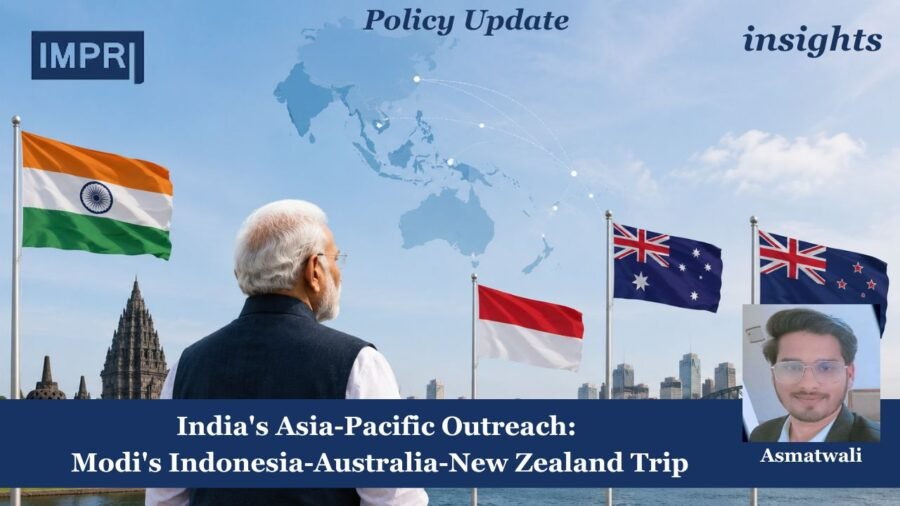
Prime Minister Narendra Modi undertook a six-day, three-nation tour of Indonesia, Australia and New Zealand from 6 to 11 July 2026, comprising a State Visit to Indonesia (6-8 July), the Third India-Australia Annual Summit in Melbourne (8-10 July), and an official visit to New Zealand (10-11 July), the first by an Indian Prime Minister in four decades (Prime Minister’s Office, Government of India, 2026a; Prime Minister’s Office, Government of India, 2026c).
Ministry of External Affairs officials described the tour as reflecting a shift in India’s diplomatic focus toward “the eastern maritime zones of the Indian Ocean” under the Act East Policy, coming on the heels of Modi’s visits to Mauritius and Seychelles earlier in 2025-26 (Ministry of External Affairs, Government of India, 2026a).
The trip followed directly from the 16th India-Japan Annual Summit that Modi hosted in New Delhi the previous week, and unfolded at a moment when the Quadrilateral Security Dialogue (Quad) had not convened a leaders’-level summit for nearly two years, with Washington’s Indo-Pacific posture under the Trump administration widely seen as uncertain (MEA, 2026a). This context lent India’s outreach added strategic salience, as New Delhi sought to reinforce partnerships with two of its three fellow Quad members, Australia and Japan, and to deepen a comprehensive strategic relationship with Indonesia, a key Global South and ASEAN power, at a time of intensifying Chinese assertiveness across the Indo-Pacific.
Functioning
Political and strategic engagement
In Jakarta, Modi held official talks with President Prabowo Subianto on 7 July, building on the India-Indonesia Comprehensive Strategic Partnership established in 2018 and on Prabowo’s State Visit to India as Chief Guest for the 76th Republic Day in January 2025 (PMINDIA, 2026b; Press Information Bureau, Government of India, 2026a). The two leaders agreed to institutionalise regular summit meetings (PMINDIA, 2026b). In Melbourne, the Third India-Australia Annual Summit with Prime Minister Anthony Albanese reviewed progress under the Comprehensive Strategic Partnership (CSP) established in 2020 (PMINDIA, 2026c; PIB, 2026b). In Auckland, Modi and Prime Minister Christopher Luxon elevated bilateral ties to a Strategic Partnership and adopted a seven-pillar “Roadmap to 2030” (PMINDIA, 2026d; MEA, 2026c).
Defence and maritime security
The Melbourne summit produced a new Joint Declaration on Defence and Security Cooperation, an Annual Defence Ministers’ Dialogue, and an India-Australia Maritime Security Collaboration Roadmap (PMINDIA, 2026c; PIB, 2026b). In Auckland, the two sides agreed on a maritime cooperation arrangement under their 2005 defence memorandum of understanding, and the Roadmap to 2030 includes a defence and security pillar (PMINDIA, 2026d; MEA, 2026c).
Trade, investment and critical minerals
The Jakarta talks reviewed cooperation spanning trade and investment, critical minerals, energy and agriculture, among other areas (PMINDIA, 2026b). The Roadmap to 2030 with New Zealand includes a trade and economic cooperation pillar (PMINDIA, 2026d; MEA, 2026c).
Energy security
Melbourne produced a Joint Statement on Energy Security, and the leaders welcomed outcomes of the Quad Foreign Ministers’ meeting held in New Delhi in May 2026, reaffirming cooperation through the Indian Ocean Rim Association under India’s chairmanship (PMINDIA, 2026c).
Education, culture and people-to-people ties
In Jakarta, Modi addressed the Indonesian House of Representatives, inaugurated the restoration of the Prambanan Temple complex in Yogyakarta, and witnessed the signing of an agreement between IIM Bangalore and Indonesia’s Singhasari Special Economic Zone (MEA, 2026b). The India-Indonesia review also covered the digital economy, space, health, education, culture and people-to-people ties (PMINDIA, 2026b). The Auckland visit coincided with New Zealand’s Matariki festival and began with a traditional Māori welcome ceremony at Government House (MEA, 2026c), with people-to-people ties also forming part of the Roadmap to 2030.
Performance
On the Indonesia leg, both sides set out to substantially expand bilateral trade beyond its current level of roughly USD 25 billion, and progressed the India-Indonesia Shared Vision task force process alongside continuing ISRO-BRIN space cooperation, including support for India’s Gaganyaan Mission through the Biak Telemetry, Tracking and Command Facilities (MEA, 2026b; PMINDIA, 2026b). India also concluded a defence agreement covering the sale of missile systems to Indonesia, consistent with New Delhi’s emerging profile as a net security provider in the Indo-Pacific following earlier missile-package sales to the Philippines and Vietnam (Kelly, 2026).
In Australia, concrete outcomes included administrative arrangements enabling export of Australian uranium to India for peaceful purposes under International Atomic Energy Agency safeguards, a Memorandum of Understanding between the Australian Maritime Border Command and the Indian Coast Guard, a $10-million Maitri Grants allocation, letters of intent for Flinders University and Victoria University campuses in India, and a new National Centre of Excellence for Skilling in Mining in Bhubaneswar (PIB, 2026b; ANI, 2026). Both sides also reaffirmed their commitment to concluding a Comprehensive Economic Cooperation Agreement (CECA) to build on the existing Economic Cooperation and Trade Agreement (ECTA) (PMINDIA, 2026c).
In New Zealand, the two Prime Ministers set a goal of doubling bilateral trade by 2030 and signed a memorandum of understanding across defence and maritime security, hydrography, sports, disaster management, dairy, tourism, maritime heritage, culture, food technology and ocean research (PMINDIA, 2026d). New Zealand also reiterated a commitment to promote up to USD 20 billion in private investment into India over 15 years, alongside a joint working group against transnational organised crime and terrorism (MEA, 2026c; PMINDIA, 2026d).
Impact
The three legs of the tour suggest India is hedging its Indo-Pacific strategy away from reliance on the Quad and toward a denser lattice of bilateral partnerships, precisely because Quad leaders’ engagement has stalled and Washington’s regional posture under President Trump remains unsettled. This is less a retreat from multilateralism than a diversification of it: where the Quad offers a slow-moving, four-party consensus mechanism, direct defence and resource agreements with Australia, Indonesia and New Zealand let India move at its own pace on issues of uranium supply, maritime domain awareness, and critical minerals that a broader grouping would take longer to align on.
The pattern also has an ASEAN dimension the article doesn’t yet draw out: the Indonesia missile-sale deal sits alongside earlier arrangements with the Philippines and Vietnam, meaning India is now a defence supplier to three Southeast Asian states with their own maritime disputes with Beijing, effectively giving New Delhi a stake in ASEAN’s internal balancing against China without requiring ASEAN centrality as the vehicle.
Set against China’s own Pacific outreach infrastructure and security financing in the South Pacific, and its established position in ASEAN supply chains, India’s critical-minerals push with Australia and New Zealand reads as an attempt to secure independent access to inputs that China otherwise dominates, rather than merely an energy-security footnote. The recurrence of Hormuz and West Asia references in the Indonesia and Australia joint statements reinforces this: India is signalling that its western and eastern theatres are no longer diplomatically separate, and that instability in one is now explicitly cited to justify deeper partnership commitments in the other.
Emerging Issues
i. Sustaining momentum beyond declarations: A dense set of roadmaps, dialogues and MoUs across all three legs will require sustained bureaucratic follow-through to avoid the implementation lags that have affected past India-Indo-Pacific initiatives (PIB, 2026b).
ii. Quad drift: With no Quad leaders’ summit for nearly two years and an uncertain US posture, India’s bilateral deepening with Australia and Japan partially substitutes for, but cannot fully replace, quadrilateral coordination (MEA, 2026a).
iii. Balancing China: Enhanced defence and maritime security cooperation with Indonesia, Australia and New Zealand must be calibrated against India’s simultaneous efforts to stabilise its own relationship with Beijing since the 2020 border clashes (Kelly, 2026).
iv. Trade agreement delays: The India-Australia CECA and elements of the New Zealand investment-promotion commitments remain aspirational, non-binding, and subject to prolonged negotiation, as seen with the multi-year gap between ECTA and CECA (PMINDIA, 2026c; MEA, 2026c).
v. Domestic political sensitivities abroad: The New Zealand leg saw public protests, including on Khalistan-related issues, underscoring the diaspora and security-sensitivity dimension of India’s Pacific outreach (MEA, 2026c).
vi. Implementation capacity constraints: Translating the roadmaps, MoUs and dialogues signed across all three legs into operational outcomes depends on sustained funding commitments, coordination across multiple ministries (external affairs, defence, commerce and atomic energy among them), and continuity of political attention beyond the visit cycle conditions vulnerable to shifting budget priorities, bureaucratic turnover, and broader geopolitical uncertainty, including an unsettled US Indo-Pacific posture (PIB, 2026b).
Way Forward
The Indonesia-Australia-New Zealand tour indicates that India’s Indo-Pacific strategy is diversifying beyond its traditional focus on Japan and the United States toward a broader lattice of bilateral Comprehensive and Strategic Partnerships, reinforced by the MAHASAGAR vision and the Indo-Pacific Oceans’ Initiative (MEA, 2026a; PMINDIA, 2026b). Converting the summits’ defence, energy, critical minerals and connectivity commitments into implemented outcomes will require dedicated follow-up mechanisms, such as the newly established Defence Ministers’ Dialogue with Australia and the third India-Indonesia Shared Vision task force meeting expected later in 2026 (PIB, 2026b; MEA, 2026b).
Looking ahead, India will need to use the Quad Foreign Ministers’ and eventual leaders’-level platforms to anchor these bilateral gains within a coherent multilateral framework, while continuing to extend its net-security-provider role and Global South leadership credentials across Southeast Asia and the Pacific Islands (MEA, 2026a; Kelly, 2026). Sustained parliamentary, business and people-to-people engagement, including the newly established India-Indonesia Parliamentary Friendship Groups and the India-New Zealand Roadmap to 2030, will be essential to embedding these gains beyond the tenure of the current leadership in all four countries (PIB, 2026a; PMINDIA, 2026d).
References
1. ANI. (2026, July 11). Deepened bonds, strengthened partnerships: PM Modi concludes three-nation visit, departs from NZ to India. https://aninews.in/news/world/pacific/deepened-bonds-strengthened-partnerships-pm-modi-concludes-three-nation-visit-departs-from-nz-to-india20260711162914/
2. Kelly, R. (2026, July 8). India’s Modi seeks to project influence on Asia-Pacific trip. Foreign Policy. https://foreignpolicy.com/2026/07/08/modi-trip-asia-pacific-india-indonesia-australia-new-zealand/
3. Ministry of External Affairs, Government of India. (2026a, July 4). Transcript of special briefing by MEA on Prime Minister’s visit to Indonesia, Australia and New Zealand. https://www.mea.gov.in/media-briefings.htm
4. Ministry of External Affairs, Government of India. (2026b, July 7). Transcript of special briefing by MEA on the state visit of PM Narendra Modi to Indonesia. https://www.mea.gov.in/media-briefings.htm
5. Ministry of External Affairs, Government of India. (2026c, July 11). Transcript of special briefing by MEA on official visit of Prime Minister Narendra Modi to New Zealand. https://www.mea.gov.in/media-briefings.htm
6. Ministry of External Affairs, Government of India. (2026d, July). Visit of Prime Minister to Indonesia, Australia and New Zealand. https://www.mea.gov.in/press-releases.htm
7. Press Information Bureau, Government of India. (2026a, July 8). India-Indonesia Joint Statement on the state visit by Prime Minister of India to Indonesia. https://www.pib.gov.in/PressReleasePage.aspx?PRID=2282084
8. Press Information Bureau, Government of India. (2026b, July 9). Third India-Australia Annual Summit Joint Statement. https://www.pib.gov.in/PressReleasePage.aspx?PRID=2282687
9. Prime Minister’s Office, Government of India. (2026a, July 4). PM to visit Indonesia, Australia and New Zealand. PMINDIA. https://www.pmindia.gov.in/en/news_updates/
10. Prime Minister’s Office, Government of India. (2026b, July 8). India-Indonesia Joint Statement on the state visit by PM of India to Indonesia. PMINDIA. https://www.pmindia.gov.in/en/news_updates/india-indonesia-joint-statement-on-the-state-visit-by-pm-of-india-to-indonesia/
11. Prime Minister’s Office, Government of India. (2026c, July 10). Third India-Australia Annual Summit joint statement. PMINDIA. https://www.pmindia.gov.in/en/news_updates/third-india-australia-annual-summit-joint-statement/
12. Prime Minister’s Office, Government of India. (2026d, July 11). PM holds official talks with Prime Minister of New Zealand. PMINDIA. https://www.pmindia.gov.in/en/news_updates/pm-holds-official-talks-with-prime-minister-of-new-zealand/
13. RNZ. (2026, July 11). Luxon and Modi agree on partnership with trade and maritime security ambitions. Radio New Zealand. https://www.rnz.co.nz/news/politics/700635/luxon-and-modi-agree-on-partnership-with-trade-and-maritime-security-ambitions
About The Contributor
Asmatwali is a research and editorial intern at IMPRI. He is a scholar in the Department of West Asian and North African Studies at Aligarh Muslim University. Earlier, he worked on two project reports based on semi-structured interviews for the think tank JINF, Japan.
Acknowledgement
The author expresses sincere gratitude to IMPRI (Impact and Policy Research Institute) for providing the author with the opportunity to prepare this policy update article and for fostering a rigorous learning environment that connects research with public policy practice. He also extends his sincere thanks to Pragya Raghav & Nayanshi Jain for their valuable feedback, useful suggestions, and support in shaping this article in the required policy-update format.
Disclaimer: All views expressed in the article belong solely to the author and not necessarily to the organization
Read more at IMPRI:
India-Japan and the Indo-Pacific Pivot Amid West Asian Turmoil
Sectoral Priorities in the West Bengal Budget 2026–27: A Focus on Welfare and Infrastructure