









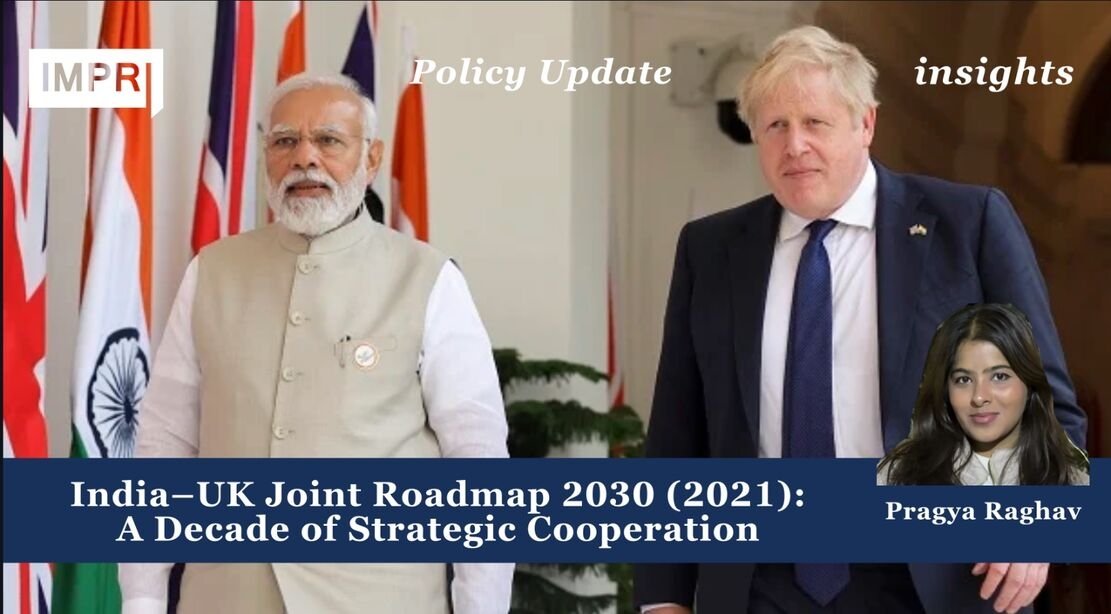
Policy Update
Pragya Raghav
Background
India and the United Kingdom share a long-standing relationship rooted in historical connections, cultural ties, democratic values, and growing economic cooperation. Over the years, this relationship has evolved into a comprehensive strategic partnership driven by shared interests in trade, technology, security, climate action, education, and innovation.
A major turning point came in September 2004 when Prime Minister Dr. Manmohan Singh and UK Prime Minister Tony Blair met in London and upgraded bilateral relations to a Strategic Partnership. During the visit, both leaders adopted the Joint Declaration titled “India–UK: Towards a New and Dynamic Partnership.” The declaration laid the foundation for annual summits and regular meetings between the foreign ministers of both countries while identifying key areas of cooperation, including defence, trade, science and technology, environmental protection, counter-terrorism, education, and cultural exchange. Since then, regular high-level visits, ministerial dialogues, bilateral agreements, Memoranda of Understanding (MoUs), and negotiations on trade and investment have steadily strengthened the relationship.
Building on this foundation, Prime Minister Narendra Modi and UK Prime Minister Boris Johnson launched the India–UK Roadmap 2030 during the India–UK Virtual Summit on 4 May 2021. The Roadmap was designed as a ten-year framework to revitalise bilateral relations and create a modern, forward-looking partnership capable of addressing both national priorities and global challenges. It aims to deepen cooperation across trade, investment, technology, defence, climate action, healthcare, education, research, innovation, and people-to-people exchanges. By expanding collaboration in these areas, the Roadmap seeks to improve the lives and livelihoods of citizens in both countries while contributing to regional stability and sustainable economic growth.
The Roadmap also reflects the changing geopolitical environment following the United Kingdom’s withdrawal from the European Union. As part of its “Global Britain” strategy, the UK has placed greater emphasis on strengthening economic and strategic partnerships beyond Europe, with India emerging as one of its most important partners in the Indo-Pacific region. For India, the partnership complements its broader foreign policy objectives of diversifying global economic partnerships, attracting investment, promoting technological advancement, and enhancing cooperation in the Indo-Pacific. As a result, the India–UK partnership has become increasingly important in shaping the strategic priorities of both nations.
As two major democratic economies with strong innovation ecosystems, highly skilled workforces, and expanding markets, India and the United Kingdom possess significant potential for collaboration. Their complementary strengths create opportunities in manufacturing, advanced technology, artificial intelligence, fintech, education, scientific research, healthcare, defence, clean energy, space technology, and green industries. At the same time, both countries share a common interest in addressing global challenges such as climate change, terrorism, cyber threats, pandemics, energy security, and supply chain resilience. Their partnership demonstrates how democratic values, international cooperation, and shared principles can contribute to global peace, sustainable development, and the protection of the rules-based international order.
To provide a long-term institutional framework for this partnership, the Roadmap aims to elevate bilateral relations into a Comprehensive Strategic Partnership (CSP). It outlines clear objectives for cooperation over a ten-year period across multiple sectors and establishes an Annual Strategic Review at the Foreign Minister level to monitor implementation, assess progress, identify emerging priorities, and report directly to the Prime Ministers of both countries. This mechanism ensures that the Roadmap remains responsive to changing global circumstances while maintaining momentum towards achieving its long-term objectives.
Functioning
The India–UK Roadmap 2030 is implemented through five broad pillars that provide a structured framework for deepening cooperation across strategic, economic, scientific, and social sectors. Together, these pillars guide bilateral engagement and help both countries achieve the long-term objectives of the Comprehensive Strategic Partnership.
1. Strengthening People-to-People Relations
People-to-people engagement forms the foundation of the India–UK partnership. The Roadmap 2030 places significant emphasis on strengthening educational, cultural, and social ties by encouraging greater mobility of students, researchers, professionals, and artists. According to the Ministry of External Affairs (MEA), the Roadmap promotes academic collaborations, joint research programmes, institutional partnerships, and cultural exchanges to foster stronger connections between the two societies.
The Indian diaspora in the United Kingdom, comprising around 1.6 million people, continues to play a vital role in strengthening bilateral relations by contributing to the UK’s economy while serving as an important cultural bridge between the two countries. The 2022 India–UK Joint Statement further reinforced this pillar through initiatives such as the India/UK Together programme, expanded scholarship opportunities, and greater support for educational exchanges, recognising that long-term strategic partnerships are strengthened by strong societal and cultural connections.
2. Broadening Trade and Economic Cooperation
Economic cooperation remains one of the strongest pillars of the India–UK relationship. Under the Roadmap 2030, both countries have worked towards creating a more open, predictable, and mutually beneficial trading environment. According to the UK Parliament House of Lords Library (2024), India and the United Kingdom launched the Enhanced Trade Partnership (ETP) in 2021, laying the foundation for negotiations on a comprehensive Free Trade Agreement (FTA).
The partnership seeks to increase bilateral trade, encourage investment, improve market access, and create new employment opportunities in both countries. It also aims to strengthen cooperation in sectors such as financial services, manufacturing, digital technology, and innovation. The 2022 Joint Statement acknowledged the significant progress made during trade negotiations and reaffirmed the shared commitment of both governments to expanding economic and commercial ties.
3. Advancing Defence and Security Cooperation
Defence and security cooperation has become an increasingly important component of the India–UK strategic partnership in response to evolving regional and global security challenges. According to the Ministry of External Affairs, both countries are working together to strengthen maritime security, counter-terrorism efforts, cyber security, and intelligence sharing while promoting peace and stability across the Indo-Pacific region.
The partnership is guided by a shared commitment to a free, open, and rules-based international order. As highlighted by the UK Parliament House of Lords Library (2024), the 2022 Joint Statement elevated bilateral defence cooperation through the Comprehensive Strategic Partnership by expanding collaboration in defence technology, cyber resilience, and regional security, reflecting the growing strategic convergence between the two nations.
4. Promoting Climate Action and Clean Energy
Climate change and sustainable development have emerged as key priorities under the India–UK Roadmap 2030. Both countries have committed to accelerating the transition towards low-carbon growth while fulfilling their obligations under the Paris Agreement. According to the Ministry of External Affairs, bilateral cooperation focuses on renewable energy, clean technologies, green finance, sustainable infrastructure, and climate-resilient development.
The 2022 Joint Statement reaffirmed the commitment of both governments to promoting clean energy, increasing climate finance for developing countries, and supporting innovation in green technologies. India and the United Kingdom also continue to collaborate through various international climate initiatives to reduce carbon emissions, strengthen environmental sustainability, and support the global transition to clean energy.
5. Strengthening Health, Science, and Innovation
Health, science, and innovation have become central pillars of the India–UK partnership, particularly following the COVID-19 pandemic. According to the UK Parliament House of Lords Library (2024), both countries have expanded cooperation in medical research, digital healthcare, biotechnology, and life sciences to improve preparedness for future global health emergencies.
The 2022 Joint Statement highlighted collaboration between the UK’s National Health Service (NHS) and India’s National Health Authority (NHA) to strengthen digital health systems and improve healthcare delivery. In addition, both governments committed to developing a comprehensive Health and Life Sciences Action Plan aimed at advancing medical research, tackling antimicrobial resistance, promoting pharmaceutical innovation, and enhancing resilience against future public health challenges.
Performance
Since the launch of the India–UK Roadmap 2030, both countries have made significant progress in strengthening their Comprehensive Strategic Partnership through sustained political engagement, expanding economic cooperation, and collaboration across key strategic sectors. Regular high-level meetings, trade negotiations, and joint initiatives have helped translate the objectives of the Roadmap into tangible outcomes.
Strengthening High-Level Political Engagement
Regular engagement between the leaders and ministers of both countries has remained a defining feature of the partnership. According to the UK Parliament House of Lords Library (2024), the UK’s Integrated Review Refresh 2023 reaffirmed India as one of the United Kingdom’s most important strategic partners in the Indo-Pacific region. The review reiterated the UK’s commitment to implementing the India–UK Roadmap 2030, advancing negotiations on the Free Trade Agreement (FTA), and supporting India’s G20 Presidency.
During Prime Minister Rishi Sunak’s visit to India for the G20 Summit in September 2023, both countries agreed to deepen cooperation in defence technology, innovation, trade, and investment. The Ministry of External Affairs (MEA) also emphasised that the partnership continues to be guided by shared democratic values, mutual trust, and common strategic interests, reflecting a long-term commitment to building a modern and future-oriented bilateral relationship.
Expanding Trade and Investment
Trade has remained one of the strongest drivers of the India–UK partnership. According to the UK Parliament House of Lords Library (2024), bilateral trade reached £38.1 billion in the four quarters ending in the third quarter of 2023, making India the United Kingdom’s twelfth-largest trading partner.
To further strengthen economic ties, both countries launched negotiations for a Free Trade Agreement (FTA) in January 2022. The agreement aims to reduce tariffs, improve market access, promote investment, and create new business opportunities across multiple sectors. According to the Ministry of External Affairs, the proposed agreement is expected to support sustainable economic growth, encourage innovation, generate employment, and enhance long-term prosperity in both countries.
Progress Towards a Comprehensive Strategic Partnership
The Roadmap 2030 has strengthened cooperation far beyond trade by expanding collaboration in defence, technology, climate action, education, healthcare, and scientific research. Parliamentary discussions in the United Kingdom have consistently recognised India’s growing strategic importance. According to the UK Parliament House of Lords Library (2024), parliamentary committees welcomed stronger cooperation with India in areas such as maritime security, emerging technologies, climate action, and regional stability. They also encouraged both governments to conclude the Free Trade Agreement at the earliest opportunity.
At the same time, parliamentary reports acknowledged that negotiations remained challenging because of differences in regulatory frameworks, market access concerns, and India’s traditionally protectionist trade policies. The Ministry of External Affairs has maintained that continued political dialogue, mutual understanding, and sustained diplomatic engagement are essential for resolving these issues and further strengthening the Comprehensive Strategic Partnership.
Transition from Roadmap 2030 to Vision 2035
The successful implementation of the India–UK Roadmap 2030 has paved the way for a broader and more ambitious framework for bilateral cooperation. According to the Ministry of External Affairs (2025), both countries adopted the India–UK Vision 2035, which builds upon the achievements of the Roadmap rather than replacing it.
Vision 2035 reaffirms the commitments made under the Roadmap while extending cooperation into priority areas such as trade, investment, advanced technology, defence, clean energy, education, innovation, climate action, and people-to-people exchanges. It also introduces regular high-level reviews to monitor implementation, evaluate progress, and ensure that both governments remain accountable for achieving their long-term objectives.
Expanding Cooperation Across Emerging Sectors
The progress made under the Roadmap has also led to several landmark initiatives that further strengthen bilateral cooperation. According to the Ministry of External Affairs (2025), India and the United Kingdom concluded the India–UK Comprehensive Economic and Trade Agreement (CETA) and agreed to pursue a Bilateral Investment Treaty (BIT) to promote investment and provide greater certainty for businesses.
Cooperation has also expanded into emerging and strategic sectors, including artificial intelligence, semiconductors, biotechnology, quantum technologies, critical minerals, clean energy, and advanced manufacturing. In addition, both countries have launched a 10-Year Defence Industrial Roadmap, strengthened university partnerships, promoted Green Skills initiatives, and increased collaboration in climate finance, offshore wind energy, and civil nuclear cooperation.
These developments demonstrate that the India–UK Roadmap 2030 has evolved beyond its original objectives into a broader and more future-oriented strategic framework. By expanding cooperation across critical sectors while maintaining regular political engagement, both countries have laid a strong foundation for sustainable economic growth, technological advancement, and long-term strategic collaboration.
Impact
Since its launch in 2021, the India–UK Roadmap 2030 has strengthened bilateral cooperation across trade, technology, defence, climate action, healthcare, and innovation. It has expanded market access, encouraged scientific collaboration, improved mobility for skilled professionals, and deepened strategic engagement. The partnership has also contributed to sustainable development, economic growth, and stronger people-to-people ties, making India and the United Kingdom more important strategic partners.
Strengthening Science, Technology and Innovation
The Roadmap has significantly expanded collaboration in science and technology. According to the Ministry of External Affairs (MEA), both countries now cooperate in emerging sectors such as artificial intelligence, quantum technologies, biotechnology, green hydrogen, and cyber-physical systems. Through the India–UK Science and Innovation Council and the Global Innovation Partnership (GIP), the focus has shifted from research collaboration to commercialising innovation, encouraging technology transfer and the development of market-ready solutions.
Expanding Trade and Investment
One of the Roadmap’s most significant achievements has been strengthening bilateral trade. According to the Press Information Bureau (PIB, 2026), the Comprehensive Economic and Trade Agreement (CETA), which came into force on 15 July 2026, removes tariffs on most Indian exports to the UK, benefiting sectors such as textiles, engineering goods, pharmaceuticals, and leather products. The agreement is expected to increase exports, attract investment, improve supply chains, and create new business opportunities while protecting India’s sensitive agricultural sectors.
Enhancing Skilled Mobility
The Roadmap has improved the movement of professionals between the two countries. According to the PIB (2026), the Double Contribution Convention (DCC) exempts Indian professionals on temporary assignments in the UK from paying dual social security contributions for up to five years. The agreement is expected to benefit more than 75,000 professionals and 900 Indian companies, while creating greater opportunities in information technology, healthcare, financial services, education, and research.
Promoting Innovation and Industrial Growth
The partnership has strengthened collaboration between governments, industries, universities, and startups, supporting programmes such as Make in India and Startup India. According to the PIB (2026), increased investment in advanced manufacturing, renewable energy, biotechnology, and life sciences is expected to improve productivity, encourage innovation, and generate high-skilled employment in both countries.
Advancing Climate Action
Climate cooperation has become a key pillar of the partnership. According to the MEA, India and the UK have expanded cooperation in renewable energy, green hydrogen, climate finance, and clean technologies. Through the Global Innovation Partnership, both countries are also supporting the development and transfer of sustainable technologies, contributing to global climate goals and the transition to a low-carbon economy.
Strengthening Strategic Cooperation
The Roadmap has transformed India-UK relations into a broader Comprehensive Strategic Partnership by expanding cooperation in defence, healthcare, digital technologies, and regional security. According to the MEA, collaboration during the COVID-19 pandemic and continued coordination in multilateral forums have strengthened both countries’ ability to address shared global challenges, including health security, cyber threats, and Indo-Pacific stability.
Supporting Inclusive Growth
According to the PIB (2026), CETA is expected to create employment across manufacturing, logistics, and MSMEs by increasing demand for labour-intensive exports such as textiles, leather goods, and processed foods. The agreement is also expected to benefit farmers, women entrepreneurs, and small businesses by expanding access to international markets.
Enhancing Global Competitiveness
By reducing trade barriers and promoting investment, the Roadmap has strengthened India’s integration into global value chains. According to the PIB (2026), CETA supports the vision of Viksit Bharat 2047 while reinforcing the UK’s Global Britain strategy. Together, these initiatives have enhanced the global competitiveness of both countries and laid the foundation for a stronger long-term strategic partnership.
Emerging Issues
1. Prolonged Trade Negotiations
Negotiating the Comprehensive Economic and Trade Agreement (CETA) proved to be a lengthy process. Although the Roadmap was launched in 2021, CETA was concluded only in May 2025 after 14 rounds of negotiations and entered into force on 15 July 2026 (PIB, 2026). Differences over tariffs, investment protection, labour mobility, services, government procurement, and intellectual property delayed the agreement, highlighting the complexity of balancing the economic priorities of both countries.
2. Balancing Market Access with Domestic Interests
Trade liberalisation required both countries to strike a balance between expanding market access and protecting sensitive sectors. Before CETA, Indian exports faced high tariffs in several sectors, reducing their competitiveness in the UK market (PIB, 2026). At the same time, India sought to safeguard industries such as dairy, cereals, edible oils, and horticulture from import competition. Balancing these competing interests remains an ongoing challenge.
3. Limited Commercialisation of Research
Although scientific collaboration between India and the UK has expanded considerably, converting research into commercially viable products remains a challenge. According to the Department of Science and Technology stated in the reports of MEA, India’s Gross Expenditure on Research and Development (GERD) remains around 0.64% of GDP, significantly lower than many developed economies. Strengthening industry–academia collaboration and increasing research investment will be essential to maximise the benefits of innovation.
4. Supply Chain and Technology Dependence
The partnership increasingly relies on cooperation in strategic sectors such as semiconductors, artificial intelligence, telecommunications, quantum technologies, and critical minerals. However, global supply chain disruptions and dependence on limited suppliers continue to pose risks to technology access and industrial resilience (PIB, 2026). Diversifying supply chains and strengthening domestic capabilities remain key priorities.
5. Financing the Green Transition
Achieving ambitious climate and clean energy goals requires substantial financial investment. According to the International Energy Agency (IEA), India will require over USD 160 billion annually by 2030 to meet its clean energy transition targets. Mobilising sufficient public and private finance for renewable energy, green hydrogen, and climate-resilient infrastructure remains a major implementation challenge.
6. Addressing Skill Gaps
The Roadmap has improved mobility for professionals and researchers, but demand for skilled workers continues to outpace supply in sectors such as artificial intelligence, biotechnology, semiconductors, and clean energy. Developing a future-ready workforce through greater investment in education, research, and skill development will be essential for sustaining long-term cooperation.
7. Managing Global Uncertainty
The Roadmap has been implemented during a period of geopolitical tensions, supply chain disruptions, and rapid technological change. According to the MEA, both countries have responded by strengthening cooperation in areas such as vaccine research, cyber security, resilient supply chains, and defence technology. However, evolving global economic and geopolitical developments continue to pose risks to trade, investment, and long-term strategic cooperation.
Way Forward
The India–UK Roadmap 2030 has established a strong foundation for a long-term strategic partnership, but its continued success will depend on effective implementation and sustained political commitment. Both countries should focus on fully implementing the remaining commitments under the Roadmap through regular ministerial reviews, stronger institutional coordination, and measurable outcomes. Early conclusion of the Bilateral Investment Treaty (BIT) and effective implementation of the Comprehensive Economic and Trade Agreement (CETA) will be crucial for expanding trade, attracting investment, and improving business confidence. Greater support for Micro, Small and Medium Enterprises (MSMEs), startups, and research institutions will also ensure that the benefits of the partnership are shared more widely across the economy.
Looking ahead, India and the United Kingdom should deepen cooperation in emerging technologies, clean energy, defence manufacturing, healthcare, education, and innovation while addressing challenges such as supply chain vulnerabilities, climate financing, and technology commercialisation. Expanding collaboration in artificial intelligence, semiconductors, quantum technologies, biotechnology, and critical minerals can strengthen economic resilience and global competitiveness. At the same time, stronger partnerships between universities, research institutions, and industry will help translate research into innovation, high-skilled employment, and sustainable economic growth. By effectively implementing the commitments under Vision 2035, both countries can build a future-oriented partnership that promotes shared prosperity, regional stability, and sustainable development.
References
Department of Science and Technology. (2023). India’s Gross Expenditure on Research and Development (GERD).Government of India. https://dst.gov.in/
Government of India & Government of the United Kingdom. (2004). India–UK: Towards a New and Dynamic Partnership (Joint Declaration). Ministry of External Affairs. https://www.mea.gov.in/
Government of India & Government of the United Kingdom. (2022). India–UK Joint Statement. Ministry of External Affairs. https://www.mea.gov.in/
House of Lords Library. (2024). India–UK relations. UK Parliament. https://lordslibrary.parliament.uk/
Ministry of External Affairs. (2021). India–UK Roadmap 2030. Government of India. https://www.mea.gov.in/
Ministry of External Affairs. (2022). India–UK Joint Statement. Government of India. https://www.mea.gov.in/
Ministry of External Affairs. (2025). India–UK Vision 2035. Government of India. https://www.mea.gov.in/
Press Information Bureau. (2025–2026). Press Releases on India–UK Comprehensive Economic and Trade Agreement (CETA), Double Contribution Convention (DCC), Bilateral Investment Treaty (BIT), and India–UK cooperation.Government of India. https://pib.gov.in/
Press Information Bureau. (2025). India–UK Vision 2035: Joint Statement. Government of India.https://pib.gov.in/
Press Information Bureau. (2025). India–UK Technology Security Initiative (TSI). Government of India. https://pib.gov.in/
International Energy Agency. (2023). World Energy Investment 2023. https://www.iea.org/reports/world-energy-investment-2023
UK Government. (2023). Integrated Review Refresh 2023: Responding to a More Contested and Volatile World. https://www.gov.uk/government/publications/integrated-review-refresh-023-responding-to-a-more-contested-and-volatile-world
About the Contributor
Pragya Raghav is pursuing a B.A. (Hons.) in History at Mata Sundri College for Women, University of Delhi, with a minor in Political Science. She is passionate about public policy, international relations, governance, climate policy, and sustainable development. Through research and policy analysis, she aims to contribute to evidence-based policymaking and create meaningful social impact.
Acknowledgment
I would like to express my sincere gratitude to IMPRI (Impact and Policy Research Institute) for providing me with the opportunity to prepare this policy update and for encouraging evidence-based policy research. I am also thankful to the Ministry of External Affairs, the Press Information Bureau, the Government of the United Kingdom, and other official sources whose publications and reports served as valuable references for this article. Finally, I extend my heartfelt thanks to Asmatwali and Rakhi for reviewing my work and providing valuable feedback and constructive suggestions.
Disclaimer-
The views and opinions expressed in this article are solely those of the author and do not necessarily reflect the views, policies, or positions of IMPRI (Impact and Policy Research Institute) or any other affiliated organisation.
Name of the reviewer:
Asmatwali and Rakhi
Read More at IMPRI:-
The 8th Central Pay Commission (2025): Reforming Public Sector Compensation