









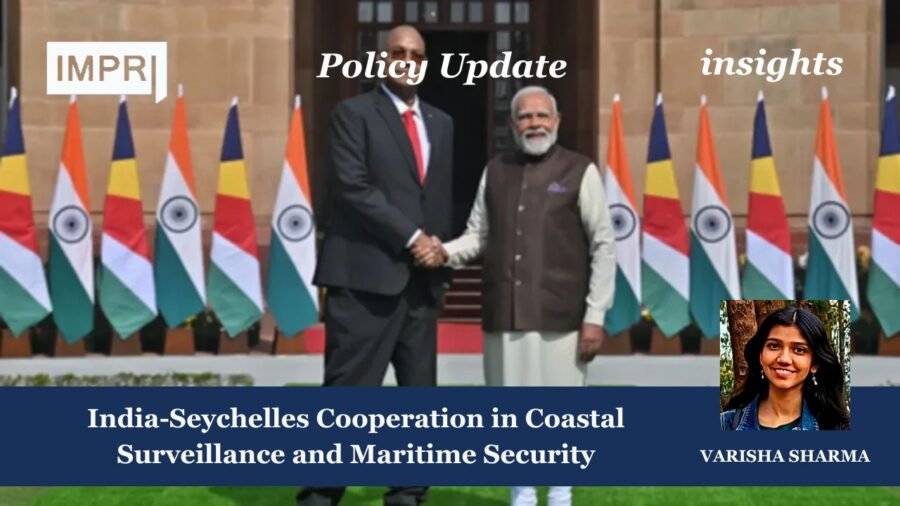
Policy Update
Varisha Sharma
Introduction
The Indian Ocean Region (IOR) is one of the most strategically important maritime regions in the world. Encompassing critical sea lanes through which over 80 percent of the world’s energy supplies transit, it is simultaneously a zone of immense economic opportunity and increasing security threats such as piracy, human trafficking, illicit arms transfer and unreported and unregulated (IUU) fishing (Indian Navy, 2015).
Given such complexities, the cooperation between India and Seychelles for coastal surveillance has emerged as a cornerstone of regional maritime security architecture. Rooted in decades of diplomatic ties and formalized through successive agreements on defence equipment, coastal radar systems, and information sharing, the India-Seychelles coastal surveillance cooperation framework offers a compelling case study of an asymmetric but mutually reinforcing strategic partnership.
Background
India and Seychelles have maintained diplomatic relations since Seychelles gained independence from the United Kingdom on June 29, 1976 (Ministry of External Affairs [MEA], Government of India, n.d.). The defence relationship was formally institutionalized through a Memorandum of Understanding (MoU) on Defence Cooperation signed in 2003, which laid the foundation for India to assist in developing the Seychelles People’s Defence Forces (SPDF) (Chhetri, 2022). This foundational MoU was supplemented by a series of subordinate agreements in subsequent years, including an MoU for stationing an Indian Navy Dornier aircraft in Seychelles (February 2011), and an MoU for the supply of a Coastal Surveillance Radar System in the outer islands (February 2012) (MEA, n.d.).
In 2006, India gifted the naval vessel PS Topaz to Seychelles, followed in 2013 by the donation of a Dornier Do-228 maritime reconnaissance aircraft, deployed by the Seychelles Coast Guard to shield its Exclusive Economic Zone (EEZ) against piracy and terrorism (Newsbharati, 2018). As early as 2009, India responded to Seychelles’ request and dispatched naval vessels to patrol the Seychelles EEZ against piracy. These deployments established India as a consistent and capable security partner for an island nation whose EEZ is very vast and covers approximately 1.4 million square kilometres.
The 2015 Coastal Surveillance Radar Project
The most concrete expression of India–Seychelles surveillance cooperation came in March 2015, when Prime Minister Narendra Modi, the first Indian Prime Minister to visit Seychelles in 34 years, formally activated the first coastal surveillance radar (CSR) station in Mahe, the capital island of Seychelles (Nkala, 2015). During the visit, Modi described the CSR project as “another symbol of the cooperation between the two countries” (Millennium Post, 2015). India gifted and installed six coastal surveillance radar systems across Seychelles in 2015, significantly enhancing the island nation’s coastal security capability.
These radars formed part of India’s ambitious plan to establish 32 CSR stations across multiple Indian Ocean island states, including the Maldives, Mauritius, and Sri Lanka, enabling the Indian Navy and its allies to monitor vessel movements across the entire region (Nkala, 2015). The Information Management and Analysis Centre (IMAC), which operates from India’s coastline, provides a continuous and real-time view of approximately 7,500 kilometres of Indian coastline, and multiple Indian Ocean coastal states, including Seychelles, have joined this integrated radar network.
Simultaneously, Modi announced that India would donate a second Dornier Do-228 maritime surveillance aircraft to Seychelles, to supplement the first aircraft donated in 2013 (Nkala, 2015). Both governments also signed four formal agreements during the 2015 visit covering cooperation in hydrographic survey, renewable energy, infrastructure development, and the joint development of navigational charts (Millennium Post, 2015). Modi further extended a $100 million line of credit to Seychelles for defence procurement, allowing the island nation to acquire additional patrol boats, aircraft, and weapons for its coast guard and police services (Nkala, 2018).
The Assumption Island Project
The proposed development of the Assumption island that’s located 1,140 kilometres southwest of Mahe is one of the controversial aspects of India-Seychelles bilateral relations. The island offers commanding proximity to major shipping routes connecting the Gulf of Aden with Southern Africa. During PM Modi’s 2015 visit, both governments signed an agreement to develop infrastructure on the island, which Seychelles hoped would include facilities to enhance its Coast Guard’s surveillance, search-and-rescue, and maritime patrol capabilities.
The agreement was revised and ratified by both governments in January 2018, with the Seychelles Cabinet confirming that its main aim was to provide a framework for Indian assistance in enhancing military capabilities for the control and maritime surveillance of Seychelles’ EEZ, protection of its outer islands, and search and rescue operations in the region.
However, the agreement collapsed under pressure from Seychelles’ parliamentary opposition, which commands a majority in the National Assembly. Critics alleged that the deal effectively ceded sovereignty to India and amounted to the establishment of a foreign military base. The agreement was subsequently abandoned for ratification by the Seychelles legislature.
Despite this setback, India recalibrated rather than retreated. During President Danny Faure’s state visit to India in June 2018, both governments signed six new agreements, including a white shipping data agreement, a cybersecurity MoU, small development project grants, and a cultural exchange programme for 2018–2022 (Chhetri, 2022).
2023 IFC-IOR and RCOC MoU
The most recent and institutionally significant step in India–Seychelles coastal surveillance cooperation came on February 21, 2023, when India’s Information Fusion Centre- Indian Ocean Region (IFC-IOR) signed a landmark MoU with Seychelles’ Regional Coordination Operations Centre (RCOC) (Press Information Bureau [PIB], Government of India, 2023). The MoU was signed by Captain Rohit Bajpai, Director of the IFC-IOR, and Captain Sam Gontier, Director of the RCOC. According to India’s Ministry of Defence, the agreement aims “to promote collaboration between the two Centres towards enhancing maritime domain awareness, information sharing and expertise development” (PIB, 2023).
The centre facilitates real-time information sharing with 28 partner nations and hosts International Liaison Officers (ILOs) from 12 partner nations such as Seychelles, Australia, France, Japan, the United Kingdom, and the United States (PIB, 2023; Bhatt, 2025). The RCOC, for its part, is a key node in the Maritime Security Architecture of the Western Indian Ocean, supported by the Indian Ocean Commission (IOC) and operating alongside the Regional Maritime Information Fusion Centre (RMIFC) based in Madagascar (PIB, 2023). The partnership allows the Indian Navy to extend its surveillance coverage further south into the Western Indian Ocean, a region increasingly vulnerable to piracy resurgence and non-traditional threats (Shukla, 2023).
Impact of Sagar and India-Seychelles Maritime and Coastal Surveillance Cooperation
The India-Seychelles coastal surveillance partnership cannot be understood in isolation from India’s broader strategic doctrine. The SAGAR (Security and Growth for All in the Region) framework, articulated by Prime Minister Modi in March 2015, provides the overarching policy rationale for India’s Indian Ocean engagement. SAGAR envisions India as a “net security provider” and “preferred security partner” to Indian Ocean littoral states, emphasizing the exchange of information, coastal surveillance, infrastructure development, and capacity building (Padmaja, 2018).
INS Savitri in Seychelles to Strengthen Maritime Cooperation and launch Joint EEZ Surveillance
Source: ABPLive
A critical context for this cooperation is India’s concern about China’s expanding maritime footprint in the Indian Ocean. China’s Belt and Road Initiative and the so-called “String of Pearls” strategy (Baruah, 2022). India’s provision of surveillance radar systems, patrol vessels, and aircraft to Seychelles is widely interpreted by regional analysts as part of a deliberate counterbalancing strategy, ensuring that India, and not China, remains the dominant security partner for these strategically located island nations (Nkala, 2015; Pant, 2018). Moreover Seychelles faces multiple maritime security threats especially due to piracy activity. Thus India’s coastal surveillance and the IFC-IOR-RCOC information sharing infrastructure becomes extremely crucial.
Emerging Issues
Despite its considerable achievements, the India-Seychelles coastal surveillance cooperation framework faces structural and political challenges. The Assumption Island episode exposed the limits of India’s ability to deepen its military footprint in small island states where domestic politics, opposition sentiment, and sovereignty concerns can override executive preferences (Pant, 2018). India’s challenge is to balance its strategic interest in expanding its surveillance and logistics infrastructure in the Indian Ocean with genuine respect for the agency and sensitivities of smaller partner nations.
Sustaining the quality and operability of donated equipment is another challenge. The effectiveness of Seychelles’ coastal surveillance radars and Dornier aircraft depends heavily on India’s continued technical support, maintenance assistance, and personnel training , all of which require durable institutional commitments that can outlast political cycles in both countries. Scale of investment remains another major challenge
Conclusion
The India–Seychelles coastal surveillance cooperation partnership is one of the most substantive and multidimensional security relationships in the Indian Ocean Region. From the foundational 2003 Defence MoU and early naval deployments, through the landmark 2015 installation of coastal surveillance radar systems and Dornier aircraft donations, to the institutionally sophisticated 2023 IFC-IOR-RCOC information-sharing agreement, India has invested consistently and strategically in Seychelles’ maritime security capabilities.
Looking forward, India’s evolving MAHASAGAR (Mutual and Holistic Advancement for Security Across the Regions) framework, which builds on SAGAR, signals an ambition to broaden the scope of IOR engagement beyond security alone, incorporating economic development, environmental cooperation, and sustainable blue economy objectives (Bhatt, 2025). For Seychelles, a country whose economy depends heavily on fisheries and tourism, this expanded agenda offers the possibility of a more comprehensive and equitable partnership.
References
Baruah, D.M. (2022, May 22). Maritime competition in the Indian Ocean. Carnegie Endowment for International Peace. https://carnegieendowment.org/posts/2022/05/maritime-competition-in-the-indian-ocean
Bhatt, P. (2025, November 21). SAGAR to MAHASAGAR: India’s maritime security achievements and way forward. South Asian Voices. https://southasianvoices.org/sec-f-in-r-mahasagar-india-11-21-2025/
Chhetri, V.S. (2022, August 31). Bilateral Relations between Seychelles and India. Diplomacy and Beyond Plus. https://diplomacybeyond.com/bilateral-relation-between-seychelles-and-india/
Indian Navy. (2015). Ensuring secure seas: Indian maritime security strategy (IMSS 2015). Integrated Headquarters, Ministry of Defence (Navy). https://bharatshakti.in/wp-content/uploads/2016/01/Indian_Maritime_Security_Strategy_Document_25Jan16.pdf
Millennium Post. (2015, March). India-Seychelles sign 4 pacts to boost cooperation. https://www.millenniumpost.in/amp/india-seychelles-sign-4-pacts-to-boost-cooperation-57551
Ministry of External Affairs, Government of India. (n.d.). India-Seychelles bilateral brief. https://www.mea.gov.in/Portal/CountryNews/11879_Bilateral_Briefs_for_Website.pdf
Newsbharati. (2018, July 4). Indian Ocean region: ‘Assumption.’ https://www.newsbharati.com/Encyc/2018/7/4/India-Seychelles-relations.amp.html
Nkala, O. (2015, March 20). India Developing Network of Coastal Radars. DefenceNews. https://www.defensenews.com/naval/2015/03/20/india-developing-network-of-coastal-radars/
Nkala (2018, June 28). India donates Do 228 to the Seychelles. DefenceWeb. https://www.defenceweb.co.za/?p=52199
Padmaja, G. (2018, April 25). Revisiting ‘SAGAR’ – India’s template for cooperation in the Indian Ocean Region. National Maritime Foundation.
https://maritimeindia.org/revisiting-sagar-indias-template-for-cooperation-in-the-indian-ocean-region/
Pant, H.V. (2018, June 27). Making no assumptions: India’s Seychelles conundrum. The Diplomat. https://thediplomat.com/2018/06/making-no-assumptions-indias-seychelles-conundrum
Press Information Bureau, Government of India. (2023, February 22). Maritime security: Memorandum of Understanding (MoU) between the Information Fusion Centre – Indian Ocean Region (IFC-IOR) and Regional Coordination Operations Centre (RCOC). https://www.pib.gov.in/PressReleasePage.aspx?PRID=1901371
Shukla, A. (2023, February 22). Indian Navy tightens its watch over ships transiting the Indian Ocean Region. Broadsword. https://www.ajaishukla.com/2023/02/indian-navy-tightens-its-watch-over.html
About the Contributor
Varisha Sharma is a research intern at IMPRI and a final year student of Political Science Honours at Miranda House, University of Delhi. Intellectually driven and curious, her interest in International Relations stems from her love for traveling and learning about new cultures.
Acknowledgement
I would like to extend my sincere gratitude to the team at IMPRI India for their guidance and support.
Disclaimer
All views expressed in the article belong solely to the author and not necessarily to the organisation.