




Policy Update
Mallika Amale
The Arctic region is emerging as a strategic arena for geopolitical competition among both Arctic and non-Arctic superpowers. It comprises the northernmost parts of Norway, Sweden, Finland, Russia, the United States, Canada, Greenland (Denmark’s autonomous territory), and Iceland. The once largely ice-covered Arctic ocean is melting due to the accelerating effects of climate change, thereby opening up new opportunities for energy exploration and potential transit routes which are significantly shorter than the traditional Suez canal route.
India, though a non-litoral Arctic state, has a vested interest in the Arctic region. Its engagement is driven by massive economic and energy prospects, climate change concerns, scientific exploration, and more importantly, strategic and security concerns. In March 2022, India unveiled its first dedicated Arctic policy, titled “India and the Arctic: Building a Partnership For Sustainable Development.” However, the policy does not take into account the rising geopolitical rivalries in the region, which is especially important if India is to counter China’s expanding influence in the Arctic. It is also worth noting that India is not a newcomer in the Arctic; it has historically maintained a presence through scientific research and limited diplomatic initiatives dating back to the 1920s.
Additionally, the resource-rich Arctic region is of strategic importance for India with its growing demand for energy resources and hydrocarbons. According to the 2008 US Geological Survey, the region may be home to about 90 billion oil barrels, 1,669 trillion cubic feet of natural gas, and 44 billion barrels of natural gas liquids. Also, rare earth minerals and critical metals such as Cobalt, Copper, Lithium, Lead, Nickel, etc can be found here, which are essential for developing defence equipment and clean energy technologies.
India’s Arctic cooperation also includes partnering with Russia, one of its oldest allies, which has increased its militarisation efforts in the past few years. It has been pushing for large-scale operationalisation of the Northern Sea Route (NSR) along Russia’s Arctic coast, which is approximately 40 percent shorter as well as cost-effective than the Suez canal route.
Source: The Arctic Institute
However, since Russia’s annexation of Crimea in 2014, and more importantly, since its invasion of Ukraine in 2022, the security environment in the region, including the Arctic, has become fragile. Consequently, Western sanctions on Russia and its resulting diplomatic isolation have constrained all of Moscow’s avenues for collaboration. In response, Russia has sought deeper engagement with non-western partners over the past few years leading to the strengthening of Sino-Russian relations. Experts point out that Russia has become increasingly dependent on China. In April 2018, China declared itself as a “near-Arctic” state, signalling its intention to expand influence in the region. This is evident by its increasing investments in critical Arctic energy infrastructure and the introduction of the “Polar Silk Road” – an extension of its infamous Belt and Road Initiative. Amid this evolving geopolitical landscape, India faces tremendous challenges as well as opportunities.
Functioning
There is no specific standalone India-Russia Arctic security dialogue, rather the cooperation is realised through numerous other mechanisms of bilateral and ministerial dialogues, and multilateral engagement.
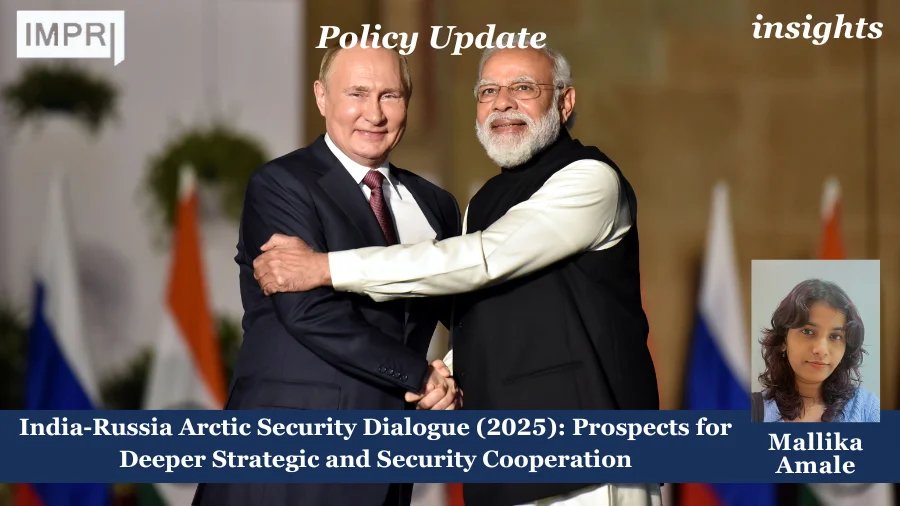
The highest level of dialogue between the two is the annual India-Russia summits that began in 2000, with the signing of the “Declaration on the India-Russia Strategic Partnership.” Discussions on collaboration in the Arctic first occurred during the 2019 meeting in Vladivostok. Later on, in 2024, a joint statement was released outlining enhanced cooperation in the Russian Far East and Arctic across sectors such as agriculture, energy, mining, and maritime transport for the period of 2024-2029. On the sidelines of the annual meet in December 2021, India and Russia established a new annual 2+2 Ministerial dialogue, bringing together the Foreign and Defence Ministers of both countries to discuss matters of global and regional political-security developments. During this meeting, India also offered to help Russia with developing the NSR.
Moreover, in July 2024 both countries agreed to establish a joint working group to work towards cooperation in Arctic shipping. The first meeting was held in October 2024 with representatives present from the Indian Ministry of Ports, Shipping and Waterways; and the Russian State Commission for the Arctic Development. Key issues were discussed, including building joint Arctic shipbuilding projects, training Indian sailors for polar navigation, and drafting a memorandum of understanding for cargo shipping cooperation along the NSR.
The eight states in the Arctic circle are members of the Arctic Council, which was initially established in 1996 for cooperation on environmental matters and sustainable development, now has to deal with the increasing securitisation and militarisation of the Arctic. India was granted observer status in the council in 2013, and renewed its status once again in 2019 for a period of five years. Also, India’s Arctic policy of 2022 will work in tandem with the Arctic Council. The policy states that its aim is “ensuring that as the Arctic becomes more accessible, the harnessing of its resources is done sustainably and in consonance with best practices formulated by bodies such as the Arctic Council.”
Other mechanisms exist for trade and defence cooperation such as the India-Russia Intergovernmental Commission for Trade, Economic, Scientific and Cultural Cooperation (IRIGC-TEC) and the India-Russia Inter-Governmental Commission on Military & Military-Technical Cooperation (IRIGC-M&MTC) respectively.
India and Russia also cooperate at multilateral platforms namely the UN, G20, BRICS, and the SCO. The seventh meeting of the BRICS Working Group on Polar and Ocean Science and Technology was held in May 2025, wherein both India and Russia worked together as well. Key issues were addressed such as developing capabilities to monitor oceanic and polar regions, with a focus on meteorology, climate forecasting, etc. among other things.
Performance
Even though no significant headway has been made towards establishing a specific bilateral Arctic Security dialogue between India and Russia, or formulating an Arctic security related policy, several other indicators suggest steady progress towards potential deeper cooperation in the region.
Due to the warming of the Arctic ice, especially during the summers, the Northern Sea Route is witnessing consistent growth in maritime traffic and freight volume. A record number of about 37.9 million tonnes in cargo volume was in transit via the NSR in 2024, with over 92 transit voyages taking place. Projections made during the International Arctic Forum held in March 2025 suggest that this volume may increase in future by up to 150 million tons.
The operationalisation of the Chennai-Vladivostok Eastern Maritime Corridor since November 2024 presents a huge opportunity for India to integrate into the NSR, making trade between India and Russia, and by extension to Europe faster, cost-effective, and more efficient. The traditional route that India and Russia transit through now via Suez canal from the Mumbai port to the port of St. Petersburg is about 8,675 nautical miles, whereas the Chennai-Vladivostok route is 5,647 nautical miles, cutting almost sixteen days worth of travel time. Also, this route may gain prominence with the growing instability near the Bab-el-Mandeb strait with the Red sea crisis and the growing risk of piracy in southeast Asia and the Malacca strait. Also, the Russian representative for Arctic Development, Vladimir Panov highlighted the role of India in the future development of the NSR, signalling towards better cooperation.
Since 2003, India and Russia have conducted the biennial joint military exercise INDRA, which also includes the navy. In March 2025, the navies of both countries participated in INDRA 2025 held off Chennai and in the Bay of Bengal.
It is worth noting that the upcoming India-Russia Annual Summit in December 2025 is expected to yield more concrete steps for development of the Arctic, with a focus on connectivity and resource development. Experts point out that Russia is eager for India to assume a greater role in the Arctic. The agenda for the upcoming annual summit further includes defence industry collaboration, energy cooperation, civil nuclear partnership, and Arctic engagement.
Impact
Potential increasing security partnership between India and Russia may prove to be challenging. As mentioned before, Russia has significantly increased militarisation in the Arctic. This, more or less, prompted other NATO countries, including the US, Canada, Finland, and Norway to expand their militarisation efforts in the region as well. Furthermore, Russia’s assertive stance necessitates careful and strategic calibration by India with respect to its Arctic cooperation with Moscow and its relations with western and NATO countries.
This dialogue may be the embodiment of India’s multi-alignment strategy. More crucially, India can play a huge role in balancing out the effects of the increasing Sino-Russian engagement in the Arctic. According to the Russian Ambassador to India, Denis Alipov, Russia regards India to be a “stabilising factor” in Arctic affairs.
For China, rough seas lie ahead. Moscow continues to remain vigilant regarding China’s expansionist ambitions, in particular the Polar Silk Road initiative, in Russia’s Far East and Arctic region. Other countries in the Arctic circle such as Norway, Finland, and Denmark refuse to partner with China for the Polar Silk Road.
Emerging Issues
- Lack of Proper Infrastructure and Climate Risks: Despite the growing strategic role of the Arctic, its infrastructure is lagging and highly vulnerable to climate change-related risks. The NSR itself is only accessible during the summer months. Severe weather conditions and unpredictable melt patterns make it impossible to navigate. More crucially, it is a critical environmental paradox: the melting of ice which enables access to new shipping lanes and hydrocarbon reserves, is itself a direct result of fossil fuel driven climate change. Exploiting these resources furthermore will exacerbate the risk of climate change.
- Russian Sanctions-related Risks: Following the 2022 Russian invasion of Ukraine, most of the Russian energy firms are facing crippling sanctions. Some of these firms such as Novatek, Rosneft, Gazprom Neft, are working on projects in the Arctic. Due to this, India, to some extent, is facing additional risk. Investing in the area becomes more difficult.
- Russia-China partnership in the Arctic: One of the biggest challenges for India has been witnessing the growing Sino-Russian relationship in the region. Russia and China have conducted over 27 joint military exercises between 2022 and 2024. Out of which 16 have been joint naval exercises in Arctic waters. New transit corridors between the two have been opened in recent years. Military, economic, and logistical cooperation between the two is at the peak.
- Balancing Partnerships: India needs to balance its strategic approach between the major players in the Arctic, including the west and in particular the NATO countries, Russia, and China. This requires bolstering its principle of strategic autonomy. Also, India needs to strengthen its bilateral ties with the littoral Nordic states.
Way Forward
India’s Arctic engagement with Russia is deepening, however now it is of paramount importance that we steer towards a sustainability-driven partnership. The region’s rapid militarisation, coupled with accelerating ice melt, poses a dilemma. As the Arctic becomes increasingly accessible, Russia has increased large-scale hydrocarbon extraction through projects such as Vostok Oil and Arctic LNG-2. But, this directly contradicts the environmental imperative of preserving the Arctic ecosystem. India’s own Arctic policy, unveiled in 2022, stresses sustainable development and responsible science-based engagement. Aligning with those principles, India should resist participation in fossil fuel projects that deepen the climate crisis and instead prioritise renewable technology cooperation and joint research on climate resilience. By adopting a sustainability-first approach, India can position itself as a credible and constructive actor amid an increasingly fragmented Arctic order.
Furthermore, India must balance its partnership with Russia with outreach to Nordic states and other Arctic Council members, ensuring it is not subsumed within Russia’s growing alignment with China. The future of the India–Russia Arctic Security Dialogue, therefore, lies not in resource extraction or militarisation, but in advancing science-led diplomacy that upholds ecological integrity while safeguarding India’s strategic autonomy.
References
- Bagla, P., & Panov, V. (2025, October 1). Russia Wants India To Navigate Northern Sea Route. NDTV. https://www.ndtv.com/world-news/russia-wants-india-in-arctic-council-to-navigate-northern-sea-route-9377372
- Chaudhary, D. (2025, October 8). Putin’s December agenda includes Arctic cooperation pact with India Read more at: https://infra.economictimes.indiatimes.com/news/economy/putins-december-agenda-includes-arctic-cooperation-pact-with-india/124380503. The Economic Times. https://infra.economictimes.indiatimes.com/news/economy/putins-december-agenda-includes-arctic-cooperation-pact-with-india/124380503
- Chaudhary, D. R. (2025, July 19). Putin likely to visit Delhi after 4 years as India-Russia Summit 2025 eyes energy, defence, Arctic ties. The Economic Times. https://economictimes.indiatimes.com/news/india/putin-likely-to-visit-delhi-after-4-years-as-india-russia-summit-2025-eyes-energy-defence-arctic-ties/articleshow/122785650.cms?from=mdr
- Dieckmann, O. (2025, May 24). From Rhetoric to Reality: China-Russia Cooperation in the Arctic Accelerates. The Diplomat. Retrieved November, 2025, from https://thediplomat.com/2025/05/from-rhetoric-to-reality-china-russia-cooperation-in-the-arctic-accelerates/
- Embassy of India, Moscow (Russia). (n.d.). India-Russia Bilateral Relations. Embassy of India, Moscow (Russia). Retrieved November, 2025, from https://indianembassy-moscow.gov.in/bilateral-relations-india-russia.php
- Gupta, P., & Parnerkar, A. (2024, September 18). Understanding the potential of the Northern Sea Route. Observer Research Foundation. Retrieved November 11, 2025, from https://www.orfonline.org/expert-speak/understanding-the-potential-of-the-northern-sea-route
- Ministry of Earth Sciences. (2022). India’s Arctic Policy: Building a Partnership For Sustainable Development. Ministry of Earth Sciences. Retrieved November, 2025, from https://www.moes.gov.in/sites/default/files/2022-03/compressed-SINGLE-PAGE-ENGLISH.pdf
- Ministry of Earth Sciences. (2022, March 17). Press Release: Press Information Bureau. Press Release: Press Information Bureau. Retrieved November, 2025, from https://www.pib.gov.in/PressReleasePage.aspx?PRID=1806993
- Ministry of External Affairs, Government of India. (2019, September 5). India – Russia Joint Statement during visit of Prime Minister to Vladivostok. Ministry of External Affairs, Government of India. Retrieved November, 2025, from https://www.mea.gov.in/bilateral-documents.htm?dtl/31795/India__Russia_Joint_Statement_during_visit_of_Prime_Minister_to_Vladivostok
- Ministry of External Affairs, Government of India. (2021, December 6). India-Russia Joint Statement following the visit of the President of the Russian Federation. Ministry of External Affairs, Government of India. Retrieved November, 2025, from https://www.mea.gov.in/bilateral-documents.htm?dtl/34606/India_Russia_Joint_Statement_following_the_visit_of_the_President_of_the_Russian_Federation
- Ministry of External Affairs, Government of India. (2024, July 9). Joint Statement following the 22nd India-Russia Annual Summit. Ministry of External Affairs. Retrieved November, 2025, from https://www.mea.gov.in/bilateral-documents.htm?dtl/37940/Joint+Statement+following+the+22nd+IndiaRussia+Annual+Summit
- Ministry of Ports, Shipping and Waterways. (2024, January 25). Text of Union Minister Shri Sarbanandha Sonoval speech at INDIA-RUSSIA WORKHOP “OPERATIONALISATION OF CHENNAI-VLADIVOSTOK EASTERN MARITIME CORRIDOR”. Press Information Bureau. Retrieved November, 2025, from https://www.pib.gov.in/PressReleasePage.aspx?PRID=1999073
- Peri, D. (2024, November 18). Chennai-Vladivostok eastern maritime corridor operational: Sonowal. The Hindu. https://www.thehindu.com/news/national/chennai-vladivostok-eastern-maritime-corridor-operational-sonowal/article68882958.ece
- Peri, D. (2025, March 21). India a stabilising factor in the Arctic, says Russian Ambassador. The Hindu. https://www.thehindu.com/news/national/india-a-stabilising-factor-in-the-arctic-says-russian-ambassador/article69354871.ece
- Tadeu, J., & Neto, A. (2025, May 26). Scientific cooperation among BRICS countries strengthens oceanic and polar research. BRICS. Retrieved November, 2025, from https://brics.br/en/news/scientific-cooperation-among-brics-countries-strengthens-oceanic-and-polar-research
About the Contributor
Mallika Amale is currently interning at IMPRI. She is pursuing a Master’s in International Relations and Strategic Studies from the School of International Relations and Strategic Studies (SIRSS) at the University of Mumbai. Her research interests include India’s foreign policy, maritime security in the Indian Ocean Region, and the Indo-Pacific.
Acknowledgement: The author sincerely thanks the team at IMPRI for their valuable guidance, as well as my peers for their support during the whole process.
Disclaimer: All views expressed in the article belong solely to the author and not necessarily to the organisation.
Read more at IMPRI
India-Bhutan: Hydro-Electric Trade and Future Prospects
India-Central Asia: The Need For Joint Counter-Narcotics Operations (2025)